Feeds:
Posts
Comments

Archive for September, 2011

Hit the Road, Jack

I’m on the road today, probably already hours into my drive as this article is posted.  I’m heading out for the Haen Gallery in Asheville, NC today to drop off some new work then on to Alexandria, VA to do the same at the Principle Gallery.  I will also be giving a gallery talk at the Principle Gallery on Saturday at 1 PM.  It’s a trip I do a few times a year, a  highway marathon covering about 1400 miles in two days.  It’s a lot of time behind the wheel but it gets me back to my homebase quickly and efficiently.  As I like it.

I’m always glad to give these talks at the galleries that represent me.  It gives me a chance to explain some things in greater detail and to answer the questions of the folks who attend.  It’s also a great source of feedback on the recent work, feedback that goes beyond the validation that comes when a piece is sold.  I can get a better idea of how things in the work that I like resonate with others.  This is important to me because I feel that the strength of my work is the wide embrace of it, the way it communicates to a wide audience.  If people aren’t reacting to it in some way, it’s not communicating in the way I hoped.

So, if you’re in the Alexandria area tomorrow, please stop in at the Principle Gallery and say hello.  I look forward to seeing you there.

Here’s a little traveling music from the great Hank Snow.  Though he may appear to be from a decidedly different time and place and may not be the style of the moment, I have always admired this man from Nova Scotia and his wonderful songs.  Plus this song always seems right when you’re hurtling through the Shenandoah in your car.

Read Full Post »

Some Sort of Solution

As I was finishing up the framing for  the group of work I had recently completed and would be delivering in the next few days, I came to the last piece, 4 Windows, shown here.  I realized that I hadn’t yet addressed the question posed to me a week or so back when I posted this painting on this blog.  I had been asked how I would sign a group of small pieces– each piece individually or a single signature that blankets all four pieces?

I had always signed the pieces individually when I had done this sort of piece in the past so I thought I might simply go that route.  But the question really made me think about my concerns about keeping this as it was, as a single piece rather than one that could be taken apart and made into 4 smaller individual paintings. I know that should not be my concern, that once the painting leaves my possession I have no control over how someone treats it.  They could smash them, burn them, paint over them and there is nothing I can do.  But that doesn’t mean I can’t somehow signal my intent for the piece, that I desire that this work stays as it is, intact.

This being the case, I decided that one signature that somehow bonded the 4 pieces together would be some sort of solution.  This way there would be no signatures, save one, if somone decided to separate the paintings.  I wanted it to be distinctive though, something that differed from my standard signature and signified my intent.

I decided to go with a signature in the bottom right corner of the bottom right piece in the group.  It would be like my normal signature except that I would add the number 4 through the bottom of the line that normally encircles my name.  That number would designate the number of pieces in the group.  In the future, I can use this same method for signing similar pieces.  Maybe that will keep these paintings intact through time, as I originally saw them.  It might not be perfect but it works for me.

Read Full Post »

Rohrshach

I think this is the pelvis from an extraterrestrial being.  Or Wile E. Coyote with his back to a mirror.

My friend in Texas wrote the other day that looking at some of my paintings is a bit like taking a Rohrshach test.  I had never thought of it like that but we do indeed often examine the paintings I present here and try to interpret them in ways that go beyond what they actually appear to be.  A tree becomes more than a tree and the landscape is often expressive of more than a result of geology.  We are filling our interpretations with the same psychological content that one of Rohrshach’s patients might have when he first started using the inkblots as way of diagnosing patients around 1920.

Hermann Rohrshach based his tests on a popular19th century parlor game called Blotto ( or Klecksographie for you German speakers out there.)  There were decks of different cards cards available and a sort of charades-like game was played where you would try to get the other players to see what you saw in the inkblot.  Rohrshach was studying schizophrenic patients and made the inadvertent discovery that they responded quite differently to the game than most other people.  This led him to a systematic examination of their responses which led to the Rohrshach test as we know it.  It was used quite extensively in psychiatric examinations for a number of decades until it began to fall out of favor in the 1960’s.

We used to have some sort of parlor game in the 1960’s based on the Rohrshach test.  I don’t think we ever really played it or even read the instructions and my sister probably doesn’t even remember it.  I remember looking at the cardsat the time and not seeing too much.  A few butterflies.  Sheep.  I saw more interesting things in the folds of the curtains in the living room or in the bark of the trees around our home.  Or the clouds in the sky.  They all seemed more compelling to a child than those goofy inkblots.

But I do see the connection between the tests and what we do as a group here.  Hopefully, some of you don’t see a demon’s head or anything that disturbing when you look at one of my paintings.


Read Full Post »

Zen Garden

I’ve been working on a series of  paintings of interior scene, many of which I have featured here recently.  They have a limited number of elements and there is an almost formal order in the way they go together, with only so many available options.  But even with this limited visual vocabulary and subtle, muted tones in the colors used, these scenes seem to have great emotional depth that transcends the apparent limitations.

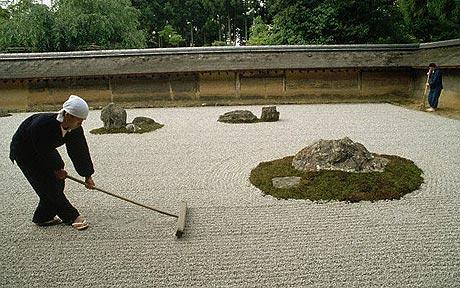
It reminds me of a zen garden, those minimalist meditative spaces consisting of sand and stone and a small bit of vegetation where the sand is raked each day.  There is little there.  Pure simplicity.  Yet there is great depth in its expression.

Zen Garden at Ryoan-ji , Kyoto

One of the most famous zen gardens is Ryoan-ji near Kyoto, Japan.  It is 30 meters long and 10 meters wide and consists of 15 stones, a bit of moss and sand.  It seems so simple yet so complex at the same time. 

 The emptiness, the lack of the non-elemental, allows room for the expanse of thought.  There is a great power that occupies the stillness of this space, a concept that I hope carries through in these small paintings of sparse interiors with simple scenes outside their windows.


Read Full Post »

Another Labor Day

Just another Labor Day, the annual holiday here that marks the end of the summer.  Most of us don’t even think for a moment about what the name of this holiday anymore, don’t realize that this holiday was meant to honor the trade and labor unions that have been so demonized in recent years. I know that I’m aware of the history of this holiday and even I forget it most of the time.  And that is a shame because we all could use a reminder of how the working class of this country has truly built the great wealth of the nation.

I guess I’m a labor guy.  My first real job was in a grocery store, a Loblaw’s, and we were unionized.  My next two jobs were also unionized and for a couple of years I was  a Teamsters’ union steward for my department  when I was working in the A&P Food Processing Plant.  I learned a lot from that experience, things that shaped how I still view the world today, thirty years later. 

There were some good guys who were supervisors at the plant. Bosses.  Management.  I could  see how people would say there’s no need for all the labor regulations and the protections of unions when I worked for these select few.  They were fair and pragmatic in their approach to dealing with the workers and most of us worked harder than hell for these guys. 

 But many were not fair-minded and used their position of authority as a hammer to try to pound everyone under them as though they were nails.  They continually tried to circumvent every rule and regulation and were constantly at odds with their workers.  These guys were the face for me of why there was a need for labor unions in many places.  I can still see many of their faces so vividly in my memories of that time.  They were the first layer of management, the least trained and most ill-equipped, and they would do anything to meet the demands that the layer of management above that had placed on them, even if it meant abusing the rights of the workers under their supervision.

It’s not that they were bad guys.  They had goals set for them that had to be met and they were simply not very skilled at dealing with people, specifically their workers.  So they would try to bully and punish.  Probably in the same way that they had been dealt with most of their lives.  As a union steward, I could see that the behavior of these abusive bosses made the need for protecting the workers imperative even though there were other fair and just bosses out there.  There would always be some bad bosses, especially at the lowest and middle levels, and they were the ones who dealt primarily with the labor force.

We were built with our labor force and we have prospered most as a nation when the labor force shares equitably in the wealth being created.  On this labor day, we should remember that and be thankful for the sacrifices made by those workers and unions before us in creating protections against the bad bosses of this world.


Read Full Post »

I call this new painting Telepathy, a 14″ by 18″ piece on paper.  I see it as being about the connection and unspoken communication between the two red trees. 

I suppose telepathy is the right word.  I’m not talking about the ability to send thoughts to or read the  thoughts of another person like a psychic medium.  This is the telepathy in looking across a room and with a glance knowing what the other person feels about what is occurring or has been said.  The ability to read that person’s thoughts through the knowledge of their opinions. 

Actually, the word telepathy was first coined by the German scholar Frederic W.H. Myers in 1882. I doubt that we are related but the name Frederick was common in our family for a number of generations.  But I think that was pretty common for Germanic families with the influence of Frederick the Great who was King of Prussia around the time many of these families migrated to this country.  Myers’ meaning for the word was that there was communication without any use of the normal senses, such as  the sight I used in my use of the word.

So perhaps I misuse the word telepathy.  But that form of communication that consists of a knowing glance or a raised eyebrow transmits so much information that is surely seems telepathic to me.

Read Full Post »

Rocket J. Squirrel

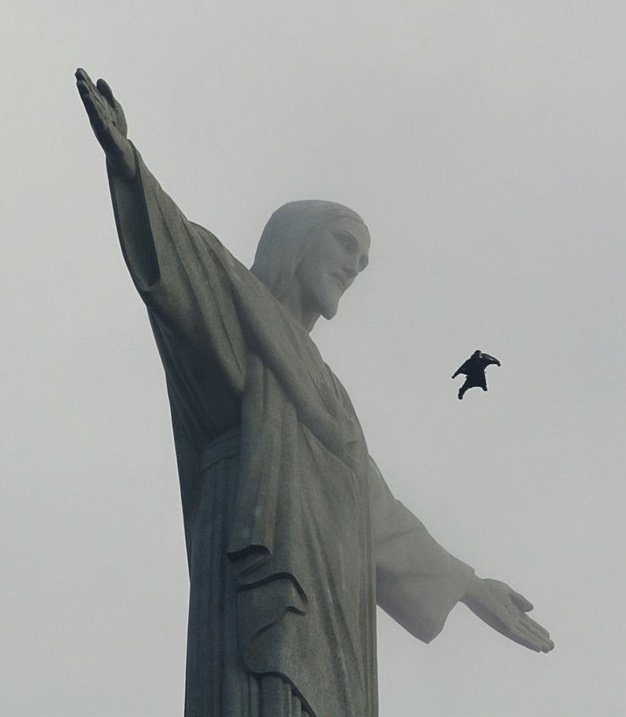
I’ve written about these guys before, those brave but crazy few who climb into nylon flying suits and dive headfirst from ultrahigh perches to blaze through the sky at incredible speeds like a superhero or something from a dream.  I’m envious beyond belief at the thrill and sensation they must be feeling as they hurtle through the sky and everytime I come across videos of them doing their thing I’m mesmerized.

Jeb Corliss is one of the big daddies of wingsuit jumping, shown here as he flies over Sugarloaf in Brazil, and travels the world over finding new challenges to conquer.  Besides an upcoming threading of a narrow canyon with his wingsuit in China in late September, his goal is to do this at some point completely without a parachute, landing upright on the ground.

This is his newest video called Grinding the Crack which shows him in Switzerland, I believe, where he soars along a rockface ( watch for his timy shadow as it descends away from him on the rocks) and threads through several trees barely 10 or 15 feet from the ground.  There are shots from the ground in this video that show how close it really is.. It’s pretty remarkable.  It certainly makes my day look pretty dull, and extremely safe,  by comparison.

I’m not complaining.  It’s just that this is- wow!

Read Full Post »

The End of an Era

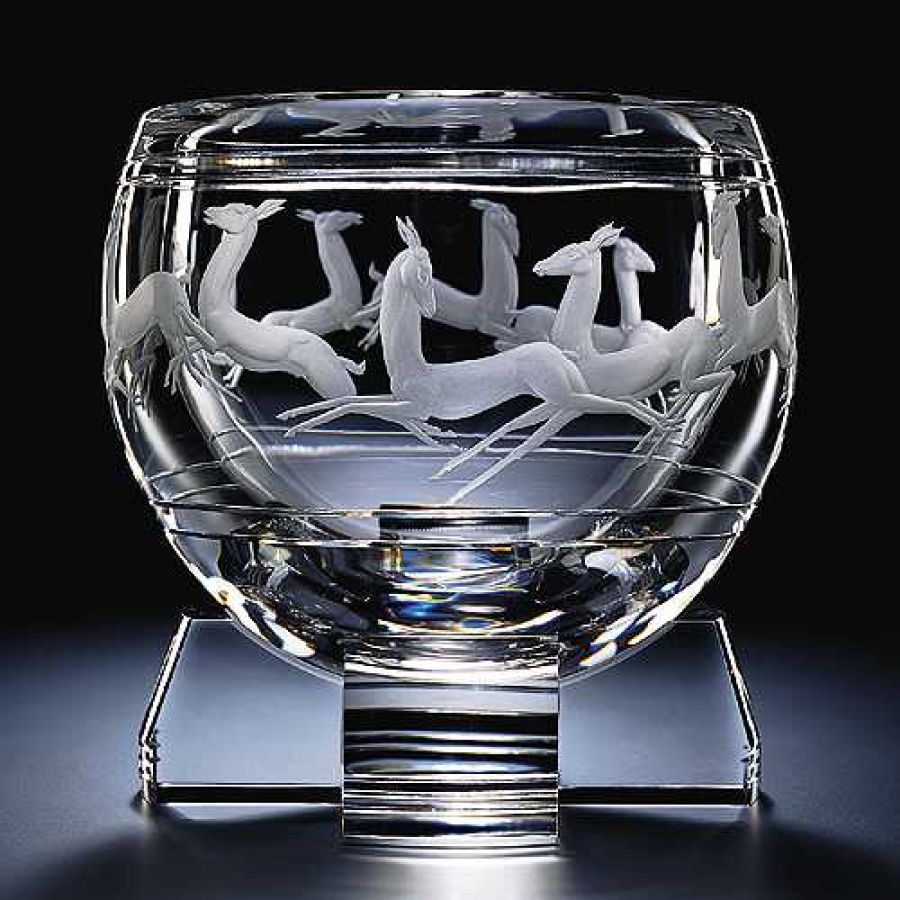
 After a storied history that spanned the last century as the great American maker of fine crystal, Steuben is closing down later this year.  They produced their extraordinary work in Corning since the beginning of the company in 1903.

I remember watching the engravers at work several times during visits to the museum which had sections where you could see them through glass panels.  They had rows of engraving tips on their workstation and beautiful drawings that worked from in creating pieces such as the spectacular one above.  It’s hard to believe that the fabled brand will end.

Goergia O'Keeffe in Steuben Crystal

One of their great groups of glass was the one that they produced in the late 30’s for a 1940 exhibit at their Manhattan showroom.  Called  Twenty-Seven Contemporary Artists, they took designs from 27 artists and translated them into glass.  The artists included Matisse, Georgia O’Keeffe, Dali, Thomas Hart Benton, Grant Wood, Leger, Dufy, De Chirico among many others. 

It’s a sad time to see such beautiful work come to an end.  I know it has certainly influenced what I look for in my own work and how I approach it.  Their designs are usually clean and crisp with strong imagery and the lines of the crystal are always just right and graceful.  All you could ask for…

Read Full Post »

« Newer Posts