Feeds:
Posts
Comments

Archive for November, 2014

Subway TrainI heard a version of  Duke Ellington‘s signature tune, Take the “A” Train, the other day that caught me off guard.  The music was playing in the background and I caught the notes of a tune that made me stop and listen.  It was so familiar but it was so different.  Then I recognized it and realized it was someone other than the Duke and his orchestra.  It didn’t have the urbane and upbeat swing, that joyful feeling of breezing carefree along that marked the original.

No, it was a slow jaunt, a meandering and elegantly peaceful ride.  No horns.  Just a thumping upright bass and gorgeous piano work over some light drum work.  It was still the same tune but it was oh so different in feel.  It was from jazz great Ray Brown and his trio– Gene Harris on the piano.  Beautiful stuff.

GC Myers  Call To Waking smallIt reminded me of the times when I had taken the color from my work and work in tones of gray or sepia just to change things up a bit, to cleanse the palette so to speak.  The piece shown here on the left is an example.

I described it as being like hearing a song that you’ve heard a thousand times before then hearing a completely different take on it.  It’s the same tune, same notes and chords, but it just feels different, opens up something new inside.  This version by the Ray Brown Trio is exactly what I was describing.

It is the same but different.  Plus soaking in that bass thump is just a great way to kick off a quiet Sunday morning.  Have a great day…

Read Full Post »

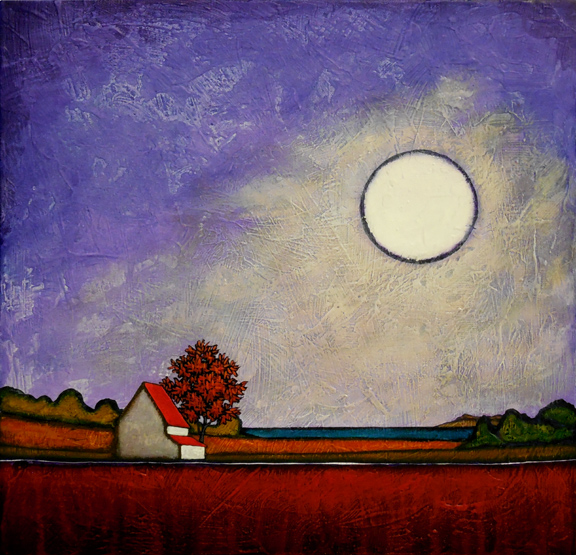
GC Myers- Chaos and Order smIn its simplest terms, this painting is about all that we don’t know, individually and collectively.

I call this 20″ by 24″ canvas Chaos and Order.  In it, the Red Tree dwells in a land that is apparently in order, a clean landscape of neat rows in the fields and a clear path that takes one through it.  It is seemingly the master of its domain, possessing knowledge of all things within its reach.

Yet, by merely looking into the night sky and seeing the great patterns of chaos written upon it, the Red Tree realizes the limits and boundaries of its knowledge.  It tries to make it fit into some sort of orderliness, something that it can understand on its limited terms but the patterns are too great and come at it like the cacophony of a thousand different languages being spoken at once.

What is the message here?  That we are small and weak before the power of the universe?

Yes and No.  Yes, without knowledge, with only a fear of what lays in that chaos, we are weak and small.  But I don’t think that is the message I see here.   It is that we are merely searchers, still learning the secrets and languages hidden right before our eyes.   The great chaos we see before us might be daunting but we will always try to make order from it in order to find our place within it.  That is simply who we are.

This is another painting that will be at my show, Into the Common Ground, at the Kada Gallery in Erie, PA,  opening December 5.


Read Full Post »

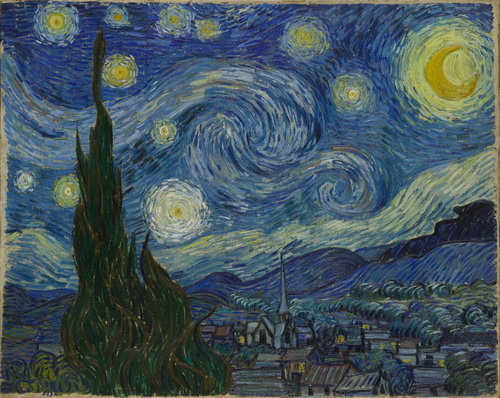
Van Gogh The Starry Night 1889 MOMAThe Starry Night by Vincent Van Gogh is one of the most beloved paintings of all time, stirring all sorts of emotions from a wide spectrum of the population as it presents a paradox of serenity and turbulence in the night sky of Provence.  It has been analyzed to death by art critics, psychologists, theologians and every art history student since it was painted in 1889, each striving to explain the meaning that they pull from it.

And maybe they’re all right.

But recently there has been a different analysis of this work.  It has to do with fluid dynamics and the problem of finding a mathematical equation for turbulence– the sort of turbulence you might see in an eddy in a stream or that which is depicted in the swirling light and color of Van Gogh’s painting.  Russian mathematician Andrei Kolmogorov (1903-1987) came closest to solving this problem in the early 1950’s yet it remains one of the great unsolved problems of physics.

Back in 2004, the Hubble telescope picked up images of eddies of gas and dust around a distant star and scientists were reminded of Van Gogh’s painting.  Scientists from a number of countries collaborated on an analysis of the luminance in his painting and discovered that the structure of his painting was very much patterned like Kolmogorov’s equations for turbulence.

I am not going to say much more.  There is a wonderful short film below from TED-Ed and Natalya St. Clair that much better explains this. But before you watch, I wanted to add one more thing which is the supposed inspiration for Van Gogh’s sky.

Drawing of M51 Whirlpool Galaxy Lord Rosse 19th CenturyThere was a drawing that was well known in Europe in the latter part of the 19th century that was done by William Parsons, also known as Lord Rosse, who had built a large telescope on his Irish castle in the 1840’s.  Called Leviathan, it was the largest telescope in the world until 1918.  With it, Lord Rosse was able to observe the great swirls of the near universe, turning them into drawings which circulated throughout Europe.  This one shown on the left is of  the Whirlpool Galaxy, M51, and is believed to have been the spark for Van Gogh’s sky.

Anyway, watch this great short on the analysis of Van Gogh’s great painting.  Or perhaps you would rather just be content with our own interpretation of the work and what it does for you personally.  Either way is good.

Read Full Post »

The cradle rocks above an abyss, and common sense tells us that our existence is but a brief crack of light between two eternities of darkness.

–Vladimir Nabokov

*******************

GC Myers- Cradle of LightThis another painting that is headed to the Kada Gallery as part of my solo show, Into the Common Ground, opening there on December 5th.  I call this 12″ by 16″ canvas Cradle of Light, very much based on the idea expressed in the quote above from Vladimir Nabokov.  Similarly, I tend to believe that our lives are bursts of ephemeral light in the darkness of the universe, so preciously short that each moment in the light is a gift.

Maybe that explains my rising at the first vague hint of light in the early morning sky.  Our time here seems so short , so tenuous, that to waste the light seems foolhardy.  Of course, this realization doesn’t keep me  from squandering this rare commodity on an epic scale nearly every day.  But at first light I am always reminded of the fact of our mortality, of that short time we have to fulfill our purpose here.

Whatever that purpose might be…

Read Full Post »

The-Best-Years-of-Our-Lives-  Dana WinterVeteran’s Day is coming up and I thought I might have an image that somewhat represents the experience of some vets on their return home.  In the 1946 movie, The Best Years of Our Lives, Dana Andrews‘ character, Fred, struggles on his return to his hometown and comes across a local airfield where they are junking old war planes from the recently ended World War II.  He crawls into an old B-17 bomber and takes his former seat in the front turret of the plane where he was a nose gunner.  He vividly relives for a brief moment the terror that was still haunting him, tainting every moment of his life.  The haunting image of Andrews appearing ghost-like in the nose of that B-17 is a powerful one in a movie filled with powerful scenes, one that doesn’t sugarcoat the experiences and hardships of the returning vets.  It remains relevant to this very day.

I thought for this Sunday’s musical interlude, I would play something in the spirit of this upcoming holiday.  It would be easy enough to play something patriotic but this isn’t really a holiday of nationalism and a call to arms.   No, this is a holiday that celebrates an end to war , namely World War I when the holiday was originated as Armistice Day, and honors the service of all soldiers with the hope that they will soon return home and resume their lives there.  This holiday honors those who have served and sacrificed so much, not the wars to which they are sent.

The song is Johnny I Hardly Knew Ya which is the original tune on which the Civil War era  song When Johnny Comes Marching Home is based.  While When Johnny Comes Marching Home is more celebratory and martial in tone, Johnny I Hardly Knew Ya is pointedly anti-war and mournful.  It was supposedly written in the 1790′s as a protest to the British imperialist invasion of Ceylon, present day Sri Lanka.  It tells of a young woman seeing her lover , who left her after their illegitimate child was born to join the army,  returning from war.  He is much changed in appearance and she mourns for his loss.

This is a very emotional version of the song from British opera and folk singer Benjamin Luxon accompanied by American Bill Crofut on banjo.  Have a great Sunday and gives some thought to the men and women who have given their time and their selves to serving their countries.  Let’s vow to treat them better.

Read Full Post »

Spend time every day listening to what your muse is trying to tell you.

–Saint Bartholomew

********************

GC Myers- Listening to the MuseThis is an 18″ by 18″ canvas that is headed to the Kada Gallery in Erie in a few weeks for my show, Into the Common Ground, that opens there on December 5th.  I call this painting Listening to the Muse, very much in line with the quote from St. Bartholomew from back in the 1st century AD.  It was true then and still is, twenty centuries later.

I see this piece as being about the value of silent listening, of finding a quietness of mind and spirit that allows one to observe the world as it moves  along.  I think  the muse dwells in those deep recesses of quiet, timelessly waiting to reveal its secrets if only we can calm the chaos and sound surrounding us long enough to hear.

This is one of those pieces where I could write for hours and not add a bit to what the painting itself reveals with a glimpse.  That being said, I will shut up and listen. Hopefully, the muse will appear.

Read Full Post »

Maurice de Vlaminck- Houses at Chatou 1905

Maurice de Vlaminck- Houses at Chatou 1905

When I get my hands on painting materials I don’t give a damn about other people’s painting… every generation must start again afresh.

— Maurice de Vlaminck

********************

I have to admit I don’t know much about French painter Maurice de Vlaminck  (vlah-mink)  who lived from 1876 until 1958.  His work is best known for a short period  in the early years of the 20th century when he was considered one of the leading lights, along with Andre Derain and Henri Matisse, of the Fauve movement.  Fauve translates as wild beast and the style of these painters was very much like  that to the sensibilities of that time.  It was brightly colored with brash brushwork and little attention paid to detail.  It was all about expression and emotion.

I recognize some of his early Fauvist work, mainly for the obvious influence of Vincent Van Gogh  it exhibits, and none of his later which becomes less colorful and exuberant, perhaps shaped by his experiences in WW I.  But his name is one that I have often shuffled over without paying too much time to look deeper.

Maurice de Vlaminck At the Bar 1900

Maurice de Vlaminck- At the Bar 1900

But I came across this quote and it struck me immediately.  It was a feeling that I have often felt  when I immerse myself in my work.  All thoughts of other painters– of their influence, of comparisons and artistic relationships– fade into nothing.  It is only me at that moment faced with the task of pulling something new and alive from the void.  I can’t worry myself at that moment about what other painters are doing.  Their whats and hows and whys  are all moot to me then because I am only trying to express something from within.  It might only exist and live for me in that instant, though I hope it transcends the moment, but that is the whole purpose and all of the works of all the painters throughout time can’t change this singular expression of this moment.

This single, simple quote brought me into kinship with de Vlaminck and made me promise myself to explore more deeply into his work and life so that when I come across his name in the future I don’t simply skim past without a thought.  But when I am painting, rest assured I will not be thinking of Maurice de Vlaminck.  And that is as it should be…

Read Full Post »

Sapanta_Peri_monastery_1Last week I showed the Merry Cemetery in Romania with its colorful wooden tombstones.  After that, a friend sent me a link to another blog that showed an image of a  nearby monastery, Peri Monastery,  in the same town, Sapanta.  It was a magnificent structure, supposedly the tallest wooden structure in Europe, that looked like something pulled from a fairy tale.  Despite its appearance, it is a new structure but one that is in the tradition of the wooden churches of that region, with wooden shingles on the roof and wooden pegs used throughout instead of nails.

Nearby is the bell tower for the monastery.  It is an equally striking building as is the carved gate to the grounds.

sapanta-peri-monastery-bell tower

Bell Tower, Peri Monastery, Sapanta, Romania

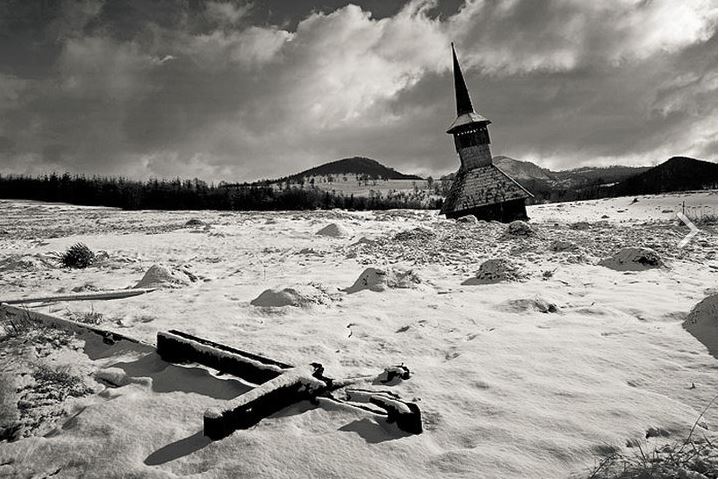
sapanta-peri-monastery-02-gateWhile looking at some other images of this monastery, I came across these images below that captured my imagination.  One is a winter scene of a destroyed church.  I don’t have any info on the story behind this but it is an intriguing photo.  The other is of haystacks in the field.  They stack the hay on poles which creates these slender, almost human-like shapes, that seem to be marching across the fields. Fittingly, the Romanians call them Germans.  I kind of think they look like the Shmoos from the old Li’l Abner comics.

Sapanta Romania Winter Scene Romanian Hay Stacks- Germans

Read Full Post »

GC Myers- Far Above It All smThis is a new painting, a 20″ by 24″ canvas , that is called Above It All, part of the show opening December 5th at the Kada Gallery.  I felt from the time this painting was complete that with its intertwining tree set apart from the village below that it was about some form of love.  But what sort of love and how to describe it in words?
It seemed like a from of eternal love, one bound together through time, much like that in the myth of Baucis and Philemon that I have described here on  several occasions.  But I thought I would look to the words of someone else to perhaps give a new perspective on what I was seeing in this.

That brought me to the poems of Rupert Brooke, the British poet who was just in his ascension as a major poetic voice when he died at the age of 27 in 1915.  He was in the British naval forces of WW I on the way to Gallipoli  when he developed sepsis from an infected mosquito bite.   He was buried in an olive grove on the Greek island of Skyros.   An odd casualty of the war but still a casualty that deprived the world of what might have come from his hand.

The poem of Brooke’s that hit me the most fitting for this piece was one titled The Call, written when he was only about 20 years old.  It has the intensity of youthful love, like a flaming torch held high.  And that’s what I see in this painting.  So, if you can tolerate poetry, and I know some can’t, give a read to the verses below from Rupert Brooke.  It’s powerful and straightforward. And fitting, or so I think.

                      The Call

Out of the nothingness of sleep,
The slow dreams of Eternity,
There was a thunder on the deep:
I came, because you called to me.

I broke the Night’s primeval bars,
I dared the old abysmal curse,
And flashed through ranks of frightened stars
Suddenly on the universe!

The eternal silences were broken;
Hell became Heaven as I passed. —
What shall I give you as a token,
A sign that we have met, at last?

I’ll break and forge the stars anew,
Shatter the heavens with a song;
Immortal in my love for you,
Because I love you, very strong.

Your mouth shall mock the old and wise,
Your laugh shall fill the world with flame,
I’ll write upon the shrinking skies
The scarlet splendour of your name,

Till Heaven cracks, and Hell thereunder
Dies in her ultimate mad fire,
And darkness falls, with scornful thunder,
On dreams of men and men’s desire.

Then only in the empty spaces,
Death, walking very silently,
Shall fear the glory of our faces
Through all the dark infinity.

So, clothed about with perfect love,
   The eternal end shall find us one,
Alone above the Night, above
   The dust of the dead gods, alone.

            -Rupert Brooke

Read Full Post »

black-crowI normally wouldn’t repeat an earlier post on a Sunday morning, the time I usually reserve for a little music.  But I wanted to replay this song from a few years back and liked the post that went with it.  Plus, it gives me a chance to update it a bit as well.  So, here it goes:

One of the benefits of having my studio located in the woods is the opportunity to watch the wildlife from a fairly close perspective.  I have known all manner of animals over the years, from the mother raccoon and her kits that took up residence for a short time in the roof of my first, more rustic studio further up in the woods, and the everpresent deer that often nap  in the shady lawn outside my studio windows to the coyotes and bobcats that I have captured on my trail cam and have ran across in person, as well. 

I get to see how the animals interact, how they break down into family units and establish order.  How they survive the elements and their habitation among us humans.  Their survival instinct is powerful, a hard thing to see at times but powerful, nonetheless.

Over the years I have witnessed many deer with legs that have been broken, most likely from a misstep or an encounter with a woodchuck hole.  I am always amazed at their ability to persevere and prosper.  There was a doe several years ago who came around with a front hoof dangling, completely broken away from the leg above.  Eventually she lost the hoof completely, leaving a stump.  But it didn’t stop her.  She actually had 3 or 4 fawns over the next few years and it was only when she walked slowly to feed that you recognize that she was missing a hoof.  In full flight, she moved as fast as  the other deer and managed to evade predators and hunters for years.

I currently have a black crow that haunts the pines in front of my studio.  He came to my attention early in the winter.  I saw crow tracks in the snow that went from the studio all the way down the long driveway, about 1/5 of a mile.  I couldn’t understand why a crow would walk throught he snow when he could fly.  This went on for several days until I finally caught a glimpse of him, ambling up the drive.  It was a badly damaged  wing that hung off of his back to one side.  He would walk and hop with real determination and was seldom alone.  There was normally a group of crows that accompanied him, cawing to him from the trees above and sometimes coming down to walk with him.  I got the idea that they sometimes let him know what was ahead or behind, acting as his eyes in the sky.

I thought about trying to capture him and get him to an animal rehabilatation specialist such as the unit at Cornell University but he was always quick to spot me and would disappear into the woods with surprising speed.  He was even aware and suspicious  of me when I watched him from my front windows. 

His mobility has improved over the past six months.  He hops quickly and to my surprise has developed the ability to take flight for moments at a time.  Not for very long distances but enough to carry him to low branches of the trees from where he can hop to higher branches.  Once he reaches the top he will glide, without flapping his wings, to a point quite a ways down the drive from where he will commence his walk/hop.

I really admire his grit and evident intelligence.  I have gotten into the habit of putting out for him  the poor small rodents that my studio cat, Hobie, captures and kills in the woods around the place, laying them at  my feet proudly as gifts on a daily basis.  I have watched him and his kin find these small gifts  a number of times and I think he understands the gesture.  Doesn’t make him any less wary of me but that’s okay.  He gets an easy meal and I get to see that the mice and moles go back into the big circle quickly.  Win/win.

Update: The crow continued his rehabilitation to the point that he was nearly indistinguishable from the others.  He was able to fly with immediate lift and his wing only drooped a bit more than the rest.  This return to normal function allowed him to range further away so that I eventually lost track of him.  Whether he is still alive, I can’t say.  But his ability to survive and prosper through what could have easily been a deadly injury was really inspiring.  I have a tremendous amount of respect for crows.

Here’s a really nice rendition of Joni Mitchell’s song Black Crow from Diana Krall.  Just right for a Sunday morning.

Read Full Post »

« Newer Posts - Older Posts »