Feeds:
Posts
Comments

Archive for February, 2016

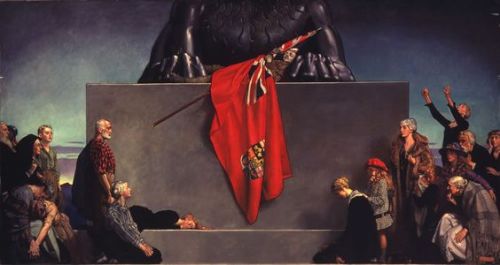
John Liston Byam Shaw  The Flag 1918

John Liston Byam Shaw- The Flag 1918

I’ve written here about how uncertain the future is for any artist’s legacy.  I usually point out that how one’s work fares in the next few generations and beyond is out of the artist’s hands.  I can cite example after example of artists who have created brilliant work in their time yet whose names and images remain relatively unknown in this time.  Their work often goes for relatively little at auctions and is seldom spoken of, yet it is nonetheless beautiful and moving.

One fine example is John Liston Byam Shaw ( most often known as simply Byam Shaw) who was a British artist and illustrator who lived from 1872 until 1919, dying in the influenza epidemic after the first World War at the relatively young age of 46.

John Liston Byam Shaw  Boer War

John Liston Byam Shaw- Boer War

Heavily influenced by the Pre-Raphaelites, Shaw produced what I consider a large and gorgeous body of work.  It is wide in the scope of its themes and imagery and when I look at the Google Images page there is one after another  of just great paintings.

The image shown here on the right, Boer War, is perhaps his best known painting.  It a war painting without the actual imagery of war, depicting the sense of loss and despair felt by those loved ones who survive the fallen.

A more obvious reference to the aftermath of war is shown in the painting at the top of this page in The Flag, a memorial piece done at the end of WW I.  I am really drawn to the use of color and tone in this painting.  Just a wonderful painting.

There are so many more that I have selected just a few that struck me.  If you look for yourself I am sure you will find some others that will do the same for you.  One of the paintings shown below, the first at the top of this group , a watercolor titled The Ballad of Luther, went to auction  in the last few years and didn’t even draw an opening bid of less than $900.

As I said, legacy is out of the hands of the artist.  All they can do is to make an effort to produce work that fills their own need for expression and emotion.  I think Byam Shaw definitely did this and that is enough, especially for those fortunate enough to find his work.

John Liston Byam Shaw  The Ballad of Luther 1918

John Liston Byam Shaw – The Ballad of Luther

John Liston Byam Shaw Queen of Hearts

John Liston Byam Shaw- Queen of Hearts
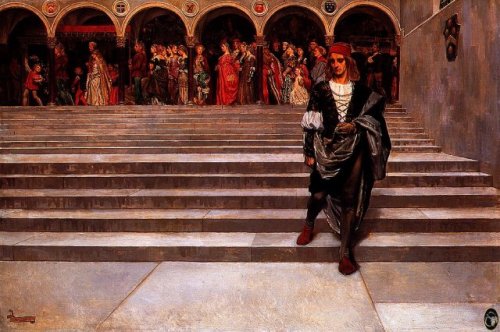
John_Liston_Byam_Shaw_This is a heart the queen leant on  Marriage Procession Arthur Guinever

John Liston Byam Shaw-This is a heart the queen leant on / Marriage Procession Arthur and Guinevere

John Liston Byam ShawQueen Mary and Princess Elizabeth Entering London

John Liston Byam Shaw-Queen Mary and Princess Elizabeth Entering London

john-byam-liston-shaw_now-is-the-pilgrim-year-fair-autumns-charge

John Byam Liston Shaw- Now is the Pilgrim Year Fair Autumn’s Charge

John Liston Byam Shaw  Rising Spring

John Liston Byam Shaw- Rising Spring

John Liston Byam Shaw -Illustration for Old King Coles Book of Nursery Rhymes

John Liston Byam Shaw -Illustration for Old King Coles Book of Nursery Rhymes

Read Full Post »

Vintage Baseball Photos 1800'sFor me,  Punxsutawney Phil is not the ultimate predictor that winter is coming to an end.  No, it is those first reports from Florida and Arizona that baseball’s Spring Training is beginning that does it for me.  The baseball is in the air  once more and I feel so much better when I am immersed in the rhythms of baseball.
And there is such a rhythm.  With its 162 games played over its six month season, it is present in some form on a daily basis for those who follow the game.  Each day brings something new that adds to the game’s long history, to its poetry and legend, to its voluminous statistics, to its never-ending debates over the superiority of teams, players and eras.  For someone like me who is a huge fan of the game’s folklore and history, nothing could be better.

Speaking of folklore, the photo at the top is perhaps the oldest image of the game, taken sometime before 1870.  It sold a few years ago on eBay for  $3800.  It shows a group of schoolboys at the Bluff School in Claremont, New Hampshire.  It was used in  Ken BurnsBaseball documentary and was taken by the early photographic studio of French & Sawyer which operated in Keene, NH.   Their partnership dissolved in 1870 so the photo was taken before that time.  It could be as early as the late 1850’s,  pre-Civil War.  The interesting thing is that there is action in the photo, a rarity for any photos of the era.  It also shows the players in positions that closely resemble today’s game which adds to that feeling of connection through time that is a part of the game.

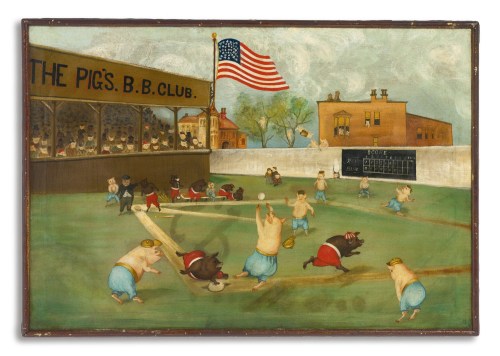
The painting below is an early painting of the game.  I don’t know who painted it or when and can’t find anything about it.  It was listed on a folk art site and is no longer there so details on it are sketchy.  I think it’s a fun piece and reminds me that baseball is coming soon and winter is coming to an end.

The Pigs Baseball Club Ca 1890 21 x 30

Read Full Post »

GC Myers Time Comes Together 2006Valentine’s Day.

It would be easy to go on and on about the day and the meaning of love but sometimes words just do not do the subject justice.

So I will keep it short today and share a poem from the Nobel Peace Prize winning Turkish poet, Nazim Hikmet, along with this Sunday’s musical selection, a cover of Bruce Springsteen‘s Drive All Night from Glenn Hansard (best known for his songs from the film and stage production Once) with backing vocals from Eddie Vedder.  A very good cover of one of my favorite songs from The River album of 1980.

Have a good Valentine’s Day…

******************

I love you
like dipping bread into salt and eating
Like waking up at night with high fever
and drinking water, with the tap in my mouth
Like unwrapping the heavy box from the postman
with no clue what it is
fluttering, happy, doubtful
I love you
like flying over the sea in a plane for the first time
Like something moves inside me
when it gets dark softly in Istanbul
I love you
Like thanking God that we live.

Nazim Hikmet
*******************

Read Full Post »

van-gogh-self-portraitI showed this short video here about six years back.  It’s a compilation of morphing self portraits from Vincent Van Gogh put together by Phillip Scott Johnson that I found intriguing then and now.

It’s a short piece, less than a minute in length, and it’s interesting to see how the familiar views of Van Gogh relate to one another and how his appearance or, at least,  his perception of it, changed through the years.   His state of mind is evident in each piece, with some showing a vibrant, seemingly healthy man and others showing the more tortured Van Gogh that we tend to think of as the man.

I found it interesting now because I have been spending some time recently looking at my own older work in a different way.  I am not looking at the pictures as whole images.  Instead, I have been looking at the individual marks I am using in each and seeing how it has changed through the years.  Or how it has stayed the same in some cases.

I’ve always said that my painting for me was a continuum that, while changing all the time, always seemed the same to me– always in the present.  But looking at it in this manner I am finding that my mark-making does change periodically which fundamentally changes the way a picture is painted and how it emerges in the end.

It’s not something I often think about– I just paint in whichever way the moment strikes me.  Sometimes it is dependent on the condition of the brush or the weight and quality of the paint I am using.  As a brush ages and wears, especially with the rough treatment given to them by me, it makes a more and more distinct mark that I find appealing.  Looking back, I can often tell when I am using fresh or old brushes.

So, I watched this film in the same way and it is fascinating to just look at Van Gogh’s mark-making throughout without focusing on the faces.  It is varied and each differing style serves the image in different ways.  Some marks are wildly expressive and others small and quietly acting in service to the greater whole.

As I said, it’s less than minute and interesting even if you don’t give a damn about the mark-making part of it.


Read Full Post »

GC Myers-The Incantation 1994I was going through some old images the other day and for some reason I always settle on this image shown here, an old piece from my earliest painting efforts over twenty years back.  I call it The Incantation.  At that moment a news station was on the TV, with its incessant and seemingly never-ending  coverage of the presidential primaries.

So much is said yet there seems to be so little substance in it that it turns into just words uttered.

Nonsense or an incantation, of sorts.

In my mind, the connection was made between this image and the song below, Hoodoo Voodoo from Billy Bragg and Wilco, based on unpublished lyrics from Woody Guthrie.  Guthrie had  several songs with nonsensical lyrics, often written for his children. I like this version– it spans that gap nicely between nonsense and incantation.

Actually, I think Sarah Palin quoted many parts of this song verbatim during some of her speeches, most notably her recent ones while stumping for Donald Trump. As I said: nonsense and incantation.

Give a listen and read along.  Hopefully the next time you’re held under a spell cast by the talking heads on one of the news networks, this song will start playing in your mind.  Nonsense is the only defense against their incantations.

Hoodoo voodoo, seven twenty one two
Haystacka hostacka, ABC
High poker, low joker, ninety-nine-a-zero
Sidewalk, streetcar, dance a goofy dance

Blackbirdy, bluejay, one, two, three, four
Trash sack, jump back, EFG
Biggy hat, little hat, fatty man, skinny man
Grasshopper greensnake, hold my hand

Hoodoo voodoo, chooka-chooky-choo-choo
True blue, how true, kissle me now

Momma cat, Tommy cat, diapers on my clothes line
Two, four, six, eight, I run and hide
Pretty girl, pretty boy, pony on a tin can
I’ll be yours, you’ll be mine

Hoodoo voodoo, chooka-chooky-choo-choo
True blue, how true, kissle me now

Jinga jangler, tinga lingle, picture on a bricky wall
Hot and scamper, foamy lather, huggle me close
Hot breeze, old cheese, slicky slacky fishy tails
Brush my hair, kissle me some more

Hoodoo voodoo, chooka chooky choo choo
True blue, how true, kissle me now

Hoodoo voodoo, chooka chooky choo choo
True blue, how true, kissle me now
Kissle me now

Brush my hair
And kissle me some more

Kissle me some more
Kissle me some more

Read Full Post »

Automata

AutomataI came across this film  early this morning and was immediately intrigued.  It’s a film of an automata, a hand-crafted machine made by Swedish artist/craftsman Per Helldorff (his site can be seen here) that has a figure playing the old shell game, the classic con game using three shells or cups and a ball or pea.  The operator puts a ball under one of the cups and shifts them around while the sucker–oops, I mean bettor– tries to follow the motion and pick the final location of the ball.  It’s a ruse that has literally  been around since the times of ancient Greece.

We love to be tricked, don’t we?

I sat and watched this several times, trying to figure out the mechanics behind the trick and can’t quite get it.  I think there must be two  balls and a magnet or  a catch of some sort.  Take a look at see what you think.  I’ve also included a few more of Mr. Helldorff’s other automata.  Just lots of fun.


Read Full Post »

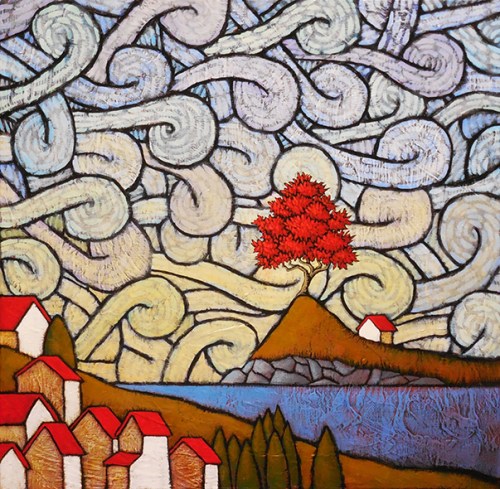
GC Myers- Icon: Joe H.Here’s my latest entry into the Icon series, a 12″ by 12″ canvas piece that is titled Icon: Joe H.  He is my 3rd great-grandfather and his name was Joseph Harris and he was born in the Lindley (the town named after our common ancestor, Eleazer Lindsley,who was among the first Icons) area south of Corning in 1833.
He led a fairly typical life for the time and place, serving in the Civil War and raising a family.  He worked primarily as a blacksmith and a sawyer ( I have a lot of lumbermen in my family– maybe that’s where my affinity for trees comes from) in his early years, working for a number of years in the then booming timber business that was taking place in northern Pennsylvania and western NY.   It was there that his wife, Emeline Whitney, died just a year or so after the end of the Civil War.  Later in his life, he returned to the area of his birth, settling in as a farmer  just over the border in Pennsylvania where he died in 1922.

That was about the extent of his life for me, at least what I could find of it in records.  I did discover that he married his step-sister, Jennie, who was twenty years younger, as his second wife.  But it was my research into local newspapers that gave me a better sense of him.

Looking at records gave no indication of anything but the basics but in his 1922 death notice printed in the Wellsboro Agitator ( I love the name of that paper!) the headline lists him as a “Skilled and Noted Musician.”  It goes on to say that he had been the one-time Banjo Champion of the United States.  He very well may have picked up the banjo from his Civil War experience as it’s popularity in the time after the war is often attributed to many people being exposed to it for the first time during their service.  I could never find anything to document a championship which was no big surprise as it most likely occurred somewhere in the 1870’s or 1880’s and whatever group sanctioned the competition is more than likely no longer in existence.

But I was pleased to know that music played a big part in his life and I later found an item that confirmed this.  It stated that his son, William Harris, was working as a musician in one of the  oilfield boom towns in northern PA in the 1890’s when he tragically took his own life by shooting himself at the hotel where he was living.  As is often the case, you find a lot of tragedy when you look backwards so it’s some consolation to know that there was a bit of music and joy mixed in there somewhere.

I did visit Joe’s gravesite a while back.  It is a bare-boned and flat plot of land that sits next to a harsh little trailer park visible from the new interstate.  Standing at his grave you looked into the backyard of several trailers, the kind of yards scattered with kids toys, spare tires and oil drums.

It made me a little sad but then, I guess a guy who lived through the Civil War, endured the death of his first wife and several of his children before him and lived to see the first World War, this wasn’t all that bad.

Read Full Post »

GC Myers= In DelightThere is delight in singing, though none hear beside the singer.

Walter Savage Landor

*********************

The British poet, Walter Savage Landor, who wrote those words above knew what he was talking about: Sometimes you do something that is filled with pleasure for yourself yet it might not stir the soul of a single other person.  The delight comes in simply doing it.

Not that Landor, who lived from 1775 to 1864,  was without accolades.  He had an incredibly long career–almost 70 years— and was held in the highest esteem by his peers. But he never gained widespread public popularity or love for his work in his life or after.

His poetry was his singing and sometimes only he and perhaps a few others could appreciate that voice.

I chose these words from Landor for this painting not only because I felt that he was writing about his own work in a way.  I used it because of the great pleasure I took in painting the painting above, an 18″ by 18″ canvas that I am fittingly calling In Delight.  It was one of those paintings that gave me a lot of joy at every step of its growth, each stroke making it come more and more to life for me.

It’s that fulfillment of joy that makes me not worry about how it is received.  If not a single person sees a thing in it, I do not care.  It pleased me to simply make it and even now it makes me smile when I look at it from my chair in the studio.

For me, I felt like I was singing with a rich and full voice.  But again, that’s just my ear.  You might hear fingernails on a chalkboard when you look at it.  And that’s okay– the delight was in the singing.

Read Full Post »

hundertwasser_land-of-men-birds-shipsThe painting above is titled Paradise-The Land of Men, Birds and Ships.  It’s actually a mural that was painted on a building outside of Paris in 1950 by artists Friedensreich Hundertwasser and  René Brõ.  It was saved from demolition in 1964 although I have no idea where or in what condition it now stands.  I’ve featured Hundertwasser’s work, with it’s rich colors and organic shapes, here on the blog a few times in the past.  I like his work,  I like this and thought it fit well with the song I’ve chosen for today’s Sunday Morning Music.
That song is Ships and Birds from one of my favorite albums, Wilco and Billy Bragg‘s 1998 Mermaid Avenue.  It’s a collection of old unheard Woody Guthrie lyrics set to new music composed by Wilco and others.  This track features Natalie Merchant singing the lead and is just a lovely, simple  song.  A nice way to kick off any Sunday morning.

Have a great Sunday…

Read Full Post »

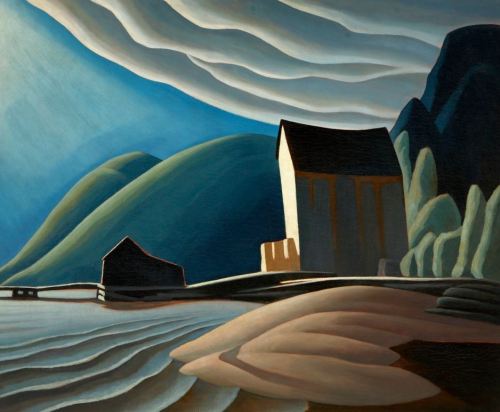
Lawren Harris- Ice House, Coldwell, Lake Superior 1923

Lawren Harris- Ice House, Coldwell, Lake Superior 1923

Art is the distillate of life, the winnowed result of the experience of a people, the record of the joyous adventure of the creative spirit in us toward a higher world; a world in which all ideas, thoughts, and forms are pure and beautiful and completely clear, the world Plato held to be perfect and eternal. All works that have in them an element of joy are records of this adventure.

Lawren Harris

****************

I love this quote from the great painter (please note that I didn’t preface it with Canadian) Lawren Harris.  I know that whenever I am working and am excited with the joy of what is unfolding before me, I feel closer and more connected to some sort of power that is beyond my knowledge.  It’s as though I feel tapped in to that winnowed result of the experience of a people as Harris puts it.  That is a great feeling, exhilarating and calming at the same time.  It is ultimately the feeling that brings one to art, both as a viewer and a creator.

Unfortunately, in the course of creating, it is sometimes a feeling that is forgotten, put aside for ends other than this element of joy.

It’s easy to do, believe me.

But rediscovering that joy is like coming across it for the first time.  Even though you know you have experienced it before, it feels all new and shiny, full of promise.

Effervescent– that is the word that comes to mind when I think of these moments of joy.

So, let me stop right here.  I am close to my own joy and don’t want to delay it for another minute.  Effervescence will not wait around too long, you know.

Hope you find some of your own today.

Read Full Post »

« Newer Posts - Older Posts »