Snowing like made still. Been out plowing for a couple of hours already this morning, just trying to keep the driveway open, and there is definitely a few more hours of plowing ahead. But I thought I’d take a break, drink some coffee and try to throw out some music for a snowy Sunday morning.
Came up with an old song, Valley of Tears, written and performed originally in 1957 by Fats Domino and covered by a number of other artists over the years. Buddy Holly did a version that charted in 1961 that had a skating rink/ magic organ quality to it but I really like this version from the late great Solomon Burke accompanied by one of my favorites, Gillian Welch, and her husband David Rawlings.
Solomon Burke was one of the early greats in the transition period between R&B and Soul. He was a real preacher and blended the spiritual and the physical aspects of soul– the sex and the salvation– into his music. He never got the acclaim as some of the other big names of 60’s Soul but he is is revered.
This is a great, heartfelt performance of the song. Give a listen while I get back to my own valley of tears. If you consider the falling snow tears, that is. Have a good day.
The American poet Mary Oliver died yesterday at the age of 83. I can’t claim to know much about poetry but I always found her work engaging and enlightening. There was a plain-spoken quality to her work that gave her musings the feel and clarity of newfound wisdom. She is gone but her voice will carry on. Here’s a post from a couple of years ago that was about the relationship of a painting of mine to one of her better known poems, Wild Geese.
**********************
You do not have to be good. You do not have to walk on your knees For a hundred miles through the desert, repenting. You only have to let the soft animal of your body love what it loves. Tell me about your despair, yours, and I will tell you mine. Meanwhile the world goes on. Meanwhile the sun and the clear pebbles of the rain are moving across the landscapes, over the prairies and the deep trees, the mountains and the rivers. Meanwhile the wild geese, high in the clean blue air, are heading home again. Whoever you are, no matter how lonely, the world offers itself to your imagination, calls to you like the wild geese, harsh and exciting — over and over announcing your place in the family of things.
—Mary Oliver
****************
A while back, a person interested in my work sent me the poem above, Wild Geese. It was written by the esteemed Pulitzer Prize winning poet Mary Oliver. This person wanted to know if I would be interested in translating this poem into into one of my paintings for them. I replied that when I had some time I would gladly do that as I think the poem strikes a chord that very much resonates in my work.
After a short while, this person contacted me again and said they had been looking at my work and had found a painting that they felt captured the spirit of the poem. The painting is the one shown at the top, The Singular Heart.
I was thrilled by the choice. It had the feeling and message of the poem without being absolutely literal. It’s exactly how I wanted to portray it. And the message and title of the painting fell perfectly in line with Oliver’s poem. The Red Tree stands, singular and alone, with the realization that it has a unique place, as does every being, in the family of things.
I told this person a bit about this painting and an experience I had with it that stuck with me. Once it hung in my home area gallery, the West End Gallery, and I met with a local college art class there. One of the questions was which of the pieces there was my favorite. I normally don’t answer that question because I have always felt that any painting that I decide to show has something unique to it, some quality that makes it special to me. Kind of like a parent with their kids.
But on this occasion I didn’t hesitate and pointed at this painting. I told them if I were to try to describe in one painting what I wanted to say with the body of my work and what I hoped for myself as a person, that this piece would summarize it perfectly.
I told this person that I felt it was perfect choice and was pleased when they chose this painting to represent the poem in their home. It means a lot when any painting finds a home but is even more special when I know that it resonates on many levels with its owner, that it goes deeper than the surface.
Here’s a clip of Mary Oliver reading her poem, Wild Geese:
When I read the line above taken from the journal of the great Canadian artist Emily Carr (1871-1945), it really hit close to the bone for me. I thought about my early forays in my youth when I believed I wanted to be a writer.
I loved the words and their power, their ability to create emotion and reaction in the mind of the reader. But I cared little about creating narrative, about the details, the nuts and bolts, involved in storytelling. It was the essence of things that interested me, the atmospheres of silence and distance and empty space.
It was all too heady for an uneducated and inexperienced kid. I didn’t know what to do with writing that evolved into what seemed to be ethereal nothingness. More and more, it became a frustrating exercise.
And I think that is where painting came in for me, at a time when I truly needed it. I found that painting, especially landscape painting, was less about narrative and more about that essence, about capturing moments of atmosphere and perceived emotion and spirit.
The unwordable and the unformable, as Emily Carr put it.
I definitely see this evocation of essence in the work of Emily Carr and can only hope to find the same in my own.
My annual show at the Principle Gallery in Alexandria, Virginia, opens on Friday, June 7th. This year is my 20th solo show there, something that seemed out of the realm of possibility when this run began with the first Redtree show back in 2000.
Nothing seemed guaranteed at that time.
I was still a fairly new artist at that point, showing my work publicly for barely five years with the last two years as a full-time artist. Still had that new artist smell. I understood that the Principle Gallery was taking a chance on me and that this show was a great opportunity for me as an artist. Solo shows in great galleries don’t just come to artists on an everyday basis and the success or failure of such a show could dictate how my career moved on from that point. I knew that all too well.
I remember my trepidation in the months before that first show as I prepared for it. I was operating in abject fear of my own failure was having trouble visualizing what success this show would even resemble. My final goal for the show ended up being that I simply hoped to not be embarrassed.
Fortunately, it turned out to be very successful. That led to the next year and the next and so forth. There have been varying degrees of success with the shows along the way but one thing that seldom changes is the absolute fear of failure that comes with each show. So, here I am, twenty years in, and still feeling that same ball of anxiety in my gut. If anything, it might even be worse because I see this as a personal landmark of sorts. I want it to be a show worthy of twenty years invested by the gallery.
I’ve been looking at some of he work from those earliest Principle Gallery shows, trying to see similarities and differences between the work then and now. To see how it has changed, to see what has been gained and lost. One that struck me this morning was the piece above from 2001 called Symphony to Joy. It’s a piece with what I would term great organic appeal. I mean that it in the sense given by the linework within the piece and the way the colors and forms play off one another. It just seems very natural.
Maybe I shouldn’t try to explain such things.
But what I am looking at is how I can regain that natural feel, that organic sense present in the painting. Twenty years of painting have straightened some lines, taken some spontaneity out of some color choices, and softened some rough edges. Experience and knowledge has taken the place of the urgency of the pure emotion found in these early pieces.
I sit here this morning anxiously wondering how to find a way to merge the experience with that emotional urgency. Hope I can figure it out before June 7th.
Came across this post from six years back this morning and it made me stop. Reading it again, I realized it was what I was looking for this morning– a reminder of the why, the motivation behind what I am trying to do here in the studio. Thought it was a worth running here again.
*************************
All day I think about it, then at night I say it.
Where did I come from, and what am I supposed to be doing?
I have no idea.
My soul is from elsewhere, I’m sure of that,
And I intend to end up there.
— Rumi, 13th century Persian poet
************************
The other day, while going over some very early posts from this blog, I came across this short poem from Rumi. It had been passed on to me by my friend Scott Allen from the Cleveland area after my 2008 show at the Kada Gallery. He told me that it was what he himself had felt in my work. The poem had, I’m sorry to confess, slipped my mind over the years and coming across it again immediately rekindled my original reaction to it. Then and now, I felt as though this little wisp of a poem captured the motivation behind what I was trying to do in my work.
Like Rumi’s voice in this poem, I have spent most of my life in an existential quandary, filled with doubts about who I am and what I should be doing. I often felt like a stranger in a strange land, ill at ease in my surroundings and feeling, like Rumi, that my soul is from elsewhere. Initially, I felt as though my uncertainties and doubts could be allayed externally. I was simply not in the right physical location. But it was apparent after a time that it was not an external problem. Regardless of the location, I would not be at ease on the outside until I sought and found where I needed to be internally.
That’s where the act of painting came in and to fill this void in my life. If life were an ocean, painting gave me a hope, an endpoint for which to navigate. Without it, I would still be rudderless in an ocean of doubt. With it and through it, I feel that my soul is headed in the right direction.
I don’t know exactly why I feel the need to share this intimacy with you this morning. Perhaps that openness is part of the journey or even the destination. But for me, seeing this poem again reconnected me to the journey at a point when it felt as though I was going slightly off course. Sometimes in the process of seeking one forgets why they set out on the journey in the beginning. And that why, that motivation, sometimes needs to be revisited during the journey. It gives the destination definition and immediately puts you back on course.
This morning, I feel like I am sailing on smooth seas again, knowing why I am going forward.
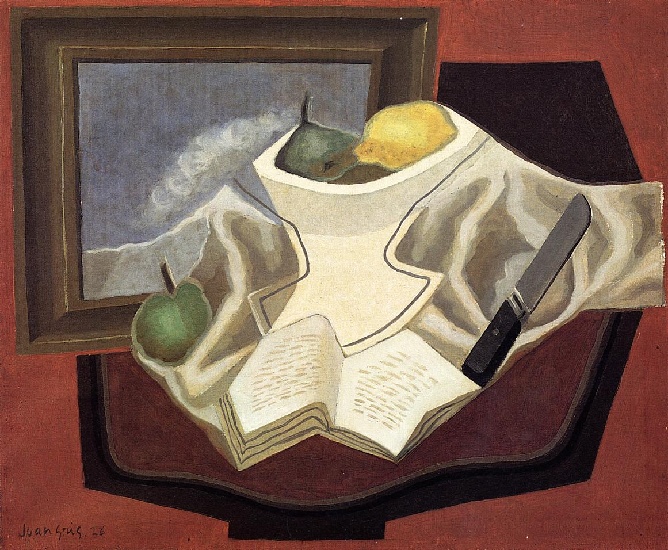
Painting for me is like a fabric, all of a piece and uniform, with one set of threads as the representational, esthetic element, and the cross-threads as the technical, architectural, or abstract element. These threads are interdependent and complementary, and if one set is lacking the fabric does not exist. A picture with no representational purpose is to my mind always an incomplete technical exercise, for the only purpose of any picture is to achieve representation.
–Juan Gris
**********************
I like this idea of painting being a fabric with a weft and a warp of elements that bring the representation to its full realization. It’s this idea that allows for such differing versions of the same image. One set of threads bring the recognizable form while the other allows for the individual artistic interpretation. Some fabrics are richer and some are coarser. Some are stronger and some are weaker.
I may not be explaining it very well but I understand it.
This comes from the great Cubist painter Juan Gris, who was born in Spain in 1887 and died in France in 1927, leaving behind a consistently wonderful body of work. He is thought of as one of the most important of the Cubists, perhaps only eclipsed by Picasso and Braque.
Since he died at such a relatively young age– 40 years old– it makes one wonder how his work would have evolved in the later years of maturity that he never obtained. As it is, there is a lot to see in his work.
His most famous piece, Still Life with Checked Tablecloth from 1915, is at the top of this page. It sold at auction in 2014 for $57.1 million and is in the collection of the Metropolitan Museum. You can click here and go their Met Collects site to get a closer look at the painting. Being able to look closely at the surfaces is very illuminating to me. Take a look for yourself.
We’re in the midst of mad, chaotic times and my thought was to play something calming here on this Sunday morning. We could all use a breather.
And for music that soothes, you can’t get much better than Claude Debussy and Clair de Lune. Here is a wonderful performance from contemporary classical guitarist Roxane Elfasci who beautifully captures all the nuance and sensitivity of the composition.
The painting shown is from a few years back and carries the title of this piece of music. I look at it and can immediately sense the melody and flow of the music. There is something calming in the atmosphere and quietness of this painting. For me, this piece of music and it serve a definite purpose in these disturbed days.
Avoid methodology. If what you’re doing is about technique, that’s not art.
–Kay WalkingStick
**********************
Very much agree with this quote from contemporary landscape painter Kay WalkingStick. Soon to be 84 years old, Kay WalkingStick is a member of the Cherokee Nation who was raised in Syracuse and was an art professor at nearby Cornell University for a number of years. She incorporates Native American symbols and patterns in her work, which are often executed in diptych forms.
Even though there has been a physical proximity. I don’t know a lot about her work. I would love to see it up close to examine the surfaces, to see how the pieces speak in person.
Her advice about not tying yourself solely to process is a most valuable lesson for all artists. I think you need to live in the fringes of technique, always ready to stray into territory of material use that is new to you as an artist. You need to feel a bit lost so that you react intuitively, using what little you do know in new ways.
That is where the magic sometimes happens, where art takes place.
I saw an idiot* on television yesterday say, “The buck stops with everybody.”
Inspiring stuff. A new chapter in Profiles in Courage.
But, even though this pains me to say, the moron* was right.
Well, right in a way, not in the instance of which he was speaking, where he was trying to relieve himself of all responsibility for the particular situation in which he finds himself. No, the fool* is the primary bearer of the responsibility for that.
I am saying the buck stops with us all right now. We have allowed and enabled this whole ugly situation to take place. We have willingly given a looter a flamethrower and we are now witnessing how much damage can be done as he flees the scene.
And he* is very much a looter. Think about it.
A looter comes riding in on a wave of chaos and confusion, grabbing whatever he can as he runs through the mayhem. He thrives on the bedlam taking place around him because his only concern, his only focus, is on himself alone. He carelessly pushes people aside to get where and what he wants. Not a bit of care for the damage being done or the losses suffered from his actions. Not a single thought for those hurt as he tramples through.
And when it looks like the authorities are closing in, the looter* uses his flamethrower and sows even more confusion. When the whole city is ablaze, you focus on putting out the fire. The looter* focuses only on moving himself to safety.
It is now time for us all to understand that this is our responsibility to end this chaos, to extinguish the fires and take the flamethrower out of the tiny hands of the looter*. We must make our presence felt and our voices heard. Hit the phones and keyboards. Take to the streets and do it now. We can’t depend on anyone else doing it for us.
It is our responsibility.
If we want to continue to be considered a great nation, this is the price we must now pay. Because as Winston Churchill states above, responsibility is the price for greatness.
Or as a reality TV show nitwit* once said, “The buck stops with everybody.”
I have been saddled with a chest cold for several days that is severely limiting my activities and making work feel like a real chore. In need of a little pick-me-up I came across this very early post from back in 2008 that is a good reminder of what I consider my work ethic. Reminds me that I need to dig a little deeper on days like this. See what you think:
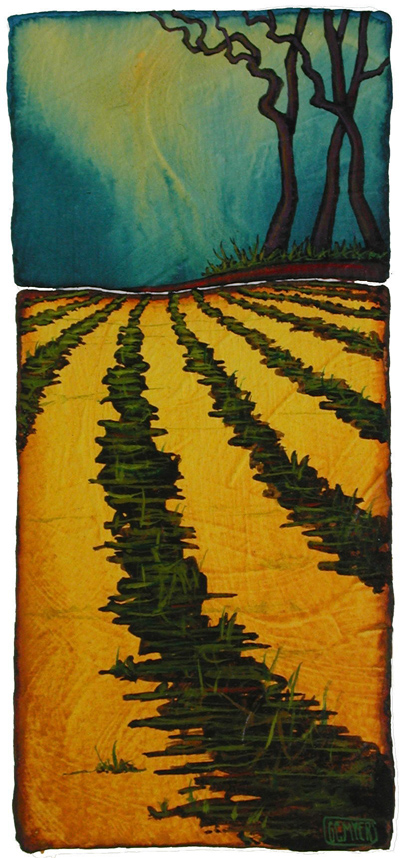
This is a piece called “Labor to Light”, a smaller piece that is at the West End Gallery in Corning. It features one of what I call my icons, the field rows running back to the horizon. To me, they represent the act of labor and the results derived from it. The ability to work hard has been very important to me in this career and something I stress to kids whenever I get to talk to them.
I remember years ago reading an interview with author John Irving (of “The World According to Garp” and “The Cider House Rules” fame) where he talked about his work routine. He talks quite a bit about wrestling in his writing as he was a high school and college grappler and he used a wrestling analogy to describe how he approached his writing.
He said that if he aspired to compete and win at the highest level as a wrestler, which would be an Olympic or world champion, he would have to train harder and longer than the men he would be competing against. If a wrestler in Bulgaria or anywhere else in the world was training 7 hours a day, he would need train at least that much and maybe more. He knew he would be basically competing against every wrestler in the world.
He then turned this mindset to writing.
His writing became a competitive effort of Olympic proportion, where he saw himself as competing with every other writer in the world for each reader that came into a bookstore. If you were buying someone else’s book, you weren’t buying his and in his mind, he had lost. So he began to train himself as a writer with the same effort as though he were an Olympic athlete, writing 7-8 hours per day, forcing himself to forge ahead even on days when it would be easy to just blow it off and do anything else.
When I read this it struck a chord. I realized that in order to reach my highest level I would have to be willing to devote myself to working harder and longer than other artists and be willing to spend more time alone, away from distraction. It would require sacrifice and hard, focused labor. But Irving’s example gave me a path to follow, a starting point.
I have since realized that there is a multitude of talented people out there, many with abilities and knowledge far beyond mine. But art is often more than sheer ability. It is the communication of an idea, a feeling, to others. And to do this successfully with your art you need to push that ability fully, in order to go beyond what your mind sees as an endpoint. I see this as my goal everyday in the studio. Sometimes I succeed and sometimes I come up short but I’m out there competing everyday.
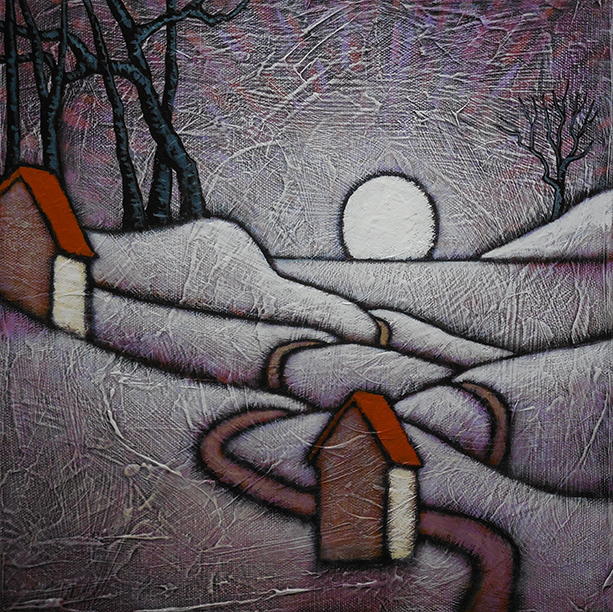 Snowing like made still. Been out plowing for a couple of hours already this morning, just trying to keep the driveway open, and there is definitely a few more hours of plowing ahead. But I thought I’d take a break, drink some coffee and try to throw out some music for a snowy Sunday morning.
 You do not have to be good.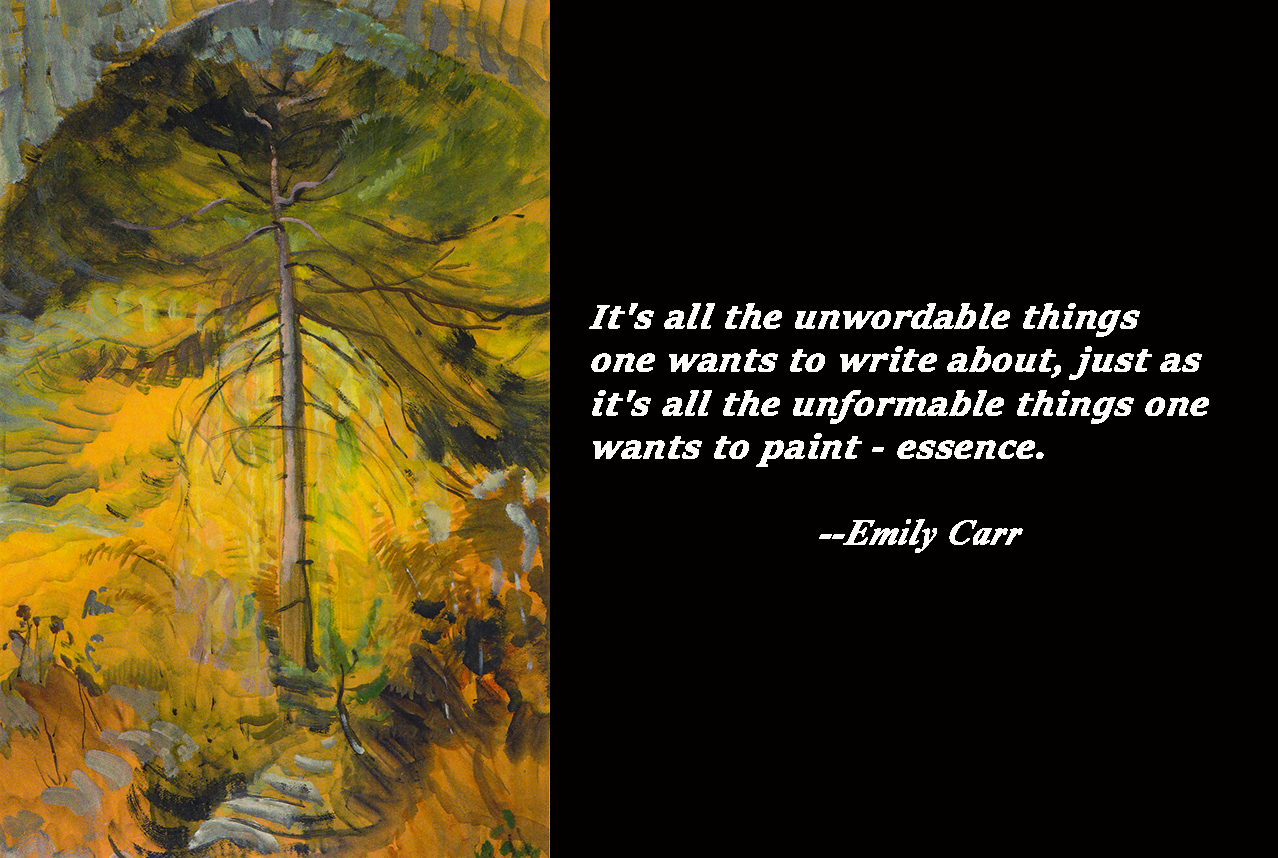




 Redtree Times