There is always hope, as long as the canvasses are empty.
–Gustav Klimt
*****************
This quote from Klimt made me smile this morning, a little knowing smile. When I am getting ready for a show, such as I am now, the studio is initially filled with prepared empty canvasses of a wide variety of sizes, coated with layers of gesso and topped with a thick layer of black paint. They are everywhere, all propped up against any available surface that will support them.
Having them around is comforting, representing possibility. It is the hope of which Klimt speaks. Each blank canvas has the possibility of being a whole new world, a new experience, a new revelation. There is almost a hum of potential life coming from them.
But as the weeks and months pass and many of the canvasses are painted, taking on their new identities, the supply of blank surfaces dwindles down to the point where there is now only a smattering of blank canvasses scattered around the studio. It is at this point when I get anxious, most likely from no longer being surrounded by those empty surfaces that have come to symbolize hope and potential for me.
It is at this point that I can begin to see the end of this painting session, that soon I will have to stop for a bit to ready the work, to photograph, to stain frames and varnish paintings to make them presentable for the show. This makes makes me a little glum because I am usually very hyped up and wanting to do even more, to further explore all the new avenues that are opening up before me in the paintings in which I am working.
Looking around now and seeing just a few empty canvasses is a reminder of that coming point. It makes me pause in for a moment, anticipating that coming shift of gears, and for that moment I am a bit down. But reading Klimt’s words makes me smile, knowing that I just received a new shipment of canvas the other day which is waiting patiently downstairs to be prepped so that it soon can carry all my hopes and possibilities.
The art of an artist must be his own art. It is… always a continuous chain of little inventions, little technical discoveries of one’s own, in one’s relation to the tool, the material and the colors.
–Emil Nolde
************************
I totally agree with the words above from Emil Nolde, the German Expressionist painter who lived from 1867 to 1956. The artist’s personal relationship with their materials defines their creative voice, giving it distinguishing characteristics that allow it to hopefully stand clear of the work of other artists. The way one handles and choose their paint, the way they treat their surfaces, how they define space and form in the picture plane, how traditional methods are altered and adapted to their own way of seeing and thinking– all of these and so many other elements make that creative voice unique. It is these things that make an individual artist’ work distinctly recognizable.
That’s the truth part of this post. Below is the deception.
Now, there’s nothing controversial in this sentiment but I was hesitant in using the words of Emil Nolde, who has been the subject of much scrutiny lately as his past associations with the Nazi party in Germany have come to light.
Nolde’s situation was an unusual one. He was a well established Expressionist painter in his 60’s when the Nazi’s came to power in Germany in the 1930’s. While he was an ardent supporter of the party and a fervent anti-Semite who flew a swastika flag above his home, Nolde’s work was deemed degenerate by the Nazis and was very much disliked by Hitler. I am not sure but he may well have been the only party member to have his work shown in the sweeping Nazi exhibit of degenerate art.
During the war, Nolde was forbidden from selling his work without the permission of the Nazi party. But Nolde took that caveat and portrayed it as a complete prohibition of his work and himself, which it was not. He was still able to work and he was not persecuted in any way. Nolde created a series of small watercolors which he claimed were ideas for paintings that he was forbidden from painting. It became the basis for a celebrated show, Unpainted Pictures. This idea of a persecuted artist creating a body of forbidden work in his head became a symbol of artistic resistance that sustained his legacy for many years after the war, a story pushed by the foundation he had formed to manage an archive and museum of his work.
But it was a false story.
Nolde and his foundation hid his Nazi past and his anti-Semitism for decades. Passages from his memoirs that spoke of his complicity with the Nazis and his anti-Semitic leanings were excised and stories that portrayed him as a victim were embellished. This went on until 2013 when the foundation’s new leadership, sensing that the previous administrators had laundered a dirty past, pushed for transparency and released the entire archives, previously under wraps, to the public.
I am not sure how Nolde will be portrayed or judged going forward, whether it will be on his paintings or on his actions before and during WW II. There was a good article recently on this story in the New York Times. I urge you to take a look as it tells the story much better than I can here.
I have started working on some new pieces that are wet work which means I am working flat, on a table, instead of at an easel. It’s something I don’t do as much as I used to, especially in the early years when my work was all done at a table. My work table is an old Hamilton drafting table with a 40″ by 60″ top that is a monster, built heavy with a steel spring mechanism that lifts and lowers the work surface.
This table been a good soldier over the years and has been the spot where almost all of my wet work on paper has been created. When I am spending more time at the easel it becomes a spot where I amass tubes and bottles of paint and ink, rolls of paper towel, piles of paintbrushes and bits and pieces of paper with crude drawings and scribbles notes about ideas that might someday appear somewhere. Or might not.
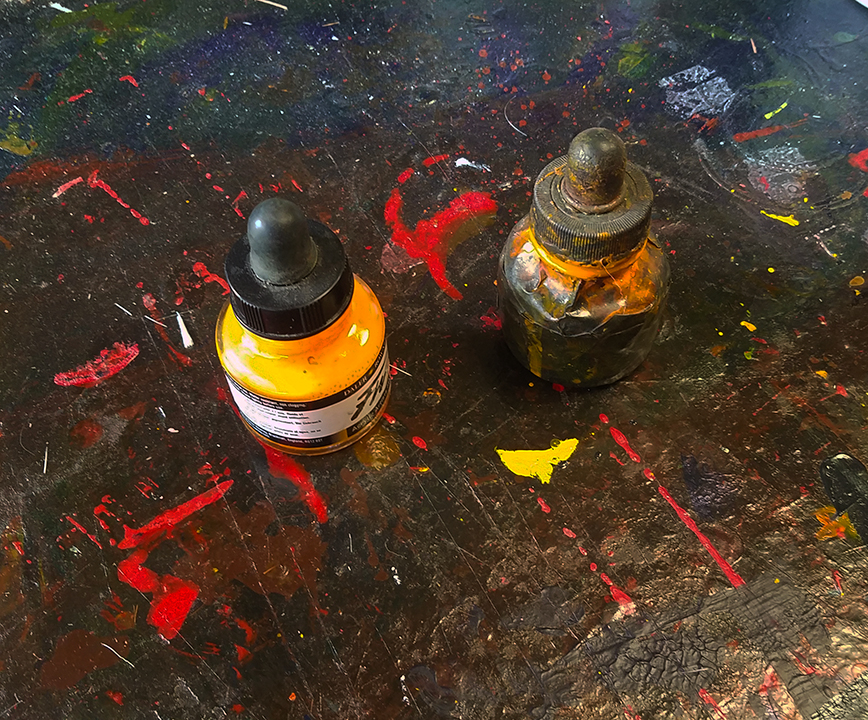
I was clearing a space to begin working and I really took a look at the surface of the table. It is covered with a thick vinyl mat, a once pale green sheet that is now thickly coated with layers of paint and ink from years of use. I used to try to clean the surface periodically, scrubbing at it until much of the pigments lifted. But it has been a very long time since that last happened and it now has a deep dark hue, a mix of all the colors of my palette.
I find it very satisfying in looking at the surface. It is a visual reminder of time spent and efforts made, bringing to mind the Japanese concept of wabi-sabi which emphasizes the finding of beauty in the wear and imperfections of things.
In the photo at the top, I pulled out one of my old ink bottles and placed it on the surface alongside a new bottle of the same color ink. The old bottle should have been discarded years ago but I hold onto it out of some form of nostalgia. It is coated with layers of ink that have become almost black from me handling it with hands stained with many hues for a very long time. Chances are that if you saw any of my work from 2004-2012, this bottle had something to do with it.
Like the surface of the table,which you can see in the photo, the evident wear shown on the bottle speaks to me. It should be trash but it has meaning for me now, it speaks of thousand so of hours standing over that table, deeply engrossed in the work I was doing. Work that has long left me and now reveals what truths they might hold to others now.
Seeing the two bottles reminds me of seeing a war veteran who has been through every battle standing side by side on the battlefield with a raw recruit who has yet to be tested. That worn bottle was a good soldier, one whose small efforts made the larger effort possible. Hopefully, that new recruit will serve as admirably as the old vet.
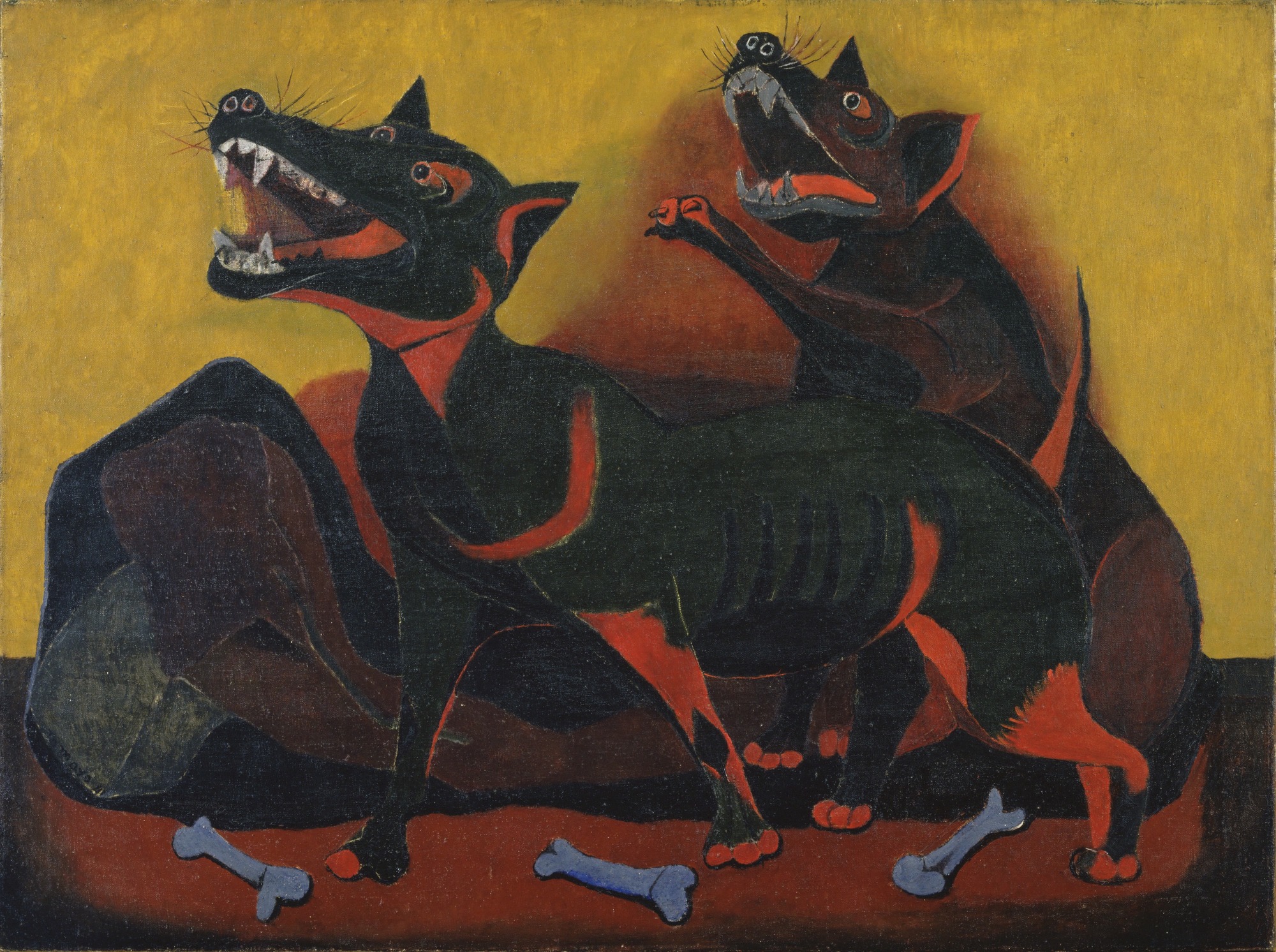
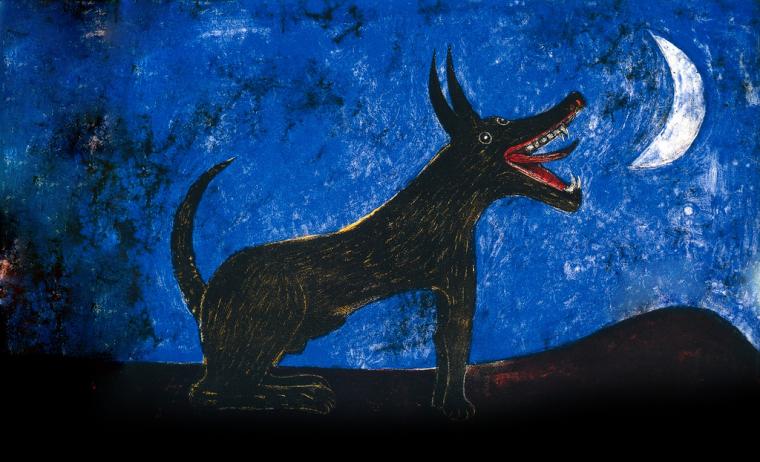
Just a few paintings and a simple quote today from the Mexican painter Rufino Tamayo (1899-1991). I love his use of color, something for which he was celebrated. He was very prolific through a long career and while his work is easily understood by everybody, everywhere, as he said above, it was often built with the colors and imagery of his homeland.
I am showing just the tiniest sampling of his body of work which, simply put, is good stuff.
********************** Satisfaction lies in the effort, not in the attainment. Full effort is full victory.
–Mahatma Gandhi
********************
I often paint the rows of a freshly cut field in my work. While this creates an interesting visual effect with its pattern of alternating colors, it also satisfies my own need to express the importance — and necessity–of effort for myself and for my work.
I have often pointed out at gallery talks that I spend huge amounts of time alone working very hard in my studio, well over 70,000 hours over the past twenty-plus years. I usually make a joke of this, saying that I enjoy these long periods of solitude and tell people I am hard at work during my time in the studio so they will just leave me alone. Okay, there is a lot of truth there as far as not having people bother me but the fact remains that while I find my time in the studio enjoyable as well as enlightening, it does require great effort and work.
And I wouldn’t have it any other way.
I guess that’s because there is usually a moment after finishing a piece or a group of work for a show when I stop and look at the work in its state of completion. In this moment there is a great sense of satisfaction at the result of my full efforts. And that full effort gives the results a sense of completeness and that brings me my own sense of personal completeness, a fulfillment of some small purpose that I find necessary in order to persist in this world.
That small moment of satisfaction makes all the work, all the frustration and missteps fade away. That which should have depleted me now serves as nourishment. I find myself strengthened for another day.
Maybe that what I see in this new painting, a 24″ by 24″ canvas which going soon to Alexandria, VA for my upcoming solo show at the Principle Gallery, which opens June 7. It is called A Sense of Satisfaction, of course. It very much reflects what I have written here, with the Red Tree representing someone looking back on the results of a long day of labor. And again, they feel uplifted rather than worn down.
I know it’s not always that way. There have been times when work has been very draining, definitely in my past and occasionally even now. But knowing that special moment of satisfaction that comes along every so often is out there as a reward makes me look forward to the task and the effort ahead.
******************
The post above was written several years back was written about an earlier painting with similar receding fields rows in its foreground. I felt that the message from that earlier post applied equally well to the new painting at the top so I borrowed much of it for today’s post, with a few edits.
All over the place this morning as I looked for a piece of music. Went from the 1970’s funk of Curtis Mayfield to 1990’s Tom Waits to Pete Townsend at the Secret Policeman’s Ball to Tom Morello and Rage Against the Machine to early and late Warren Zevon to a William Burroughs spoken word piece (Seven Souls) set against an electro beat. There was also some Jimmy Reed blues and some Ian Duryand the Blockheads.
It was fun, as always, one of my favorite parts of doing this blog. I like sliding down those rabbit holes, moving from one thing to another connected by some vague association recognized by an algorithm that is well beyond my comprehension.
But despite it all, nothing hit the spot that I wanted to hit this morning. I felt all out of rhythm in a way. Then I somehow fell on this bit of music.
I don’t exactly know what connection led to this piece, a classical guitar performance of a composition, Oblivion, from the late Argentine tango composer Astor Piazzolla. It is performed by contemporary Ukrainian guitarist Nadja Kossinskaja and it just seemed to fit the feeling of the morning at this point in time.
It finally got me back in rhythm and back on track, regardless of how I got to it.
Give a listen. It’s good stuff and a good way to kick off a Sunday whether it’s wet and gray, as it is here, or sunny and warm. Have a good day.
The way of the Creative works through change and transformation, so that each thing receives its true nature and destiny and comes into permanent accord with the Great Harmony: this is what furthers and what perseveres.
—Alexander Pope
***********************
I am moving toward final preparations for my annual show at the Principle Gallery which opens five weeks from today, on June 7th. This year’s show is titled Redtree: New Growth which references my first solo show, Redtree, at the gallery way back in 2000. I thought invoking the Redtree label was appropriate as this is going to be my 20th solo exhibit at the Principle and the Redtree has certainly remained a vital part of my work.
There is no getting away from that.
But the addition of New Growth is important, both for this show and for myself as an artist. The Redtree is still present in my work but there is also a need to evolve it, to keep moving away from any sort of static position. A need to not settle for what I am now but, instead, to aspire and move to become something more.
Change and transformation, as Pope put it.
There is a constant need to have that which he describes as my true nature and destiny move closer to that Great Harmony.
There are moments when I am at work when I feel I am close to that point, that I am looking at my real essence, my true nature. They are rare moments but there in no mistaking those instances of clarity. I have felt that a few times in prepping this show and am grateful for these occurrences because even though they are fleeting, they leave me with a desire to push my own boundaries and expectations.
Looking back on the prior 19 Principle Gallery shows, I can see evidence of other times when I was experiencing this same feeling. They showed themselves as moments of growth that standout to me. There were years that stand out for me, where the work jumped forward in bounds. And there were years where there was an evident pause in the growth of the work, where I almost seemed to be complacently resting.
Maybe a bit too satisfied with where I was? Probably. Or maybe I was wary of moving because I was afraid there was nowhere to go, that I was as far in my journey as I was able to go? I can’t say for sure.
But this year’s Principle Gallery show challenged me. That is was my 20th show there seemed like such a milepost for me that I became concerned that it was becoming an endpoint with nothing beyond it. That produced an almost feverish desire to create work of a truly essential nature.
I won’t know whether I actually succeed in this quest for a few years as I am too enmeshed in the work now to be objective. But I feel as strongly about this work as any I have ever done and if my emotional reactions to it are any indicator, it will age well.
The painting at the top is the title piece for this show, Redtree: New Growth. A 36″ by 24″ canvas, it has a sharpness and clarity that just feels right for the moment. This painting aligns perfectly, at least in how I view it, with Pope’s words above.
I would much rather be writing about art this morning and I am sure most of you would rather be looking at a piece of art than listening to my opinion on any current event. You might even mumble that I should shut my trap and paint. Well, this is my space, my journal, my diary, and when I am affected I need to put my feelings down somehow. And after watching the testimony of the Attorney General yesterday before the Senate Judiciary committee, I feel the need to air a grievance or two. It left me angry and more than a little worried about the future of this country.
I believe that we are closer to becoming an autocracy than we have ever been at any point in our history. The AG basically said yesterday that the president is above the law, that the president has the right to shut down any investigation into his actions if that president– the person under investigation— feels that the investigation is unfair to him. The AG also stated that because there is a Department of Justice policy that the president cannot be charged with a crime ( a ridiculous policy in itself!) he should not even be subject to investigation in the first place.
Think about that. The person with the greatest power in the nation cannot be held accountable by federal law enforcement agencies. He is free to lie and break multiple laws– even work with foreign powers to subvert our elections– in order to protect his position and the DOJ will simply stand by or work to investigate the president’s personal or political enemies, something that the AG did not rule out yesterday.
The AG showed himself to be the dangerous enabler many folks thought he would turn out to be. It was evident yesterday that this man was not acting as the protector of the people and our laws but as the protector of a single person– the president– who he has put above all law.
He has assumed the position not as attorney general but as both protector and sword of the president.
I don’t think that is in the job description. That is a real danger to real democracy and multiplies the power and threat of the presidency.
A lot of folks might say that this is just rhetoric and overstated hype. But autocracy and tyranny creeps up on you in small steps. It doesn’t just drop one day and you’re suddenly in an authoritarian society. It comes in small concessions made to the long established traditions and norms. It comes in accepting half-truths and outright lies even when they are easily proven to be falsehoods. It comes in beating down and denigrating the free press.
It comes with ridiculous promises and claims that stoke a sense of rabid nationalism among their true believers and so many clouds of confusion that the average citizen throws up their hands and says, “Whatever!” And that is exactly what they need to keep their march to autocracy. They need people to give up and turn blind eyes to their subversion because at this point, an alert citizenry that holds their representatives in government accountable might be the only thing keeping us from sliding into the abyss of tyranny.
I personally feel like we are at the edge of that chasm now and it is only a thin string that is keeping us from tumbling over.
For those of you who give a damn I say stay alert. Read the news and support the free press. Read the Mueller Report. If something doesn’t sound right or make sense, investigate. Call or write your reps and senators. Vote every chance you have. Ask questions.
Democracy and what we consider real freedom are not guaranteed nor are they free. At some point, a price must be paid by us all. It is looking more and more like we are all being called to account.
One last note and this rant is done: I think there is a lot more to come out, if it is allowed to see the light of day, concerning the Russian connections, especially in areas like money laundering, influence peddling and kompromat. I also think much might be heard soon about the Russian owned Alfa Bank.
Here’s a song from a couple of years back that says it all. It’s Take Back the Power from the LA-based ska punk band, The Interrupters. Have the best day you can and stay alert. Art tomorrow, I promise.
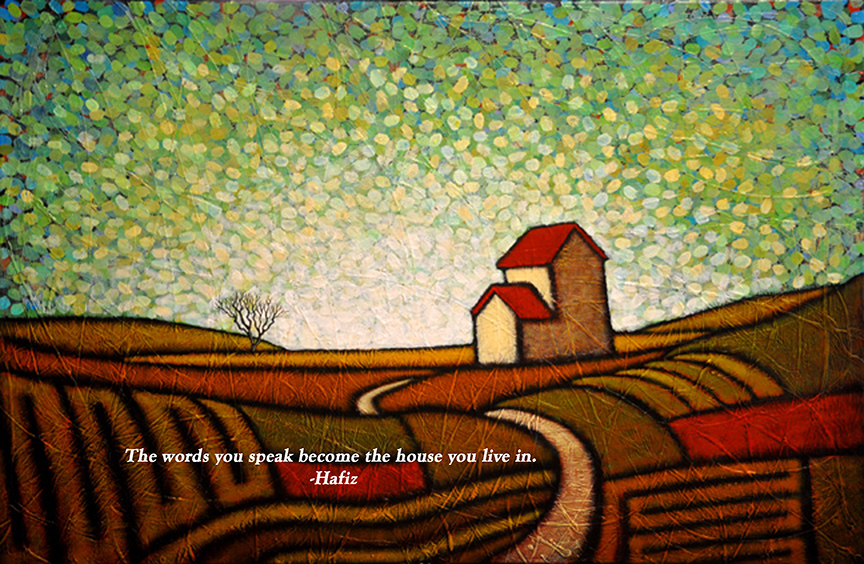
I think the 14th century Persian poet Hafiz had it right. We live in and with our words. Our words give us shape and form. Our words, as Hafiz points out, build our house.
We are looking now at a house, a white house if you will, that is built not with the strength of truth but rather with the inherent weakness of over 10,000 lies. It has been built primarily by one builder but he has had many assistants who have willingly chosen to add their own lies to the structure. Many of these assistants were once known as reputable builders who, for some unknown reason, have decided that they would now hang their reputations on this creaking, ugly structure built on inferior materials and a faulty foundation, one perhaps built by shady foreign contractors. Instead of using the solid strength of truth they have opted for building with rotting beams of lies, glossed over to only look like they possess strength and lasting power.
But beams that are made from lies, like beams built from rotting wood, are doomed to fail and weaken the structure. Maybe even bring the whole house down.
The only thing that might save us now are building inspectors who can put a halt to this doomed project. Unfortunately, many of the inspectors have willingly chosen to approve of the structure knowing that it is built on lies. They, too, have decided for some unknown reason to place their reputations and their legacies on a structure that is not built to survive for too long.
My question today is this: Why do these builders choose to continue to move ahead with their seemingly endless supply of lies when they are continually being exposed as weak and dangerous to the structure and why do some of the inspectors continue to turn a blind eye and give their approval?
All the new lies and all the false certifications of approval that are added each day cannot bolster this groaning structure.
Some say that we will all be injured if this house falls and that might be true.
But far more of us will suffer if it stands and becomes the house in which we all live.







 Redtree Times