Feeds:
Posts
Comments

Archive for the ‘Biographical’ Category

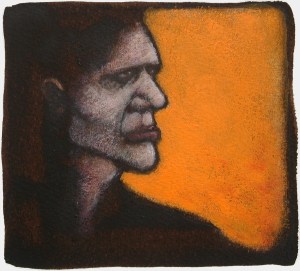
GC Myers- A Hard PastIt’s Mother’s Day again. You might think the image I am showing today is an odd selection for this day. It’s a small painting called A Hard Past that is from my 2008 Outlaws series.  It’s one of a few pieces that I deeply regret ever letting go as it holds personal meaning for me.  I just didn’t realize this at the time.

I know that this may not seem like a flattering thing to say but every time I look at this image I see my Mom’s face.  At least,  a certain look she had when she was sitting by herself in silence at the kitchen table, drinking a cup of tea and smoking her ever-present Camel cigarettes, those unfiltered beauties that no doubt contributed to the lung cancer that took her life at age 63.

She would sit in stillness for a long period time at that table with a distant and hardened gaze on her face.  I always wondered what she was thinking or where she was in that moment.  But when you’re a kid you just move through the kitchen without a word or a question.

More’s the pity…

The title, A Hard Past, came from this memory of her.  She had a pretty hard life- her mother died when she was three,  no school beyond ninth grade, years of toiling in a factory and a long, turbulent and angry marriage to my father.  It gave her a hard edge, a toughness that several people commented on after her death back in 1995.  But they also commented on her humor, generosity and willingness to help others who might need a hand– those qualities that I also saw in her.  Those qualities that I so miss.

So while it may not seem like a flattering tribute, just seeing my Mom in this piece means so much to me.

For today’s music, I’m going with her favorite, Eddy Arnold, and a song that she probably felt fit her like a glove, You Don’t Know Me.  It’s a classic song that Arnold is credited with co-writing along with songwriter Cindy Walker in 1955.

Have  great Mother’s Day…

Read Full Post »

Portrait of a Group of LumberjacksI’ve got a soft spot for pictures of lumbermen.  I’ve written here before about my great-grandfather, Gilbert Perry, who was a pioneer in the Adirondack logging of the late 1800’s.  It was in the days before chainsaws and gas-powered tractors when everything was done with axes, crosscut saws, teams of horses and the brute force of large crews of men.  My aunt once had a photo of him alongside a huge stack of logs atop a horse-drawn sled but it was lost before I able to see it.

But besides Gilbert, early loggers from the Eastern forests are pretty numerous in my family and in my wife’s family.  I am always surprised at how many turn up when I am doing research. Being a lumberjack was a rough and dangerous job, one that was romanticized in the late 1800’s in magazines such as Harper’s Weekly and the Atlantic as the Eastern equivalent of the Western cowboys of that time.

A number of those in our families lost their lives in the forests.  Among them, Cheri’s great-grandfather was crushed beneath a large log and died before he could be extracted.  I read an account of a great-uncle of mine in the Pennsylvania Black Forest whose leg was crushed between two logs in a sluice that was being used to move them.  The article tells how they  rushed him to a train and sped at breakneck speeds towards Williamsport trying to save him.  Unfortunately,  he passed away as they pulled into the city.

So whenever I run across a photo from of early lumberjacks I have to stop and take a look.  I don’t know anything about the photo at the top, when or where it was taken.  I suspect it’s from around the turn of the century but whether it is from the Eastern forests, the Northwest or the great forests of the upper Midwest is beyond me.  Regardless, it’s just a great photo on so many levels and is one of my new favorites.

Read Full Post »

GC Myers- No MailI was looking at this painting in the studio yesterday.  It’s another orphan, one of those pieces that went out into the world and came back without being able to find a home.  I normally try to figure out if there is an apparent flaw in these orphans  and often there is something that is just not right.  But sometimes I notice that these pieces are often pieces that I see as being more personal, more connected with my own life’s narrative.  This painting, called No Mail, falls into this category.  It evokes a certain time and feeling so vivid in my memory that it immediately emerges for me when I look at this painting.

I went back in the archives for the blog and found what I had written about this piece several years back.  I’d like to share it just to show the connections that some paintings make even though they may not reach out to everyone.

This is a piece that’s been bouncing around my studio for a month or so, one that I call No Mail. It’s a smallish painting on paper, measuring about 8″ by 14″. I haven’t decided whether I will show this one or simply hold on to it. It’s a matter of whether I believe others will see anything in it rather than me wanting to keep it for myself. Maybe it’s that I see a very personal meaning in the piece that is reflected in the title and I can’t decide if it will translate to others.

For me, this painting reminds me of my childhood and the house I consider my childhood home, an old farmhouse that sat by itself with no neighbors in sight. Specifically, this painting reminds me of exact memories I have of trudging to the mailbox as an 8 or 9 year-old in the hot summer sun. There’s a certain dry dustiness from the driveway and the heat is just building in the late morning. It was a lazy time for a child in the country. Late July and many weeks to go before school resumes. The excitement of school ending has faded and the child finds himself spending his days trying to find ways to not be bored into submission.

The trip to the mail box is always a highlight of the day, filled with the possibility that there might be something in it for me. Something that is addressed only to and for me, a validation that I exist in the outside world and am not stranded on this dry summer island. Usually, the tinge of excitement fades quickly as I open the old metal mailbox and find nothing there for me. But occasionally there is something different, so much so that I recognize it without even seeing the name on the label or envelope.

It’s mine, for me, directed to me. Perhaps it’s my Boy’s Life or the Summer Weekly Reader. I would spend the day then reading them from front to back , reading the stories and checking out the ads in Boy’s Life for new Schwinn bikes. Oh, those days were so good. The smell of the newly printed pages mingling with the heat and dust of the day to create a cocktail whose aroma I can still recall.

But most days, it was nothing. Just the normal family things– bills, advertisements and magazines. Or nothing at all. The short walk back to the house seemed duller and hotter on those days.

That’s what I see in this piece, even though it doesn’t depict everything I’ve described in any detail. There’s a mood in it that vividly recalls those feelings from an 8 or 9 year-old, one of eager anticipation and one of disappointment.

Childhood days with no mail.

Read Full Post »

GC Myers- Deep Focus  Reading about Carmen Herrera, the artist I featured here yesterday who was “found” at age 89 and is still actively painting at 100, brought some thoughts about the idea of retiring to mind.  While it’s not something that I dwell on, I am at that age when one begins to think about such things.  In the last year or so,  at different times I have been asked by a couple of friends who are not artists, one who is my age and is retired, if I was thinking about retiring.

The question kind of surprised me each time I was asked.  I mean, I know that it’s a possibility and I do the things that one should do when planning for retirement in a financial sense.  But being asked about it caught me off guard.

But giving it some thought made me realize that retirement was not the end point I was shooting for in my life.  In fact, I can’t imagine ever retiring from what I do.  How could I put aside that thing that has given me purpose, that thing that connects me to this world and gives me expression?  Why would I stop searching for answers to  questions I haven’t even asked yet?

The whole idea of retiring seems like a foreign concept to me and my life as it has come to be.

In fact, as I’ve gotten older, I find myself looking for more and more time in which I can continue my work.  Time has become a more and more precious commodity.  Any time spent ill or in pain is time taken from this work so I have began actively working harder at being fit and healthy.  I hate giving up time for working out or walking.  I would much rather be working but knowing that it is required for continuing my work longer into this life makes this a valuable investment.

Seeing Carmen Herrera at work at  100 years old, even  in her wheelchair, and the many other artists who worked into their 80’s and 90’s gives me hope for this idea of never retiring.  Looking around the studio, I realize that there is so much more work to be done.  Work that I feel I must do.  Each day seems to uncover more and more facets to be probed, more questions to answer.  There is just not enough time in this life and I am not going to give up until that sun on the horizon leaves and fails to rise the next morning.

So hopefully, if I am lucky enough, you’ll see me several decades down the line, still at work.  And happy for it…


Read Full Post »

GC Myers- In the DreamlightI’ve dreamt in my life dreams that have stayed with me ever after, and changed my ideas: they’ve gone through and through me, like wine through water, and altered the colour of my mind.

Emily Bronte, Wuthering Heights

*****************

This is another new painting that is slated for my annual show, Part of the Pattern, at the Principle Gallery which opens June 3.  I call this piece, a 36″ by 12″ canvas, In the Dreamlight.  It has, at least to my eye, a contrasting feeling of vague dreaminess along with one of ultra-clarity.  Kind of like the feeling of those dreams that I have had that linger with me for years afterward.

I think we may have all had those dreams, those visions that reveal some mystery and spark some sort of inner questioning.  I still vividly remember several dreams from my childhood and, much like Emily Bronte’s Wuthering Heights character Catherine’s words shown above, they have altered the color of my mind.

Often, I find myself flashing back to those dreams, rerunning and experiencing once again portions of them in my present mind.  They are often enigmatic and filled with a mystery that begs to be answered.  And my mind believes they are answerable if I look long and hard enough.

In some ways I believe that is the purpose of my work– to somehow uncover the answers to these dreamed questions.  If the dreams are symbolic, might not the answer be found in a like symbolism?

As it is with all so  many things, I don’t know the answer.  But this painting reminds me of that feeling, that sense of being so near to the center of the mystery yet never quite being able to truly know the answer.

But maybe if I look once more, I will see what I’m seeking…

Read Full Post »

GC Myers The Anticipation  2003Sunday morning quiet…

It’s always one of my favorite times, bringing back memories as a kid when I would get up before everybody else and have the house basically to myself.  Nothing expected and nothing to be said.  Go out to the road to get the paper and read the comics.  Maybe have some hot chocolate to dunk my toast in. Safe in my home with my parents sleeping nearby…

A child’s tranquility, seemingly so easy and natural.  We add and absorb so many things that change us from that easy and natural state.  You can spend your whole life trying to recapture that feeling, that momentary bliss, but unfortunately it is as elusive as the fog.  But every so often we experience a flash of moments that seem reminiscent of those times before everything didn’t seem like old news, before everything had been seen or heard–that feeling of newness and wonder that only a kid can truly feel.

Man, is that a good feeling.  It can sustain you for days and days until the memory of it dissolves and is forever lost.

Hope to find it again soon.

This Sunday I thought I’d share a performance from one of my favorites, Richard Thompson.  This is him performing his Sunset Song at the Goldmark Gallery, an art gallery in Uppingham, England, that often hosts musical performances for small groups. It’s a great version of a lovely song.  I chose the painting at the top, a piece called The Anticipation from back in 2003, to go with this song.  It’s a painting that always catches my eye.

Enjoy and have a great Sunday…

Read Full Post »

GC Myers- Icon-MartinI thought I had put the Icon series on hold for a bit as I moved more heavily into the work for my upcoming shows in June and July.  But the other day I just had an itch to jump quickly into one of the ancestors who remains prominent but a bit of a mystery for me.  It was painted quickly without hardly any dawdling over it and by the time it was blocked out in the red oxide paint that I use for my underpainting it felt like it was coming to life.

The painting is a 12″ by 12″ canvas that is titled Icon: Martin P.  It is my depiction of my 3rd great-grandfather, a man born in Canada sometime around 1800.  I have seen his birth year listed as 1798, 1800 and 1802.  His name is also somewhat up for debate.  It has come down through time as the anglicized Martin Perry but I have seen the last name listed  as the French-based Paré, Parent and Poirer.  He was of French-Canadian descent, that is without dispute.  Outside of this and a few other facts, there is little else to go on besides assumptions that can be gleaned from what little is known and rumors from the family that remains in the far north of New York state, near the Canadian border.

For instance, there is no known record of the name of his wife, my 3rd great-grandmother.  I have heard rumors from the family there that she was a maiden from the Mohawk tribe that occupied a reservation in the area where Martin came to live but there is no evidence of this, either in records or in DNA.  I have heard from a professional genealogist who ran into this dead-end and was unsuccessful in uncovering anything.

Martin was not known to be a farmer though his children all ended up as such.  He was rumored to have been a coureur des bois, literally a wood’s runner or woodsman,  which was basically a frontier figure who lived as a hunter and sometime guide.  In the few records I can find from his later life, he is listed simply as a laborer, no doubt at a time when the idea of being a woodsy, especially an old one, was on the decline in the quickly settling areas of the east.

But one thing I do know is that he must have been a tough old man.  At the outbreak of the Civil War, he enlisted in late 1861, along with son of the same name, at the age of 60 years old.  He served in the 98th New York Infantry and in the following year, saw action at the Battle of Williamsburg and the the Battle of Seven Pines. which was at that time, early in the Civil War, the largest conflict of the campaign.

I don’t know how he came through it all except to note that he was mustered out later that year, 1862, due to disability.  The idea of a 60 year old man marching a thousand or so miles and fighting in battles that were often at close range seems pretty wild in these times but I don’t think it was such for a man raised in the northern wilds.  He would have been used to tough conditions, to wet and cold and a spartan lifestyle.  For him to have been pulled from the conflict points to a real injury, illness or wound of some sort.

I have yet to find the date of his death.  Records in that time and place are often iffy at best but I continue to search.

So, in my depiction of Martin Perry I see him as that coureur des bois, bearded and dressed in buckskin.  From what I can tell, he lived on the fringes of the civilized world  with a foot always in the wild.

Read Full Post »

GC Myers- Early RiserThe early morning has gold in its mouth.

Benjamin Franklin

*******************

I am an early riser.

I guess that I’m here in the studio at 5:30 in the morning is a testament to that fact.  It’s always been that way for me even as a child.  The prospect of what the new day might bring has always been exciting enough to rouse me in the early morning.  On those days when I have a less than thrilling or an even dreaded task before me, the thought of getting started on that task so that it will just get done and out of the way does the same.

At times in my life when I worked the  overnight third shift at other jobs, the idea of going to bed when the day was breaking seemed awful and the day always felt already spent  when I eventually woke up only a few hours later, as though all possibility was drained from it while I slept.  I could never get used to that.

As an early riser, you get used to seeing the day unfold and the light changing as the sun rises.  Each morning is teeming with the potential of the new.  Even when things aren’t going well, there seems to be the possibility that this next new day will bring that change that alters one’s course in a better way.

I think that’s what I see in this new painting, a 24″ by 30″ canvas that I am calling Early Riser, of course.  The sun and its rays seem new and different but filled with a potency of possibility for the eagerly waiting Red Tree.  Meanwhile, the neighboring community slumbers, not witnessing the breaking wonder that is the new day.

This was  a difficult painting.  By that I mean it took several attempts to achieve a sky that served what I felt as I laid out the initial underpainting or bones of the piece.  Twice I got quite a ways into the sky, spending many hours each time, before painting it over and restarting.  They were patterned skies but never captured a rhythm that synced with my own emotions in the piece.  As soon as I set out the first rays of this last attempt, it felt right for this painting and everything fell into place.

And early this morning, I feel this captures my eagerness to greet the day.  Now, I have to go– there are things to be done.

Read Full Post »

GC Myers- Icon- Tacy CooperThe more I read about this ancestor,the latest entry in my Icon series,  the more interesting I find her.  Her maiden name was Tacy Cooper and she is my 10th great-grandmother, born around 1609 in England.  Little is known of her parentage or when exactly  she came to America but she is known to have lived in Dorchester, near Boston in the Massachusetts Bay Colony in the early 1630’s.

At the time, the Colony was strictly ruled by the Congregational Church and its precepts.  Very puritanical, of course.  Many of the settlers who were coming into the colony sought more religious freedom than was being offered and under the influence of Roger Williams, set out  in 1634 to leave the Colony and establish a new community outside its boundaries.  They sent out a party of scouts who chose a site on the Connecticut River below present day Hartford.  Soon after, a group of about 100 people set out by foot for this location.  Among them was Tacy Cooper and her future husband, Samuel Hubbard.  They met during this journey and Samuel later wrote that Tacy was the lone bright spot in the whole undertaking.

Although the heavy goods for the community had been shipped by boats from Boston up the river, it was a harsh trek.  Many of their provisions had also been shipped and their trip was ill-timed.  By the time of their arrival, a bitter winter had set in on them and the boats had not arrived nor would they arrive in the future. Without those provisions,  a number of this group died that winter and those who remained survived on acorns, malt and grain that had brought along as seed for future crops.  To make things worse, the Pequot Indians were attacking as they tried to stem the spread of the settlers into their territory.

But they persevered  and in 1636, Tacy and Samuel were married.  However, the religious freedom they sought did not come to bear in this new community.  Samuel spoke up in protest to the role of the Church Elders in the local government and was driven from the community along with several other families who were in agreement with him.  They fled south, settling in the area now known as Springfield, Massachusetts.  They thought they were outside  the boundaries of the Massachusetts Colony but in subsequent years,  the provisions of the settlement of the Pequot Wars brought that location back into its realm.  In protest, Samuel and Tacy became Baptists.

In the following years, Baptists were banished from the Colony and, after many threats, they fled once more, this time to Rhode Island where they were reunited with Roger Williams.  They lived peacefully there for many years as members of the Baptist Church but it didn’t end there.

In the mid 1600’s, a movement had began in England– the  Seventh Day Baptists.  While they were almost exactly the same in their beliefs as traditonal Baptists, they observed their sabbath on the seventh day, Saturday.  In 1665, Stephen Mumford moved from England to Rhode Island, bringing this new sect with him.  He spoke of this beliefs to Tacy and Samuel  and a few other members of the First Baptist Church of Newport.

It was Tacy alone who first chose to join with Mumford in observing a seventh day sabbath.  Soon after Samuel and four other joined them and they formed the first Seventh Day Baptist church in America.  Tacy is considered the first American founder of the church.  The Seventh Day Baptists exist to this day and were a big part of my mother’s line for almost two hundred years and six generation, although I am pretty sure she would have not been aware of this fact.

While I am not a religious person in any organized sense of the word, I still find it fascinating in the way religion has shaped much of my( and just about everybody else’s) past.  I am pleased that Tacy was such a strong woman.  She was the one who stood and answered the Church Elders when she and the others were made to account for their desire to break from the Baptist Church.  She went before the congregation and  with “great clearness and force” outlined their reasons for departing.  I can’t help but think that this must have been a rare moment in early America– a woman speaking to power.

This may not be the best painting of the Icons but it moves me in the same way.  I always hope to find something in these stories that I can take for my own life and I can only hope to one day have Tacy’s strength and conviction.


Read Full Post »
GC Myers- Icon: Joe H.Here’s my latest entry into the Icon series, a 12″ by 12″ canvas piece that is titled Icon: Joe H.  He is my 3rd great-grandfather and his name was Joseph Harris and he was born in the Lindley (the town named after our common ancestor, Eleazer Lindsley,who was among the first Icons) area south of Corning in 1833.

He led a fairly typical life for the time and place, serving in the Civil War and raising a family.  He worked primarily as a blacksmith and a sawyer ( I have a lot of lumbermen in my family– maybe that’s where my affinity for trees comes from) in his early years, working for a number of years in the then booming timber business that was taking place in northern Pennsylvania and western NY.   It was there that his wife, Emeline Whitney, died just a year or so after the end of the Civil War.  Later in his life, he returned to the area of his birth, settling in as a farmer  just over the border in Pennsylvania where he died in 1922.

That was about the extent of his life for me, at least what I could find of it in records.  I did discover that he married his step-sister, Jennie, who was twenty years younger, as his second wife.  But it was my research into local newspapers that gave me a better sense of him.

Looking at records gave no indication of anything but the basics but in his 1922 death notice printed in the Wellsboro Agitator ( I love the name of that paper!) the headline lists him as a “Skilled and Noted Musician.”  It goes on to say that he had been the one-time Banjo Champion of the United States.  He very well may have picked up the banjo from his Civil War experience as it’s popularity in the time after the war is often attributed to many people being exposed to it for the first time during their service.  I could never find anything to document a championship which was no big surprise as it most likely occurred somewhere in the 1870’s or 1880’s and whatever group sanctioned the competition is more than likely no longer in existence.

But I was pleased to know that music played a big part in his life and I later found an item that confirmed this.  It stated that his son, William Harris, was working as a musician in one of the  oilfield boom towns in northern PA in the 1890’s when he tragically took his own life by shooting himself at the hotel where he was living.  As is often the case, you find a lot of tragedy when you look backwards so it’s some consolation to know that there was a bit of music and joy mixed in there somewhere.

I did visit Joe’s gravesite a while back.  It is a bare-boned and flat plot of land that sits next to a harsh little trailer park visible from the new interstate.  Standing at his grave you looked into the backyard of several trailers, the kind of yards scattered with kids toys, spare tires and oil drums.

It made me a little sad but then, I guess a guy who lived through the Civil War, endured the death of his first wife and several of his children before him and lived to see the first World War, this wasn’t all that bad.

Read Full Post »

« Newer Posts - Older Posts »