Feeds:
Posts
Comments

Archive for the ‘Favorite Things’ Category

**********************

“You must study the Masters but guard the original style that beats within your soul and put to sword those who would try to steal it.”

El Greco

**********************

These words from El Greco (1541-1614) certainly were reflected in the influence his work had down through the ages. Many artists through the ages have appropriated his compositions and rendered them in their own original styles. Picasso, for example, was influenced by the elongated figures of El Greco. His View of Toledo is considered one of the first paintings solely focused on landscape, as well as the first cityscape. Below, you might be able to see a connection between it and Van Gogh’s Starry Night.

For myself, in the painting here at the top, The Burial of the Count of Orgaz, a massive painting that is about fifteen foot tall, I was struck by the gold clad figures (St. Stephen and St. Augustine) at the bottom who are lowering the dead aristocrat into his tomb. The colors and positions of the figures had me seeing them as figures in a Gustav Klimt painting.

Looking at the detail below, I could see them as being influences on his The Kiss. I don’t know whether they were an influence, but it certainly jumped into my mind. If so, kudos to Klimt for translating it into his own original style that beats within his soul, as El Greco may have put it.

And that is what influence should be. It is not trying to replicate, to copy, another’s work. It is in taking it in and synthesizing it using one’s own unique voice. I think every artist does this in some form. You just may not immediately notice it in the very good ones.

Detail from “The Burial of the Count of Orgaz”
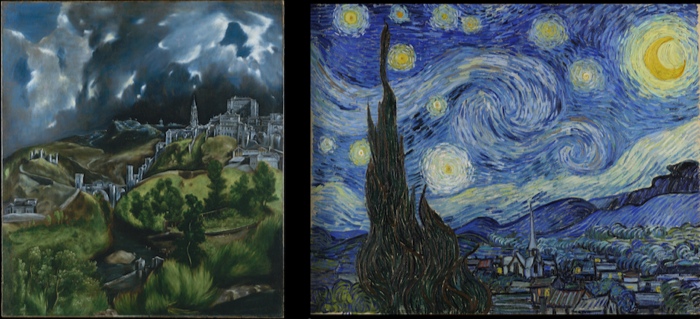
“View of Toledo” and “Starry Night”

Read Full Post »

I have a large painting on the easel I want to get to this morning. It’s at a point of transformation which is always exciting and just looking at it now, I am eager to see where it goes. But I wanted to share a post from back in 2012 about a painting done in 1997 or 1998 that has occupied an important place in my heart and mind for a long time. I think it’s a good example of the how an artist’s work often lives with the artist after it has found a new home.

****************************

I was going to write about something different but came across this older image and completely lost my train of thought, this piece replacing everything that I had been thinking. Some pieces have that effect. It’s a smaller painting, maybe 6″ square, that sold many years ago when I was first showing my work at the Principle Gallery in the mid-1990’s. Though not large, this painting has lived in a larger sense in my thoughts ever since.

It’s titled Beauty Scorned and is a relatively simple piece. But there’s something in the washed out quality of the colors and in the the bend of the twisting tree trunk that really speaks to me in a very poignant way, as though it is a pure physical expression of some deep emotion.

Beauty and sorrow.

For me, I see this as being about perceptions of beauty and acceptance. About how we often conform, like the other trees which are so much alike here, and step back from that which is different, seeing not the beauty in it but scorning it because it is unlike us.

The beauty is in its difference.

I remember when I did this piece, feeling that this was symbolic of my own work at that time. It was often quite different from the work of other painters with which I showed and I was still unsure of the validity of my own voice, often feeling that my work was somehow inferior because it wasn’t painted in the same manner, didn’t have the same look as these others. At the time, I felt like my work and my voice was truly tied to this twisting tree and those who dismissed it because it had a different look were missing the beauty and emotion that it may hold.

Just seeing it again summons all of these thoughts in a rush of feeling. It remains a potent piece for me for this reason. It also has a sad memory in it.  When I see this piece I am always reminded of the couple who purchased it and were avid and encouraging collectors that I always looked forward to seeing at shows. They had a knack for choosing work to which I was most keenly attached. This couple later divorced and the wife would still come to the shows, always so happy for and encouraging of my work. Tragically, she passed away in a plane crash this past year [2012] and now, instead of seeing the scorning of beauty in this piece as I once did, I now see the beauty of this young lady’s spirit.

It’s a different painting for me now but no less potent.

Read Full Post »


Floyd and Lucille Burroughs; Walker Evans (American, 1903 – 1975); 1936


******************

Whether he is an artist or not, the photographer is a joyous sensualist, for the simple reason that the eye traffics in feelings, not in thoughts.

Walker Evans

******************

I am a big fan of the photos of Walker Evans. Some of my early Exiles paintings were inspired by his Depression era work, many of which were captured in a landmark book, Let Us Now Praise Famous Men,. Written by James Agee, the book is a document of the two men’s journey through the American south during that trying time.

I came across this quote from Evans and it made me appreciate his work even more. The idea that the eye traffics in feelings and not in thoughts is a simple one but it cuts right to the truth as any artist knows it to be. Art, whatever medium in which it takes place in, comes far before thought. It is that reaction, that feeling that hits you before your brain even begins to fully process what you are seeing that is the engine of art.

It is the feeling that bring on real thought afterwards. Allan artist can hope for their work.

I like seeing it put that way. And Mr. Evans certainly trafficked in feelings as the artist and joyous sensualist he was.

Here are just a tiny bit of his works.


Digital Photo File Name:DP264548.TIF
Online Publications Edited By Michelle Ma for TOAH 11_23_15


Read Full Post »


**********************

A tree against the sky possesses the same interest, the same character, the same expression as the figure of a human.

Georges Rouault

**********************

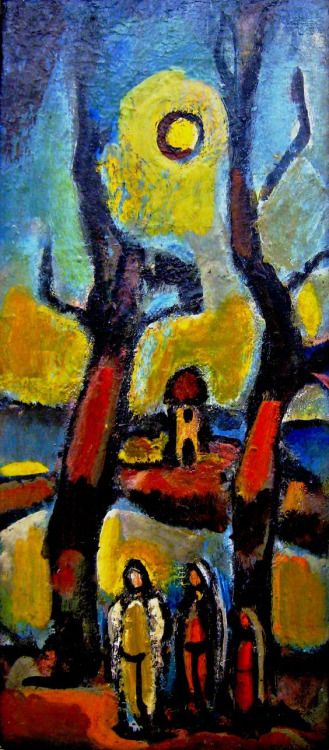
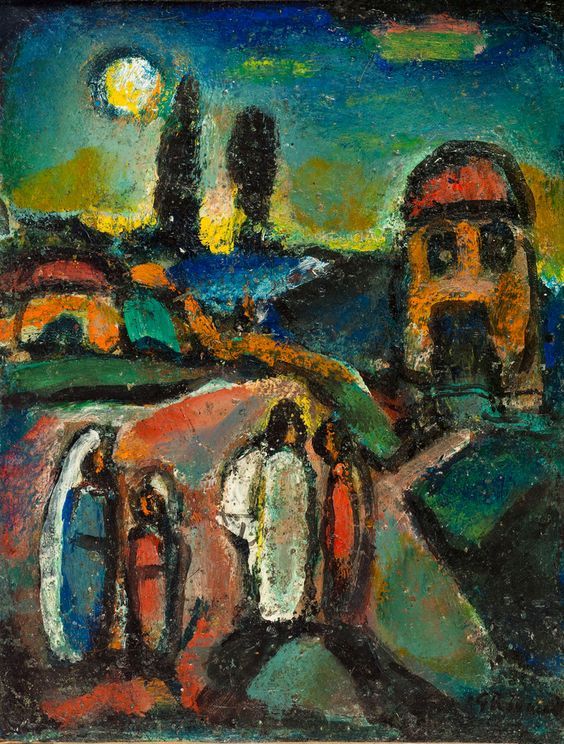
Georges Rouault (1871- 1958) has been a favorite of mine for a long time and the quote above certainly falls in line with my own feelings about the image of a tree. I have used the tree, the Red Tree to be more exact, for the past twenty years as a surrogate for the human figure in my paintings. You could pretty much insert a human figure in place of the Red Tree in many paintings and not lose much of the emotional content of the painting.

It would be a different painting, that’s for sure. The presence of the figure would focus everything on the specific human aspects portrayed in it. Is it a man or a woman? A child? Tall or short? Thin or wide? The interpretation of the painting becomes much more narrowly defined.

Using the Red Tree, on the other hand, allows for a broader reading, allows the viewer to see it in whatever terms they desire. It can be their own surrogate in the landscape. Or it can take on the characteristics of someone with meaning for them or someone expressing feelings that they share.

Or it can simply be a tree.

So, while I like being able to give the viewer those choices,I see the trees in my work, as Rouault says, as having the same interest, the same character, the same expression as the figure of a human.

Wouldn’t have it any other way.

Read Full Post »

*************************

“The untold want, by life and land ne’er granted,

Now, Voyager, sail thou forth, to seek and find.”

Walt Whitman, Leaves of Grass

*************************

A little short on time this morning (what’s new?) but I wanted to share this new song from an upcoming album by a favorite of mine, Rhiannon Giddens. She has one of those voices that always seems absolute and powerful. A beautiful rarity. I felt that this particular song fit right in with the theme behind much of my work, especially in the line in its chorus :

Don’t know where I’m going but I know what to do

Does anyone really know what they’re looking for in this life? Just doing the right thing and being honest with ourselves is all we can do as we search.

So, give a listen and keep on seeking, folks. Have a great day.

*********
https://www.youtube.com/watch?v=a4Xlyi8Is98

Read Full Post »

Got way too much stuff to get at it this morning to write. But I thought I’d share a post from back in 2010 that I like a lot. Take a look.

Southern Gardens- Paul Klee

I was asked yesterday if I talked to my paintings.

Interesting question.

I talk to animals. I talk to trees and plants. I talk to my car. I talk to my studio, which actually has a name. I talk to ghosts, present or not. Whether any of these things or beings listens is another matter.

But talk to my paintings?

It immediately brought to mind a section of a famous lecture that I had been reading recently and had really resonated with me. It was On Modern Art,  delivered in the 1920’s by Swiss artist and a personal favorite of mine Paul Klee:

May I use a simile, the simile of the tree? The artist has studied this world of variety and has, we may suppose, unobtrusively found his way in it. His sense of direction has brought order into the passing stream of image and experience. This sense of direction in nature and life, this branching and spreading array, I shall compare with the root of the tree.

From the root the sap flows to the artist, flows through him, flows to his eye. Thus he stands as the trunk of the tree. Battered and stirred by the strength of the flow, he guides the vision on into his work. As, in full view of the world, the crown of the tree unfolds and spreads in time and space, so with his work.

Nobody would affirm that the tree grows its crown in the image of its root. Between above and below can be no mirrored reflection. It is obvious that different functions expanding in different elements must produce divergences. But it is just the artist who at times is denied those departures from nature which his art demands. He has even been charged with incompetence and deliberate distortion.

And yet, standing at his appointed place, the trunk of the tree, he does nothing other than gather and pass on what comes to him from the depths. He neither serves nor rules–he transmits. His position is humble. And the beauty at the crown is not his own. He is merely a channel.

This very much sums up how I’ve always felt about art, especially my place as an artist– a mere channel or transmitter.  And when I look at my paintings, the crown of my tree, it is not in the form of a conversation so much as listening to what the paintings have to tell me. I paint because I question and, at best, the paintings provide some answers and insight that I might not find or see otherwise.

So, do I talk to my paintings? Not so much. But do they talk to me? Yes. And I do my best to listen…

.

Read Full Post »

*******************

The anarchist painter is not the one who will create anarchist pictures, but the one who will fight with all his individuality against official conventions.

–Paul Signac
^
*******************
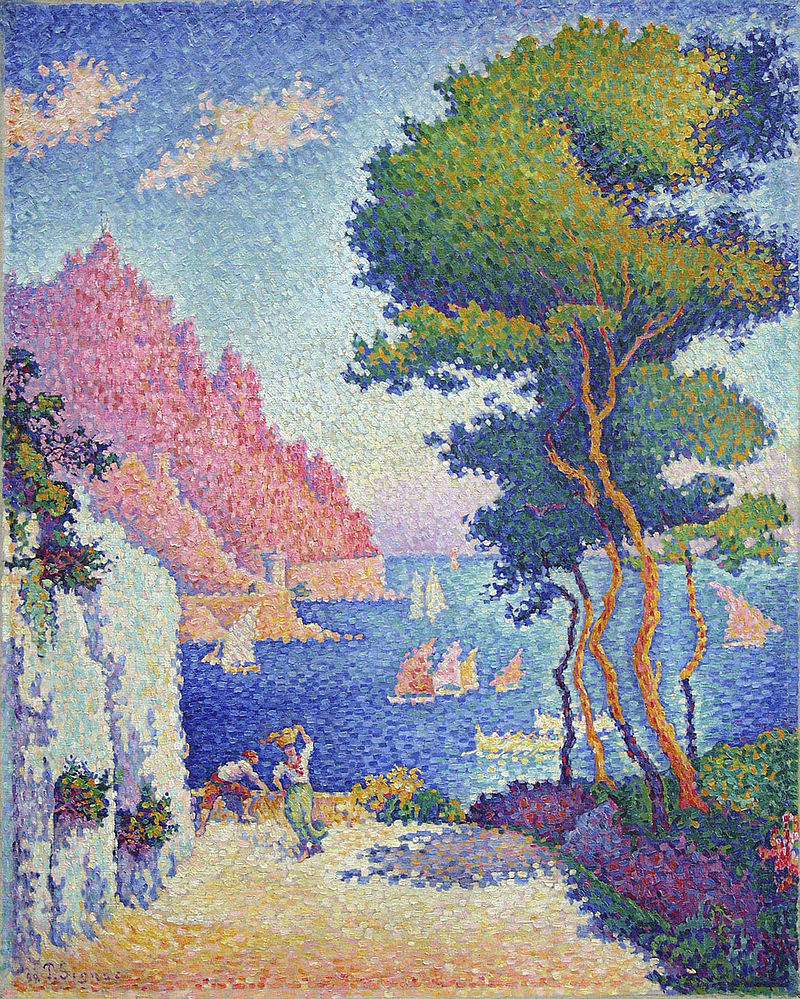
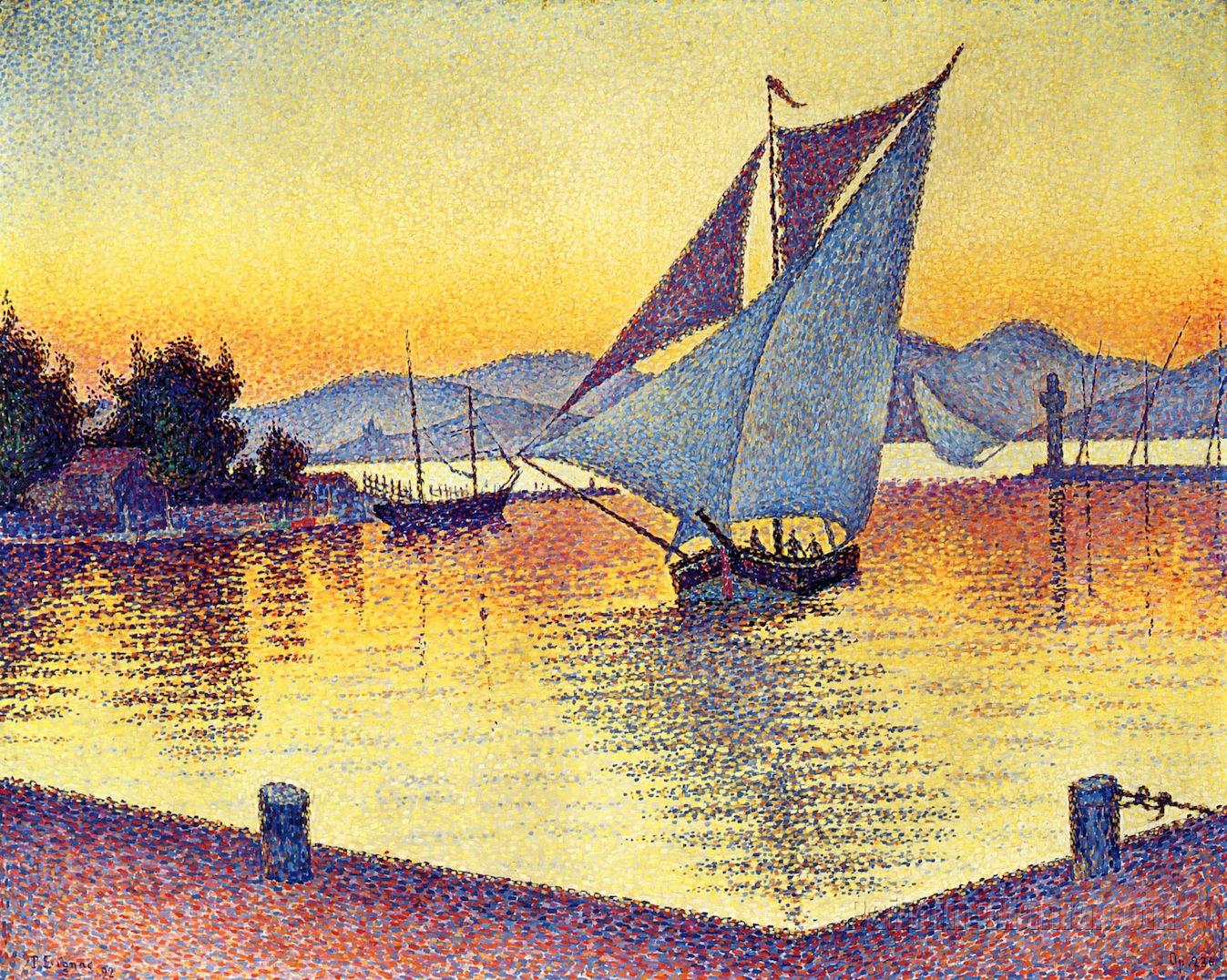
Really eager this morning to get at a painting that is on the easel. It’s at a point where it is making that final transformation that seems to make it come alive and I am excited to see the final result for this piece. But before I do that I wanted to show a few paintings from the French painter Paul Signac (1863-1935) who, along with Georges Seurat, developed Pointillism and was one of its best known proponents.
^
I have admired Signac’s work since I came across it many years ago. Maybe it is in the clarity of his colors that give his works a sense of being in the present. For example, note the vivid color in the painting at the top, Portrait of Felix Feneon.  While it was painted in 1890, it feels like it could be from any point in the next 125 years.
^
Another favorite is shown directly below. It is titled In the Time of Harmony. The Golden Age is not in the Past, it is in the Future and was painted 1893-95. It is a massive piece, nearly 10′ by 14′. I think it is a brilliant painting.
^
Here are a few more pieces from Signac that have always struck me. I am not going into his biography– like I said, I have a painting to get at– but I do recommend you take a further look. You can go to his Wikipedia page by clicking here.
^

Read Full Post »

I am sharing a favorite of mine for this week’s Sunday morning music selection. It’s from composer Philip Glass and is a piece originally from a soundtrack of the 1985 film Mishima: A Life in Four Chapters. The full title of this particular selection is String Quartet #3 Movement VI (also called Mishima Closing) and is performed by the Dublin Guitar Quartet. I have listened to this piece performed by a variety of artists and groups with different instruments and all are wonderful. But I like this version and it just seems to fit this morning.

The story behind the film that this piece is taken from concerns the life of the Japanese novelist Yukio Mishima. Born in 1925, Mishima was considered one of the most important writers of modern Japan. That would be notable enough on its own but it was the end of his life that more often than not associated with his name.

Mishima was an avowed nationalist of sorts and for many years trained physically and mentally according to the bushido, the code of the samurai. He formed a civilian militia with the purpose of defending the emperor in the event of a communist revolution and takeover. On November 25, 1970, Mishima and four members of this militia, the Tatenokai or shield society, entered a military base in Tokyo and barricaded themselves in the office of the base commandant, who they detained, tied to a chair.

Mishima then went out onto the balcony and delivered a manifesto he had prepared to the soldiers of the base who were gathered below. His speech was intended to inspire a coup within the ranks that would restore the powers of the emperor.

But the soldiers only mocked and jeered at Mishima.

Finishing his manifesto, he went back into the commandant’s office and performed seppuku or harikari, a suicide ritual in which he would stab himself and then be beheaded with a sword by one of his aides. The aide failed in three attempts at the task of beheading Mishima and another took over the task. This aide then performed the same act on the first aide who had failed in his original task.

It was a strange event and one of which I have to admit I was not aware until several years ago. I also have never seen the film but Glass’ soundtrack is powerful and beautiful. Give a listen and have a good Sunday.

Read Full Post »

Have a lot of things to get at this morning so I wasn’t planning on  writing anything. But I came across a painting from an artist unknown to me that I thought I would share. The artist is Todros Geller, a Jewish American printmaker/painter who was born in Ukraine in 1889 and, after immigrating to Canada in 1906, in 1918 moved to Chicago which remained his home until his death in 1949. I don’t know much about Geller but found this painting intriguing along with some of his other works which I urge you to look into.

Strange Worlds, above, is a 1928 painting which depicts an older man, most likely a newspaper vendor under the steps of the elevated rail in Chicago. The composition really pulled me in as did Geller’s treatment of his colors and tones. Just a wonderful piece.

I also found a nice video on this work that better interprets the painting and explains the background and history behind it. I am normally not thrilled with these kinds of interpretative art videos but this was well done and really felt that the information provided here filled out this particular painting nicely. Please take a few minutes to watch and see what you think.

Read Full Post »

Came across a blogpost from back in 2009 had a piece of music that I couldn’t remember. Playing it this morning fascinated me and I listened to it a few times. It’s a big loud choral piece with ominous sounding Latin lyrics and a thumping percussion rhythm that drives it forward in a way that makes it feel as though it is absolutely unstoppable.

It’s a piece called Dies Irae from a 2005 work, Requiem, from the contemporary Welsh classical composer Karl Jenkins. Dies Irae translates as Day of Wrath and the tone of this piece has that feel, without a doubt. Powerful stuff.

It certainly woke me up this morning. I found myself wanting to be able to paint with that kind of feel. It’s something I can;t explain fully. I see big slashes of color and full sweeps of the arm across the surface with my feet set wide apart in front of the easel as though I was delivering body blows to the canvas. Primal. No delicacy here, no up close touches of paint. Every stroke a deep mark, a bruise, on the surface.

Like I said, I can’t really explain it.

But here it is along a video comprised of apocalyptic imagery, most from the artist Alfred Kubin who I have featured here in the past. The piece at the top, Into the Unknown, is from Kubin. It may startle you awake or, at least, stir  something deep within you.

Read Full Post »

« Newer Posts - Older Posts »