Feeds:
Posts
Comments

Archive for the ‘Influences’ Category

GC Myers-Ode to Whitman Orphans is the word I use to describe the paintings that don’t find a home.  I’ve been fortunate in my career that there haven’t really been that many so that the ones that do keep coming back to me take on a special significance, especially the ones that I felt were somehow special beforehand.  It may be the extra time I get to spend with them, examining them again and again to see if there is some inherent flaw or lack of fire that keeps someone from making it their own, that gives it this significance.  I spend much more time with these orphans than those paintings that quickly find a home.

Ode to Whitman is such an orphan, it being a piece has toured the country and has yet to find a home.  It saddens me a bit when I look at this painting because I do see the spirit of Walt Whitman in this piece, at least as he translates into my own psyche.  Though quiet in nature, the Red Tree here is celebrating its very being and could be embodying Whitman’s verse:

I too am not a bit tamed,

I too am untranslatable,

I sound my barbaric yawp over the roofs of the world.

These were words that were very influential in the formation of my artistic voice.  They dared me to stand apart.  They challenged me to reveal my inner self to the world, to let my light shine.  To let my yawp go free.

And that is what I see in this  piece.  It as though once the yawp has been released, even as the surrounding trees seem to be recoiling from its sound and fury, a placid pall has come into the center of its being.  It is calm now that it knows who it is, what it is.

As you can tell, I see and feel a lot in this simple painting.  I guess that is why it pulls at me to think of it as orphan.  That’s why I am going to give this piece a home and this is going to be the painting that will be given away at the Gallery Talk this coming Saturday at the Principle Gallery, which starts at 1 PM.  I know that it will find a good home in this way because someone who didn’t like my work would not spend an hour of their time listening to me talk about it.

So I hope you can make it  to the talk and that, if you’re the one who takes Ode to Whitman home , you realize the feeling that it carries with it.

Here’s another bit of Whitman that like, from the preface to his landmark Leaves of Grass:

“This is what you shall do; Love the earth and sun and the animals, despise riches, give alms to every one that asks, stand up for the stupid and crazy, devote your income and labor to others, hate tyrants, argue not concerning God, have patience and indulgence toward the people, take off your hat to nothing known or unknown or to any man or number of men, go freely with powerful uneducated persons and with the young and with the mothers of families, read these leaves in the open air every season of every year of your life, re-examine all you have been told at school or church or in any book, dismiss whatever insults your own soul, and your very flesh shall be a great poem and have the richest fluency not only in its words but in the silent lines of its lips and face and between the lashes of your eyes and in every motion and joint of your body.”


Read Full Post »

farmerYesterday I checked my blog with a search to see if I had ever written here before about that day’s subject, Long John Baldry. I found that I had only mentioned him once in a post from back in 2009. I read the older blog and it made me chuckle. It was titled You Can’t Judge a Book… from a song that Baldry had once covered and had to do with how our preconceptions are often wrong about people.  It immediately brought to mind something that had happened over the weekend here at the studio.

My niece, Sarah, brought a friend and her husband to visit the studio from their NYC home.  Sarah didn’t share much about her friend outside of saying that they danced together  and that she was a filmmaker for one of the large  big-name auction houses.   I had no idea about what her husband did.  That was the extent of my knowledge outside of knowing they had been married the year before in New Orleans.  But they arrived and we had a wonderful visit.  Both were charming and inquisitive, asking real questions and relating their own experiences in response to my answers.  They made me feel comfortable in describing my work and process, not something that a lot of people can do easily.  We visited for a couple of hours and they headed back to the city.

During our visit we learned a bit about the friend’s husband.  I won’t use their names out of respect for their privacy.  He was in the music business in some fashion.  He was DJ and had spent a lot of time touring here and abroad.  He also was working on soundtracking films.  When I asked what sort of music he worked in, he said, in an almost apologetic way, that it was mainly rap and hip-hop.  It struck me in a curious way.  He went on to explain that it was the music of when and where he grew up, in the neighborhoods of NYC.  Again, this was said in an apologetic manner.

I didn’t think much about until after they left and I decided to see if I could find out more about his music.  He had a prodigious reputation in the rap genre, with over twenty years in the business as a DJ and producer for a pretty big name rapper.  He ran his own newer record company and has released an album  of his work only weeks before our meeting.  I watched a couple of videos of his work and listened to several songs.  I am not an authority on rap in any form but it was powerful stuff.

I was really impressed and thought back to his apologetic description of his work.  I understood it then.  He didn’t want to be judged and was trying to make it easy for me to not judge him.  I mean, here I was, a middle-aged white guy with gray hair out in the country— not exactly a prime candidate for a hip-hop connoisseur.  He had surely heard the venom directed toward his musical genre before from people who looked like me.

So, he judged me before I could judge him.  I understood that.  It’s what I would have done had I been in  his place.  My only regret is that it robbed me of an opportunity to ask the many questions that I formed in  looking up his work after they had left the studio.  It would have been fascinating to compare our creative processes, to see how he synthesized his influences.  I got the impression from our talk that, though we worked in vastly different environments  with disparate  influences, we both working on a similar creative rhythm, expressing emotion within the framework of our own personal environments.

Well, the next time we will both know and won’t worry about judging one another.  Here’s the original post from back in 2009:

I’ve just put the final details on a couple of paintings that will be part of my solo show at the Principle Gallery in Alexandria, VA.  The show opens June 12th and I’m scheduled to deliver the work to the gallery a week before so I’m in the final stages of preparation.  This is my tenth one-man show at the gallery and before that I did two shows as part of a group of painters from the Corning , NY area that was dubbed the Finger Lakes School.  

I particularly remember one moment from the first show with that group.  There was a pretty good crowd and several of us from the group mingled, answering questions and such.  I had a small break in the conversation and I heard a female voice from behind ask her companion where we were from.  Her friend answered that we were from the Finger Lakes region in New York.  He  said it was a pretty rural area with a lot of wineries and farms.

“Well, you know, they do look like farmers,” she replied.

I think I did a spit take.  Over the years I often think back to that lady’s comment and sometimes laugh.  Maybe we shouldn’t have all worn our overalls and straw hats that night.  It just reminds me how people judge others by that initial glimpse and how often  they end up being wrong.  Actually, I’ve come to the conclusion that, in the end, I would prefer being mistaken for a farmer than an artist anyhow.  Offhand, I can think of more positive attributes for the farmer.   So, if you can make it to the opening look for the guy who looks like a farmer…

That brings me to a song, You Can’t Judge a Book, that was originally written by blues great Willie Dixon and made popular by Bo Diddley.  My favorite version was from Long John Baldry, one of the pioneers of the British blues/rock movement in the early 60’s and a guy who had real panache, but I couldn’t find a version online.  But while searching I came across an interesting jazzy version of the song from Ben Sidran.  Give a listen  and enjoy…


Read Full Post »

GC Myers-The Sky Doesn't Pity 1995smI was looking around my studio, taking in some of the work hanging on the walls throughout the house.  There are pieces from other artists, including some notables such as David Levine and Ogden Pleissner, but most of it is older work of my own.  There are a few orphans, paintings that showed extensively but never found a home.  In some I see flaws that probably kept someone from taking it home but most just didn’t find that right person with which to connect.  Most of the other hanging work is work that I won’t part with, work that somehow has deeper meaning for me.  Work that just stays close.

One of these paintings is the one shown here, The Sky Doesn’t Pity, a smallish watercolor that’s a little over 4″ square.  It was painted in 1995 after I had started publicly showing my work for the first time at the West End Gallery in Corning, NY, not too far from my home.  The gallery has been what I consider my home gallery for 18 years now, hosting an annual solo show of my work for the last eleven years.  This year’s show, Islander, ends next Friday.

But when this piece was done I was still new there, still trying to find a voice and a style that I could call my own.  I had sold a few paintings and had received a lot of encouragement from showing the work at the gallery but was still not sure that this would lead anywhere.  I entered this painting in a regional competition at the Gmeiner Art Center in Wellsboro , a lovely rural village in northern Pennsylvania with beautiful Victorian homes and gas lamps running down Main Street.

It was the first competition I had ever entered and, having no expectations, was amazed when I was notified that this piece had taken one of the top prizes.  I believe it was a third but that didn’t matter to me.  Just the fact that the judges had seen something in it, had recognized the life in it, meant so much to me.  It gave me a tremendous sense of validation and confidence in moving ahead.  Just a fantastic boost that opened new avenues of possibility in my mind.

I still get that same sense even when I look at this little piece today, a feeling that would never let me get rid of this little guy.  I can’t tell you how many times I have glimpsed over at this painting and smiled a bit, knowing what it had given me all those years ago.


Read Full Post »

Annie Louise Swynnerton -Sense of Sight 1895At this last gallery talk at the West End Gallery, I was asked about what I thought my lasting legacy would be, the questioner commenting that they thought my work would continue to live on.  Although I was flattered by the thought, I quickly downplayed the idea of such a thing, saying that an artist has little, if any control, over how their work will be perceived in the future.  I said that I have seen so much incredible work over the years from long dead artists whose name or body of work has little or no recognition today.  They may have had acclaim in their time or locality but didn’t have the legs to make it through time intact.

Annie Louise Swynnerton -Joan of ArcComing home after that, it didn’t take long to make a quick search and find an artist whose work I felt was powerful and compelling but had little in the way of modern acclaim.  Her name was Annie Louise Swynnerton who was born in Manchester, England in 1844 and died in 1933.  She lived much of her adult life in Italy married to sculptor Joseph Swynnerton and  prospering as a renowned painter during the Victorian era, not a small feat for a female in that time.  Her work was collected widely ( John Singer Sargeant purchased her painting The Oreads, which is now in the Tate) and in 1922  she became the first female associate of the British Royal Academy since the 18th century.  Altogether, a large career for the time, especially  for a  feminist and suffragette.

Annie Louise Swynnerton -The LetterMaybe Annie Louise Swynnerton doesn’t belong completely in the category of the unknowns, given her presence in a number of museum collections.  But perhaps she aspired for more, maybe even deserved more with her obvious talents.  What keeps the name of one artist on the minds and lips of newer generations of viewers while some equally talented artists fade from sight?

It’s something that the artist can’t control or fully manage.  I know that the only control I have over the future is to maintain a sense of continuity and consistency in my work, giving future generations a coherent body of work to which my name might be attached.

Maybe…


Read Full Post »

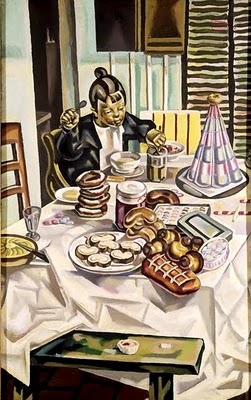
Maria Blanchard-Enfant aux pâtisseries1924I often highlight artists here whose work  has been little known or appreciated or those who have overcome great obstacles in finding their artistic voice.  Maria Blanchard is one who falls into both of these categories.  Born in Santander, Spain in 1881, Maria was dealt a harsh hand due to a damaging fall her mother took during her pregnancy.  She suffered from dwarfism, was hunchbacked and had great difficulty in walking due to a hip deformity.  Unfortunately, these disabilities made her the subject of much ridicule throughout her life.  But through it all, she had her art and made the absolute most of it.

In 1903, she went to Madrid to study painting and reveled in the expression it offered.  She learned much and worked hard, finally winning a grant in 1909 to continue her studies the Academy Vitti in Paris.  It was during this time in Paris that she broke free from her traditional training and was introduced to Cubism, the art movement then in its formative years.  Her work became very cubist at this point but evolved over time into a distinct style that incorporated elements of cubism and traditional sensibilities of form and composition.

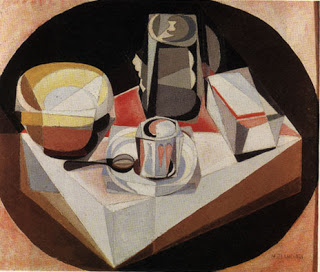
Maria Blanchard-Still LifeIn 1914, she returned to Spain, taking the chair of drawing in Salamanca.  But her appearance brought her taunts from the students and in 1916 she returned to Paris where she still painted in a Cubist manner, producing work such as the still life shown here on the left.  Around 1920, she made the move to the incorporated style that she worked in for the remainder of her life.  With her work, Maria supported herself along with her sister and her children who had come to Paris to live with her.

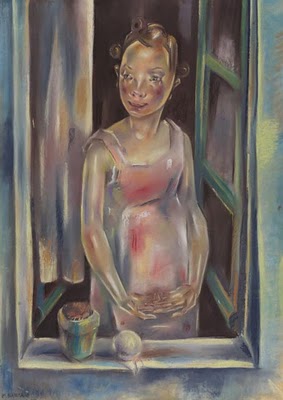
Maria Blanchard -L'Enfant à la glace1925However, the economic bust of the late 20’s caused her sales to suffer and she struggled mightily, her already fragile health suffering from the added stress of trying to produce work that would create enough income for her family.  She continued to deteriorate and finally passed away in 1932 at the age of 51.

As I said, her name and her work is not well known to the casual observer.  She has remained collectible, however, with her work’s value continually rising.  For example, an early Cubist painting of hers from around 1917 sold at auction in 2012 for over $700,000 and her work regularly sells well at auction for hundreds of thousands of dollars.  Of course, this is small comfort for the harsh life she endured.  But this recognition by collectors of the enduring quality of her work is testimony to the strength of her vision and the way in which she expressed it.  Her legacy lives on.  Such is the beauty of art…

Maria Blanchard-MaterniteMaria Blanchard-L'Enfant au Bracelet (1922-23) Maria Blanchard-Jeune Fille à la Fenêtre Ouverte (1924)

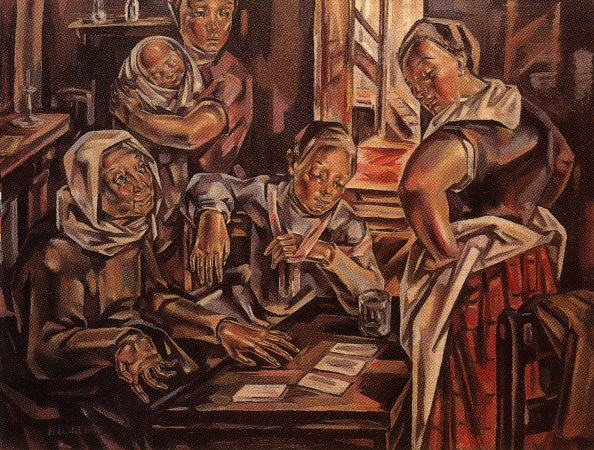
Maria Blanchard-La Echadora de Cartas

Read Full Post »

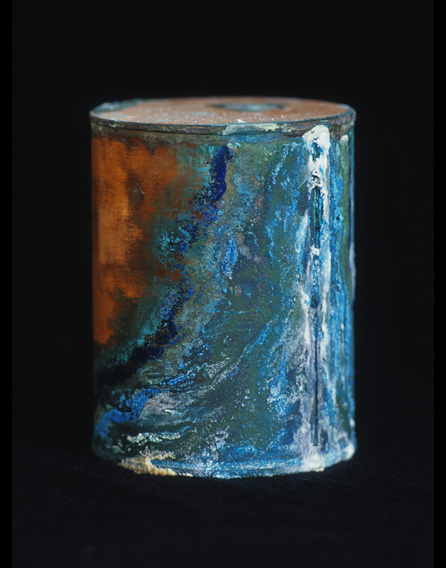
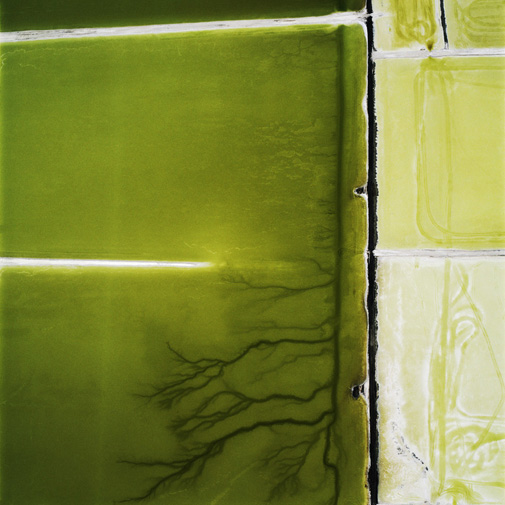
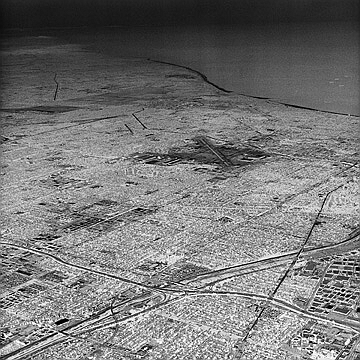
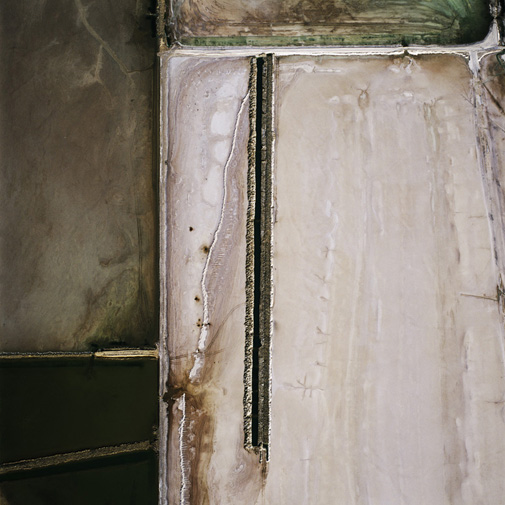
David Maisel Oblivion 1382-52nI really don’t have the time to really get into the work of photographer David Maisel but wanted to at least pass on a few of his images as well as a link to his website.  Initially, I came across some of his black and white views of Los Angeles taken from great altitudes, transforming the landscape into an abstract form that feels darkly uneasy and machine-like, the urban sprawl constantly self-replicating.  I am drawn to aerial imagery and these pulled me in at once.

David Maisel  Terminal Mirage 22But going to his site, I was hit with a wide spectrum of images that knocked me out.  Color filled views of geometric beauty shot over the Great Salt Lake. Creepy shots of clear-cut forest zones in Maine with massive piles of logs splayed out like toothpicks.  Images that capture what he calls the apocalyptic sublime in the aftermath of Mount Saint Helens.  Images in black and white and in colors that come off as shocking of mining sites.  It was stunning work that captured the environmental impact of the continual push of humans into all spaces– beautiful and terrifying at once.

David Maisel Library of Dust 1165Even the parts of his body of work that seem to stray from his aerial assault on our perceptions were fascinating.  X-rays of antiquities.  A series called Library of Dust that shows the degradation of copper canisters containing the cremated remains of patients of an Oregon Insane Asylum who died there between the 1883 and the 1970’s, all unclaimed by family and forever resting anonymously in a decaying building.  Thousands of these sealed copper cans lining simple shelves while time works its magic.

It’s all remarkable and thought provoking work.  As I said, beautiful and terrifying.  I could see myself getting lost in any of his projects.  I encourage you to check out his site and see for yourself.

David Maisel  Terminal Mirage 19 David Maisel  Terminal Mirage 18 David Maisel  Terminal Mirage 8 David Maisel Oblivion 1381-41n David Maisel Oblivion 1380-45n David Maisel  Terminal Mirage 20 David Maisel Untitled [Library of Dust]

Read Full Post »

GC Myers- The Eternal Gift At last week’s Gallery Talk at the West End Gallery, there was a question about the painting shown here, The Eternal Gift.  The questioner  wanted about the two different colors for the foliage in the trees, especially since I seldom use green in my central trees.  I explained that this how I chose to translate the story of Baucis and Philemon from Greek mythology, one of my favorite stories.  I gave a quick synopsis of the story explaining that I first used this imagery of two different trees entwining and growing together  to illustrate this tale a few years ago a when I was commissioned to do so by a couple celebrating their anniversary.

I thought I would take this opportunity to relate the story again here, as I wrote about it back in 2010:

I often get requests for commissioned work but usually am not excited by the prospect of being dictated to in the creation of my work, actually turning down many that get too specific in their requirements. I want my paintings to reflect my thought process and emotion as well as my craft. As a result, I have an informal set of rules that let me have free rein in the creation of the work so that the painting is allowed to form in an organic way. Not forced, which often takes away the vitality of many pieces, in my opinion. 

But this particular request is unlike many others that I receive. They want this piece to relate the story of the classic myth of Baucis and Philemon, which is the tale of a poor but happy couple who are unknowingly visited by Zeus and Hermes disguised as dusty travelers. Beggars, really. The two gods had went door to door among their neighbors seeking hospitality and were rebuffed in every attempt, often with harsh words. Zeus became angry as door after door was slammed in his face. Finally, they came to the door of the shack of Baucis and Philemon, the poorest looking home they had yet approached. 

Upon knocking, they were greeted warmly by an elderly couple who welcomed them in to their simple but cleanhome and treated them with what little they had in the way of food and drink. They were gracious and hospitable, seeking to give comfort to the strangers. As the night wore on, the couple, who had been serving their simple wine to the travelers from a pitcher, noticed that the pitcher stayed full even after many pours. They began to suspect that these were not mere beggars but were, in fact, gods. 

They apologized to the gods for not having much to put before them then offered to catch their prized goose, which was really a pet, and cook it for them. The old couple chased the goose around the shack until finally the frightened creature found sanctuary on the laps of the gods. Stroking the now safe goose, Zeus then informed them of their identities and, after complimenting on their hospitality and of the mean-spiritedness of their neighbors, told them to follow them. They climbed upon a rise and Zeus told them to look back. Where once their town had stood was nothing but water, from a deluge that had washed away everything, including all who had insulted Zeus. From where their poor home had been, a majestic golden-roofed temple with sparkling marble pillars rose from the receding waters. 

Zeus told the couple that this was their new home and asked what wish he could grant them. They asked that they be made priests, guardians of this temple and that they should always remain together until the ends of their lives. Seeing their obvious love for each other, Zeus readily agreed. The couple lived for many more years together, reaching a prodigious age. One day they stood together and all the past moments from their life and love together flooded over them. Baucis saw leaves and limbs sprouting from Philemon and realized that the same thing was happening to her. On the plain outside the temple, they transformed into two trees, an oak and a linden, that grew from the same trunk, their limbs intertwined, eternally together. 

That’s a simple re-telling of the tale but I think you can see why this couple might want a symbol of this story to mark their time together…

[The painting shown here, The Eternal Gift, is part of my current show and is available at the West End Gallery.  It is a 10″ by 18″ image on paper.]

Read Full Post »

Spirits Within - Artwork from Charles Frizzel

A Native American grandfather talking to his young grandson tells the boy he has two wolves inside of him struggling with each other. The first is the wolf of peace, love and kindness. The other wolf is fear, greed and hatred. Which wolf will win, grandfather? asks the young boy. Whichever one I feed, is the reply.

I came across the above, a short and often told story along with an illustration from artist Charles Frizzell,  on the Facebook page called Hippie Peace Freaks.   So simply put, it speaks of the dual natures  that reside in each of us, that polarity that I often try to capture in my work.  Our actions and choices form who we are and, hopefully, we opt to feed our peaceful wolves.

Here’s a video featuring the music of the great early bluesman Robert Johnson that also illustrates the point in a slightly different manner.  In Me and the Devil  Blues, his inner demon, his bad wolf, has taken a place beside him at all times.

Read Full Post »

You Are Here

Who are we? We find that we live on an insignificant planet of a humdrum star lost in a galaxy tucked away in some forgotten corner of a universe in which there are far more galaxies than people.

–Carl Sagan

Earth Seen From Dark Side of Saturn NASA-JPL-CaltechWhen I saw this recent photo taken from the Cassini  Spacecraft capturing Saturn and its rings as well as our own little blue speck of a planet, all I could think of was how utterly trivial my own worries and concerns were in the scope of all things.  I guess that can be a frightening thing, to feel so small and insignificant in relation to the universe, to realize that you are but a grain of sand on an immense beach filled with more grains of sand than you can possibly imagine.

 But to my surprise, I am not frightened.  If anything, I am pacified, knowing that  I am but a grain of sand subject to forces beyond my control.  And a grain of sand cannot alter the beach or stand up to the force of the ocean.  It goes where the tide carries it, where the wind blows it.

What good is worrying to a grain of sand?

So, go with the flow today.  We are all grains of sand and should enjoy our time on this beach while the sun shines down on us.

Read Full Post »

GC Myers- The Stand

Our deepest fear is not that we are inadequate. Our deepest fear is that we are powerful beyond measure. It is our light, not our darkness, that frightens us most. We ask ourselves, ‘Who am I to be brilliant, gorgeous, talented, and famous?’ Actually, who are you not to be? You are a child of God. Your playing small does not serve the world. There is nothing enlightened about shrinking so that people won’t feel insecure around you. We were born to make manifest the glory of God that is within us. It’s not just in some of us; it’s in all of us. And when we let our own light shine, we unconsciously give other people permission to do the same. As we are liberated from our own fear, our presence automatically liberates others.

— Marianne Williamson

*******************************

The quote above is an interesting example of how the internet sometimes creates its own mythology.   When I first came across this quote it was attributed in many places to Nelson Mandela, taken from his inaugural address in 1994.  That sounded right.  But I also saw that it was attributed to Marianne Williamson, the bestselling New Age guru.  And indeed, with just a short investigation, it was confirmed that Williamson was the author of this quote and Nelson Mandela had never uttered those words despite all those web followers who believed it so.

But regardless of authorship, it remains a good and inspirational quote.  I think it serves the painting at the top, The Stand, well as a description for what I see in it.  It is about letting your light shine and moving forward into a world of new possibilities.  Too often we are content to exist as less than we can be, to settle for a known mediocrity because we believe that the safety of this choice outweighs our desire for fulfillment.  Plus, it’s easier to stay put– no risk of stumbling in the spotlight and our friends are still there to commiserate.  Stepping up requires the risk of failure and the possibility of moving beyond those around you.

But, as the quote rightfully points out, we are doing no one a favor by denying our full potential.  Each of us serves as an example for those around us and to wallow in an unfulfilled life sets a bad example, denying inspiration to others.  No, we should dare to shine and let those around us look for their own potential in the light it provides.

There is a lot more that could be said here but I think brevity rules this day.  You can see this painting, The Stand, a 24″ by 48″ canvas, at the West End Gallery where my annual solo show, Islander,  opens tonight with a reception from 5- 7:30 PM.  I will be at the gallery so if you would like to stop out and talk for a bit, that would be great.  If not, come out anyway  to have a glass of wine and hear my friend Bill Groome play some wonderful parlor guitar music.  We’d love to see you there!

Read Full Post »

« Newer Posts - Older Posts »