Feeds:
Posts
Comments

Archive for the ‘Motivation’ Category

NeilGaiman-by-AdrienDegganI tend to think that all forms of art– music, literature, dance and the visual arts– somehow transmit information or knowledge of some sort that enhances our lives as humans.  It is something beyond the sheer pleasure it offers, something deeper and necessary.

In the most recent post from Maria Popova‘s wonderful site, Brain Pickings,  there is an outline ( and an available full Soundcloud recording) of a recent lecture from author Neil Gaiman ( of Sandman fame among many other things) where he speaks on the purpose and lives of stories, how stories grow and spread through time and cultures.

One of my favorite bits from this post came as Gaiman illustrates the purpose of story telling in telling an anecdote about his cousin Helen, a 97-year-old Holocaust survivor:

A few years ago, she started telling me this story of how, in the ghetto, they were not allowed books. If you had a book … the Nazis could put a gun to your head and pull the trigger — books were forbidden. And she used to teach under the pretense of having a sewing class… a class of about twenty little girls, and they would come in for about an hour a day, and she would teach them maths, she’d teach them Polish, she’d teach them grammar…

One day, somebody slipped her a Polish translation of Margaret Mitchell’s novel Gone with the Wind. And Helen stayed up — she blacked out her window so she could stay up an extra hour, she read a chapter of Gone with the Wind. And when the girls came in the next day, instead of teaching them, she told them what happened in the book.

And each night, she’d stay up; and each day, she’d tell them the story.

And I said, “Why? Why would you risk death — for a story?”

And she said, “Because for an hour every day, those girls weren’t in the ghetto — they were in the American South; they were having adventures; they got away.

I think four out of those twenty girls survived the war. And she told me how, when she was an old woman, she found one of them, who was also an old woman. And they got together and called each other by names from Gone with the Wind…

We [writers] decry too easily what we do, as being kind of trivial — the creation of stories as being a trivial thing. But the magic of escapist fiction … is that it can actually offer you a genuine escape from a bad place and, in the process of escaping, it can furnish you with armor, with knowledge, with weapons, with tools you can take back into your life to help make it better… It’s a real escape — and when you come back, you come back better-armed than when you left.

Helen’s story is a true story, and this is what we learn from it — that stories are worth risking your life for; they’re worth dying for. Written stories and oral stories both offer escape — escape from somewhere, escape to somewhere.

I think that is a wonderful example of how art serves as a template or pattern that we can follow in order to survive life in general.  And as I said, that is one of the great purposes of art.

Please check out the full article on Brain Pickings.
 

Read Full Post »

Vincent Van GoghWhy does one not hold on to what one has, like the doctors or engineers; once a thing is discovered or invented they retain the knowledge; in these wretched fine arts all is forgotten, and nothing is kept.

Vincent Van Gogh

Letter to his brother Theo 1888

*****************************

When I read this quote from Van Gogh, I flashed back to a conversation I had several years back with an artist friend who was urging me to begin filming my painting process.  He said that a deer could jump in front of my car going home from the gallery that night and nobody would ever know how my  paintings came about.  He  thought would be a loss.

That made me think but I still didn’t follow his advice and protected my process, except for small glimpses here and there, for years like an alchemist greedily withholding their found knowledge.  It was one of several reasons for my lack of enthusiasm for teaching.

But time normally changes all things.  I began to realize that it was a fool’s mission in keeping my process to myself.  The  process was tool for expression– it was not the expression.

An artist often has individual expression that transcends subject, material and technique.  For example, an artist painting exactly like me– same trees and process– would produce work that would be different than my own.  It would have a different soul, if it had one at all.  If this artist’s purpose was mere copying, it would not.  I can say this because I’ve seen this before.

So, after a bit, I came to understand that showing or teaching my process would not diminish my work in any way.  In fact, I began painting the way that I do because I initially wanted to see paintings that I wasn’t seeing anywhere else.  Wouldn’t it be great to spur that same thing in others?

To that end, as I announced earlier, I am teaching my first two day workshop,  September 17 & 18,  at the Arts Center of Yates County in Penn Yan, NY.  It’s a lovely town sitting at the end of scenic Keuka Lake, one of the Finger Lakes, famed for their beautiful vistas and multitude of wineries.

I am pretty excited about this and am starting to put together just how I want to teach this.  I don’t want to spend any more energy  hiding my process and I plan to fill each of the  two days with as much info as I can get across while still making it entertaining and educational.  So if you want to spend a couple of late summer days in a beautiful setting learning a form of expression that might spur other good things for you, contact the Arts Center of Yates County.

Hope to see you there.

Read Full Post »

GC Myers 2015 Therapists Program smIn the aftermath of Friday’s show at the Principle Gallery, I was planning on taking it easy today and not posting anything today.  But in the hoopla of getting ready for the show I completely overlooked the fact that last week I published my 2000th blogpost here on RedTreeTimes.

It’s not really that big a deal. I mean, anyone with a computer, an internet connection and a few extra minutes can write a blog and put something out everyday.  That doesn’t mean it will be  all that interesting or will say anything earth-shattering.  I think a pretty high percentage of my posts are evidence of that.

It’s just a testimony to endurance (or obsession), to staying with it for now going on eight years, getting up each morning and forcing myself to try to say or show something even slightly of interest to those of you who stumble across this blog.  It’s not always easy and there are days when I would rather do just about anything else, especially when I think of the so many forgettable posts that have appeared here over the years.

But once in a while, I’ll go back in the archives and come across an older blog and, after reading it, think to myself, “Hey, that’s pretty good.  Where did that come from?”   It’s the same feeling that I sometimes get with my painting.  And I think it’s that moment of surprise in seeing something that seems beyond me that makes it all worthwhile, that makes me want to continue to struggle every morning in front of this damn computer screen.

Thanks for those of you out there who have read it through the years.  Glad to have you aboard.

That said, I wanted to also point out the photo at the top.  It’s the program cover for this year’s conference for the American Academy of Psychotherapists, taking place in St. Louis later this year.  Arlington-based therapist Dean Chelpon was in charge of this year’s program and, having followed my work for several years, asked if they could  use one of my paintings for the cover.

They chose this painting titled  Witness Stand and I think it makes an effective cover, especially with that tagline under it, Where Therapists Fear to Tread.  Thank you, Dean, for thinking of my work.  I am honored to have it featured on your program.

Read Full Post »

American Art Collector GCM Article May 2015 sIn the new June issue of American Art Collector, there’s a nice preview of my upcoming solo show, Native Voice, which is opening June 5 at the Principle Gallery in Alexandria, VA.

It’s a brief overview of the show and my career as well as the significance of the show’s title to me.  Most pleasing to me is the fact that the three paintings they chose to display in the article show themselves very well , giving what I think is a good indicator of the look and feel of this show.

Another pleasing aspect is a short paragraph, written by a couple from the Bay Area of California who collect my paintings, which describes their views on the work. As an artist, it’s always interesting to get a view of how people honestly react to what you’re doing.  And for myself, it’s great to  get  affirmation that the belief I have in the reality of the internal world I am trying to express in my work has translated successfully and is coming across as a similar reality to others.  That’s very heartening and inspiring to me in the studio.

That being said, it’s time I get back to work.  There’s still much work to be done before the show is complete.


Read Full Post »

Joseph Campbell quoteI’ve been a fan of the late mythologist Joseph Campbell for many, many years.  In his many books on myth, including his classic The Hero With a Thousand Faces, as well as a great PBS series, The Power of Myth,  with Bill Moyers , Campbell documented myths from around the world but more importantly showed how intimately they related to our individual lives.  Campbell showed us that we all had lives that very much followed the patterns that ran through the classic myths of all cultures.

In short, we are all, in our own way, heroes.  We may not slay dragons or find great treasures, but we all at a point experience some form of the hero’s journey.

There’s a wonderful animated short film called What Makes a Hero?  from TED Ed and educator Matthew Winkler that succinctly illustrates Campbell’s premise, including the eleven stages of the hero’s journey.  It’s a delightful short that will hopefully help you to begin to see the mythic elements that make up your own life.

Read Full Post »

GC Myers Conquest  smConquest is one of those words that have grand connotations, often thought of it in terms of strength and domination, of empires and battles between nations and ideologies.But it can have a much smaller, more personal meaning as well, one where it is all about overcoming those things that keep us from becoming the person we ourselves as being.

Fear, for instance.

And that’s the meaning I see for myself in this new 24″ by 30″ painting, Conquest, part of my June show at the Principle Gallery in Alexandria.

It feels as though the Red Tree is in a moment of personal conquest, perhaps even epiphany.  It has overcome the struggles of the journey, symbolized by the path and fallen tree as well as the worked rows of the field, to reach a point where it can reflect back on it all, seeing in the clear bright light the realization of earlier, distant hopes.

These moments of conquest may not appear as epic moments for all to see. Personally, the times when I have most felt this feeling have not been grand moments of statement at all. There are few of those moments in most lives. Rather, they are often small and personal- a quiet and sudden recognition that I am at some point that seemed out of reach earlier in the journey.

In that moment, there is instant reflection on what led to this point.  The earlier fears that seemed like shackles now appear as harmless boogeymen, mere figments of imagination hidden in the dark.  But in the bright light the darkness recedes, revealing new horizons to move toward.

One person’s triumph over their fears is perhaps as large a conquest as that of any empire.

Read Full Post »

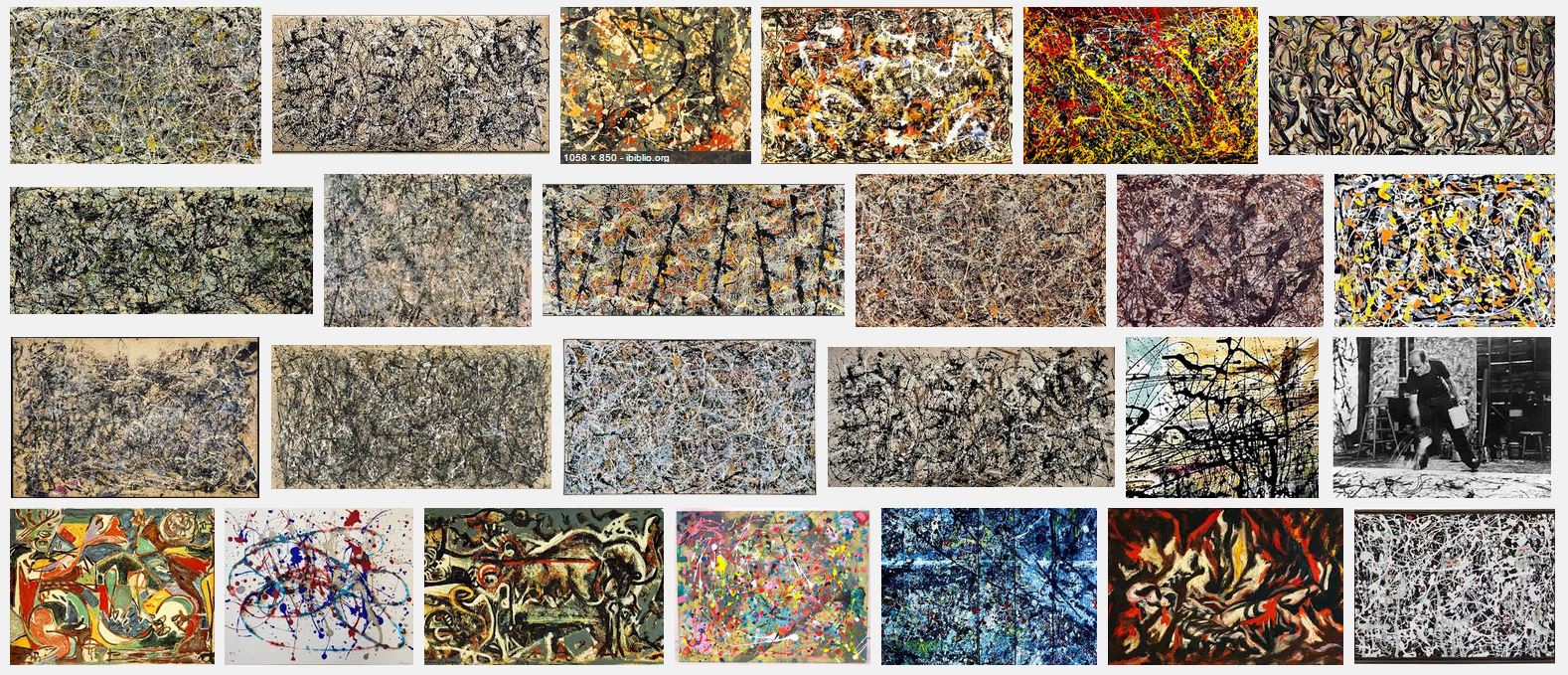
Thomas Hart Benton Google ScreenshotOne of the books in my to-read pile that is more of a tower now is one called Tom and Jack from writer Henry Adams.  It details the long relationship between Thomas Hart Benton and Jackson Pollock, two painters seemingly worlds apart– Pollock known for his vibrant abstracted drip paintings and Benton for his distinct but more objective view of the American landscape.

But Benton was a mentor, teacher and surrogate father for Pollock and many of his lessons found form in Pollock’s work, particularly the ability to create a rhythm in each painting.  Both were masters of the graceful organic rhythms that run through their works.

One of the things I often do when looking at the work of other artists is to do a Google image search for that artist.  Seeing the work grouped together, as you can see in the  images at the top and bottom of the page, allows me to quickly take in the overall tone and feel, to get an idea of the general fingerprint of that artist.  At the top is a screenshot of Benton’s landscapes and the thing that  immediately jumps out at me is the beautiful organic roll  of the landscape that creates a rhythm that instantly draws me in.

Thomas Hart Benton _trail-ridersOne of the paintings from the Benton page is shown here on the left, The Trail Riders, and is a great example of this rhythm.  It creates a sense of movement and gives the forms of the landscape an almost human quality in its curves and rolls which makes it seem familiar.  Part of us, who we are.  For me, that rhythm in Benton’s work was a revelation.  The landscape became something more that a static backdrop.  It was alive and breathing and moving, very often the central character in the work.

And I knew that was what I wanted in my own work, just as I believe Pollock  observed it and wanted for his own work.  And he found a way to take that rhythm and create his own living  landscape through his distinct  visual vocabulary.  Much different than Benton but built on the same underlying energies.

Seeing both their works is really motivating for me, making me chomp at the bit  this morning.  Each spurs me in many directions, but always fast and forward moving.

And that is always a good thing…

Jackson Pollock Google Screenshot

Read Full Post »

Trey Ratcliff - china-deep-in-the-guangxi-provinceSometimes you can look at something and it immediately translates into something for you, something from which  you can take inspiration and  make something new.  That’s what came to mind for me when I came across this great image from photographer Trey Ratcliff.  It’s a panoramic view of a fairytale-like  landscape in the Guangxi region of  China that he took after scaling a peak similar to those you see in the photo.

It’s just a great image, one that gets my motor racing.  I immediately find myself comparing it to my own landscapes, noting  how the forms flow together to create a wonderful rhythm in the image.  There’s so much that will easily convey into my own work that it is in place before I really have time to think about it.  It’s like a jolt of creative electricity.  I just need to get to the easel before it rolls to the back of the line of imagery that is formed in my head.

For more of Trey Ratcliff’s incredible photograph’s from around the world, visit his website Stuck in Customs.  And check out the image shown above on Google+— it’s a 19,000 pixel  high def shot that is fully zoomable so that  you can fly in and out of the little valleys in the distance.  Pretty remarkable.


Read Full Post »

gc-myers-1994I am ridiculously busy this morning, with several imminent deadlines and tons of work to be taken on in the next several weeks.  I am not complaining.  It’s a good busy.  But having done this blog for so many years now, I felt obligated to post something this morning.  However, I couldn’t focus  so I went to the archives and immediately  came across the post below that addresses the hard work that it takes to reach the full potential of one’s  abilities.

Without the effort, potential is a hollow nothing.

Here’s what I wrote several years back:

I had a nice email from a gentleman who told me about a prize his 16 year old daughter had recently won for one of her paintings.  I took a look at the piece and responded to him.  It was nice painting, nicely composed and had strong lines and color.  It was far ahead of anything I was doing at that age, especially by the virtue that it was complete.  I could see this young person doing more with their talents in the future.  I wrote him back and told him this but with my standard warning, one that I have written about  here before:  Potential  must be actively pursued with constant efforts and a consistent pushing of one’s abilities

I wrote him to tell him this, to let him know about some of the young talents I have seen come and go because they felt their talent was something that was in them and could be turned on and off with the flip of a switch.  I told him to tell her to look at the work required as a musician looks at rehearsals.  Perhaps even look at their talents as being like those of a musician, talents that need constant exercise in order to stay sharp and strong.  For instance, even if you have great innate talent, you can’t expect to play the violin like Itzhak Perlman if you don’t devote your talents in the same way as he does. A great part of his life is in nurturing his abilities.

I always feel like a sourpuss when I’m giving this advice.  Nobody wants to hear that they need to work harder.  Everyone wants to think that they have this great talent born within them and it will flow like a spigot whenever they so desire.  If only that were true.

I think you will find that those who succeed at the highest levels in any field are those who understand this need to constantly push and work their talents.  I’m sure there are exceptions but none come immediately to mind.  I wrote about this in a blog post when I first started this, over two years ago.  I wrote about something author John Irving had said about competing as a writer as he competed as a wrestler, putting in the same sort of work as though he were attempting to be an Olympic wrestler. 

Hard work.   It’s not glamorous especially in this world of instant gratification but it is a proven entity .

I’m showing the piece above to highlight this.  It’s a small painting that I did before I was showing in any galleries, in 1994.  At the time, it pleased me very much and I could have very easily kept painting in that style and been pretty happy, without much effort.  But there was a little voice in me that kept saying to push ahead and work harder, to see what I could accomplish with greater effort.  It became not an end but a stepping stone to move ahead.

That is how I hope this man’s daughter see her painting– as a stepping stone.  She may think it is the best thing she has ever done but if she is willing to push ahead and put in the effort, she will look at it someday as a mere step in her journey.

Read Full Post »

GC Myers- Way of Peace smStop looking outside for scraps of pleasure or fulfillment,
for validation, security, or love —
you have a treasure within that is infinitely greater
than anything the world can offer.

-Eckhart Tolle

**************

I call the new painting above Way of Peace.  It is a 30″ by 40″ canvas that is now showing at the West End Gallery.

I am really drawn personally to this piece, very attracted by its peaceful quiet and the depth of its inviting warmth.  I like the way the path leading into the scene seems to transform into a stream, as though there is a moment as one struggles along the path toward their own inner reality when resistance fades and it becomes easier to proceed ahead.  Less struggle and more fluid and free flowing.  More natural.

I think the words at the top from Eckhart Tolle mesh very well with the message I find in this piece.  It is one that is a common theme in my work: that real discovery is found within our self. And I think this painting oozes with that message.  It may seem to be a representation of the outer world and if that is how you see it and that satisfies your appreciation of the piece, that is perfectly fine.  Absolutely nothing wrong in seeing it that way.

But for me, it is in fact an aspiration-based self portrait constructed on an inner landscape.

Sounds like a mouthful but it’s pretty simple at its heart.  Think of what you might picture for yourself if someone asked you to paint a picture of of who you are or hope to be. Some might paint a straight portrait.  I picture myself and my aspirations in the landscape and this piece is very much how I see it.

However, there are some miles to go before I get there…

Read Full Post »

« Newer Posts - Older Posts »