We’re into the heat here and in many areas across the nation with near record temps in Alexandria yesterday and the fires in Colorado still raging. The dog days of summer. I thought I’d have a musical break and in looking for something appropriate came across Fire from The Crazy World of Arthur Brown from back in 1968. We’ve moved way past this in terms of outlandishness in the forty-plus years since this performance on Britain’s Top of the Pops but I have to chuckle at the outrage it must have provoked at the time. I can only imagine the middle-aged British parents who had endured World War II and the German Blitzkrieg upon seeing this must have felt that the world was in a death spiral and that Arthur Brown was indeed the god of hellfire. Of course, he was just a guy trying to draw some attention and sell some records, which he did.
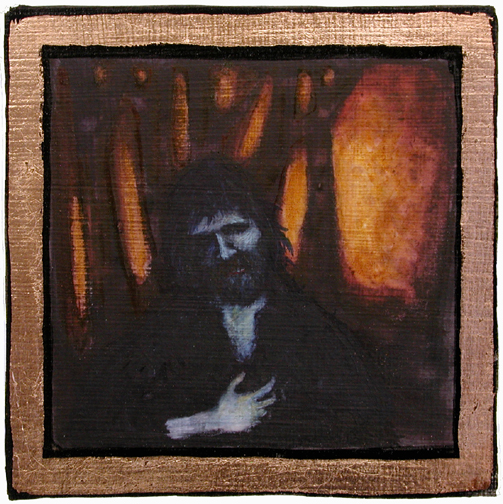
The painting shown above is one of my personal favorites called Elvis in the Wilderness. It was part of my Outlaws series from several years back. I’ve shown it here before but I thought it fit the spirit of this song and the background has the feel of impending fire. Here’s Arthur Brown. Hopefully, his fire will soon diminish and the fires in Colorado will cease.
Jack White has a recent album out, Blunderbuss, on which he puts his own stamp on the Little Willie John classic I’m Shakin‘. My own first taste of this song was Dave Alvin and the Blasters‘ version back in 1981 which was great version pretty much in line with the original and has always served as the one which comes most quickly to mind. Dave Alvin has long been a favorite of mine but has always flown well under the radar of most folks. unfortunately. But I do like this version from Jack White. I came across a YouTube video of the song that has set footage of the dance line from a vintage episode of Soul Train to the song and it fits pretty well. Plus it’s great to have a chuckle at some of the styles from that time, which looks to be the mid to late 70’s, judging by the number of big bell bottoms.
Anyway, here it is to give your Sunday a shakin’ start…
I was going to write a bit this morning about this painting, Moonrise Kingdom, which is part of my show currently hanging at the Principle Gallery. But as I sat here looking at the image my mind went kind of blank and all I could think of was a song from Chuck Berry called Havana Moon. I’m not sure what this song has to do with this painting except that there is a moon in each but that song just won’t shake loose.
It’s actually a pretty good song for 6 in the morning, a bit different than standard Chuck Berry rockers. Spare and atmospheric. Rhythmic. Even though I love all of Berry’s old classics, this song remains one of my favorites from his songbook. And it sounds good when I look at this painting. Win win.
I call this new painting, 18″ by 26″ on paper, Liebestraum after the title of the famous piano piece from composer Franz Liszt. Liebestraum translates as dream of love and there is a dreamlike qualityto this piece, in the way the two trees intertwine to become almost one beneath a warm dusky sky and in the way the thin white ribbon of a path winds rhythmically through the landscape in a way that seems to mimic the graceful weaving of the musical composition’s melody.
Looking just now, I notice that the two fields in the center, one orange and the other yellow, seem to form a divided heart shape, like one of those pairs of lovers’ pendants where each contains a half of a heart. Interesting that this evaded my eye before.
Yhe Hungarian-born Franz Liszt is an interesting character. He was a phenomenon of his time, a womanizing piano virtuoso whose playing caused an incredibly frenzied response from his adoring female fans. There was such a hysteria over his performances that a term, Lisztomania, was coined by the physicians who studied the effects at the time. We don’t often think of classical performers, particularly of the mid 1800’s, as having the public persona of an Elvis but Liszt may have been the prototype for the modern rock star. For you film buffs, you no doubt recognize Lisztomania as the title of the Ken Russell film from the 1970’s that featured The Who’s Roger Daltrey as the pianist in a slightly twisted telling of his tale.
The painting, Liebestraum, is part of my show which opnes next Friday at the Principle Gallery in Alexandria, VA.
Although it is primarily a piano piece, I do like this guitar version. Enjoy.
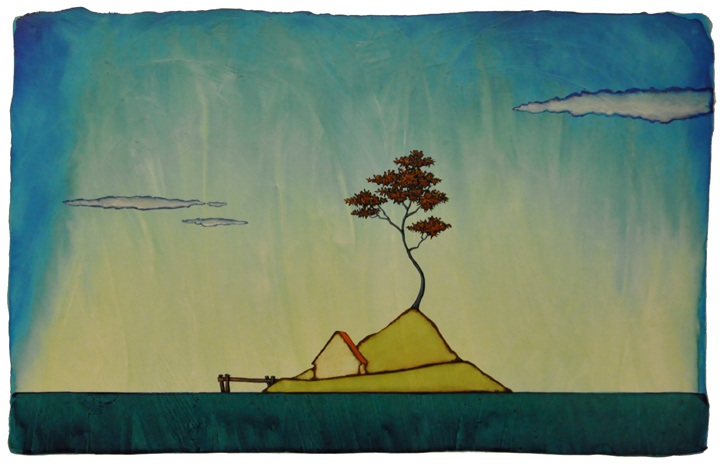
A new painting that is headed for my upcoming show , A Place to Stand, at the Principle Gallery , opening June 8. This is a 12″ by 36″ canvas that carries the title Almost Blue, a title taken from the great Elvis Costello song.
I often talk about the color blue as being addictive, about how difficult it is at times to pull myself away the color when I am working with it. It is the yin to the yang of the reds and yellows I often work with in my paintings. The reds and yellows are often bold in statement, claiming a small piece of the world as their own and making the case that they have meaning in this world. The blues, however, don’t make such brash statements. They create a different atmosphere, one that is quietly questioning why they are here in this world. Blue is a calm sense of wonder and reflection, almost melancholy at times.
The Red Tree is here but its normally bold statement of self is enveloped in the blueness of the sky and landscape surrounding it, making it feel less like a statement than a question. There is an uncertainty as to the whys and whats of its existence and the red of the tree seem almost ready to turn to blue. It is almost blue.
I was going to have a video of either Elvis Costello or his wife, Diana Krall, doing the song here. Both are fabulous. But I came across this video of the late jazz great Chet Bakerdoing the song in a performance taken from the film Let’s Get Lost, a documentary about his life made in 1988 not long before his death. If you don’t know much about Chet Baker, you should really check out his bio. It is the stuff of classic tragedies and will surely someday be the subject of a great film. This version of the song is a great expression of his existence and in the photos shown throughout the video you can see the toll that life, violence and drug abuse took on Baker over the years.
One of the benefits of having my studio located in the woods is the opportunity to watch the wildlife from a fairly close perspective. I have known all manner of animals over the years, from the mother raccoon and her kits that took up residence for a short time in the roof of my first, more rustic studio further up in the woods, and the everpresent deer that often nap in the shady lawn outside my studio windows to the coyotes and bobcats that I have captured on my trail cam and have ran across in person, as well.
I get to see how the animals interact, how they break down into family units and establish order. How they survive the elements and their habitation among us humans. Their survival instinct is powerful, a hard thing to see at times but powerful, nonetheless.
Over the years I have witnessed many deer with legs that have been broken, most likely from a misstep or an encounter with a woodchuck hole. I am always amazed at their ability to persevere and prosper. There was a doe several years ago who came around with a front hoof dangling, completely broken away from the leg above. Eventually she lost the hoof completely, leaving a stump. But it didn’t stop her. She actually had 3 or 4 fawns over the next few years and it was only when she walked slowly to feed that you recognize that she was missing a hoof. In full flight, she moved as fast as the other deer and managed to evade predators and hunters for years.
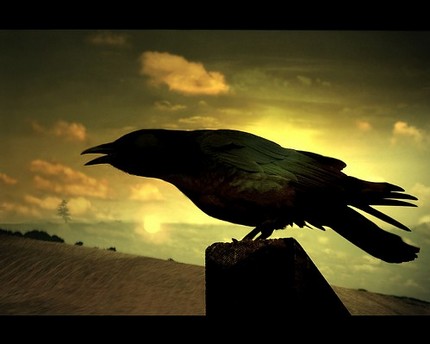
I currently have a black crow that haunts the pines in front of my studio. He came to my attention early in the winter. I saw crow tracks in the snow that went from the studio all the way down the long driveway, about 1/5 of a mile. I couldn’t understand why a crow would walk throught he snow when he could fly. This went on for several days until I finally caught a glimpse of him, ambling up the drive. It was a badly damaged wing that hung off of his back to one side. He would walk and hop with real determination and was seldom alone. There was normally a group of crows that accompanied him, cawing to him from the trees above and sometimes coming down to walk with him. I got the idea that they sometimes let him know what was ahead or behind, acting as his eyes in the sky.
I thought about trying to capture him and get him to an animal rehabilatation specialist such as the unit at Cornell but he was always quick to spot me and would disappear into the woods with surprising speed. He was even aware and suspicious of me when I watched him from my front windows.
His mobility has improved over the past six months. He hops quickly and to my surprise has developed the ability to take flight for moments at a time. Not for very long distances but enough to carry him to low branches of the trees from where he can hop to higher branches. Once he reaches the top he will glide, without flapping his wings, to a point quite a ways down the drive from where he will commence his walk/hop.
I really admire his grit and evident intelligence. I have gotten into the habit of putting out for him the poor small rodents that my studio cat, Hobie, captures and kills in the woods around the place, laying them at my feet proudly as gifts on a daily basis. I have watched him and his kin find these small gifts a number of times and I think he understands the gesture. Doesn’t make him any less wary of me but that’s okay. He gets an easy meal and I get to see that the mice and moles go back into the big circle quickly. Win/win.
Here’s a really nice rendition of Joni Mitchell’s song Black Crowfrom Diana Krall. Just right for a Sunday morning.
I wrote the other day about the rhythm I’m looking for when I’m in the studio, that groove where the painting is more instinctual than intellectual. Everything flowing fast and easy with little thought, each brushload of paint inspiring the next and on and on. All intuition and reaction with hardly a thought given to subject or meaning. It’s a great feeling, one that makes me feel as thought I am somehow connected to some sort of better self within, one that can only be reached by letting go of conscious thought.
A rare and delicate thing.
Delicate in the sense that I find myself at points coming out of this groove to examine what I’ve done and I lapse into conventional thought. At these times I look at the work spread around the studio, in various stages of their journey to completion. I forget for the moment how the work came about , about the fact that the work is not about subject or the scene but about capturing emotion and feeling. All I see is repetition of form, red trees and red roofs set on mounds and plains.
And for that moment, I panic just a bit. The delicate thing seems almost crushed in that instant.
But then I focus on a painting and the fragility of how it came about and what it really is doesn’t seem all that delicate after all. Though there is often repetition of forms, I can see by looking at this individual painting that these elements are only part of the whole, that, while they often serve as the central focus of the piece, their importance comes from how they play off the other less obvious elements of the painting to create the real feel of it. People are not moved by the tree but by the sense of feeling that the tree evokes within the painting.
It’s not subject but the emotion captured that makes each piece unique.
And with that realization in hand, I feel free once again to go back into the rhythm, that rare and delicate thing.
The painting above is a new one that fits perfectly with this post. It is a 10″ by 16″ painting on paper that I call Beeswing, after a line from a Richard Thompson song of the same name that has as its chorus the line, ” she was a rare thing, fine as a bee’s wing…” Thereis adelicacy in this piece, a fineness of form that makes the moment of it seem forever fragile. When I look at it all I can think of are those incredibly rare moments of absolute happiness, when the outer world is completely forgotten and there is a clarity of joy in myself. A fleeting feeling, rare and delicate, fine as a bee’s wing.
There is an internet broadcast that started in 2007 and is ongoing called the Black Cab Sessions. It features a musical guest performing one song as they ride through the streets of London in the well known black London hackney. It has had a tremendous variety of artists over the year, from the very well known to not-yet-quite-there, all performing in the compact confines of the cab’s back seat. Grand pianos and harps don’t play a big part in these performances.
Here’s one of my favorites, Richard Thompson, perfroming in the Black Cab…
Most people immediately think of Roberta Flack when they think of the song The First Time Ever I Saw Your Face, and for good reason. Her 1972 version was truly beautiful and deserved every bit of the acclaim it earned. But the song didn’t originate with her and has had many versions through the years, including one of my favorites from Johnny Cash, which you can see below.
The song’s history began in 1957. Iy was written by Ewan MacColl, a British folk singer who is a very interesting character in his own right. He was a married man who fell in love with the much younger Peggy Seeger, the half-sister of folk icon Pete Seeger. He later married Seeger. MacColl wrote the song about her and for her to perform. She needed a song for a play she was appearing in here in the USA so MacColl wrote the song and taught it to her via the telephone as he was barred from entering the States because of his Communist ties. As I said, he was an interesting character. Her original version is lovely with different phrasing than the better known Flack version. I’ve also included a similarly performed and charming version from Peter, Paul and Mary.
Cash’s version is much more ponderous. It is from his American series near the end of his life. His voice was weaker and even rawer than in his younger days but Cash used it in an incredibly expressive way, giving the song the feeling of a dirge as he looked back from a point near the end of his and his wife’s life, to an earlier time in his life and the fresh discovery of love. It is both beautiful and sad.
Early Sunday morning. I’m in the midst of a work frenzy the last few days in the studio but I’m trying to start the day a little slower. I think I’ll take the rest of day off from the blog and listen to a little music this morning, probably something from Levon Helm who passed away a few days ago, most likely Electric Dirt,which was Helm’s last studio album. I love the cover. Here’s Levon singing the gospel-tinged When I Go Away.
Like the song says: No more troubles…
Good travelling for you, Levon.
 We’re into the heat here and in many areas across the nation with near record temps in Alexandria yesterday and the fires in Colorado still raging. The dog days of summer. I thought I’d have a musical break and in looking for something appropriate came across Fire from The Crazy World of Arthur Brown from back in 1968. We’ve moved way past this in terms of outlandishness in the forty-plus years since this performance on Britain’s Top of the Pops but I have to chuckle at the outrage it must have provoked at the time. I can only imagine the middle-aged British parents who had endured World War II and the German Blitzkrieg upon seeing this must have felt that the world was in a death spiral and that Arthur Brown was indeed the god of hellfire. Of course, he was just a guy trying to draw some attention and sell some records, which he did.




 Redtree Times