Feeds:
Posts
Comments

Archive for the ‘Painting’ Category

+++++++++++++

I really just wanted to share one of my favorite Edward Hopper paintings but the message attached really speaks to my own thoughts on painting. The painting is his Early Sunday Morning from 1930.

I like that it seems so still, so static, yet it is filled–at least for me– with tensions and deep emotional content. That reaction is my own imagination reacting to the elements of the painting. Hopper created an armature, a framework, that gives shape to the emotional response of the viewer without filling out all of the details.

You look at it and there are guides in place that gently direct you to Hopper’s own emotional location. But it never spells it out in great detail, never tells you what you should feel. It relies on your imagination to fill in the voids, to fill it with details to which you can personally relate. You are no longer a mere viewer, you are an emotional participant.

That’s how I think a painting should work, as a sort of active terminus where the work of the artist and the imagination of the viewer meet.

Sometimes, it works that way. Sometimes, it doesn’t. I think this Hopper definitely works in this way.

Read Full Post »

+++++++++++++

Art has always been the raft onto which we climb to save our sanity. I don’t see a different purpose for it now.

Dorothea Tanning
+++++++++++++
.
Doing research for this blog, I run into so many artists that work well into their nineties and beyond that I begin to get hopeful for my own longevity. I try to see if there is some sort of common denominator among them, something that might be a key to their long careers and lives.
.
There seems to be among many, at least to my eye, a constant striving for growth and change in their work. There are often new subjects, new styles, new mediums and new processes. But a constant state of wonder.
.
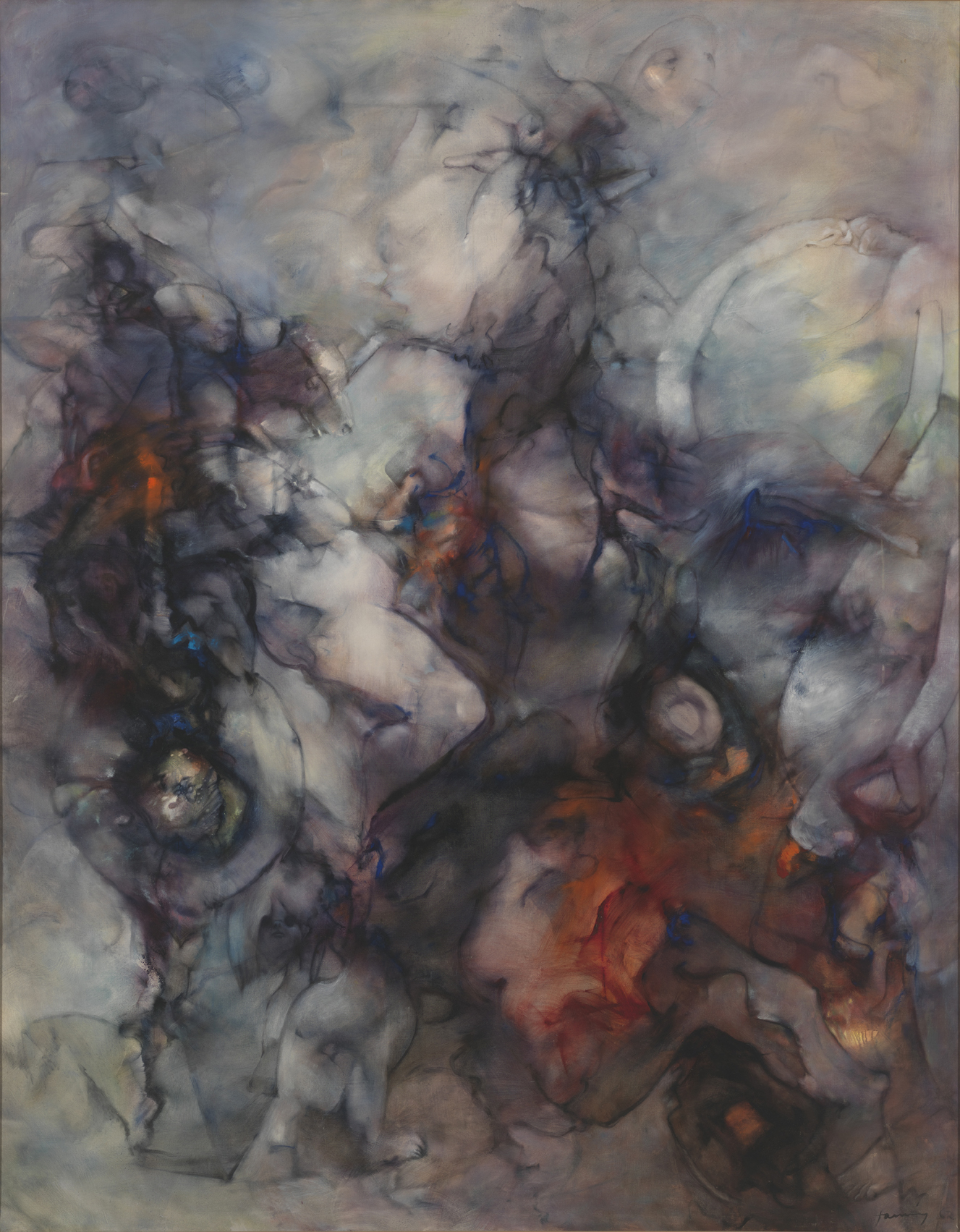
Dorothea Tanning is one such example. Born in 1910, she worked until late in her life and died at the age of 102 in 2012. Her work changed throughout her career, having multiple phases, but always remained her own. I am only showing a few of her pieces here, a few that immediately grabbed me this morning, along with a short video with a bit of an overview. Like many artists I show here, I don’t know a lot about her work but hope to use this as an introduction.
.
Hopefully, in forty years or so, I will still be following Ms. Tanning’s example. But most likely only if I try continue to attempt to grow. Because as Dorothea Tanning also said: It’s hard to be always the same person.

Tanning, Dorothea

Read Full Post »

+++++++++++++++++

If you begin to understand what you are without trying to change it, then what you are undergoes a transformation.

Jiddu Krishnamurti

+++++++++++++++++

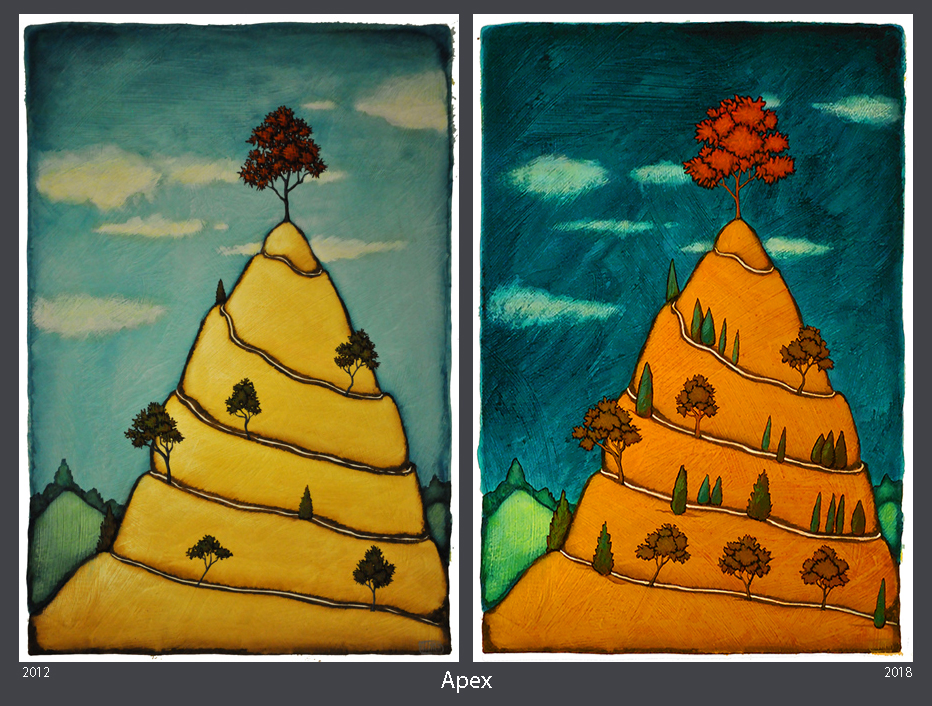
The painting, Apex, as shown above on the left had been bouncing around galleries for quite a few years. It was one of those pieces that kind of gnawed at me after awhile. There was so much that I liked about it and it felt complete yet I began to feel that something was lacking.

The color bothered me. It looked washed out and pale. Now, I have done pieces with that sort of color and it can be very effective but in this instance the lack of intensity in the colors seemed to handicap the whole painting. The more I looked at it over the years, the more I saw the blue of the sky looking dull and lifeless.

And it felt like the trees on the ascending path were too sparse. I don’t know much about musical composition, can’t tell a quarter note from a half note, but when I looked at the hill with the trees I felt like I was looking at a piece of music and some of the notes were missing. It wasn’t saying what it should be saying.

And the central character, the Red Tree at the top, felt dark and small, not bursting forward as it should, at least in my mind.

The whole thing just felt like it was on life support– barely alive but but with no vigor, no spark.

But it was still alive and there seemed to be something in it that really pulled me in, I decided I needed to intervene, to either reinvent it or completely kill it. So I went in and deepened the colors of the sky and the hill dramatically. This created a nice contrasting tension and made the tree that were added to the upward path stand out more. The Red Tree grew larger, brighter and bolder while the clouds in the sky slimmed a bit.

It was  dramatic transformation. It was like Charles Atlas’ 97-pound weakling transforming, with the aid of his patented Dynamic Tension, into a beefy he-man who takes on the beach bully and gets the girl. I know that last sentence means next to nothing to those of you under the age of fifty but if you ever saw those old magazine ads, you’ll get it. You can click here to go to an old blog entry that shows that ad.

That might be a goofy comparison but as I sit here and look at the transformed painting, it’s hard to imagine that that it once was that old version of itself.

And it all came about thanks to Dynamic Tension. Thanks, Charles Atlas!

++++++++++++++

This reinvented painting will be with me at my Gallery Talk at the West End Gallery in Corning this coming Saturday, August 4. The talk begins at 1 PM and it should be a good time. In addition to the great conversation and plenty of prizes, I have also procured a monster truck act– Truckasaurus Rex— as well as a T-shirt cannon.

Okay, maybe that’s not quite accurate. Or true in any sense of the word. You’ll have to come see for yourself. 

Read Full Post »

This short snip from a letter Vincent Van Gogh wrote to his brother, Theo, in October of 1883, might be the best piece of advice that any working or aspiring artist could receive. And it most likely applies to any other field of endeavor.

I can’t speak for the experience of most artists but, concerning my own work and abilities, I travel through an internal landscape with soaring peaks of great confidence that often plummet into deep valleys of doubt. One moment and I am high on a peak with a seemingly endless view that shows me all sorts of ways forwards. But in the bat of an eye I find myself in a deep and dark ravine with no indications of any path on which I can climb out.

I begin to doubt my abilities, begin to wonder if I have been the fool in thinking myself an artist. Ideas that just a day or so ago felt special and ready to burst out from me suddenly seem dull and lifeless. Inspiration dissipates like a mist in the sunlight.

But, as the decades doing this have taught, the answer always comes in working.

Empty the mind, push doubts to the side and pick up a brush.

Make a mark. Then another and another. Let it lead you somewhere, let it be the path out of that valley.

Work. Just work.

Read Full Post »

These words from Adolph Gottlieb, the late Abstract Expressionist painter, ring true for me. I believe that art should acknowledge the presence of powerful forces that guide our lives, good or bad. As he points out, it is this awareness that fueled the myths and symbology that have lived with us since time immemorial.

For me, it is displayed in the underlying darkness of much of my work which is evident in even my most optimistic works. This darkness gives the work, at least to my way of seeing it, a sense of tension, a counterbalance that keeps the work centered. The most optimistic work still has a wariness in this darkness that acknowledges the dangers ahead and the hardships endured in the past.

Triumph of any sort is seen as a transient emotion, one that is to be savored in the moment and recalled in the future but short-lived in the present. The darkness is always hovering nearby, presenting a potential threat or a challenge or even a dramatic change that comes with both the possibility of utter defeat or a new triumph. It is this mystery that makes the darkness so appealing and necessary.

Read Full Post »

+++++++++++++++++++

GC Myers-  Inner Perception smallThis is a painting from a few years back that has toured around a bit and found its way back to me. Called Inner Perception, it has been one of my favorites right from the moment it came off my painting table. Maybe the inclusion of the the paint brush (even though it is a house painter’s brush) with red paint in the bristles makes it feel more biographical, more directly connected to my own self. Or maybe it was the self-referential Red Tree painting on the wall behind the Red Chair.

I don’t know for sure. But whatever the case, it is a piece that immediately makes me reflective, as though it is a shortcut to some sort of inner sanctum of contemplation. Looking at it this morning, the question I was asked at the Principle Gallery talk a week or so ago re-emerged, the one that asked what advice I might give my fifth-grade self if I had the opportunity. I had answered that I would tell myself to believe in my own unique voice, to believe in the validity of what I had to say to the world.

I do believe that but I think I might add a bit to that answer, saying that I would tell my younger self to be patient and not worry about how the world perceives you. That if you believed that your work was reflecting something genuine from within, others would come to see it eventually.

I would also add to never put your work above the work of anyone else and, conversely, never put your work beneath that of anyone else. I would tell myself to always ask , “Why not me?”

This realization came to me a couple of years ago at my exhibit at the Fenimore Art Museum. When it first went up it was in a gallery next to one that held the work of the great American Impressionists along with a painting from Monet. I was greatly intimidated, worrying that my work would not stand the muster of being in such close proximity to those painters who I had so revered over the years. Surely the greatness of their work would show me to be a pretender.

But over the course of the exhibit, that feeling faded and the intimidation I had initially felt turned to a type of defiant determination. I began to ask myself that question: Why not me?

If my work was genuine, if it was true expression of my inner self and inner perceptions, was it any less valid than the work of these other painters? Did they have some greater insight of which I was not aware, something that made their work deeper and more connected to some common human theme? If, as I believe, everyone has something unique to share with the world, why would my expression of self not be able to stand along their own?

The answer to my question was in my own belief in the work and by the exhibit’s end I was no longer doubting my right to be there. So to my fifth-grade self and to anyone who faces self-doubt about the path they have chosen, I say that if you know you have given it your all, shown your own unique self, then you must ask that question: Why not me?

Read Full Post »

++++++++++++++++++

Charles Burchfield- Sun and Rocks- Albright-Know Art GalleryAn artist must paint not what he sees in nature, but what is there. To do so he must invent symbols, which, if properly used, make his work seem even more real than what is in front of him.

–Charles Burchfield

*********************

I am a big fan of the work of Charles Burchfield (1893-1967), a western  New York painter who lived and painted in the Buffalo area for most of his life. His work was decidedly visionary in its scope, taking the environment that he knew around western New York and embellishing it with a life force and energy that he sensed beneath the surface. That’s what he was referring to in the quote above– taking what you see around you and not simply recording it but painting how it moves you emotionally. To me, his work is as emotionally charged in the same way as that of Van Gogh.

Charles Burchfield- An April Mood- Whitney Museum of American ArtCreating symbols, as Burchfield refers to in the quote, has been a big part of my work. I have long emulated his use of creating a visual vocabulary that moved through a body of work. It becomes a sort of language of its own  that people who take it in and understand it find easy to read and absorb as they move from picture to picture. Those who can’t read it find less in the images and feel less drawn into them. In an earlier post featuring Burchfield, I wrote about an artist friend who just didn’t get Burchfield’s work in any sense.  He just one of those people who couldn’t read the language clearly written in the work.

I also have been influenced by the way Burchfield would constantly go back to earlier work and use it as a new starting point, as though the added knowledge gained through the years would take this work in a new direction. I often do the same thing, constantly revisiting images and motifs from years ago looking for a thread or path to follow anew.

Even this post is a revisitation, going back and looking at an influence, trying to pull that original inspiration from it. With Charles Burchfield, that’s always an easy thing to accomplish.

Charles Burchfield- Childhood's Garden

Read Full Post »

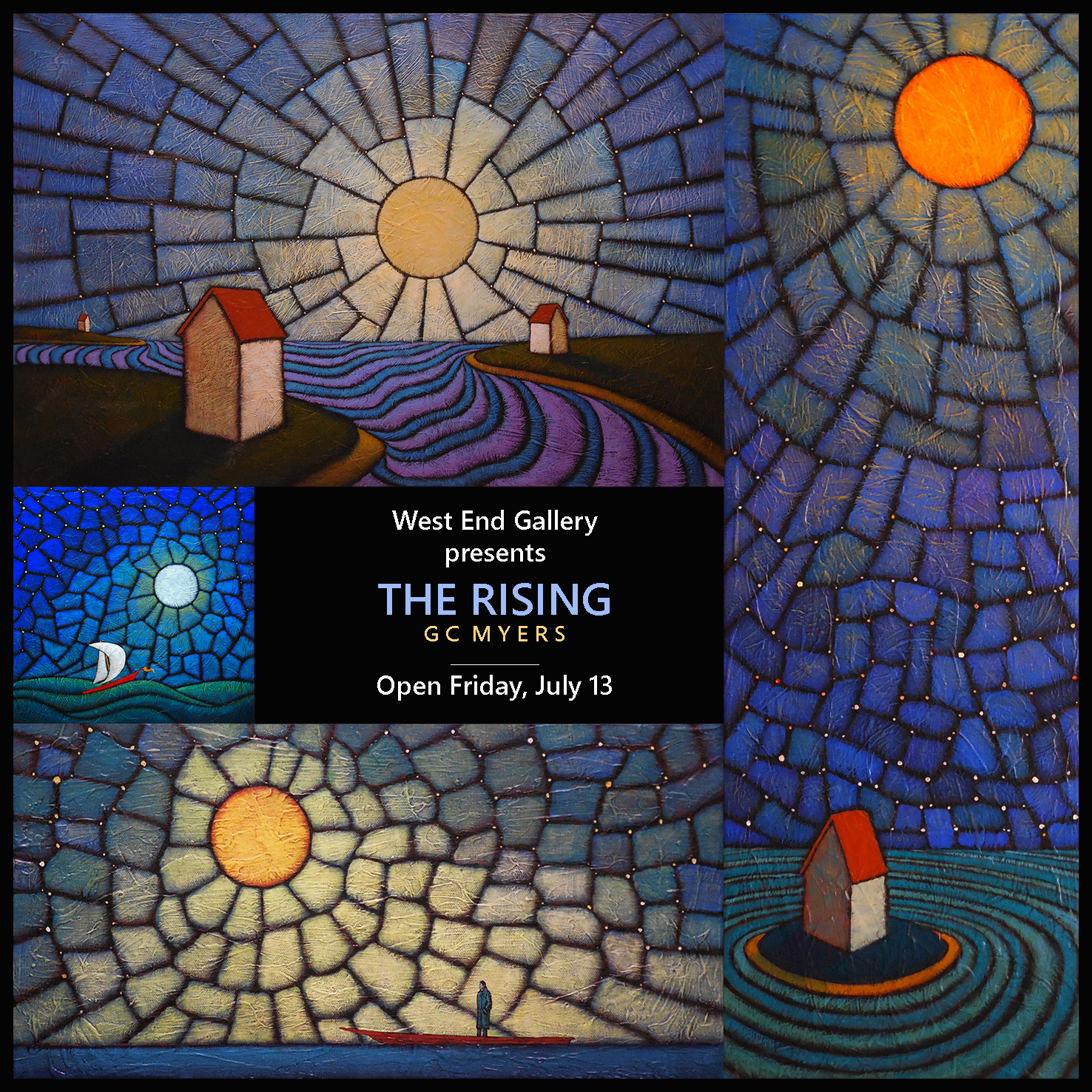
Tonight is the opening reception for The Rising, this year’s edition of my annual solo show at the West End Gallery in Corning, NY. The reception begins at 5 PM and runs until 7:30 PM.

My history at the West End Gallery is well documented here. I would not be sitting here this morning, writing this blog about my work and this show, if not for a meeting back in January of 1995 where Tom and Linda Gardner saw something of value in the milk crate that served as my portfolio, with pieces of cardboard and paper jutting out from it. From that first glimpse, they gave me my first opportunity and followed it up with the encouragement that allowed me to grow as an artist.

You have to understand that this came at a time not too far removed from what I will describe without hesitation as being the lowest point in my life. Their acceptance and embrace of my work was a lifesaver thrown out to a drowning man.

So when I tell you that I try with all my heart to create work for these shows that is meaningful and at the highest level at which I am capable, those are not just words.

It describes an act of gratitude. a Thank You for a life saved and reshaped.  A Thank You for the opportunity to grow and evolve as an artist, to live a life I never could have imagined all those many years ago.

I hope that the work in The Rising displays that sense of gratitude as well as the growth that came with it.

Hope you can make it out to the gallery tonight. I’ll be there.

Read Full Post »

A few weeks back, we had the pleasure of seeing a series of three one-man shows at the Shaw Festival in beautiful Niagara-on-the-Lake, Ontario. They were written and performed by writer/actor/comedian Stephen Fry who you may better recognize from his longtime partnership with Hugh Laurie (House) in the comedy team Fry and Laurie.

The performances were based on Fry’s recent book Mythos which contains his droll retelling of the classical Greek myths. The shows were divided into different segments: God, Heroes, and Men. God dealt with the stories of Zeus and the other surrounding gods. Heroes dealt with the epic tales of Odysseus, Heracles and Theseus. The final show, Men, told the stories of men and their interactions with the gods. All were highly entertaining.

I was pleasantly surprised that during Men, Fry chose to tell the tale of Baucis and Philemon, a story that I have retold here a number of times and one which I also have used as the basis of a series of paintings over the last several years, including not too long ago with a favorite of mine, Nuptiae. It is the story of an old couple in a poor town who share their hospitality with Zeus and Hermes who have been treated poorly by all the other townspeople.

Fry’s retelling had a bit of a different ending than the version I knew, one that I believe is based more on that from Ovid and his Metamorphoses. In the version I know, the ending is a bit happier with the couple living out their lives together as priests in the temple of Zeus and together in death as two separate trees– a linden and an oak– growing from a single trunk.

Fry’s is a bit harsher, related in many ways to the biblical story of Lot and his wife. In Fry’s retelling, Zeus tells Baucis and Philemon that they shall be spared from the terrible wrath he is setting loose upon the other townsfolk. He instructs them to walk up the hill and not turn back. But hearing the great storm and the horrible sounds coming from the village, they agree to turn back to look together, whereupon they are transformed into linden and oak trees, much as Lot’s wife was turned into a pillar of salt.

I still prefer the version I first knew but it was great to hear a variation on this story. That is the beauty of storytelling and art– it takes what we believe we know and reflects it back at us in a different and sometimes revelatory manner.

The painting at the top is a new painting from my West End Gallery show that opens tomorrow, Friday, July 13. Titled The Belonging, it is a 36″ by 24″ painting on canvas that is my most recent interpretation of the Baucis and Philemon myth– the version I knew before the Mythos shows.

These pieces may be my favorite to paint. The intent to paint them, that beginning point in their creation, has a certain feeling that pleases me and sets the tone for the whole piece. The paintings that spring from this starting point seldom disappoint me or fall short of what I hope to see. This piece very much lived up to the story for me and is one that never failed to stop and make me look when it was with me in the studio. The combination of the story and the colors, shapes and textures of the painting come together, for me at least.

Hope you can come out and see for yourself at the West End.

Read Full Post »


******************

I too am not a bit tamed,

I too am untranslatable,

I sound my barbaric yawp

over the roofs of the world.


-Walt Whitman, Song of Myself

.

**********************

This new painting,a 24″ by 30″ canvas that is part of my upcoming show at the West End Gallery, is titled My Brisant Bellow. The term brisant bellow is one I have used in the past, my equivalent to Whitman’s barbaric yawp which comes from his Song of Myself in Leaves of Grass.

It is included in the four lines above that have been a guiding beacon for me throughout the past 25 years as I have tried to be an artist. These words instructed me to be only myself, to openly and boldly express my feelings without fear or shame. To not hide my scars, my fears or my weaknesses because they are part of my wholeness and keep me in balance. To not be underestimated or devalued by myself or anyone else. To claim a foothold in this world and bellow out the proof of my existence in my own voice:

Here I am.

There are paintings that I do that are meant to represent this thought, paintings that are meant to be plainly expressions of that Here I am. I consider them icons in my body of work, pieces that fully represent my work and what I want from it. This painting definitely falls in that category. It’s simply put but not a simple expression.

When I look at this painting I personally see myself and all my hopes and aspirations, all that I am or desire to be.

What I hope for this painting is that someone else sees that same here I am in it for themselves, that they see in it those things that make them a whole and perfectly imperfect person with a place in this world and a voice that demands to be heard.

Is that asking too much?


Read Full Post »

« Newer Posts - Older Posts »