Feeds:
Posts
Comments

Archive for the ‘Painting’ Category

+++++++++++++++++

Creative scientists and saints expect revelation and do not fear it. Neither do children. But as we grow up and we are hurt, we learned not to trust.

― Madeleine L’Engle

+++++++++++++++++


This new painting is called Found Truth. It is a larger piece, 36″ by 36″ on canvas, and is part of the group of new work that will be traveling with me on Saturday down to the Principle Gallery for my Gallery Talk there.

This is a painting that very much speaks to me personally. Its scale and the initial impression it makes whenever my eyes look its way give it a sense of strength, of bold statement. And I think that is exactly what it is for me– a statement piece.

Maybe that is why I see it having a title that deals with the idea of the revelation of truth. It could the revelation of one’s inner truth or any number of other truths that make up our reality. Or maybe it is all of them because perhaps all truths are part of one larger truth.

I don’t really know. I’m still waiting for that moment of revelation.

I’m no saint so maybe I am a creative scientist, as Madeleine L’Engle writes above, because I do not fear it and do expect it. Oh, there are days when I revert to a more closed off stance, stepping back from that mound where the Red Tree stands, that spot where I have been completely exposed and vulnerable. The problem is that in order to receive revelation you have to make yourself vulnerable. In this open state you are susceptible to being hurt but, more importantly, you are in position to recognize and accept revelation.

That place of vulnerability is a spot many of us avoid, certainly as L’Engle points out, because of being hurt once or maybe many times before and the distrust this has fostered in us. None of us wants to be hurt and exposing yourself to the world creates that possibility.

So we harden our attitudes and our hearts, closing ourselves off. But in the process we also pull back from the light that nurtures us, that feeds our growth. The light that reveals the truth that we once sought and expected.

That’s how I see this painting, the Red Tree being exposed and vulnerable atop that mound. The clouds represent the perils of being there but beyond them is the light of self revelation– the reward of persevering one’s own vulnerability.

This all somehow makes sense in the small space of my mind. Hope you see it somewhat the same way in your own.

++++++++++++++++

Reminder:

Gallery Talk at the Principle Gallery in Alexandria, VA this Saturday, September 22 at 1 PM.

Painting(s?) Giveaway, Prizes, Good Conversation, Some Stories and Some Laughs.


Read Full Post »

**********************

Art has no other purpose than to brush aside… the conventional and accepted generalities, in short everything that veils reality from us, in order to bring us face to face with reality itself.

–Henri Bergson

**********************

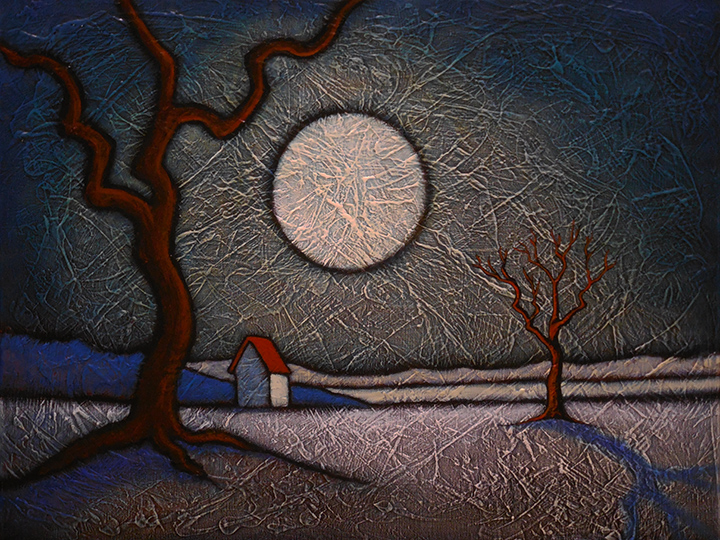
This is another new painting, 16″ by 20″ on canvas, that is part of the group of work going with me to Alexandria on Saturday for my Gallery Talk (begins at 1 PM!) at the Principle Gallery. I call it The Moon’s Revelation and I have spent a lot of time over the past few weeks looking at it, both taking pleasure in it and questioning what I was seeing in it.

What purpose, if any, does it hold?

The question of purpose is a big theme for me lately. My own purpose and that of my work. The purpose of truth. Of institutions and laws. I can’t say if I have found answers any of these questions. But I still believe that there are clues leading to my own purpose somewhere in this piece and others.

They just have to be revealed, in the way the moon brings the colors of the fields to light in this painting.

Time , as always, shall be the revelator.


Read Full Post »

+++++++++++++

I am a being of Heaven and Earth, of thunder and lightning, of rain and wind, of the galaxies.

–eden ahbez

+++++++++++++

The painting shown above is a new piece, a smallish 6″ by 12″ canvas, that will be going to the Principle Gallery on Saturday for my Gallery Talk there. Its title is And the Sky Cracked and is part of a small recent series that features my interpretations of lightning strikes. How accurate they are in a realistic or scientific way, I can’t say. That doesn’t really hold much sway for me, at least not as much as capturing how the lightning feels to me.

Lightning is an amazing thing, a natural wonder that inspires awe and fear like it was some sort of god. No wonder so many religions give their main gods the power to wield lightning. It can destroy yet can also illuminate, bringing clarity to a course of action. Being struck by lightning is how we often describe moments of the revelation of great truths, of moments of self-discovery that alter the lives of those who experience these moments.

Like the finger of a god pointing the way and giving light to the path forward.

Powerful stuff.

Walking through my woods I often see the traces of past lightning strikes etched in the bark of the trees. Some have splits that run from their tops all the way to the way to the ground, blackened by the heat of the electricity that surged through them. In the case of some recent strikes, the ground at the base of the tree is burnt where the cracked bark of the trunk runs into the soil.

We had one strike several years back that was like a multitude of shotgun blasts going off outside our door, so close there was not thunder to give us warning. The next morning I saw that an old, large white pine down our driveway had been hit by the lightning. A deep crack ran down one of its thick upper branches down into the main trunk.

About forty feet away I noticed a chunk of pine the size of a large brick laying in the grass. Looking back at the trunk I immediately saw the spot where it had been blown away from the tree, no doubt the boiling sap of the pine finding a weak spot there in which to explode.

About a year later, that large branch, the size of a mature tree in itself, came down in another storm. The power to destroy.

Here is another in this lightning series that will also be with me on Saturday. It is called Real Power and is an 18″ by 18″ canvas.

The quote at the top is from eden ahbez, perhaps one of the earliest hippies back in the 1940’s and the man who wrote the song Nature Boy, most famously recorded by Nat King Cole. I wrote about ahbez here back in 2009 and Nature Boy remains a favorite of mine. Below is the Nat King Cole version.

Hope you can make it to the Gallery Talk at the Principle Gallery in Alexandria on Saturday. It starts at 1 PM and there is at least one painting to be given away along with some other goodies. Oh, and some good conversation. See you there!


Read Full Post »

+++++++++

Poetry is an echo, asking a shadow to dance.

–Carl Sandburg

+++++++++

I like this line from poet Carl Sandburg. I think any artform acts in that way, as an echo of the person who formed it trying to bring that created remembrance forever to life. I often write about trying to see that sense of life in my work, that quality where the work has a feeling of movement–life— and seems to speak with its own voice.

What it is saying is an echo of what I was feeling in the moment it was created. And if I have done my job well, it sets these echos, these shadows, dancing. A reverberation from the past, the creators own echo sent into the future. A voice that will continue to speak, to echo, long after its creator has gone.

Or as Victor Hugo similarly stated: What is history? An echo of the past in the future; a reflex from the future on the past.

Maybe it’s too early on a Sunday morning to try to work on logic that is somewhat circular. I think I’ve said what I want to say here but the better part of it might still be in my head. Alas, that’s the way it will have to stay.

For this Sunday morning music here’s a fittingly titled song, Echo, from the celebrated British folk trio, Talisk. It has a building intensity that I very much like. Give a listen.

The painting at the top is a new piece  whose title is A World of Mystery, an 18″ by 24″ on canvas. It is headed to Alexandria with me next Saturday, September 22 for my annual Gallery Talk at the Principle Gallery. The talk, which starts at 1 PM, features a drawing for a painting of mine as well as several other goodies. Hope to see you there.

Read Full Post »

This is a new painting that I am calling Culmination. It is 36″ by 12″ on canvas and is headed to the Principle Gallery in Alexandria next Saturday, September 22, where I will be giving my annual Gallery Talk.

This painting satisfies me on many levels. First, there is a density in its color and composition that I find very appealing. Now, density is not always a quality I seek. Sometimes, I am looking for a lightness or an airiness. But here there is a denseness and weight that gives the piece its presence. I believe this comes from the deep red color ( that perhaps symbolizes the blood that has flowed through us since time immemorial?) and the compacted composition that dominates most of the picture plane.

I also am drawn to the meandering path that wends its way to the top to the top of the hill. The  shorter paths that branch off on either side give it the feeling of a tree making its way toward the sky or an artery going up through one’s body.

The tree analogy is important for me. I see this painting as being about how each of us is a culmination, an end result of all our ancestors who have come before us. I often think about that when I am looking over genealogy charts that show the generations spreading out behind the present generation. It makes me think how amazing each of our lives really is when you consider how many obstacles had to be overcome for us to be here in this moment.

Looking at those charts, I think about treacherous childhoods of earlier times when families often lost multiple children to illness. My own grandmother had three siblings who died before she was born. Or the many long and treacherous trips and voyages, over land and sea, that it took to place us in our present locales. Or I think about the many great-grandfathers and great-uncles in my line who fought in the many wars of this country or in those of their original homelands many generations before, many who died far from their native soil. Or the many who worked in dangerous conditions. Doing my wife’s and my own genealogy, I am struck by how many relatives were killed by logging accidents.

These are just a few examples but the fact that a life force somehow wound its way through the pitfalls of life through hundreds of generations to create us is, in many ways, a miracle. Each of us is the result, the culmination, of a journey from the beginning of time. I think we sometimes take this life for granted– both our own and the lives of others– and don’t see the sheer beauty in the miracle of our mere existence.

And that is what I see in this painting. The Red Tree at the top is at the terminus of its journey, standing at the convergence of the past, present and future. It owes a great debt to those who persevered to bring this miracle, a debt that will be hopefully paid through living a life of honor and respect.

I could go on but I think you get the point.

+++++++++++++

As I said, this will be at my Gallery Talk at the Principle Gallery next Saturday, September 22. The Talk begins at 1 PM and there will a painting, Deep Focus, given away along with some other neat things. It has all the earmarks of being a good time. Hope you can make it!

Read Full Post »

*******************

“Heade’s calm is unsteady, storm-stirred; we respond in our era to its hint of the nervous and the fearful. His weather is interior weather, in a sense, and he perhaps was, if far from the first to portray a modern mood, an ambivalent mood tinged with dread and yet imbued with a certain lightness.The mood could even be said to be religious: not an aggressive preachment of God’s grandeur but a kind of Zen poise and acceptance, represented by the small sedentary or plodding foreground figures that appear uncannily at peace as the clouds blacken and the lightning flashes.”

― John Updike, Still Looking: Essays on American Art

********************

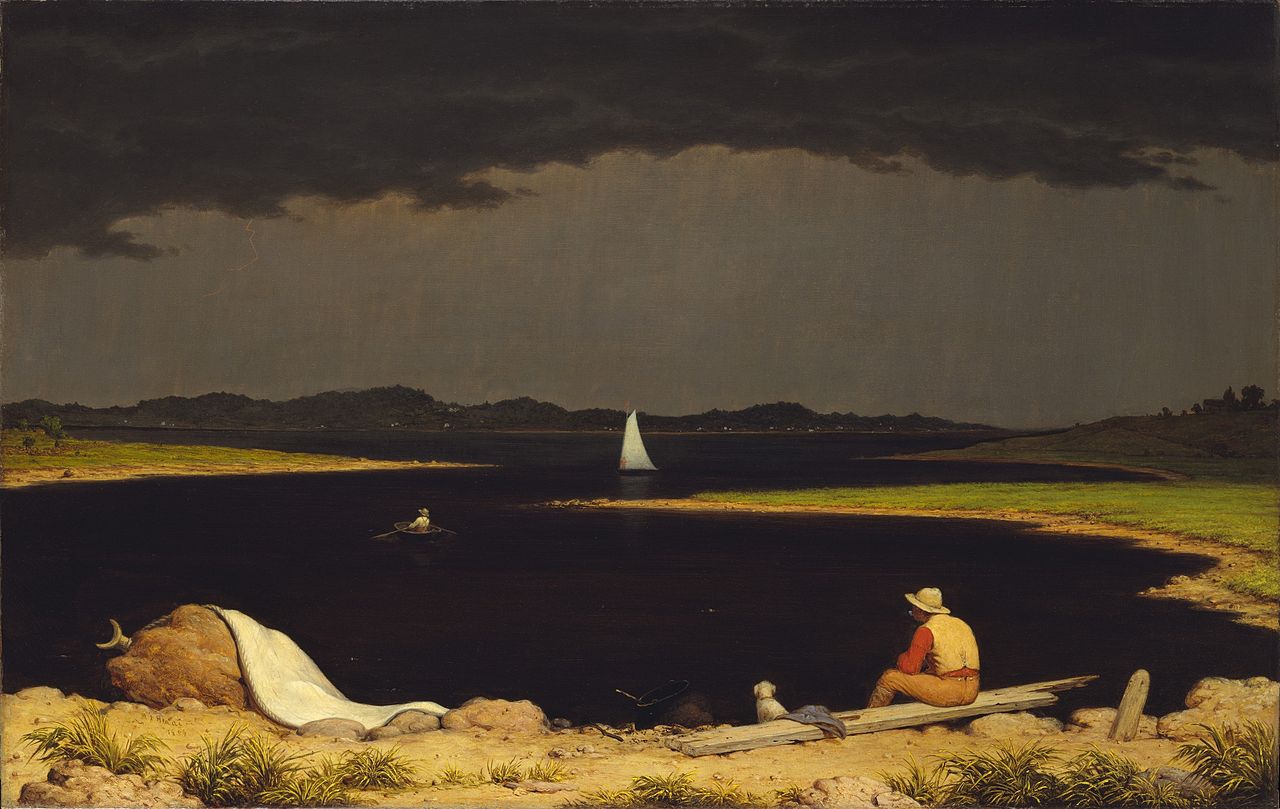
I don’t think I’ve ever mentioned Martin Johnson Heade here. This is really an oversight on my part as some of his work was really influential on the direction of my work early on, even though to the casual observer it may not seem apparent. After all, our styles and methods of painting were wildly different. The intensity of the color and contrast in his paintings of the floral subjects and tropical birds that he completed during his long and prolific career (born 1819 and died in 1904) really made me want to push my own color ahead. There is a site, Martin Johnson Heade- The Complete Works, that has his complete works online where you can see the great quality of his color and use of contrast.

But the painting shown at the top, Approaching Thunderstorm, from the Metropolitan Museum is my favorite Heade painting. The forms of the  black water of the lake set against the vibrant color of the shoreline is striking and  a most ominous storm cloud churns toward the boaters who have not yet fully heeded the signs of the oncoming storm.

It was painted in 1859, in the years before our country exploded in civil war. This painting was part of a cultural movement of the time that depicted the tension gripping our nation in metaphorical terms. The metaphor is strong and obvious in this painting with the dark band of the river symbolizing the division between the pro-slavery/states rights factions and the abolitonist/republican side. Several prominent abolitionist preachers of the era owned versions of this painting, many often referring to this coming storm in their sermons.

Knowing this makes me appreciate the painting on a different level. But it is still about the sheer emotional impact of the color and forms that hit me long before I knew its history. There is a tension and that feeling of stillness that occurs in the moment just before action occurs, something I have tried to capture in my own work at times. I still find this piece brilliant and inspiring.

Read Full Post »

+++++++++++++++++++++

Truth has no continuity. It is the mind that wants to make the experience which it calls truth continuous, and such a mind shall not know truth. Truth is always new; it is to see the same smile, and see that smile newly, to see the same person, and see that person anew, to see the waving palms anew, to meet life anew. 

― Jiddu Krishnamurti, The Book of Life: Daily Meditations with Krishnamurti

+++++++++++++++++++++

I was looking for some words to put with this new painting that is part of a group of work that is going with me to my Gallery Talk at the Principle Gallery next Saturday, September 15. I came across the words above from the late Indian philosopher Jiddu Krishnamurti and at first kind of scoffed at the idea that truth has no continuity. I immediately thought that truth, above all things, has continuity. It’s this idea that truth is some sort of nebulous form, always changing and never set, that has us in the situation we now face as a nation.

I believed that truth- especially objective, fact-based truth- was a straight unwavering line running from its inception until the end of time.

But the truth he describes is a different sort of truth. It’s a subjective truth based on our perceptions. How we see the world around us. To see truth, especially these subjective truths, as something set in concrete closes off the mind. We begin to look at the world with blind eyes and a mind filled with the truths of yesterday. We fail to see the beauty and freshness of the renewed truth that is before us in every present moment.

We may have seen yesterday’s sunrise and that has its own truth, its own set of conditions. Today’s may seem to have the same truth but it is always different, slightly changed. The same goes for each of us. We were one person yesterday but in some small and almost imperceptible way  we have changed. We may feel a bit older. A bit wiser. A bit happier or sadder or any number of different things. But we are not the same today as we were yesterday.

Our truth has changed.

And there is something wonderful in that. Oh, I know we would often like things, our truths of the past, to remain the same as we remember them. There’s reassurance in those static touchstones that clutter our memories. But today is a new truth under a new sky and a newly changed sun. The world is freshened and made new. It has a new truth of its own and it is our task, our hope and our joy to discover it anew.

I find that thought to be a fine basis for this painting, an 18″ by 36″ canvas that I call The Freshening. Winter is a perfect example of this idea of constant renewal. The falling snow creates a new truth, alters our perceptions of the world we see. It creates a new truth. And its melting creates yet another revelation of truth. As does the rising of the new day’s sun.

Maybe that seems a naive way of looking at the world in these complex times where truth means something different to so many different people. But there are simple truths  that make up our existence and looking at them in a simplified manner might not be such a bad thing.

Like looking at the world in the first light of day after a snowfall– freshened and new.

++++++++++++++++++++

My Gallery Talk at the Principle Gallery in Alexandria takes place on Saturday, September 15, beginning at 1 PM. There will be a painting giveaway, some other prizes, surprises, good conversation and puppets. Lots of puppets. Okay, that last part isn’t true. But you won’t know for sure unless you come.

Read Full Post »

I was not sure where I was going, and I could not see what I would do when I got there. But you saw further and clearer than I, and you opened the seas before my ship, whose track led me across the waters to a place I had never dreamed of, and which you were even then preparing to be my rescue and my shelter and my home.

― Thomas Merton, The Seven Storey Mountain

+++++++++++++++++++++

Well, my annual show at the West End Gallery comes down in just a few days. This year’s edition is called The Rising and Thursday is the last day to see the show.

It is a show in which I feel a real sense of pride. When I am prepping for a show, my goals for it are often vague and undefined. I feel that I want certain things for it and from it but when I try to verbalize these goals, the words evade me. I find myself like the sailor in the Thomas Merton quote above: I was not sure where I was going, and I could not see what I would do when I got there. 

I knew it was going somewhere. I just didn’t know where. I let intuition and reaction guide me and it often worked out fine.

But this show, much like my June show at the Principle Gallery, felt more preordained and focused and less haphazard in it’s final edited version, the one that hit the walls of the galleries. I still allowed for the role of intuition and the unconscious in the process of painting each piece. That is a necessity.

But where I could make conscious decisions, I did just that. I chose to simplify forms and chop out the fussiness of detail. Deepened colors. As much as I like them and appreciate their popularity, I reduced the number of small paintings and went with works that were a bit larger. It streamlined the look of the show on the wall, made it feel less cluttered, and gave each piece a bit more room in which to expand.

They weren’t big things but enough to make the work in the exhibit to be presented with fuller impact. I felt like this and the Principle Gallery show were my most mature and complete exhibits to date.

The response to the show has been great which is gratifying on many levels. A number of the original paintings from the show have flown the coop to their new homes but there are a few replacements that I feel fill the void they leave behind. One new piece is shown above. It’s Star Navigator, a 24″ by 8″ canvas that feels very much like it jibes with the words of Merton at the top.

I hope you can make it out to the West End Gallery in the next few days, if you haven’t had a chance to see The Rising.

Read Full Post »

+++++++++++++++++

Life is very short… but I would like to live four times and if I could, I would set out to do no other things than I am seeking now to do.

William Merritt Chase
+++++++++++++++++
+
I find this to be a very interesting quote from the American master William Merritt Chase (1849-1916). I don’t think about it very often but given a choice of doing what I am doing with my life and being able to freely pursue any other life, I would continue, like Chase, on the path I am currently on.
.
I know there could be greater adventures, greater importance, greater rewards, wider travels and so on in other pursuits. But this life meshes with my character and my preferences so well that the thought of doing anything else seems almost absurd at this point. It never even enters my mind.
.
And there is something calming in the certainty of this. It’s one less thing that might gnaw at me, to make me question my own decisions. One less thing in which to find uncertainty in a world overflowing with it. When I enter my studio, I know I am in my proper place. Oh, I might question my decisions, my actions, in that space but I can no longer imagine myself being in any other place. And like Chase, I find myself wishing I could live four more of these lives.
.
And that’s a good thing.
.
Here are some more painting from William Merritt Chase. Hope his words somehow apply to you. Have a great day.
+

Read Full Post »


This morning, I was looking at the wall in my studio that is directly in front of the desk where I write this as well as the easels where I paint. It’s a large stone fireplace that is about fourteen feet wide made from local creekstone. There are bookshelves built into the wall, the shelves formed by thick slabs of bluestone. There are also three half round ledges that jut out from the wall that were obviously placed to show off tchotchkes.

I have a number of personal things littering the wall. There are several of the carvings from the years before I began to paint. An old snowshoe. A carved crow from a well known regional sculptor shares one of the half round shelves with a cheap carving of Don Quixote that my sister gave me as a Christmas present when I was still a kid . There’s a Buddhist prayer wheel given to me by a friend along with a thumb piano made from koa wood, picked up on a trip to Hawaii many, many years ago.

But in the center is a painting from a few years back, an abstract comprised of colorful blocks. I knew when I did this piece that it was strictly mine and wasn’t surprised that it didn’t find a home. There are several such pieces here in my main painting space. Maybe it’s the fact that I did them just for my own satisfaction that make them favorites of mine. I know this painting catches my eye several times a day and there is definitely a sense of satisfaction in each glance.

Even with that, I don’t know that I would do such a piece again. If I did, the scale of the painting would be much larger, maybe four or five feet square, so that its colors and forms had the size to make a real statement. A bold yelp whereas this small painting is a whispered wish. But that whisper is mine and I wish on it every day.

Below is a post from back when it was made. The quote totally aligns with how I see the key to creativity– finding that medium and process that corresponds with the way one thinks and feels.

____________________

GC Myers- Jazz ( Song One)The artist is a man who finds that the form or shape of things externally corresponds, in some strange way, to the movements of his mental and emotional life.

Graham Collier 

****************

I have been working on dream inspired patterned forms, as I’ve noted here several times recently. I have been incorporating into the layers that make up my skies in simple landscapes where they serve to give added depth and texture. It works really well in that context and it would be easy to just use it in that way.

But there is something about some of them that make me just push them to the forefront alone without masking them with any representational forms over them. Something beyond narrative. Elemental. Like it is somehow tied to my own internal shapes and forms and patterns.

I was thinking this when I came across the quote at the top from the late jazz musician/composer Graham Collier. It made so much sense because I think that is, in general, the attraction of art  for me– it’s an external harmony of internal elements.

I didn’t know much about Collier who died in 2011. He was a bassist/bandleader/composer who was the first British grad of the Berklee College of Music. He played around the world and also wrote extensively on jazz but he still wasn’t on my radar. While I like jazz, my knowledge, as it is in many things, is pretty shallow. So I decided that I should listen to some of Collier’s music.

The first song I heard was titled  Song One (Seven-Four) and it just clicked for me. It was so familiar and seemed to be right in line with the piece at the top, a 12″ by 12″ painting on masonite panel. It made me think about the connection with music, how sounds often take the form of shapes and colors in the minds of both musicians and listeners.

Again, very elemental.

So I began to think of these newer pieces as music. It creates a context that makes sense for my mind, one that gives me a way of looking at the work without seeking representational forms. It’s an exciting thing for me and I look forward to some newer explorations in this realm in the near future. For Graham Collier’s clarification, I am calling the piece at the top Jazz ( Song One).  Here it is :

Read Full Post »

« Newer Posts - Older Posts »