Last week, we watched the HBO documentary Mavis! which is, of course, about the career of singer Mavis Staple. Ever since I have been going to YouTube to listen to her early gospel work with her family, the Staple Singers, in the 1950’s. It’s just great stuff, a little gritty and blues-edged beneath with her vocals soaring above it all. It seemed so ahead of the time, especially given what was being played on pop radio at that point.
I thought for this Sunday morning music I would keep this simple and play one of my favorites, I’m Coming Home from 1959. I think it’s a great example of what they were doing then.
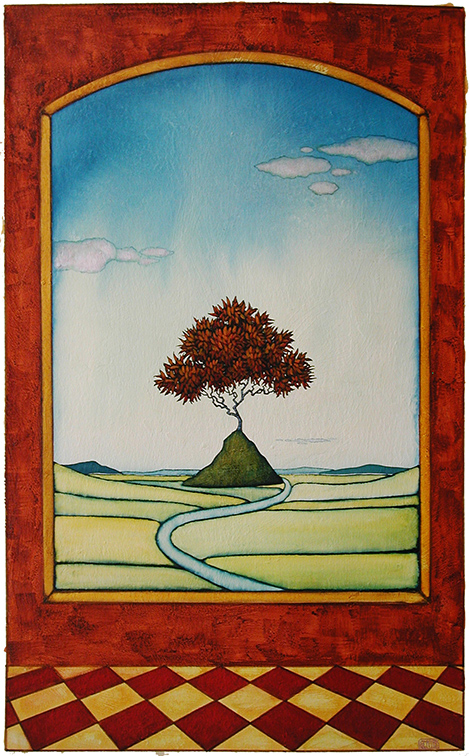
I picked the painting above for this song.The painting at the top is from my In the Window series from back in 2005 and is titled In the Window: Worlds Beckon. I chose it for this post because it reminded me of the thought of going home in the way of this song, that there is another world beyond this one. We may exist in this room, this life, now but there’s a whole different one just outside the window. That’s how this painting always struck me and it jibes with the song, at least for me.
I guess that I’m here in the studio at 5:30 in the morning is a testament to that fact. It’s always been that way for me even as a child. The prospect of what the new day might bring has always been exciting enough to rouse me in the early morning. On those days when I have a less than thrilling or an even dreaded task before me, the thought of getting started on that task so that it will just get done and out of the way does the same.
At times in my life when I worked the overnight third shift at other jobs, the idea of going to bed when the day was breaking seemed awful and the day always felt already spent when I eventually woke up only a few hours later, as though all possibility was drained from it while I slept. I could never get used to that.
As an early riser, you get used to seeing the day unfold and the light changing as the sun rises. Each morning is teeming with the potential of the new. Even when things aren’t going well, there seems to be the possibility that this next new day will bring that change that alters one’s course in a better way.
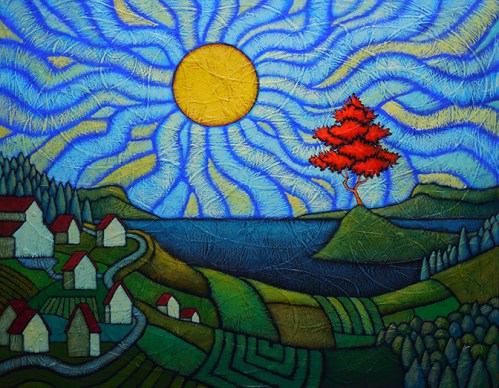
I think that’s what I see in this new painting, a 24″ by 30″ canvas that I am calling Early Riser, of course. The sun and its rays seem new and different but filled with a potency of possibility for the eagerly waiting Red Tree. Meanwhile, the neighboring community slumbers, not witnessing the breaking wonder that is the new day.
This was a difficult painting. By that I mean it took several attempts to achieve a sky that served what I felt as I laid out the initial underpainting or bones of the piece. Twice I got quite a ways into the sky, spending many hours each time, before painting it over and restarting. They were patterned skies but never captured a rhythm that synced with my own emotions in the piece. As soon as I set out the first rays of this last attempt, it felt right for this painting and everything fell into place.
And early this morning, I feel this captures my eagerness to greet the day. Now, I have to go– there are things to be done.
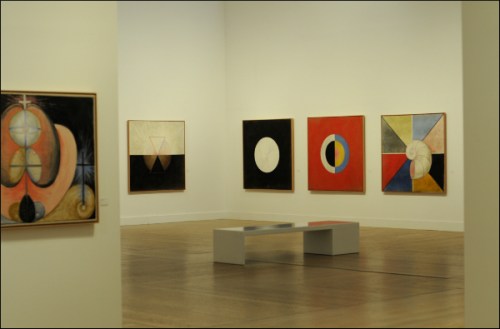
Just a few days ago, a new exhibit opened at the Serpentine Galleries in London. It features a group of abstract and symbolic paintings from a Swedish painter by the name of Hilma af Klint who lived from 1862 until 1944. The images of her work on display are quite captivating and intrigued me enough to look further into her work. It’s an interesting case.
She was trained in the 1880’s in Sweden as a traditional artist and for most of her life supported herself with naturalistic landscapes and portraits. This work is well done and attractive but unremarkable. She considered this conventional work as a means of supporting her “life’s work” which were the many spiritually inspired abstract pieces produced from the 1890’s up to the time of her death in 1944.
Interested in spirituality and theosophy, Hilma formed a group of women who met on a regular basis to hold seances to attempt to contact and channel the spirits from other dimensions. She claimed to have been “commissioned” by one of these spirits to create a series of large paintings which occupied her for a number of years. These paintings consisted of geometric and organic forms and a distinct visual vocabulary expressing a deeply spiritual element.
At the time of her death, there was a huge group of work, over 1200 paintings of varying. Some are epic in their size, measuring over 10′ in height. However, none were ever displayed publicly in her lifetime and she stipulated that it not be allowed to be exhibited until twenty years after her death. for fear that it would not be understood in that present time. Little did she know that it would actually be more than forty years before it came to light in an exhibit in 1986. In recent years there have been two major exhibits of her work, including this current show at the Serpentine Galleries, which have really pushed her work into the spotlight.
Her recent discovery and the depth of her work has created a quandary fo art historians who struggle to place her in the timeline of art history. Her work was formed independently of and, in most cases, before the abstract movement pioneered by Kandinsky, Malevich and Mondrian. They don’t know how to categorize her: Is she a pioneer or simply an outsider?
I don’t think this categorization matters. Just take a look at some of these works on display and most likely you won’t care either. The work definitely is in the present and alive. And that is all that matters.
I wasn’t going to feature another new painting here this morning but I felt that this piece just fits perfectly into the momentary state of our politics. At least how it appears to me.
In most of the recent paintings from this series featuring patterned skies (I don’t know what else to call them) the sky represents hidden forces and powers that are just beyond our sight and reach. It’s pretty much the same with this piece except that there is, at least for me, a more chaotic and turbulent aspect in the sky.
The tree stands as a direct counterpoint to this chaos, straight and unwavering. It has strength and resolve along with a placid sense of being. A sense of self awareness beyond the influence of the madness occurring beyond it. While it is simple in design, it has been a painting that has given me a lot to think about while at the same time calming me.
As I was nearing the end of this 18″ by 24″ piece, I began to think of the famous poem If from Rudyard Kipling and how it related in many ways to how I was seeing this painting. The poem is basically a father’s advice to his son, telling him all of the things he should learn to endure if he wants to become a man. It would also be good advice for the ideal political candidate, male or female. I think most of the people we have seen in this year’s presidential primaries fail to meet most of those requirements that Kipling has laid out.
The poem is below but if you would rather hear it read aloud, there is a recording of actor Michael Caine reading it at the bottom.
If you can keep your head when all about you
Are losing theirs and blaming it on you,
If you can trust yourself when all men doubt you,
But make allowance for their doubting too;
If you can wait and not be tired by waiting,
Or being lied about, don’t deal in lies,
Or being hated, don’t give way to hating,
And yet don’t look too good, nor talk too wise:
.
If you can dream—and not make dreams your master;
If you can think—and not make thoughts your aim;
If you can meet with Triumph and Disaster
And treat those two impostors just the same;
If you can bear to hear the truth you’ve spoken
Twisted by knaves to make a trap for fools,
Or watch the things you gave your life to, broken,
My latest works have been focusing on the use of pattern within my landscapes. Well, I guess you could call it pattern. There is often a motif of shape and sometimes a direction of movement but for the most part it is fairly chaotic and seemingly without order. Maybe that is what art is –trying to see pattern within chaos, trying to impose some sense of order so that we might better understand what we are seeing.
And maybe it is our reaction to seeing an emerging pattern that defines what we consider as beautiful. I am sure many of you have once seen an image that struck you immediately and remained in your mind even if it was only seen in a glimpse. I know I have. I am often mystified as to why this occurs. My only explanation is that its form and pattern somehow jibe with some innate sense of form and pattern, something inborn and with us since the beginning of our time as a species.
Perhaps even the patterns of those things of which we are made. Maybe the pattern is us.
And that could be expressed through religion. Or spirituality. Or physics. Or art…
That being said, this new painting is an 18″ by 36″ canvas that I am calling Into the Pattern. For me, it represents what I have written above– that we are part of the pattern and the pattern is part of who we are. The Red Tree here is understanding of this and begins to meld into the strong pattern of motion seen in the sky, as expressed by the leaves coming from its limbs.
This is a pretty simple image but it has a nice tension between chaotic motion and calm stillness of understanding. At one point, I had painted in a figure near the tree. For me, it absolutely destroyed the impact of the whole piece, distracting focus from what the painting was trying to send out. The figure just plain bothered me and it didn’t take much thought for me to decide to paint it over.
It was amazing how this changed the painting and my perception of it. Now, it is one of those pieces that I look at quite often throughout the day here in the studio, pondering what it is saying to me and trying to decide if we are part of the pattern or if it is part of us. Or both…
The more I read about this ancestor,the latest entry in my Icon series, the more interesting I find her. Her maiden name was Tacy Cooper and she is my 10th great-grandmother, born around 1609 in England. Little is known of her parentage or when exactly she came to America but she is known to have lived in Dorchester, near Boston in the Massachusetts Bay Colony in the early 1630’s.
At the time, the Colony was strictly ruled by the Congregational Church and its precepts. Very puritanical, of course. Many of the settlers who were coming into the colony sought more religious freedom than was being offered and under the influence of Roger Williams, set out in 1634 to leave the Colony and establish a new community outside its boundaries. They sent out a party of scouts who chose a site on the Connecticut River below present day Hartford. Soon after, a group of about 100 people set out by foot for this location. Among them was Tacy Cooper and her future husband, Samuel Hubbard. They met during this journey and Samuel later wrote that Tacy was the lone bright spot in the whole undertaking.
Although the heavy goods for the community had been shipped by boats from Boston up the river, it was a harsh trek. Many of their provisions had also been shipped and their trip was ill-timed. By the time of their arrival, a bitter winter had set in on them and the boats had not arrived nor would they arrive in the future. Without those provisions, a number of this group died that winter and those who remained survived on acorns, malt and grain that had brought along as seed for future crops. To make things worse, the Pequot Indians were attacking as they tried to stem the spread of the settlers into their territory.
But they persevered and in 1636, Tacy and Samuel were married. However, the religious freedom they sought did not come to bear in this new community. Samuel spoke up in protest to the role of the Church Elders in the local government and was driven from the community along with several other families who were in agreement with him. They fled south, settling in the area now known as Springfield, Massachusetts. They thought they were outside the boundaries of the Massachusetts Colony but in subsequent years, the provisions of the settlement of the Pequot Wars brought that location back into its realm. In protest, Samuel and Tacy became Baptists.
In the following years, Baptists were banished from the Colony and, after many threats, they fled once more, this time to Rhode Island where they were reunited with Roger Williams. They lived peacefully there for many years as members of the Baptist Church but it didn’t end there.
In the mid 1600’s, a movement had began in England– the Seventh Day Baptists. While they were almost exactly the same in their beliefs as traditonal Baptists, they observed their sabbath on the seventh day, Saturday. In 1665, Stephen Mumford moved from England to Rhode Island, bringing this new sect with him. He spoke of this beliefs to Tacy and Samuel and a few other members of the First Baptist Church of Newport.
It was Tacy alone who first chose to join with Mumford in observing a seventh day sabbath. Soon after Samuel and four other joined them and they formed the first Seventh Day Baptist church in America. Tacy is considered the first American founder of the church. The Seventh Day Baptists exist to this day and were a big part of my mother’s line for almost two hundred years and six generation, although I am pretty sure she would have not been aware of this fact.
While I am not a religious person in any organized sense of the word, I still find it fascinating in the way religion has shaped much of my( and just about everybody else’s) past. I am pleased that Tacy was such a strong woman. She was the one who stood and answered the Church Elders when she and the others were made to account for their desire to break from the Baptist Church. She went before the congregation and with “great clearness and force” outlined their reasons for departing. I can’t help but think that this must have been a rare moment in early America– a woman speaking to power.
This may not be the best painting of the Icons but it moves me in the same way. I always hope to find something in these stories that I can take for my own life and I can only hope to one day have Tacy’s strength and conviction.
Between two worlds life hovers like a star, ‘Twixt night and morn, upon the horizon’s verge. How little do we know that which we are! How less what we may be! The eternal surge Of time and tide rolls on, and bears afar Our bubbles; as the old burst, new emerge, Lash’d from the foam of ages; while the graves Of Empires heave but like some passing waves.
—Lord Byron, Don Juan
***************
I chose the stanza above from Lord Byron’s Don Juan to kind of describe this new painting because it seemed to fit so well what I was seeing in this piece.
When I look at it the Red Tree seems to be an intermediary between differing worlds– between the solid ground of earth and the airiness of the heavens, between the closer living of the settlement of houses and the wide open spaces of the fields and hills beyond, between the now and eternity, between the visible and the invisible.
Standing with one foot in either world, it becomes a moment of contemplation on the temporary nature of our existence. Standing there before the suddenly visible and unrelenting power of nature and the universe– the eternal surge of tide and time— the Red Tree recognizes its own smallness and insignificance–How less what we may be!
This idea of insignificant beings living but for a short time may seem like a dismal prospect to some. But I don’t see it that way. If anything, I see this as a celebration of just having the opportunity to bear witness to the grand spectacle of life set before us each day, to have a chance to play a part, albeit small, in the machinations of the universe.
Maybe this is too much for a simple painting such as this to bear. Maybe you will not see it in the same way, only seeing a tree on a mound overlooking a group of houses with a patterned sky. That’s fine because in its simplest terms that is what it is.
But even the simplest moments and images can have greater depth and meaning if we only choose to look more closely, to choose to perceive our place in the world in a different manner.
Well. that’s what I think anyway…
—Oh, this painting is 18″ by 18″ on canvas and I am calling it Jumping Off Point.
Not until we are lost do we begin to understand ourselves.
—Henry David Thoreau
**********************
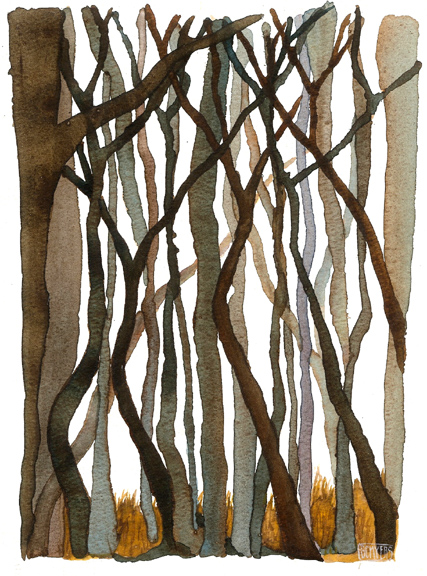
I used the painting above to illustrate a post several years back. Titled I Was Lost, this is an experimental piece I did back in early 1997. It remains one of my favorite pieces, one that I linger over when I come across it in my computer’s files or when I go through some older work stored in a bin here in the studio.
There’s nothing special about this piece. It’s a simple thought that was quickly rendered. It definitely didn’t end up anywhere in the vicinity of perfection. Some of the lines veer and quiver uncertainly while the tree trunks sometimes bulge erratically. There’s not really much to grab onto in this piece.
Yet for all it’s deficiencies there is something in this painting that simply speaks to me in a personal way. There’s a flawed elegance in it that moves me– a grace that provides me with hope on those days when the world seems bleak and it is hard to see beyond the trees that obscure the path ahead.
Thoreau’s words mesh well with this piece. To put it another way: Adversity builds character. A-B-C.
When we are lost in the woods, look past the trees that block our view. There’s a way forward. We may not like it at the time but every challenge provides us with the opportunity to discover more of who we really are.
Sorry for going off on a pep talk this morning. Hopefully, you didn’t need it. And if you did, I hope this helps a bit.
Painting is the pattern of one’s own nervous system being projected on canvas.
—Francis Bacon
********************
I am still in the midst of processing this new painting for myself, trying to determine what it is saying to me. For now, I am calling this 16″ by 20″ canvas Sustenance. There is something about the pattern of the sky filled with rays containing smaller strokes that remind me of surging atoms. Maybe it’s my own nervous system being projected as Bacon says above or maybe it is an energy that feeds everything. The ubiquitous energy that transforms into vibrant, richly colored life.
I am still not sure.
You might notice that this is not a Red Tree. Yes, this is the rare Green Tree. Coming to the end of this painting, I decided on green as a contrast to the reds and oranges I had used for the land around the tree. It just felt right from a design standpoint and I think it works here.
It has emerged better than I had originally thought it might when I was working on it. But, as I said, I am still taking this in. There are a lot of things in this simple painting that speak to me but I still can’t exactly put them into words.
And I kind of like that it doesn’t have an obvious read for me, that it leaves me without words. So, I will stop now and just try to figure out what those words are…
I’ve written here about how uncertain the future is for any artist’s legacy. I usually point out that how one’s work fares in the next few generations and beyond is out of the artist’s hands. I can cite example after example of artists who have created brilliant work in their time yet whose names and images remain relatively unknown in this time. Their work often goes for relatively little at auctions and is seldom spoken of, yet it is nonetheless beautiful and moving.
One fine example is John Liston Byam Shaw ( most often known as simply Byam Shaw) who was a British artist and illustrator who lived from 1872 until 1919, dying in the influenza epidemic after the first World War at the relatively young age of 46.
John Liston Byam Shaw- Boer War
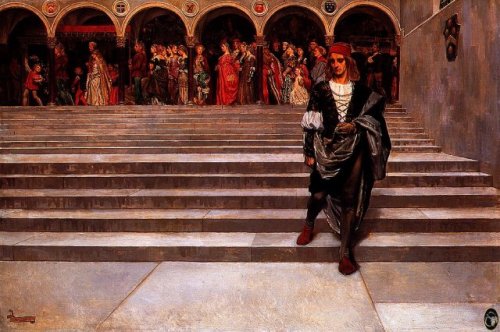
Heavily influenced by the Pre-Raphaelites, Shaw produced what I consider a large and gorgeous body of work. It is wide in the scope of its themes and imagery and when I look at the Google Images page there is one after another of just great paintings.
The image shown here on the right, Boer War, is perhaps his best known painting. It a war painting without the actual imagery of war, depicting the sense of loss and despair felt by those loved ones who survive the fallen.
A more obvious reference to the aftermath of war is shown in the painting at the top of this page in The Flag, a memorial piece done at the end of WW I. I am really drawn to the use of color and tone in this painting. Just a wonderful painting.
There are so many more that I have selected just a few that struck me. If you look for yourself I am sure you will find some others that will do the same for you. One of the paintings shown below, the first at the top of this group , a watercolor titled The Ballad of Luther, went to auction in the last few years and didn’t even draw an opening bid of less than $900.
As I said, legacy is out of the hands of the artist. All they can do is to make an effort to produce work that fills their own need for expression and emotion. I think Byam Shaw definitely did this and that is enough, especially for those fortunate enough to find his work.
John Liston Byam Shaw – The Ballad of Luther
John Liston Byam Shaw- Queen of Hearts
John Liston Byam Shaw-This is a heart the queen leant on / Marriage Procession Arthur and Guinevere
John Liston Byam Shaw-Queen Mary and Princess Elizabeth Entering London
John Byam Liston Shaw- Now is the Pilgrim Year Fair Autumn’s Charge
John Liston Byam Shaw- Rising Spring
John Liston Byam Shaw -Illustration for Old King Coles Book of Nursery Rhymes
 Last week, we watched the HBO documentary Mavis! which is, of course, about the career of singer Mavis Staple. Ever since I have been going to YouTube to listen to her early gospel work with her family, the Staple Singers, in the 1950’s. It’s just great stuff, a little gritty and blues-edged beneath with her vocals soaring above it all. It seemed so ahead of the time, especially given what was being played on pop radio at that point.
 The early morning has gold in its mouth.
 Just a few days ago, a new exhibit opened at the Serpentine Galleries in London. It features a group of abstract and symbolic paintings from a Swedish painter by the name of Hilma af Klint who lived from 1862 until 1944. The images of her work on display are quite captivating and intrigued me enough to look further into her work. It’s an interesting case.
 Interested in spirituality and theosophy, Hilma formed a group of women who met on a regular basis to hold seances to attempt to contact and channel the spirits from other dimensions. She claimed to have been “commissioned” by one of these spirits to create a series of large paintings which occupied her for a number of years. These paintings consisted of geometric and organic forms and a distinct visual vocabulary expressing a deeply spiritual element.


 I wasn’t going to feature another new painting here this morning but I felt that this piece just fits perfectly into the momentary state of our politics. At least how it appears to me.
 My latest works have been focusing on the use of pattern within my landscapes. Well, I guess you could call it pattern. There is often a motif of shape and sometimes a direction of movement but for the most part it is fairly chaotic and seemingly without order. Maybe that is what art is –trying to see pattern within chaos, trying to impose some sense of order so that we might better understand what we are seeing.
 The more I read about this ancestor,the latest entry in my Icon series, the more interesting I find her. Her maiden name was Tacy Cooper and she is my 10th great-grandmother, born around 1609 in England. Little is known of her parentage or when exactly she came to America but she is known to have lived in Dorchester, near Boston in the Massachusetts Bay Colony in the early 1630’s.
 Between two worlds life hovers like a star,
 Not until we are lost do we begin to understand ourselves.
 Painting is the pattern of one’s own nervous system being projected on canvas.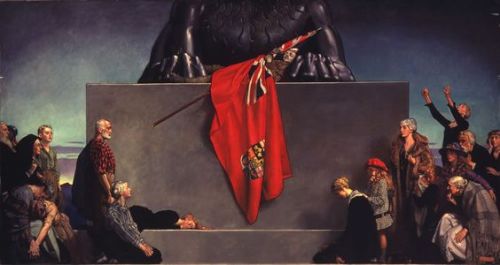




 Redtree Times