Feeds:
Posts
Comments

Archive for the ‘Painting’ Category

van-gogh-self-portraitI showed this short video here about six years back.  It’s a compilation of morphing self portraits from Vincent Van Gogh put together by Phillip Scott Johnson that I found intriguing then and now.

It’s a short piece, less than a minute in length, and it’s interesting to see how the familiar views of Van Gogh relate to one another and how his appearance or, at least,  his perception of it, changed through the years.   His state of mind is evident in each piece, with some showing a vibrant, seemingly healthy man and others showing the more tortured Van Gogh that we tend to think of as the man.

I found it interesting now because I have been spending some time recently looking at my own older work in a different way.  I am not looking at the pictures as whole images.  Instead, I have been looking at the individual marks I am using in each and seeing how it has changed through the years.  Or how it has stayed the same in some cases.

I’ve always said that my painting for me was a continuum that, while changing all the time, always seemed the same to me– always in the present.  But looking at it in this manner I am finding that my mark-making does change periodically which fundamentally changes the way a picture is painted and how it emerges in the end.

It’s not something I often think about– I just paint in whichever way the moment strikes me.  Sometimes it is dependent on the condition of the brush or the weight and quality of the paint I am using.  As a brush ages and wears, especially with the rough treatment given to them by me, it makes a more and more distinct mark that I find appealing.  Looking back, I can often tell when I am using fresh or old brushes.

So, I watched this film in the same way and it is fascinating to just look at Van Gogh’s mark-making throughout without focusing on the faces.  It is varied and each differing style serves the image in different ways.  Some marks are wildly expressive and others small and quietly acting in service to the greater whole.

As I said, it’s less than minute and interesting even if you don’t give a damn about the mark-making part of it.


Read Full Post »

GC Myers- Icon: Joe H.Here’s my latest entry into the Icon series, a 12″ by 12″ canvas piece that is titled Icon: Joe H.  He is my 3rd great-grandfather and his name was Joseph Harris and he was born in the Lindley (the town named after our common ancestor, Eleazer Lindsley,who was among the first Icons) area south of Corning in 1833.

He led a fairly typical life for the time and place, serving in the Civil War and raising a family.  He worked primarily as a blacksmith and a sawyer ( I have a lot of lumbermen in my family– maybe that’s where my affinity for trees comes from) in his early years, working for a number of years in the then booming timber business that was taking place in northern Pennsylvania and western NY.   It was there that his wife, Emeline Whitney, died just a year or so after the end of the Civil War.  Later in his life, he returned to the area of his birth, settling in as a farmer  just over the border in Pennsylvania where he died in 1922.

That was about the extent of his life for me, at least what I could find of it in records.  I did discover that he married his step-sister, Jennie, who was twenty years younger, as his second wife.  But it was my research into local newspapers that gave me a better sense of him.

Looking at records gave no indication of anything but the basics but in his 1922 death notice printed in the Wellsboro Agitator ( I love the name of that paper!) the headline lists him as a “Skilled and Noted Musician.”  It goes on to say that he had been the one-time Banjo Champion of the United States.  He very well may have picked up the banjo from his Civil War experience as it’s popularity in the time after the war is often attributed to many people being exposed to it for the first time during their service.  I could never find anything to document a championship which was no big surprise as it most likely occurred somewhere in the 1870’s or 1880’s and whatever group sanctioned the competition is more than likely no longer in existence.

But I was pleased to know that music played a big part in his life and I later found an item that confirmed this.  It stated that his son, William Harris, was working as a musician in one of the  oilfield boom towns in northern PA in the 1890’s when he tragically took his own life by shooting himself at the hotel where he was living.  As is often the case, you find a lot of tragedy when you look backwards so it’s some consolation to know that there was a bit of music and joy mixed in there somewhere.

I did visit Joe’s gravesite a while back.  It is a bare-boned and flat plot of land that sits next to a harsh little trailer park visible from the new interstate.  Standing at his grave you looked into the backyard of several trailers, the kind of yards scattered with kids toys, spare tires and oil drums.

It made me a little sad but then, I guess a guy who lived through the Civil War, endured the death of his first wife and several of his children before him and lived to see the first World War, this wasn’t all that bad.

Read Full Post »

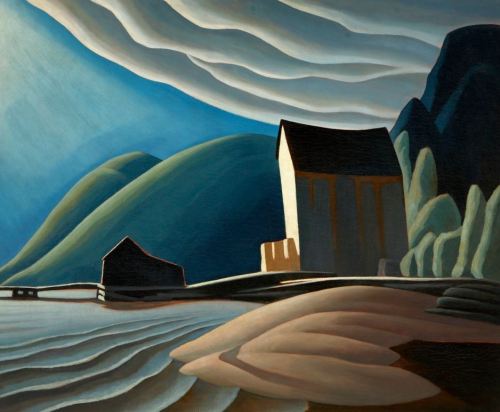
Lawren Harris- Ice House, Coldwell, Lake Superior 1923

Lawren Harris- Ice House, Coldwell, Lake Superior 1923

Art is the distillate of life, the winnowed result of the experience of a people, the record of the joyous adventure of the creative spirit in us toward a higher world; a world in which all ideas, thoughts, and forms are pure and beautiful and completely clear, the world Plato held to be perfect and eternal. All works that have in them an element of joy are records of this adventure.

Lawren Harris

****************

I love this quote from the great painter (please note that I didn’t preface it with Canadian) Lawren Harris.  I know that whenever I am working and am excited with the joy of what is unfolding before me, I feel closer and more connected to some sort of power that is beyond my knowledge.  It’s as though I feel tapped in to that winnowed result of the experience of a people as Harris puts it.  That is a great feeling, exhilarating and calming at the same time.  It is ultimately the feeling that brings one to art, both as a viewer and a creator.

Unfortunately, in the course of creating, it is sometimes a feeling that is forgotten, put aside for ends other than this element of joy.

It’s easy to do, believe me.

But rediscovering that joy is like coming across it for the first time.  Even though you know you have experienced it before, it feels all new and shiny, full of promise.

Effervescent– that is the word that comes to mind when I think of these moments of joy.

So, let me stop right here.  I am close to my own joy and don’t want to delay it for another minute.  Effervescence will not wait around too long, you know.

Hope you find some of your own today.

Read Full Post »

GC Myers- Where the Winds GatherSometimes I will get an image in my mind that seems all fleshed out and full.  It’s just a matter of moving that image from the inner workings of my consciousness into the outer world of reality.  Sometimes, it goes smoothly and the final painting matches that first thought of it.

But more often, that trip from thought to reality produces something completely unlike the original vision. And sometimes that is not so good.  The work shows the struggle in trying to force the vision into reality and the whole thing looks forced and without rhythm.  But occasionally, one slips out that is not at all like the original vision but somehow finds its own rhythm and comes to life on its own.

I think that is what happened with the painting shown above, a small 9″ by 12″ canvas that I call Where the Winds Gather.  I’ve had an image of this painting in my mind for a few weeks and as I would be doing other things it would often bounce through my mind.  But it looked much different than this painting.  The color was not the same nor was the manner in which the whirls of wind in the sky were painted.  Some of that is the result of working in a smaller size which restricted the type of marks I could make with my brush.

There was a point when I was well into this piece that I could see that it had strayed far afield from my original concept and I began losing my enthusiasm.  For a while I wanted to just set it aside or simply call it a day and paint it over.  But I decided to push through and see if it could evolve into something more.  And slowly it did, at  least in my own eyes.  There’s an interesting balance of rough and soft in this and the pattern in the sky came together much better than it appeared in its earlier form.

There’s just something I like in this piece.  Maybe it’s just the fact that it came to life despite my own original misgivings.  I know that I admire that kind of determination from someone in overcoming the low expectations placed on them.  Grit.

Maybe that should be the title– Gritty Determination.


Read Full Post »

This quote from Leonard Bernstein came back to mind when I recently  ran across this post from several years back.  It’s a big part of what I do and seeing it again serves as a reminder that feeling that sense of place is vital in achieving work that I feel has life in it.  Off the top of my head, I can’t recall where this painting finally found a home but I am hoping it is serving its caretaker as well as it served this post which I am reposting today.
GC Myers - A Strange and Special Air 2011“Any great art work … revives and readapts time and space, and the measure of its success is the extent to which it makes you an inhabitant of that world – the extent to which it invites you in and lets you breathe its strange, special air.”

—Leonard Bernstein

^^^^^^^^^^^^^^^^

I came across this quote from Leonard Bernstein that I really thought captured what I hope occurs in my work.  I think that my work is most successful when people allow themselves to feel themselves as part of the landscape before them, to enter and breathe in that strange and special air, as Bernstein describes it.  I know that this is the case for myself.  I have written about this here before, about how these landscapes, with their blue and orange fields and bright red trees, feel as real to me as looking out my studio window.  The fact of the blue in the field is overruled by its harmony within the composition which creates that sense of rightness to which I often refer.

Maybe this sense of rightness is what makes up that strange and special air.  I don’t know. I only know that I still seek words or explanations to describe why a painting works, by which I mean has an emotional impact on the viewer.  The new painting above is such a piece for me. It’s a 15″ by 25″ image on paper that I am calling, thanks to Mr. Bernstein, A Strange & Special Air.

I could sit here and try to break down the painting, talking about color and contrast, texture and depth.  Line quality and composition.  All of the things that I might momentarily consider while I’m at work on such a painting.  But when all is said and done, I still have no idea why it has its own life, its own strange and special air.

Except that I feel that I am there, transported into that strange and special air,  when I look at it.

And glad of it.

Perhaps that is enough and all that needs to be considered. For now, I accept that and will be satisfied to dwell in this landscape with its strange and special air.

Read Full Post »

GC Myers-  Icon: FrancoisMy current Icon series has been a real pleasure for myself in that it’s refreshing to work on pieces that I realize are only for myself, not worrying if they strike a chord with anyone else.  For me, it’s fulfilling to flesh out some of my ancestors and their stories, to give them an image that I an hold on to.  As I’ve said these are meant as symbols– I’m not trying to recreate their actual appearance.  In most cases, there is nothing to work with, nothing that would give me a clue as to how they might really look.  So, this is how I see them in my mind.

The painting at the top is a 12″ by 12″ canvas that is titled Icon: François.  He is my 9th gr-grandfather, born in 1640 in the area around Boulogne, France.  It is on the English Channel not to far from Calais.  He was a soldier in the Grandfontaine Company of the Carignan Regiment,  which was sent in 1665 to Quebec in what was then called New France.  The troops came in several ships, François arriving in August aboard the ship L’Aigle d’Or— the Golden Eagle.

These 1200 troops were sent to protect the new settlements that France had established and to aide in fort construction along the Richelieu River.  They were also sent for another purpose– to help populate New France.  Some were offered money or land to stay in the new country and build a life there.  François, I believe, fell into that category as he showed up soon after in census listings as a master woodworker living in Quebec.

While I am not positive that he received any incentives to stay in New France, such is not the case with his wife and my 9th gr-grandmother, Marguerite Paquet.  She was one of the Filles du Roi, or the King’s Daughters.  Between 1663 and 1673, King Louis XIV sponsored this program which offered young French women, all single and many orphaned, free transportation and settlement to New France along with a dowry of money or land in the new land if they agreed to marry one of the men living there.  You see, the first settlers were overwhelmingly male.  I have at least two or three Filles du Roi in my line as do most French Canadians.

François died as relatively young man in 1675 but not before he and Marguerite had three children which set off a long line that runs through Canadian history to today, spawning hundreds of thousands, if not millions, of descendants.

I see François is this painting as an Adam-like character, naked and in a new world that he will one day help populate. The brushstrokes radiating from the halo represent the generations that descend from the choice he and his wife made to seek a new life in the new world.  It’s a simple painting and a relatively simple story– at least as simple as you can make one’s entire life into a short tale.

Read Full Post »

GC Myers The Journey Begins 2002I’ve always put my work out there on the internet, never getting upset when people use it for their own purposes so long as they aren’t claiming it as their own or selling it in any form.  After all, the whole purpose in doing this is to expose the work to as many people as possible.  Periodically I check to see where it ends up.  It’s interesting to see how several sites use my work on their masts, especially groups associated with archaeology who use my work from the Archaeology series.

The painting above, a piece from 2002 called A Journey Begins, was used back in November to illustrate the winning entry in the 2015 English Poetry Contest  at  Hong Kong Baptist University.  The poem is titled The Lie and was written by Zabrina Lo, a third year student in Language and Literature.  I was struck how well the two pieces of art blended, each fitting perfectly well with  and complementing the other.

Here is the poem The Lie from Zarina Lo:

Her seat has been empty for a year.
Still we sit
together. Not together. Around the table
we eat the tasteless water chestnut cakes
which I insist ordering.
I lie that the plum rain of China in early January
nourishes the jade-like crunchy corms –
the best time to savour this New Year’s dish.

But I am silenced
by the huge heap of sliced cakes that remain
almost untouched by everyone here
except me
and by my father’s empirical science of how autumn, not winter,
is the harvesting season.
Already gone.

But I can’t refrain from lingering on
the past winters when my mother, with her gnarled veiny hands,
insisted on making and filling my tiny childhood plate full with
her – not my – favourite water chestnut cakes.
She never knew that when I said I loved her cakes, I loved
her smile at the sight of me eating, savouring, appreciating her cake –
her world.
That sight gave her bland, unrecognized life the sweetest touch she’d ever known
in our home where water chestnuts never grew, cracked and bloomed
through the floors, walls, ceilings and
outside the window.
She never knew
that the sweetness I tasted was not from the cake
but her heart.

I imagine
that if I listened hard enough I would hear the crunch of water chestnuts
from the empty chair next to me
where she would be sitting and smiling as usual
as if New Year never came,
and that I could tell her honestly
the blissful flavour she thought I liked
was never there
and would never be there again.

Read Full Post »

GC Myers- Icon- Peter the ScoundrelThis painting, a new 24″ by 20″ canvas, is titled Icon: Peter the Scoundrel.  This may not be my favorite painting from the Icon series that I’ve been working on as of late but this has been by far the hardest piece for me to complete.  It just kept going and going and I completely repainted the head and face at least six different times.  Each face never felt right and I could not get a handle on how I wanted to portray the person behind this painting.

Actually, I could never get a handle on this person, period.

His name was Peter Bundy, my 3rd great grandfather and he is buried in an old cemetery in Caton, just outside of Corning.  It’s a cemetery that I knew well from my childhood, having spent a lot of time with my favorite cousin in Caton.  In fact, my cousin worked in the cemetery as a teen, digging graves by hand.  I never knew at the time how many ancestors of mine were buried right there but doing research on my family lines I found that there were dozens and dozens of relatives there including  this Peter Bundy.

His grave stone says that he was born in Scotland in 1823 and served in the Civil War with the Ohio 75th Regiment.  Doing a bit of research I found a veteran’s pension record from the 1890’s that stated he had been captured and held at the infamous Andersonville Prison Camp.  That same record listed him as having an aliasCharles McKinney.  My mind began to imagine that perhaps he was a Union spy.

If only it could have been that simple.

A few years passed and one day I had a message about my family line on the Ancestry site.  It was from a family who had done research on their family line and had found that my gr-grandfather Peter Bundy was also their gr-grandfather.  Except that he had a different wife and a different name– Levi McProuty.  It turns out that my Peter Bundy held that name and married  under it in the years before the Civil War.   Living in western Steuben County, they had two children, a boy and two girls, before he ostensibly left in 1861 to serve in the Union army.  A year or so later, his wife was informed somehow that he had been killed in combat.

She and her children never saw him again.

It seems that in the year that he was gone, he had shed the name of Levi McProuty,  married my 3rd great-grandmother, Elizabeth Everetts, and had a child, my 2nd gr-grandmother.  While he may not have even served in the war as Levi McProuty, he did leave for service in the Civil War as Peter Bundy.  He returned to his second wife and child.

However, for the next twenty or so years, he didn’t show up in any public records.  But his wife and child did– his wife under the name of McKinney and his daughter under her married name.  He showed up in some veterans’ pension records  and the census before dying in 1901.  His wife died in 1915.  Both were listed under the Bundy name.

I don’t know if this is clearly written so that you can follow it– I know that it is so convoluted that I have trouble keeping it straight in my head.

So, was he really Peter Bundy or Levi McProuty?  Or Charles McKinney?  Or somebody completely different?  Was he even born in Scotland?  I find myself thinking that he may not have even served in the war, that he may have stolen the identities of other soldiers.  How he ended up serving in an Ohio regiment– Ohio being several hundred miles away– is another question that comes to mind.  Was his time at Andersonville just another lie? I don’t know if anything that is considered factual about this person is indeed real except for the fact that this person, my great-great-great grandfather, lived for a time and died in Caton–that’s on his gravestone.

And that he was a scoundrel.  That is not on his stone.

I think it’s this doubt that fed the troubles I had with this painting.  I could never see a face or a facial expression that suited this person because I never had an idea of his truth.  And just when I thought I would have a sense of him, there was always a new twist with which to contend.  When I had the different faces on this figure I felt a lot of discontent and anxiety, even waking up in my sleep thinking about it.

So yesterday morning, I came into the studio and decided to just simply put him in a mask.   A grinning, mocking mask that let’s me know that I don’t really know him and I doubt that I ever will.


Read Full Post »

GC Myers- Icon-EleazerWhen you delve back into your ancestry you often uncover surprises, some pleasantly exciting and some a bit disappointing.  In some cases, it’s a bit of both.  Such is the case of the person behind this latest painting from my current Icons series.  This piece is 24″ by 12″ on masonite and is titled Icon: Eleazer.

The person represented here is a fellow named Eleazer Lindsley.  He was born in Morristown, New Jersey in 1737, a member of the family that founded much of that area.  He did well in the years before the American Revolution, owning a grist mill and several other businesses.  He was a man of status that was increased with his participation in the war.  He served as a Colonel and acted as an aide-de-camp to both General George Washington and General Lafayette.  Both were guests in his home at various time and Lafayette personally gifted and placed a signet ring on Eleazer’s hand in appreciation. It was never to come off and was buried with him when he died in 1794.

After the war, for some reason Eleazer chose to leave the comforts of his home state and set out with his extended family to settle in the newly acquired frontier territory.  After the war, the government took much of the land in what is now central and western NY and divided it into parcels that were given to those who served in the war as a form of payment for their services rendered.  Under these Land Patents, a private might receive 200 acres, moving up through the ranks to a general who might receive 2000.   When Eleazer and his family arrived in this area they collectively held 6000 acres.

They settled just south of what is now Corning, NY, occupying a fertile river valley.  Today, much of the area probably still looks relatively unchanged from that time with most of the land still in fields and forests. This area is now the town of Lindley— they dropped the “s” from the name in the 1840’s for some reason.  Eleazer became the first state assemblyman from the area.  He was also active in a plan to secede from NY and from a new state consisting of the area that is now central and western NY.  When he died in 1794, this plan died as well, although it has periodically been thrown out there by upstaters over the years.

There’s a lot more to tell about Eleazer, much to be proud of,especially for someone like me who grew up near the area and never knew of my connection with the founders.  But there was also one dark fact that taints the whole story.

You see, when Eleazer arrived in their new home their party consisted of about 40 members, most of them my ancestors.  But among the group were also seven slaves.  The family story, much of which is contained in family papers and documents held now at the University of  Michigan, claim that the slaves were treated as family members, one being called Uncle Pap, and that they were eventually emancipated in the very early 1800’s.  A story written in the late 1800’s says that many of the slaves settled and raised families in the area.

Now, part of me wants to believe that part of the story or to write it off as simply being an accepted thing at the time–after all, Washington, Jefferson and so many other Founding Fathers had slaves.  But the fact remains that Eleazer owned slaves and it bothers me that he somehow justified that in his mind, especially given that he so heartily participated in a war of independence.

When painting this piece, I found it hard to not make him a bit harsher in his gaze.  Though there is no evidence of mistreatment,  he holds a pair of shackles in his hands as a symbol of slavery.

When you do genealogy you often find yourself hoping for and attributing high ideals to your ancestors.  You want to see them in the very best light and tend to set aside negatives.  But as you dig more and more, you find that they are simply the same flawed humans that we encounter every day, possessing good and bad qualities. I often find myself wondering if I would personally like these ancestors.  But, like him or not, Eleazer is part of my family tree. But I do like this painting, if only for the narrative behind it.  I think the dichotomy of light and dark elements in the story are exactly what I hope for in this series.

Read Full Post »

GC Myers- Icon-William EnglandAs pointed out in recent posts, I’ve been working on a group of new work that I am calling Icons, images that put people that I have come to know through doing some genealogical work.  They are not intended to be accurate depictions of these ancestors.  In each case, I have just found something compelling that sticks with me.  Such is the case with the painting above, a 10″ by 20″ canvas that I call Icon: William England.

I grew up knowing almost nothing about my ancestry.  In fact, I thought that a generation or two back, somebody had inadvertently tipped over a big rock and we had spurted out before they could put the rock back in place.  Not a lot of esteem at that point.  So it was a thrill as each new layer of our family history was uncovered.  I was pleased to see how many ancestors served in all of the wars of our country going back hundreds of years.  Many had fought in the American Revolution.

It turns out, on both sides of the conflict.

I can’t remember the source but I read once that during the revolution the American public was divided pretty evenly into three parts: a third that desperately wanted our independence from Britain, a third that wanted to remain part of the British Empire and a third that really didn’t care either way so long as they could live their lives as they had up to that point.  The  first group, of course, were the Patriots that we have come to believe was everyone living in America at that point and the second were the Loyalists who identified themselves as British living in the America colony.

One of my ancestors was a man named William England who fell into the Loyalist group.  Born in Staffordshire, England, he came to America as a teen and settled in the Saratoga Springs area of New York after serving in the British 60th Regiment during the French and Indian War.  He purchased a farmstead in Kingsbury, NY and was settled in when the Revolution broke out.Faced with the choice of breaking from his homeland or remaining loyal, he chose to protect what he felt was his British homeland.

Serving as a Sargeant with McAlpin’s Rangers, he fought in a number of battles including Burgoyne’s defeat at Saratoga.  British troops and families were driven north into Canada, settling in the Three-Rivers area of Quebec.  It was there that he, along with many other Loyalists, settled and raised his family in the years after the war, most of his children integrating through marriage into the early families of French Canada.

Many worked their way back into America in the late 1800’s, including his grand-daughter Mary England who died in St. Regis Falls, NY in 1896.  She was my 3rd great grandmother who was married to Jean-Baptiste Therrien.  Many of their children’s names were anglicized from Therrien to Farmer when they moved into NY.  I came across a photo of her when she was quite old and you can see the hardness of rural Canadian life written in her face.

This painting shows the conflict ( or at least the conflict I perceive) that took place in William England when the war broke out.  He had to make a hard decision, one that cost him his farm and all of his possessions, in order to stay loyal to his homeland.  He had to break the bond ( shown here in the form of the broken tree limb) with the America that emerged and face a new life in a territory he did not know.

We all have interesting twists in our family trees, some that take us in directions we would never imagine.  While I am proud of my ancestors who fought for the American cause, I am equally pleased with the loyalty and devotion shown by William England.

Read Full Post »

« Newer Posts - Older Posts »