Feeds:
Posts
Comments

Archive for the ‘Poetry’ Category

+++++++++

“We shall not cease from exploration
And the end of all our exploring
Will be to arrive where we started
And know the place for the first time.”

― T.S. Eliot, Four Quartets

++++++++++

The painting shown above is Light and Wisdom, part of my show, Moments and Color, that is currently on the walls of the West End Gallery. It’s a personal favorite of mine and one that I think sometimes get overlooked by other work that is larger or brighter. Maybe it’s just that I see a lot of personal symbolism in it. The background of the sky resembles a maze which symbolizes the search for something, for example. And it has my recurring symbols of the Red Roofs, the path that runs toward a distant point, the guide trees that frame the scene, the far horizon and, of course, the Red Tree arriving at a moment of realization in the form of the light from the rising sun.

It’s a meaningful piece for me and my hope is that others will see that in it as well.

I love the lines below it from T.S. Eliot, feeling that they express so well what I see in this painting. Life often feels like a constant search for some vaguely defined object– knowledge, wisdom, love, experience, etc.– that will make us somehow whole. Yet, as is often the case, we only reach wholeness within ourselves, in that place where the journey began. Maybe that is why I chose this painting for this bit of verse from Eliot– it has a sense of wholeness that has been ultimately fulfilled by realizing that the answer was in itself.

The answer, the light that illuminates our meaning, is always near, always just waiting for us to really see it for what it is.

+++++++++++++++

You can see Light and Wisdom at the West End Gallery where I will be giving my annual Gallery Talk this coming Saturday, August 17, beginning at 1 PM. As mentioned here before, the Gallery Talks always features some great conversation, some laughs, occasional tears and the pièce de résistance, a drawing for an original painting — or maybe two?–along with some other pretty neat prizes. Hope you can make it there!

Read Full Post »

Bazonka

Hard to believe I’ve been doing this blog for nearly eleven years now. It’s just part of what I do now so I don’t really think about it much. I was going over some stats from the site and found that the entry below from ten years back, in late August of 2009, has the most views of any single post, well over a hundred thousand hits. It’s a silly bit of verse from the late British-Irish comedian Spike Milligan called Bazonka.

In a world where everyone is trying to tell you what you should do, saying Bazonka might not be the worst advice you’ll get today. So, let me be the first to say it. Bazonka!

********************


BAZONKA

Say Bazonka every day
That’s what my grandma used to say
It keeps at bay the Asian Flu’
And both your elbows free from glue.
So say Bazonka every day
(That’s what my grandma used to say)

Don’t say it if your socks are dry!
Or when the sun is in your eye!
Never say it in the dark
(The word you see emits a spark)
Only say it in the day
(That’s what my grandma used to say)

Young Tiny Tim took her advice
He said it once, he said it twice
he said it till the day he died
And even after that he tried
To say Bazonka! every day
Just like my grandma used to say.

Now folks around declare it’s true
That every night at half past two
If you’ll stand upon your head
And shout Bazonka! from your bed
You’ll hear the word as clear as day
Just like my grandma used to say! 

— Spike Milligan


******************

Read Full Post »

**************************

For how can you compete,

Being honor bred, with one

Who were it proved he lies

Were neither shamed in his own

Nor in his neighbors’ eyes;

William Butler Yeats,

From To a Friend Whose Work Has Come to Nothing

*************************

I can’t say that I am a big Bill Kristol fan, the conservative political analyst, but yesterday he deftly used the excerpt above from a W.B. Yeats poem to describe the Mueller hearing of the day before. It so well described an honorable man dealing with the current occupant of the white house* and his minions in congress* that I wanted to know a bit more about that particular piece of verse.

It turns out that the poem from which those lines come is titled To a Friend Whose Work Has Come to Nothing that was included in a small volume of poems called Poems Written in Discouragement 1912-13.

The poem is at the bottom of the page and at first I thought it referred to someone in Yeats’ universe, a writer or artist or playwright, who had put their all into their work for years and years only to never be recognized for that work while others– who this person at least equals in talent and effort– gain greater recognition. That seems like a logical interpretation.

Turns out there is a different story behind the poem.

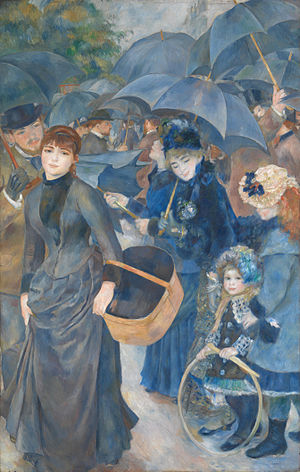
It has to do with an Irish art dealer named Hugh Lane who was trying to establish a public art gallery that would bring modern art of that time to Dublin at the beginning decades of the 20th century. He proposed to give the city his collection of 39 modern masterworks from Renoir, Manet, Degas, Monet, Daumier, Pissarro and Morisot so that they might establish a museum/gallery. The painting at the top from Renoir, The Umbrellas, was part of his collection.

To that time, Dublin had yet to display the new art of the age and its city fathers and religious leaders were not swayed by the offer. They viewed the new art as being decadent and with an air of libertinism to it. This turned into a heated public battle in which Yeats and others in the Irish artistic community fought to bring the new art culture to the country. They eventually lost and the collection ended up in the possession of the National Gallery of Great Britain after Lane died in the sinking of the Lusitania by German U-boats in 1915. He was returning from NY where he had sold two great pieces to what would become the Frick Collection. The Lusitania was only eleven miles from the Irish coast.

The battle for Hugh Lane’s collection has been fought continuously for the past century between the National Gallery and the Irish government. There are a lot more details so I am not going to get into the whole affair here. There is great article in the Guardian that goes into everything that transpired.

I just find it interesting how Yeats could turn a poem that dealt with the loss of a public debate about art and philanthropy into a poem that feels like it could be applied to many people who are in creative fields and may never realize the recognition their work may well deserve.

Or to a prosecutor dealing with shameless liars.

Here’s the whole poem:

To a Friend Whose Work Has Come to Nothing


Now all the truth is out,

Be secret and take defeat

From any brazen throat,

For how can you compete,

Being honor bred, with one

Who were it proved he lies

Were neither shamed in his own

Nor in his neighbors’ eyes;

Bred to a harder thing

Than Triumph, turn away

And like a laughing string

Whereon mad fingers play

Amid a place of stone,

Be secret and exult,

Because of all things known

That is most difficult.

–William Butler Yeats, Poems Written in Discouragement 1912-1913


Read Full Post »

****************************

“You say I am repeating 
Something I have said before. I shall say it again.
Shall I say it again? In order to arrive there,
To arrive where you are, to get from where you are not,
You must go by a way wherein there is no ecstasy.
In order to arrive at what you do not know
You must go by a way which is the way of ignorance.
In order to possess what you do not possess
You must go by the way of dispossession.
In order to arrive at what you are not
You must go through the way in which you are not.
And what you do not know is the only thing you know
And what you own is what you do not own 
And where you are is where you are not.”

― T.S. Eliot, East Coker

**************************

This is a another painting from my upcoming solo show, Moments and Color, at the West End Gallery that opens Friday. It is called Meditatio and it is a painting I have shown here before. It was painted last year but as it sat here in the studio awaiting this show, I saw things in it that made me want  to change the painting a bit.

I lightened the center of it with a few small additions of new paint to the moon and Red Tree, giving it more light. That very much changed the attitude of the piece but it transformed even more when I changed the plain black band that had surrounded the central image to a bronzed burgundy. This new band color altered the experience of the painting, giving the whole thing a warmer glow.

I thought it was strong painting before, one with a meditative presence that definitely stood out in my mind. But these seemingly small changes transformed it greatly. It still feels meditative, as the title implies, but in a more welcoming way.

I see these words above from T.S. Eliot’s East Coker as part of a conversation between the Red Tree and the rising sun/moon, who points out that it repeats its lesson with each new rise. And though it is repetitive, it is no less meaningful and instructive.

I will let you read into it what you will but I particularly love the last line here– And where you are is where you are not.

That could very well sum up my work.

Hope you get a chance to see this piece at the West End Gallery. The opening is Friday, from 5-7:30 PM.


Read Full Post »

************************

THE EVERLASTING SELF

Comes in from a downpour
Shaking water in every direction —
A collaborative condition:
Gathered, shed, spread, then
Forgotten, reabsorbed. Like love
From a lifetime ago, and mud
A dog has tracked across the floor.

–Tracy K. Smith

************************

Wasn’t going to write anything this morning but I stumbled across this video and poem and felt like sharing it. It’s The Everlasting Self from Tracy K. Smith, the current United States Poet Laureate. In this video, filmed just a few weeks ago, Smith reads her poem with the backing of Sō Percussion at National Sawdust, a center for the arts in Brooklyn.

The poem is a simple one at a glance. But in this performance Smith takes the few words of the verse and realigns them time and time again, constantly reconstructing the poem. It uses the same elements but each feels slightly different. It creates a meditative loop, something close to what I described in a recent post, Mantra, that was coincidentally from the same date as Smith’s performance.

This performance struck me because it reminds me of how I often see my work. They are often comprised of fragments of memory– repeated, realigned and reconstructed. They are seldom derived from groundshaking moments in my past but rather from tiny bits of small observations from distinct memories.

The way the light looked at a certain moment. A color seen decades ago. A tree I passed on a solitary walk.

Small things that make up a life.

I sometimes stop on my walk to or from the studio and look carefully around. I think to myself that if I were to die moments from now, could this be the one memory of this life I carry with me? Would I go through whatever incarnation there may be in future lives with the memory of the cool wind rustling the maple trees and and the filtered sunlight on the tall green grass beneath the trees? The richness of the color in the rhododendron flowers? The rhythmic thunk of the pileated woodpecker’s beak against a tree deeper into the forest? The rich earthy fragrance of the mud on my trail?

Would these images and sound and smells be constantly rumbling around my mind in different iterations for eternity?

This would all be okay with me.

And that’s what I feel from this lovely meditation from Tracy K. Smith. Made me feel good this morning.

Take a look and give a listen. Maybe it will do the same for you.

Read Full Post »


*********************

“The world is indeed full of peril, and in it there are many dark places; but still there is much that is fair, and though in all lands love is now mingled with grief, it grows perhaps the greater.”

J.R.R. Tolkien, The Fellowship of the Ring

*********************

Above is a new painting, a larger one at 30″ by 48″ on canvas, that is part of Red Tree 20: New Growth, my annual solo show that opens this coming Friday at the Principle Gallery. With its size and deep coloring, it presents a strong and striking image in person. Along with that strength, looking at it, the feeling that came to me was one of hope. There’s a sense of journey in this, a movement through dark and possible peril towards light and the possibility of tranquility. That brought about the title To the Gardens of Hope.

In short, hope is the thing that drives us through the dark.

In dark times we must hold on to hope, to have a goal of light that drives us to action. Too often we think of hope and dreams in passive terms. But hope without action is futile, a lazy daydream that will never grow in the gardens of light.

Hope combined with action is a potent force.

Maybe that is why the words above from the first book of J.R.R. Tolkien’s Lord of the Rings trilogy seem to mesh so well with how I see this painting. That story certainly had existential peril and darkness. But throughout the tale there was always an end goal that gave hope. And plenty of action was required to get to that goal, to overcome the darkness with light. This concept was not in mind during the painting but now that I think of it, this could be from one of the kingdoms or shires of those books.

That concept can also be summed up in four short lines below from the poet Langston Hughes. Without hope and dreams, we have no will to act and are, as he describes, broken-winged birds.

*****************

     “Hold fast to dreams,     

For if dreams die    

                    Life is a broken-winged bird,     

That cannot fly.”     

       ― Langston Hughes

   *****************

So, in perilous times, when darkness seem pervasive, hope has a place for those willing to step forward and move toward the light.

That’s only my take on this painting. You might well see it in different terms and that is, as always, as it should be.

This painting along with the rest of the show will be hung today in the Alexandria gallery. Hope you get a chance to stop in and see it. If you’re around Old Town Alexandria on Friday evening, I will be at the gallery for the opening reception which runs from 6:30-9:00 PM. Come in and say hello. I look forward to it.  

Read Full Post »

************************

This morning, I was looking for a piece of writing that I could pair with this new Multitudes painting, a 12″ square canvas that I call Facing the Crowd, that is part of my upcoming show at the Principle Gallery. I came across the poem below from the late poet Charles Bukowski and before I even read it I had a feeling that it might work. These paintings have a kind of Bukowski feel to them, as though each of these faces might inhabit a dark corner of his seedy world. If I look close enough I am sure I can find Bukowski’s timeworn face somewhere in there.

I was originally going to call this Welcome to my TED Talk or just Public Speaking. But I felt that Facing the Crowd described it better because I didn’t really see it as being about standing in front of crowd once in a while, even though I have given a talk or two where I definitely felt like this. Actually, I saw this as being willing to face the scrutiny and judgement of the crowd in order to be the person you desire to be.

Too often we choose to stifle our own voice and desires and instead blend in with the crowd, getting swept along in a force that overcomes all our individual efforts. The choice of the crowd becomes our choice, without nuance or depth of understanding. We lose our voice in the din of the many.

We become the din.

To choose to turn and stand before the crowd, to speak our own words in our own voice is a scary thing for any of us. But more than that, it is an act of bravery, an act of liberation from a crowd that is most often driven by the lowest common denominators of our character.

Well, that’s what I get from this. You might see it in altogether different terms and maybe even dislike this piece immensely. And I celebrate that because that is how it should be. Art allows us great liberty if we listen to our own reactions rather than becoming part of the crowd.

Anyway, here is Bukowski’s poem:

******************

“The Genius of The Crowd


there is enough treachery, hatred violence absurdity in the average

human being to supply any given army on any given day


and the best at murder are those who preach against it

and the best at hate are those who preach love

and the best at war finally are those who preach peace


those who preach god, need god

those who preach peace do not have peace

those who preach peace do not have love


beware the preachers

beware the knowers

beware those who are always reading books

beware those who either detest poverty

or are proud of it

beware those quick to praise

for they need praise in return

beware those who are quick to censor

they are afraid of what they do not know

beware those who seek constant crowds for

they are nothing alone

beware the average man the average woman

beware their love, their love is average

seeks average


but there is genius in their hatred

there is enough genius in their hatred to kill you

to kill anybody

not wanting solitude

not understanding solitude

they will attempt to destroy anything

that differs from their own

not being able to create art

they will not understand art

they will consider their failure as creators

only as a failure of the world

not being able to love fully

they will believe your love incomplete

and then they will hate you

and their hatred will be perfect


like a shining diamond

like a knife

like a mountain

like a tiger

like hemlock


their finest art”


― Charles Bukowski

Read Full Post »

********************

“There is a pleasure in the pathless woods,

There is a rapture on the lonely shore,

There is society, where none intrudes,

By the deep sea, and music in its roar:

I love not man the less, but Nature more”

Lord Byron, Childe Harold’s Pilgrimage

********************

This another new painting, coming in at 24″ by 24″ on canvas, that is headed to the Principle Gallery for my annual solo show there. The show,my 20th solo effort at the Alexandria gallery, is titled Redtree: New Growth and opens on June 7. This painting is titled Solitude’s Rapture.

I don’t know if solitude is for everybody. Some people might look at this painting with a little discomfort, seeing in it isolation and loneliness. But for myself, it represents a total freedom of the self, one that allows one’s absolute truth to emerge. A freedom that allows one to experience clear glimpses of our connection with all being.

The lines above from Byron’s Childe Harold’s Pilgrimage express this feeling well. Alone on a shore, one can begin to hear and converse with nature. The lap and roar of the sea becomes language as does the light of the sun and moon as it sifts through clouds above. It is in these conversations that we come to better understand that we are both small and large, insignificant yet integral.

Of  course, this is not a practical matter for most of us. I have my own little island of solitude here in my studio but I am not isolated. My regular life has me out in the world, interacting with people on a regular basis. But knowing that I will soon be back on my island where the only conversation taking place is in myself.

Hermann Hesse put it well in the excerpt below from his book, Reflections. He mentions it as being a way of bitter suffering. I suppose initially, for those who have been always in the society of others and seldom alone, this may be the case when faced with solitude. But, as he points out, when you get past that discomfort, the rewards of solitude are rapturous.

*********************

“We must become so alone, so utterly alone, that we withdraw into our innermost self. It is a way of bitter suffering. But then our solitude is overcome, we are no longer alone, for we find that our innermost self is the spirit, that it is God, the indivisible. And suddenly we find ourselves in the midst of the world, yet undisturbed by its multiplicity, for our innermost soul we know ourselves to be one with all being.”

Hermann Hesse, Reflections

**********************

Read Full Post »

***************************

For everyone we see and who interests us, we should create a biography of his past and future. One of the sage’s mental characteristics is his ability to dress up other people inside himself, giving them the clothes he deems most suitable for however he chooses to dream them.

Masquerades disclose the reality of souls. As long as no one sees who we are, we can tell the most intimate details of our life. I sometimes muse over this sketch of a story—about a man afflicted by one of those personal tragedies born of extreme shyness . . . who one day, while wearing a mask I don’t know where, told another mask all the most personal, most secret, most unthinkable things that could be told about his tragic and serene life. And since no outward detail would give him away, he having disguised even his voice, and since he didn’t take careful note of whoever had listened to him, he could enjoy the ample sensation of knowing that somewhere in the world there was someone who knew him as not even his closest and finest friend did. When he walked down the street, he would ask himself if this person, or that one, or that person over there might not be the one to whom he’d once, wearing a mask, told his most private life. Thus would be born in him a new interest in each person, since each person might be his only, unknown confidant. And his crowning glory would be if the whole of that sorrowful life he’d told were, from start to finish, absolutely false.

Fernando Pessoa, Masquerades

****************************

I was looking for a piece of writing to accompany this painting, Face Off, which is from my new Multitudes series when I came across this item that was published in a 2009 issue of Harper’s Magazine from the Portuguese poet Fernando Pessoa. I didn’t recognize the name but soon discovered that Pessoa, who lived from 1888 until 1935 when he died from cirrhosis, is considered one of the giants of Portuguese literature and poetry.

And an interesting character whose views might match up well with this painting. You see, he assumed and wrote under many different names. But these were not simply pseudonyms, were not just different names. No, they were mostly different personas as well. He termed them as heteronyms. In fact there is a list of over 80 of these heteronyms that he employed over his relatively short life.

The Masquerades of which he wrote above seems to be a description of his own world and life. He appears, from what little bit I have been able to find out about him in a short time this morning, to have been a man of masks.

And that’s an interesting premise, this idea of wearing a different mask for each new encounter with those we meet in our lives, giving each a bit of ourselves that might be unique to that person alone. It has the effect that while many may know us, might recognize the mask we are wearing at any given moment, none might truly know our totality.

There might be no one who would know and recognize our true unmasked face.

In a way I think that is an apt description of how I see the Multitudes series. Each face in these crowds might well be a mask of my own, one that I might have worn around others at points in my life. Angry times. Desperate times. Goofy times and times of absolute stupidity and ignorance. Lonely times. Ugly and shameful times.

As I have aged, the masks I wear seem more and more representative of my real face though I believe they are often still distorted.

Maybe that is what this series represents for me– a shedding of old masks. Maybe even old lives.

I don’t really know. Maybe you get to the point that you become the mask and the mask becomes you.

Hmm…

Read Full Post »

*************************

“The untold want, by life and land ne’er granted,

Now, Voyager, sail thou forth, to seek and find.”

Walt Whitman, Leaves of Grass

*************************

A little short on time this morning (what’s new?) but I wanted to share this new song from an upcoming album by a favorite of mine, Rhiannon Giddens. She has one of those voices that always seems absolute and powerful. A beautiful rarity. I felt that this particular song fit right in with the theme behind much of my work, especially in the line in its chorus :

Don’t know where I’m going but I know what to do

Does anyone really know what they’re looking for in this life? Just doing the right thing and being honest with ourselves is all we can do as we search.

So, give a listen and keep on seeking, folks. Have a great day.

*********
https://www.youtube.com/watch?v=a4Xlyi8Is98

Read Full Post »

« Newer Posts - Older Posts »