Feeds:
Posts
Comments

Archive for the ‘Quote’ Category

++++++++++

While I recognize the necessity for a basis of observed reality… true art lies in a reality that is felt.

–Odilon Redon
++++++++++
Love this quote from the French artist Odilon Redon (1840-1916). His work certainly reflected this thought, most generally having deep emotional tones.
.
I first came across his work in the form of a book of his drawings. I thought that was his dominant form of expression until I began to look deeper into his paintings. The boldness, purity and harmonies of his colors struck me. The colors alone carried the emotional weight of many of his paintings, seemingly allowing the viewer to sense its tone and message in a single glimpse. Longer observation is rewarded as one better sees the subtlety in Redon’s expression.
.
I am definitely a fan of Odilon Redon and,  even though our styles and methods greatly differ, try to carry that idea of felt reality into my own work. Here’s a video that gives a nice overview of his paintings.
.


Read Full Post »

++++++++++++++

“Touch your inner space, which is nothingness, as silent and empty as the sky; it is your inner sky. Once you settle down in your inner sky, you have come home, and a great maturity arises in your actions, in your behavior. Then whatever you do has grace in it. Then whatever you do is a poetry in itself. You live poetry; your walking becomes dancing, your silence becomes music.”

~Osho

++++++++++++++

Read Full Post »

+++++++++++++++

“How vast those Orbs must be, and how inconsiderable this Earth, the Theatre upon which all our mighty Designs, all our Navigations, and all our Wars are transacted, is when compared to them. A very fit consideration, and matter of Reflection, for those Kings and Princes who sacrifice the Lives of so many People, only to flatter their Ambition in being Masters of some pitiful corner of this small Spot.”

― Christiaan Huygens, Cosmotheoros: or, conjectures concerning the inhabitants of the planets (ca 1695)

+++++++++++++++

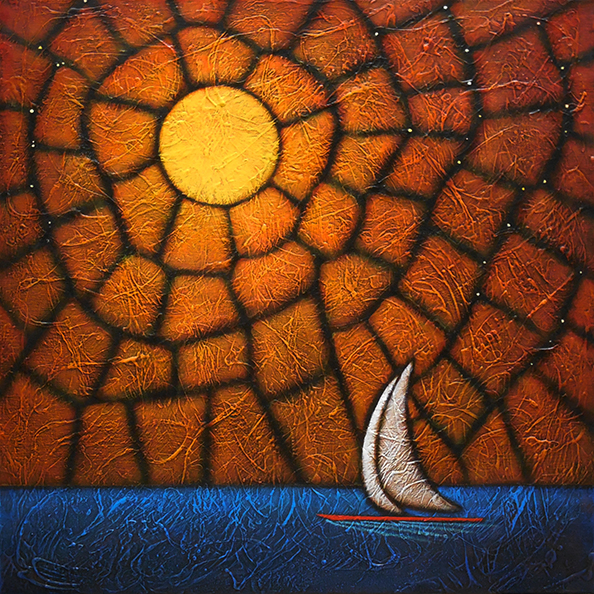
I am a bit slow getting around this morning so I thought I’d share one more painting from the Principle Gallery show. This is titled The Navigator and is 24″ by 24″ on canvas.

Accompanying it are the words from the 17th century Dutch scientist Christiaan Huygens. Shortly before his death in 1695, he had written a book, Cosmotheoros, in which he postulated on the existence of extraterrestrial life in the far reaches of the universe. His lifelong study of the cosmos allowed him to see how tiny and possibly inconsequential our world was in relative terms.

And that is a fitting thought for this painting as the boat skims over a vast sea, guided by the light from huge suns that are so distant that they may not even exist at this moment even though their light still travels to us through the dark of space.

The universe is humbling in its scale and scope.

Read Full Post »

*******************

The interpretation of our reality through patterns not our own, serves only to make us ever more unknown, ever less free, ever more solitary.

Gabriel Garcia Marquez, Nobel Speech 1982

*******************

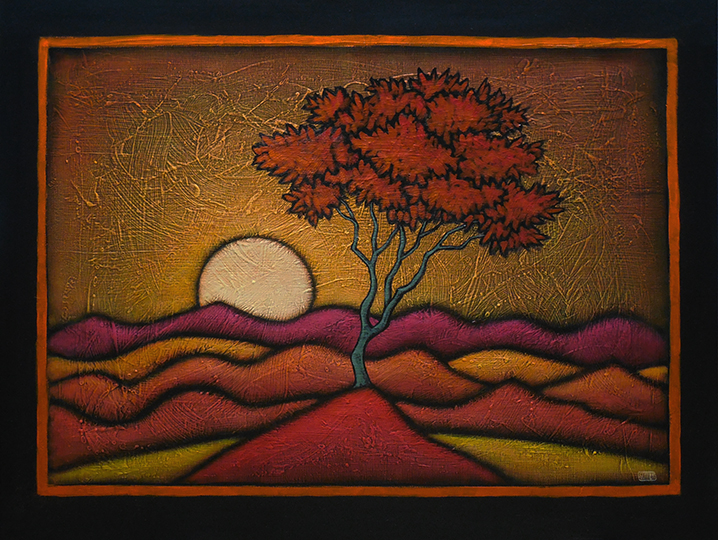
This is a new painting, a 16″ by 20″ canvas, that is part of Haven, my solo show that opens Friday at the Principle Gallery in Alexandria. It is titled Seeking the Design.

I chose the words above from the Nobel Prize speech from the late author Gabriel Garcia Marquez to accompany this painting even though Marquez was speaking above how the people and countries of South America had suffered over the centuries by trying to adhere to patterns of behavior and expectation imposed upon them by foreign influences.

These words spoke to me on a more individual level. We often live our lives according to the norms and expectations of others, following well worn paths from which we seldom, if ever, depart. As a result, we often become no more than others expect us to be.

It as though we have not even attempted to find our own pattern, our own design for living.

And that is what I see in this painting. The Red Tree, an earthly being, has come to the end of that worn path and must make a decision about how to proceed. While there are multitudes of options revealed in the maze-like underpainting of the sky and earthly options that likely exist beyond the layers of distant hills, the Red Tree must choose between finding the pattern that best suits its own desires and needs or going back on that path to follow in the footsteps of the crowd that travels along it.

I get the feeling that latter option would result in one feeling, as Marquez pointed out, more unknown, ever less free and ever more solitary.

For me, this painting has a nice harmony between dark edged weariness and colorful optimism. It is both scary and invigorating in finding one’s own design or pattern to follow. I believe the Red Tree will be following its own path.

Well, that’s how I see it, anyway.


Read Full Post »

+++++++++++++++++

Keep close to Nature’s heart… and break clear away, once in awhile, and climb a mountain or spend a week in the woods. Wash your spirit clean.

John Muir

+++++++++++++++++

I wish I had a bit more time this morning to write about this smaller painting, a 10″ by 20″ canvas that takes it title, Nature’s Heart,  from the words above from the fabled naturalist John Muir. There has been a recent assault on many of the protections given to our environment and we can’t afford to idly stand by while this happens.

We need clean air, clean water and clean soil to continue as a species. Just as important, we need those pristine places where we can wash our spirits clean, as Muir said.

I see this piece as a plea for everyone to take a position as caretakers of the world in which they aim to prosper.

Take an active stand. Listen and speak up.

Be nature’s heart…

++++++++++

This painting, Nature’s Heart, is part of Haven, my solo show at the Principle Gallery in Alexandria that opens next Friday, June 1.

Read Full Post »

***************

Each individual work serves as an expression of our most personal state of mind at that particular moment and of the inescapable, imperative need for release by means of an appropriate act of creation: in the rhythm, form, colour and mood of a picture.

Lyonel Feininger
***************
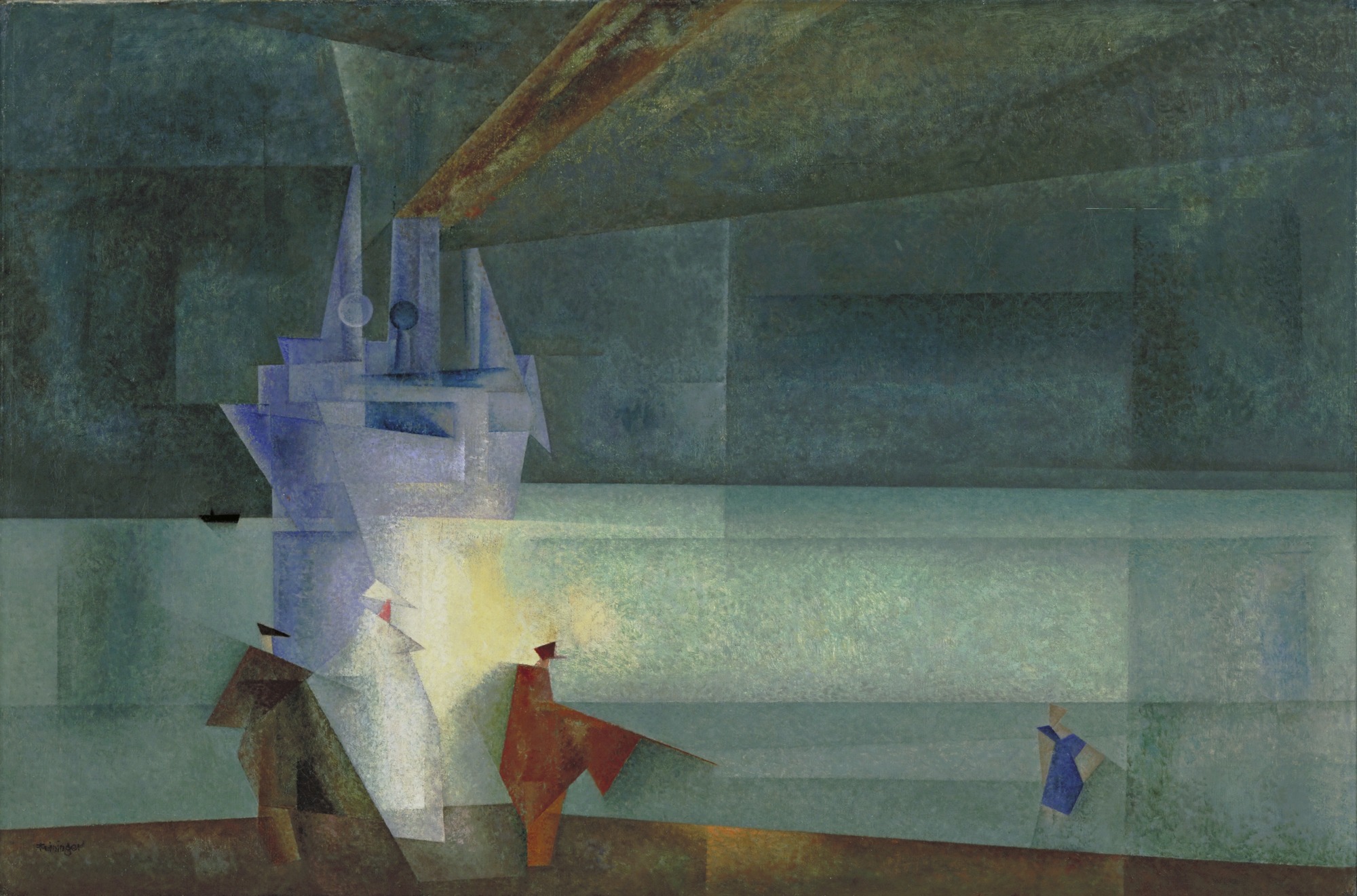
Busy today but wanted to share some work and a video from a painter, Lyonel Feininger (1871-1956),  whose work I believe has not received the attention I believe it deserves. For an artist who had a painting sell for $23 million at auction, it seems kind of absurd that his name is not more well known. I like his works for the very things he speaks of in the quote above– their rhythm, form, color and mood. Take a look.

Read Full Post »

*******************

“Fairy tales do not tell children the dragons exist. Children already know that dragons exist. Fairy tales tell children the dragons can be killed.” 

 G.K. Chesterton

********************

This is a new painting from my upcoming solo show, Haven, at the Principle Gallery. It’s 12″ by 24″ on canvas and is titled Hope Rising.

There are a number of pieces from this show that lean towards darker and deeper hues than much of my other work.  Generally, when these colors have appeared in the past it was the result of being in what I perceived to be perilous times.

Such is the case with this work for it feels as though we live in a time of dragons.

But as Chesterton points out, the lesson to be gleaned from the fairy tales is that while we may live among dragons, they are not invincible. They are always defeated by forces of goodness and righteousness.

I get that feeling of hopefulness from this painting. It feels like a quiet moment when the fear brought on my the dark of night is alleviated by the reflected light of the moon that announces that there is a new day soon arriving.

The dragons can be held at bay and the darkness will only be a temporary condition if we hold tight to what is true and right.

The light of truth ultimately overcomes the false light offered by the dragon’s fire.

And that is not only in fairy tales.

Read Full Post »

++++++++++++

I felt deep within me that the highest point a man can attain is not Knowledge or Virtue or Goodness or Victory but something even greater, more heroic and more despairing: Sacred Awe!

Nikos Kazantzakis

++++++++++++

I was all set to write something this morning about stupidity. I noticed that a post I wrote a year ago, On Stupidity, has been getting a large number of views lately. It is about the danger of stupidity, about how even the very highly educated can be stupid, especially in highly charged times when they can fall prey to social and political movements. This coincided with recent thoughts I have been having about how we have devalued intelligence and reason in this nation in recent times, to a point of vilifying the cerebral and elevating moronic behavior.

I was deflated by the whole thing and decided I needed to focus on something other than that, something that dealt with something far more uplifting. I came across the words above from author Nikos Kazantzakis from his book Zorba the Greek. It’s part of a scene where the narrator, a young, bookish Greek man is asked by Zorba, a raw and raucous peasant, to explain the meaning of the stars and the universe that they are sitting beneath. The narrator tries unsuccessfully to put this idea of  Sacred Awe into a form that Zorba will understand. While he doesn’t understand the given explanation, Zorba does recognize the depth of the mystery that he senses in that night sky.

That brings me to this painting, a 36″ by 36″ canvas that I am calling Sacred Awe. It is part of my solo show, Haven, at the Principle Gallery in Alexandria, opening June 1.

This piece has been hanging in the studio for several months now and I have spent a fair amount of time in the space of this painting. Like Zorba, it is a painting that begs for an answer to the mystery of the stars and the constellations that swirl above. Yet all that is given in response is a sense of awe and nothing more.

And nothing more is needed.

Sacred Awe elevates the mind, stimulates the senses and is the beginning of all art and poetry. In it we connect to a mystic continuum that sees us as small as particles of dust and as large as the great waves of light that pass through the vastness of space.

It is all and it is nothing.

There’s a great meditative  and mysterious quality in this painting, at least for me. It both pleases and puzzles me.

A fitting response to sacred awe.

Read Full Post »

**********************

Then very slowly I go to slightly lighter colors until little by little, the forms begin to take shape and I start to see what is happening. Since I never plan in advance, I simply let myself be led by instinct, taste and intuition. And it is in this manner that I find myself creating visions that I have never before imagined. And little by little certain color effects develop that excite me and I find the painting itself leading me on and I become only an instrument of a greater, wiser force…or being…or intelligence than I myself am.

–Eyvind Earle

**********************

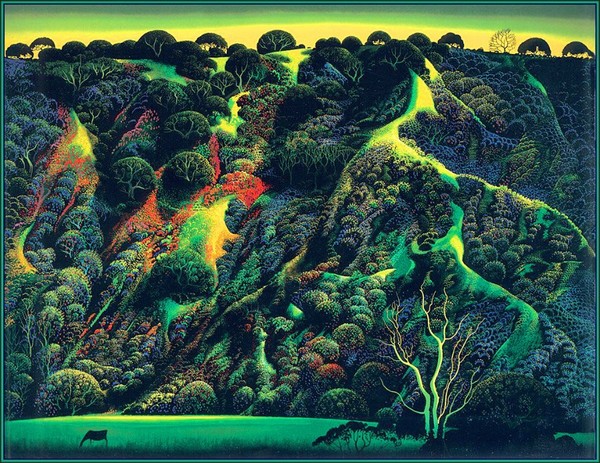
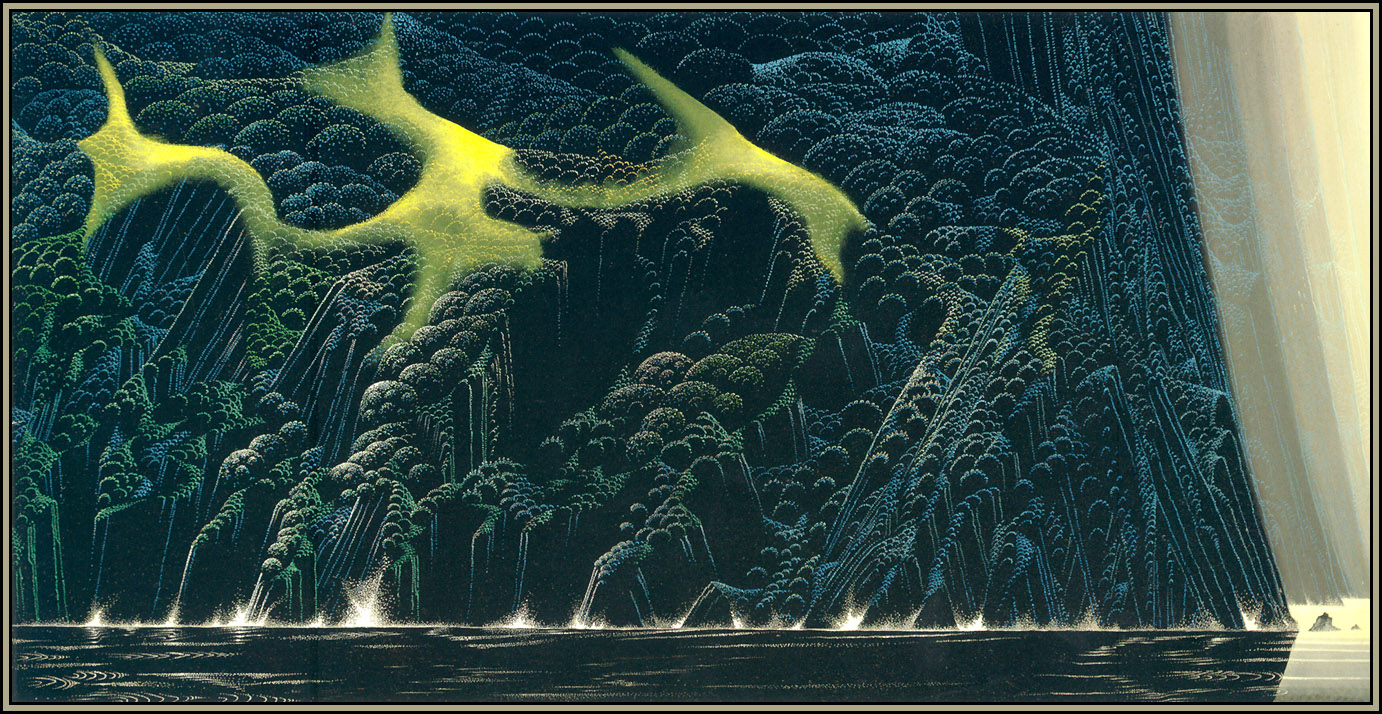
I wasn’t going to post anything as my time is very short this morning. But I took a minute and pulled down a book from my shelf and gave it a quick look. It was one of a beautiful two book set of the works and writings of Eyvind Earle, the late artist/illustrator who is best known as one of the lead artists for several of the early animated classics from Walt Disney.

There’s much I am drawn to in the graphic works from Earle– the colors and the rhythm of his landscapes, for example. But today I came across the short piece of writing above that I had somehow overlooked before that gave me some insight into my attraction.

As he described his process, I was struck by how similarly we describe how we work such as not planning anything in advance, working from light to dark colors and following the excitement of certain colors until the work seems to be taken out of our hands.

Until we become instruments.

I have described the process and the final creation as being beyond me, the whole of the piece being more than the sum of of all the parts I call myself. I have also described the sense of purpose I feel from these pieces, how I feel connected to something greater. I can’t ever recollect using that term, instrument, before.

It sounds a little presumptuous but it does align with what I have described in the past. And to see that Eyvind Earle felt much the same way about his work  is comforting, especially on those mornings when I feel far removed from anything close to a greater force. Just knowing that the work might take me to that point where I transform into an instrument for something beyond myself makes the day seem easier to begin.

Read Full Post »

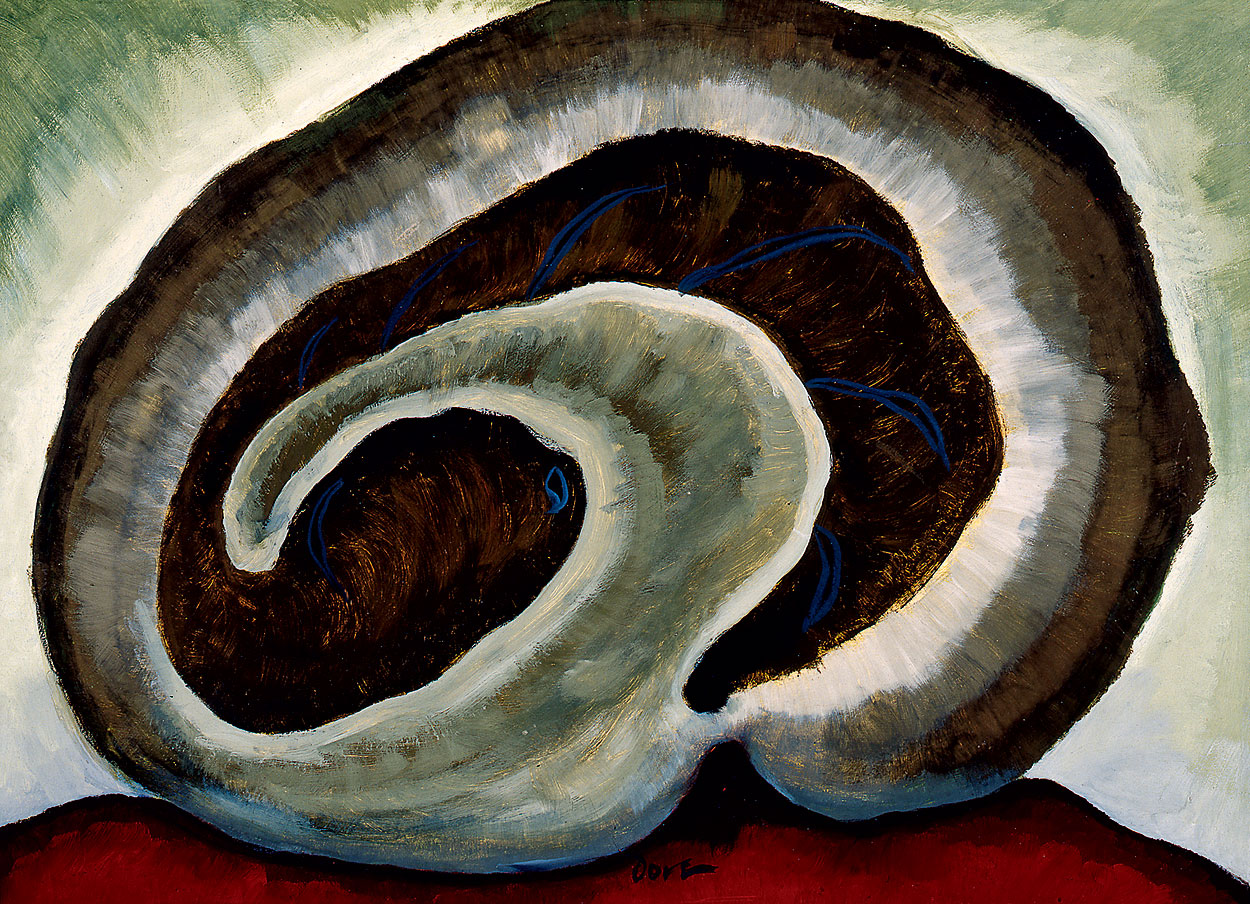
Arthur Dove- Me and the Moon 1937

******************

We cannot express the light in nature because we have not the sun. We can only express the light we have in ourselves.

–Arthur Dove

*******************

Really busy morning getting my upcoming Principle Gallery show ready. It seems there is just not enough time in the day and when there is, I don’t have the stamina to take advantage of it. Thought I’d share a few words from the Modernist painter Arthur Dove (1880-1846) who was someone I looked to when I was first beginning to paint. I liked the way he merged abstraction and representation in his work and how he used recurring elements in his work. The ball/circle shape that I use so often as my sun/moon always makes me think of Dove.

He was also from the Finger Lakes region of New York, born and raised in Canandaigua and educated up the road at Cornell. While that may hold no importance in his work, it interested me because it made me wonder how he saw the same things I have often seen in this area. How did this environment shape the way he saw and expressed the world?

Anyway, here are a few of my favorites along with a video of his work set to a nice Schubert piece.

Arthur Dove -River Bottom – 1923

Arthur Dove- Sunrise– 1924

Arthur Dove- Willow Tree — 1934


Read Full Post »

« Newer Posts - Older Posts »