I want to reach the state of condensation of sensations which constitutes a picture. Perhaps I might be satisfied momentarily with a work finished at one sitting, but I would soon get bored looking at it; therefore, I prefer to continue working on it so that later I may recognize it as a work of my mind…Nowadays, I try to infuse some calm into my pictures and I keep working at them until I have succeeded in doing so.
–-Henri Matisse, 1908
It seems like every artist has a different answer for the question of when a painting is done. Whistler and several others said it was when all traces of its creation have been concealed on the surface. Some say it is when the artist achieves their aim, what they envisioned in their mind’s eye. Edward Munch (The Scream) said that a piece is done after it has had time to mature, weathered a few showers and endured the elements, including nail scratches.
Others say they are never finished.
I tend to go with the never finished group although Munch’s definition appeals to my love of weathering and patina and Matisse’s infusion of calm is something I also aspire to in my work. Ultimately, my goal is to have the paintings complete enough that they can exist on their own, to be alive in the outer world.
In that respect, because they are human creations, I view them very much as I view other humans– never quite complete and always imperfect. That’s just how we are and I am certainly no different.
I am a collage of imperfections that is still a work-in-progress. If I saw myself hanging on the wall I might want to take a brush and soften an edge here or there and add color in certain parts of my composition. But I probably would not do it because those imperfections actually become part of the composition, create the contrasts that give us, as a painting, life. And that , even with the flaws and weathering exposed, pleases me.
None of us is perfectly painted. Nor should we be.
Very busy this morning and wasn’t willing to distract from the attention needed. But here’s a post from several years ago that I like. Hope you do as well.
Theodore Rousseau (1812-1867) was part of the Barbizon school of painters, an art movement in 19th century France that was instrumental in moving away from from the traditional formalism that was prevalent in art up to that point and towards naturalism and artistic expression of emotion. It was very influential on many of the painters who later created the Impressionist movement.
Rousseau and Jean-Francois Millet, best known for his peasant scenes, were the two artists from this school whose work really spoke to me, seeming to have honest emotional content in them. Perhaps that is why his short quote resonated so strongly with me. That and the fact that I have found myself less impressed with cleverness than honest expression through the years. I have always believed that art comes from tapping into the subconscious, something other than the part of our brain that produces conscious thought.
I guess I just don’t think we are that smart. Or clever.
I know I am not.
My work is at its best when it comes from a place of honesty and real emotion, when it is made with more intuition than forethought. When it is too thought out and directed it begins to feel stilted and contrived, losing its naturalness and rhythm and becoming heavy-handed.
That is probably the reason I tell young or beginning painters to focus not so much on the actual idea or subject of a painting but more on things like paint handling and color quality, those things that make up the surface of a painting and convey the real meaning of the painting.
And I think that is what Rousseau was probably getting at in his terse quote.
But maybe not. Like I said, I am not that clever.
This post ran about six years ago and like they say, some things never change. I certainly haven’t gained any cleverness and I still believe that honest emotion is the basis of all impactful art. But what do I know?
I was looking at some more old small paintings, stuff from before I ever showed my work in public. This piece from late 1994 always jumps out at me. It has a title written below the image (cropped out in the photo above) that says Lester’s Place. I don’t really know why I called it Lester’s or to who or what the name might refer.
There’s something about this little piece that I really like. Maybe it’s as simple as its colors. Maybe it’s the sense of place it evokes for me. Or the mystery of its narrative.
I don’t know.
And I don’t think I need to really know. I just like it for whatever reason. The funny thing is that I often think of this old John Lee Hooker song, Rock House Boogie, from the mid 1950’s when I look at this piece. This shack has the same sort of roughness and emotional coloration of this song. I can imagine someone in 1954 stumbling upon this after hearing years of music from groups like the Four Freshmen and the Modernaires on the radio.
It’s hard driving beat and sharp snapping guitar riffs would most likely create a sense of revelation or one of bewilderment and maybe even terror.
For me, even twenty years later, it was revelation.
Now, that beat has me wanting to get to it for the day. Give a listen and get to your own day.
Sometimes the horizon is defined by a wall behind which rises the noise of a disappearing train. The whole nostalgia of the infinite is revealed to us behind the geometrical precision of the square. We experience the most unforgettable movements when certain aspects of the world, whose existence we completely ignore, suddenly confront us with the revelation of mysteries lying all the time within our reach and which we cannot see because we are too short-sighted, and cannot feel because our senses are inadequately developed. Their dead voices speak to us from nearby, but they sound like voices from another planet.
–Giorgio de Chirico
***************
I am busy this morning but wanted to share a post from several years ago about painter Giorgio de Chirico. I thought I’d run it again today with the addition at the bottom of one of his more famous paintings and a short MoMA video about it. The idea that is presented about the metaphysics contained in dealing not with “perceived reality” but a “reality imagined” and of creating “a plausible representation of a believable and negotiable space” rang a bell for me as that is the space where I try to operate. Take a look.
A turning point for me when I was first stumbling around with my own painting was when I encountered the work of Giorgio de Chirico, an Italian painter of darkly toned metaphorical works. He lived from 1888 until 1978 but was primarily known for his early work from 1909-1919 which is called his Metaphysical Period. Metaphysics is devoted to the exploration of what is behind visible reality without relying on measurable data.
His work from this defining ten year period is very mystical.
De Chirico’s work after 1919 became much more based in reality and far more traditional. This later work was less colorful, less symbolic, less powerful and way more mundane. It is definitely the work from the earlier Metaphysical period that defines him as the artist as we know him today.
I was immediately drawn to that early work. It was full of high contrast, with sharp light and dark. The colors were bold, bright and vibrant, yet there was darkness implied in them. The compositions were full of interesting juxtapositions of forms and perspectives, all evoking a sense of mystery. It was a visual feast for me.
At that time in my own painting, I was still painting in a fairly traditional manner, especially with watercolors. That is to say that I was achieving light through the transparency of my paint, letting the underlying paper show through. It was pretty clean which was fine. But it wasn’t what I was looking for in my work.
Seeing de Chirico’s paintings made me realize what I wanted. It was that underlying darkness that his work possessed. It was a grittiness, a dark dose of the reality of our existence. I immediately began to experiment with different methods that would introduce a base of darkness that the light and color could play off. Plus, his ability to create a reality that seemed possible and recognizable but seemed filled with mystery was something aspired for in my own pieces.
Working with this in mind, my work began to change in short order and strides forward came much quicker as a result of simply sensing something in de Chirico’s work that wasn’t there in my own.
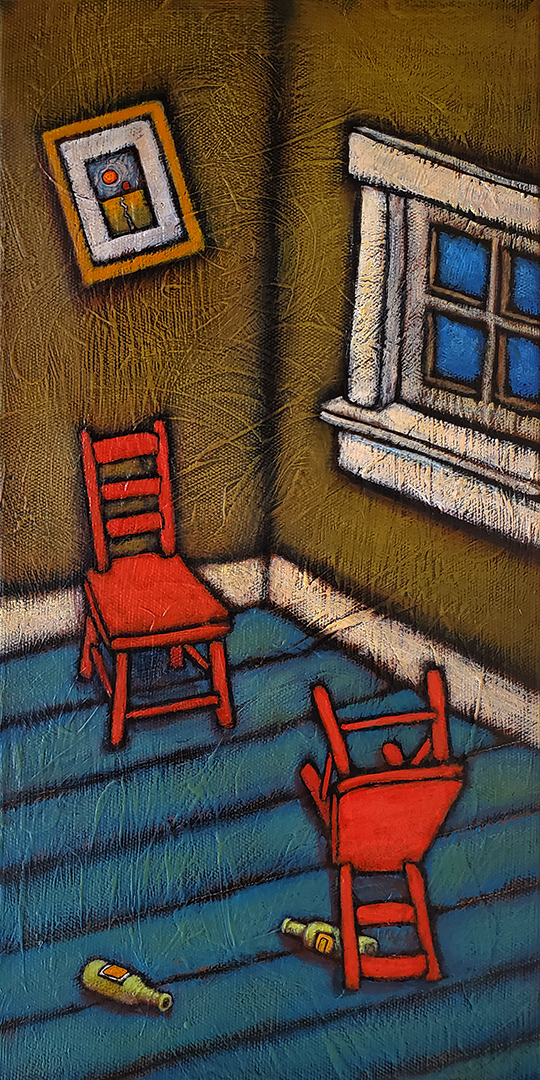
Turn out the lights, the party’s over They say that, ‘All good things must end’ Let’s call it a night, the party’s over And tomorrow starts the same old thing again
–Willie Nelson, The Party’s Over
This is a new small painting that is going to be part of my annual solo show at the Principle Gallery in Alexandria, VA. This year’s show is called Between Here and Thereand opens Friday, June 4th.
This might be an odd choice to be the first piece shown from this year’s show. It’s called After Party and is one of those pieces I often do mainly for myself. Actually, most of the work I do is for myself first.
But this and others like it might be even more so. They just really satisfy some need inside of me, something that wants to come out.
Plus, they usually make me smile or sigh. I know that this one did both.
I am not going to get into what I see in this for myself. I would rather you have your own interpretation on this one.
I will say that I immediately thought of the old Willie Nelson song, The Party’s Over, that he wrote way back in the 1950’s. A lot of us remember Dandy Don Meredith wailing it during the early years of Monday Night Football ( with Howard Cosell) when the game’s results seemed inevitable. I have been listening to a remake of this old classic as done by the Atlanta-based group Manchester Orchestra. They employ the basic structure and chorus of the song but add a bit to the song. Some may not like the idea of toying with another’s song but I think it works well here and I kind of like it for this painting.
If you can’t dig this, you got a hole in your soul– and that ain’t good.
–John Lee Hooker
On some Sunday mornings, the day I always choose a song to feature, it’s a struggle trying to find what i consider is the right song for that morning. I want it to reflect how I am feeling and maybe set the tone for the rest of the day.
This morning I was in the studio at 5:30, wanting to get an early jump on my day of painting. I began looking for a song that I though might match with the painting above, River Angel. I thought of a couple of other songs with river in their titles but when this song clicked in my head, I knew it was the one.
River Deep, Mountain High as sung by Tina Turner in 1966, produced by Phil Spector. He was crazy and dangerously despicable but, man, he made some great records. Immortal recordings.
This is one of those.
It only takes about 30 seconds for Tina to reach full emotional intensity. And she never lets down from point on. It just roars and soars above the high mountaintops.
I just love this recording. My day feels like it off to the races already. Like the late great John Lee Hooker says at the top– If you can’t dig this, you got a hole in your soul– and that ain’t good.
And she bare him a son, and he called his name Gershom: for he said, I have been a stranger in a strange land.
–Exodus 2:22
I was looking at the piece above early this morning. It’s been with me for a long time, since 2002. I sometimes take it for granted and don’t take the time to engage with it. But this morning I looked at it longer than I had in some time, reconnecting with what it has meant to me. Maybe it was because it’s near that time of the year when I get to indulge a guilty pleasure with my annual viewing of The Ten Commandments, the campy biblical epic from Cecil B. DeMille that always runs on ABC during the week before Easter. Or maybe it’s that the pronunciation of the Hebrew word ger which means stranger sounds the same as the shortened version of my name that my family often used for me growing up. I don’t really know but thought that it would be appropriate to share a post about it that has ran a couple of times during the many years this blog has been around.
I have been writing recently about some of the orphans, those paintings that make the rounds of the galleries and finally come back to me. The piece above is one of these orphans but it really isn’t. It’s mine alone, one of the rare pieces that I don’t think I would ever give up. Like many parents when looking at their children, I see much of myself in this painting.
Over the years I have periodically written about a group of paintings that were considered my Dark Work that were painted in the year or so after 9/11. The piece shown above is one of these paintings, painted sometime in early 2002. I very seldom consider a painting being for myself only but this one has always felt, from the very minute it was completed, as though it should stay with me.
It is titled Stranger (In a Strange Land) which is derived from the title of Robert Heinlein’s famous sci-fi novel which in turn was derived from the words of Moses in Exodus 2:22, shown here at the top. The name Gershom is derived from the Hebrew words ger which means stranger or temporary resident and sham which means there. Together Gershom means a stranger there. It is defined now as either exile or sojourner.
The landscape in this piece has an eerie, alien feel to it under that ominous sky. When I look at it I am instantly reminded of the feeling of that sense of not belonging that I have often felt throughout my life, as though I was that stranger in that strange land. The rolling field rows in the foreground remind me just a bit of the Levite cloth that adorned Moses when he was discovered in the Nile as an infant, a symbol of origin and heritage that acts as a comforting element here, almost like a swaddling blanket for the stranger as he views the landscape before him.
As I said, it is one of those rare pieces that I feel is for me alone, that has only personal meaning, even though I am sure there are others who will recognize that same feeling in this. For me this painting symbolizes so much that feeling of alienation that I have experienced for much of my life, that same feeling from which my other more optimistic and hopeful work sprung as a reaction to it. Perhaps this is where I saw myself as being and the more hopeful work was where I aspired to be.
Anyway, that’s enough for my five-cent psychology lesson for today. In short, this is a piece that I see as elemental to who I am and where I am going. This one stays put.
Here’s a little of the great (and I think underappreciated) Leon Russell from way back in 1971 singing, appropriately, Stranger in a Stranger Land…
A man must find time for himself. Time is what we spend our lives with. If we are not careful we find others spending it for us. . . . It is necessary now and then for a man to go away by himself and experience loneliness; to sit on a rock in the forest and to ask of himself, ‘Who am I, and where have I been, and where am I going?’ . . . If one is not careful, one allows diversions to take up one’s time—the stuff of life
― Carl Sandburg
This painting, Rest Stop, which is at the West End Gallery in Corning, is a favorite of mine. It might be in the colors or textures, those elements that often reach out to me, but it’s more likely because it’s message speaks clearly to me.
We all need to periodically stop the busyness of our lives, if only for a few moments. A short spell to pause everything and appreciate where we are in the present, to ponder how we came to be there, and to imagine where the future will take us.
An interlude to see how the past, present and future exist within us.
That’s the message I get from this painting. Now, doing such a thing is another animal altogether. For many of us, just stopping everything seems an impossibility. Or many may think such a thing is simple foolishness with no real purpose. Or some might feel that the prospect of actually thinking about anything, especially anything to do with their own life, is too tall a task.
But for some of us, these moments of ponderance are a necessity. They simply make life bearable. They create reason and meaning in a world that often seems to lack both. Those are the moments that define purpose at times when we need to know there is indeed purpose.
I get all of this with a glance at this painting. And I think that’s why I place so much stock in this piece– it speaks volumes with a so little effort. That’s the opposite of my writing or any form of expression with words.
Even this short re-examination of this painting is a form of pausing, of reflecting on what is now, what was then and what will will be. And maybe that’s the purpose of this piece and of art, in general.
Seems like a recurring theme lately with me starting most posts by saying that I am busy and eager to get to work. That’s actually a good thing for me. That eagerness to get to it is something that is not just there. It is cultivated, a result of previous actions. It usually means I am doing the right things (at least, for me) in my creative process.
So, while I wish I were willing to spend more time writing this morning’s post I am glad to want to get to my work.
But I wanted to share the painting above, Far Away Eyes, that is currently at the West End Gallery. I wrote about this piece last July and rereading that post reminded me of the struggle that I had with it. It was one of the first pieces I worked on during the early days of the pandemic. I had no momentum, no energy, little inspiration nor any eagerness to be at work. My mind was wholly distracted.
This piece though fought with me and made me work. Made me shut out the outer world for a time so that I could focus my mind on it, to become part of it.
To put it plainly, it didn’t come easy. That’s probably why this piece resonates so strongly with me. I think we all appreciate those things that make us struggle, that make us be at our best. We might be frustrated and demoralized during the battle but the result, the overcoming, makes us forget that. I know that the struggle in this piece had slipped my mind until I read the post that was written soon after this painting was completed, when the battle was still fresh in mind.
I now appreciate it for what it is, the force it possesses and not for what it provided in its creation.
As it should be.
The title for this song was borrowed from an old Rolling Stones song from their 1978 Some Girlsalbum. I didn’t mention it in the original post about the painting because I didn’t think the song itself fully lined up with the piece but its title did. But now, I’m not so sure.
Ah, St. Patrick’s Day. I grew up not knowing our genealogy. My mother, who would have been 89 today, was from the O’Dell family so we assumed we had Irish blood. But years later I discovered that the O’Dell name in our line had transformed over the years from the Woddell name. We were English, not Irish.
But while doing this research on my father’s side, which we always thought of as German, I found that his grandmother, my great-grandmother (who drowned in a canal in Allentown, PA just days after my dad was born but that’s another story) was fully Irish. I found out quite a bit more about her family’s past here in America though little of the actual Irish roots. However, my DNA has me at about 1/3 Irish
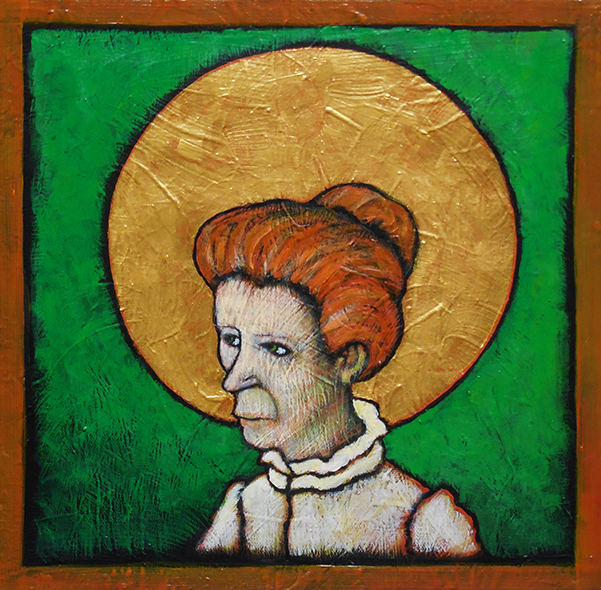
A few years ago I painted a small series of paintings of ancestors that I called Icons. One was of my great-great grandmother, Mary Tobin. I am including a post, sort of tragic in an Irish way, from a few years ago about her along with a song, The Donegal Set, from those venerable Irish musicians, TheChieftains.
Have an enjoyable St. Patrick’s Day. Or just a nice Wednesday, if that appeals more to you.
From 2016:
One of the things I am trying to emphasize with this current Iconseries is the fact that we are all flawed in some way, that we all have deficiencies and stumbles along the way. Yet, uncovering these faults in my research, I find myself holding affection for many of these ancestors that dot my family tree. Perhaps it is the simple fact that without them I would not be here or perhaps I see some of my own flaws in them.
I’m still working on that bit of psychology.
The 12″ by 12″ canvas shown here is titled Icon: Mary T. She is my great-great grandmother. Born Mary Anne Ryan of Irish immigrant parents in the Utica area she married Michael Tobin, an Irishman ( I believe he was from County Kerry but the research is still up in the air on this) who came to the States around 1850, right in the midst of the Great Irish Immigration.
Michael worked on the railroads being built throughout central New York in the late 1800’s. Following the progress of the railroads, the couple and their growing family worked their way down through the state towards Binghamton, NY where they eventually settled. Mary Anne eventually ended up as a housekeeper in a prominent home in the area. Michael died around 1890 although records are sketchy on this and Mary died at my great-grandmother’s home on Church Street in Elmira in 1914.
All told, they had seven daughters and three sons. Most worked in the then booming tobacco industry of that time and place. Most of her daughters worked as tobacco strippers and some worked as cigar rollers, as did her sons.
That’s the simple telling of the story. Looking into the back stories provide a little more depth which can sometimes change all perceptions.
None of her sons ever married and all were had desperate problems with alcohol. One son was listed in a newspaper report from some years later as having been arrested for public drunkenness around 40 times over the years, seven times in one year. He was also arrested for running a still more than once during the prohibition years. Two of her sons died in institutions where they had been placed for their alcoholism.
A Silk Spencer
I came across a story in the local Binghamton newspapers about Mary and two of her daughters, who were also working as domestics with here in the prominent Binghamton home owned by a local attorney and nephew of the founder of Binghamton. In 1874, the story reports that a number of items came up missing from her employer, including a “forty dollar silk spencer,” which is a sort of short garment like the one shown here at the right. Her neighbors informed the owner of the spencer that Mary had a number of the stolen items in her possession and a search warrant was sworn out.
Detectives came to the Tobin home and made a thorough search but turned up nothing. They then tore up the carpets which revealed a trap door that led to a small basement. There they found many of the stolen items but no spencer. But they did find a silk collar that had been attached to it.
Mary and her two daughters were arrested.
Mary did finally claim to be the sole thief and her daughters were released. I have yet to find how this particular story ends and how Mary was punished but based on the futures of some of her children I can’t see it being a happy ending.
Doing this painting, I was tempted to make my Mary a bit harsher, a lit more worn. But as I said, there’s some sort of strange ancestral affection at play even though I know she was obviously a flawed human. She’s smaller and more delicate looking in the painting than I imagine she was in reality. In the only photo we have of her daughter, my great grandmother, was sturdy looking lady. But maybe making her a bit less harsh is a little gift to my great-great grandmother for the information her story reveals about the future of my family.
This is a simple painting because, as I pointed out, this is a simple story at its surface. It’s the story of many, many families.


 Turn out the lights, the party’s over



 Redtree Times