Wanted to just share a poem and an animation of it that features it being read by the poet, Gregory Orr. I chose this one because of a line in it — No purpose but what we make— that made me think about the nature of purpose. We often speak of finding purpose in ourselves but is it something to be found? Or might it be something that we create for ourselves, something that we actually choose?
I have to think on that for a bit. In the meantime, please take a look at the short reading of the poem.
This is what was bequeathed us
This is what was bequeathed us: This earth the beloved left And, leaving, Left to us.
No other world But this one: Willows and the river And the factory With its black smokestacks.
No other shore, only this bank On which the living gather.
No meaning but what we find here. No purpose but what we make.
That, and the beloved’s clear instructions: Turn me into song; sing me awake.
Thought for this Easter Sunday I would simply share a few Victorian Easter cards to go with an appropriate musical selection for the day. Much like the Victorian era Christmas cards I’ve shown here before, The Easter greeting cards from that time sometimes had a creepy edge to them or at least some sort of inexplicable sensibility that is lost on modern audiences. Take a look below and see if they make sense to you.
Maybe next year I will share some strange photos of people dressed as Easter Bunnies posing with kids, like I have done in the past with some unsettling photos of Santas. The odd thing is that most of the creepiest Easter Bunny photos don’t seem that far in the past. A little too creepily recent for my tastes.
For this Sunday morning musical selection I am going with a song that is very on the nose for my devout friends out there. For those of you who do not observe the religious aspects of this day, it still is worth a listen. It is Sam Cooke, after all. It’s Were You There (When They Crucified My Lord) backed up TheSoul Stirrers, the gospel group with which he started his illustrious career.
Sending you Easter Greetings, maybe in the form of a chicks or bunnies wearing Pickelhauben, those old German military helmets. Seems like small animals were more militaristic then than now. Go figure.
I am in a bit of a rush this morning but wanted to play a bit of music. I came across this piece a number of years ago and it popped up again on my site yesterday. It was Pawky from the late jazz harpist Dorothy Ashby, who is considered one of the most unjustly under loved jazz greats of the 1950’s. Probably a little anti-harp bias. The harp just doesn’t have the built in cool factor of a sax or a trumpet.
I went to YouTube and began playing the 1959 album,Hip Harp, that it was from and went to do some little chores around the studio this morning.
I really enjoyed having it on. There was something easy in it, something where it would one moment move into the background or hold your rapt attention without losing anything in the listening.
I am not sure I am explaining this in the way I think I am but that’s going to have to suffice. The word pawky is a British word that means shrewd, tricky or slyly humorous and this piece fits the meaning. This song has a kind of 50’s jazzy, witchy feeling, like it should have been in the soundtrack of the movie Bell, Book and Candle, the 1958 film about modern day witches in Greenwich Village, starring Jimmy Stewart, Kim Novak and Jack Lemmon. But it was not in the film though I think the title theme poaches elements from this song a bit.
“Nothing is original. Steal from anywhere that resonates with inspiration or fuels your imagination. Devour old films, new films, music, books, paintings, photographs, poems, dreams, random conversations, architecture, bridges, street signs, trees, clouds, bodies of water, light and shadows. Select only things to steal from that speak directly to your soul. If you do this, your work (and theft) will be authentic. Authenticity is invaluable; originality is non-existent. And don’t bother concealing your thievery – celebrate it if you feel like it. In any case, always remember what Jean-Luc Godard said: “It’s not where you take things from – it’s where you take them to.”
― Jim Jarmusch, MovieMaker Magazine #53 – Winter, January 22, 2004
A friend of mine has picked up his brushes and is attempting to try his hand at painting. He sent a message saying that he was kind of copying my work and hoped that it was okay with me. I told him that it was perfectly fine. In fact, it was expected and maybe even necessary for someone to “borrow” from others.
That’s how I started painting, after all. For example, this watercolor from back in 1994 is my take at that time on the work of Georgia O’Keeffe. Some of you may see it immediately and some may not. I know that’s all I see when I look at it.
I liked this piece at the time but knew that it wasn’t enough of mine to really show. I hadn’t transformed it enough, hadn’t proclaimed it with my own voice.
To be honest, I didn’t fully have my own voice yet. But doing pieces like this and others that were derived ( a fancier way of saying stolen) from the work of others helped me get there.
“Borrowing” is a big part of making art. Like filmmaker Jim Jarmusch states above: Nothing is original.
You first take, but then you add your experience, your perceptions, your own way of expression to make something that is something all its own even though it may have the DNA of others within it.
The idea is to get to a point where you have transformed all your stolen ideas into something that is singular and honestly your own. Something beyond what you first recognized in the work of others.
The more intensely we feel about an idea or a goal, the more assuredly the idea, buried deep in our subconscious, will direct us along the path to its fulfillment.
—Earl Nightingale
It’s funny sometimes what you take from an experience in your life. At one point in my life I was in the retail car business, working at a Honda dealership both as a salesman and for a time as a finance manager. In order to keep their sales staff engaged and excited about pushing their product, the management there would periodically send us to seminars with industry-specific motivational speakers and would also have sets of motivational tapes from other speakers that they would encourage us to listen to in our free time.
One of the sets of tapes was from famed motivational speaker Earl Nightingale who had a deep and engaging voice that added a serious dimension to whatever he said. As I listened to his tapes, it was easy to feel my interest growing as he told his little tales and his lessons began registering within me.
One of his stories was a short retelling of a classic lecture called Acres of Diamonds from Russell H. Conwell (1843-1925), an interesting fellow who was a Baptist minister, a lawyer, a philanthropist and the founder and first president of Temple University. The lecture, one that Conwell delivered over 5000 times during his lifetime, made the point that the riches we seek are often right in our own backyards. His tale is of an African farmer who sells his farm in order to go in search of diamonds and finds nothing but failure that ends with his suicide. Meanwhile, the man who took over the farm found an abundance of diamonds and ended up with one of the largest diamond mines in Africa.
There were a lot of lessons to be learned from this tale. obviously. But the primary lesson for me was that I had to leave the car business– it was not my backyard. It was the place to which I had come in search of my own diamonds. I had not even, at that point, began to search my own backyard.
I am not sure if that was the message that management had been hoping would sink in.
Or maybe it was.
Their intent didn’t matter as I was soon on a different path, one that ultimately led me here, thankfully.
The other part of Nightingale’s message was that you had to set a course, aim for a destination. Everything was possible if you knew where you wanted to go and truly set your mind to it. He gave a laundry list of great human accomplishments that were achieved once we put our minds and wills in motion towards their fulfillment.
That resonated strongly with me. I had seen many people over the years who seemed deeply unhappy in their lives and most had no direction going forward, no destination for which they were working. Aimless, they drifted like a rudderless boat on the sea, going wherever the strongest current took them without having any influence over this motion.
If you can name it, you can do it in some form. Having a desired destination allows the mind, often subconsciously, to create a course that leads to that place.
As I said, it’s funny how things influence you. It’s been over thirty years since I heard those words but they still resonate strongly with me, even now. I try to be always conscious of the goals I set, knowing that the mind and the universe will always try to make a way for the possibility of achievement.
I run this post about every five years or so. As I say, there are lessons to be learned in every endeavor we undertake. Every job I ever held gave me something more than a paycheck. They showed me what I was and was not. In this case, I learned to work the fields that I knew and loved.
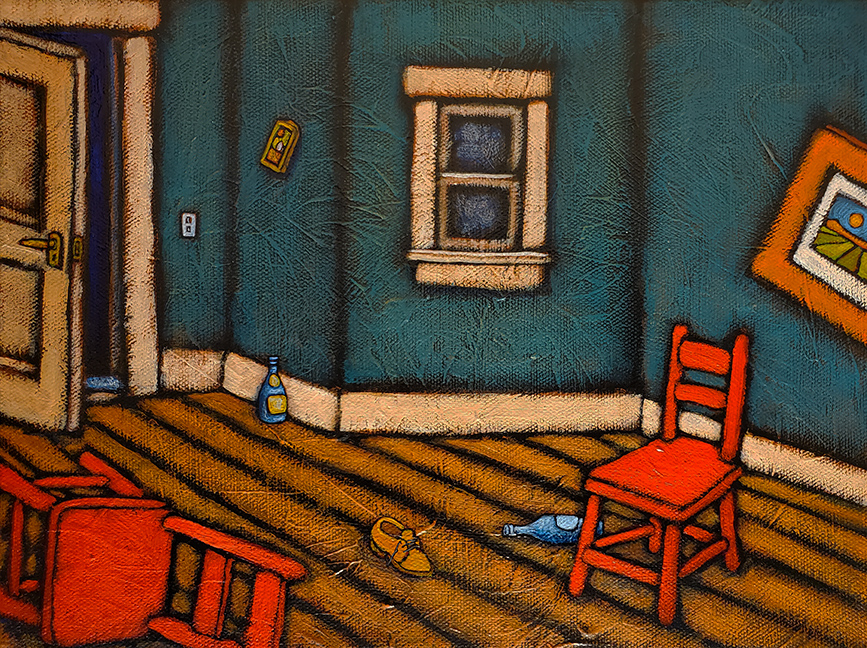
Been working lately on a group of interior scenes that are part of my June show at the Principle Gallery in Alexandria, VA. I showed one this past week called After Party and it set the tone for this group with the sloppy disheveled look of a room after the party is over.
There are many things I like about these pieces. One is the fact that they can seem humorous while still seming quietly mysterious and even pensive or somber. I like that dichotomy. Maybe that’s because I have often seen humor in some of the more serious moments of my life.
It’s often a short ride from crying to laughing.
Another of the things I like about painting these pieces is their rough edges and slightly askew perspectives. I paint these pieces with slightly larger brushes than needed which gives them the softly sloppy look that appeals to me.
Like much of my work, these pieces are not planned out. I just start in one spot and see what builds out from that first mark on the surface. I make a mark then reassess and add another then reassess again, weighing the balance of the composition as well as the balance of the colors and contrasts.
It’s like juggling where you are always readjusting with each toss of the ball and with each new additional ball thrown into the mix. Maybe that is what I should call myself–paint juggler.
This piece is a small 9′ by 12″ canvas and is called Kick Off a Shoe ( Stay a Little Longer) which is a tip of the hat, in a way, to the old Bob Wills Western swing classic, Stay All Night ( Stay a Little Longer). Below is a version of that song from Ray Benson and Asleep at the Wheel, who have for many decades kept the spirit of Bob Wills’ music alive with their own brand of Western swing. Always sure to get your toes tapping.
Give a listen and get up and dance a little. Maybe kick off a shoe and stay a little longer. What’s stopping you?
Hey, today is the birthday of Vincent Van Gogh, who was born on this day back in 1853. I thought it might be fitting to rerun a post from several years back about Van Gogh’s self portraits and the lessons they offer.
I showed this short video here about six years back, in 2010. It’s a compilation of morphing self portraits from Vincent Van Gogh put together by video maker Phillip Scott Johnson that I found intriguing then and now.
It’s a short piece, less than a minute in length, and it’s interesting to see how the familiar views of Van Gogh relate to one another and how his appearance or, at least his perception of it, changed through the years. For me, Van Gogh’s self portraits are among the most revealing and compelling of any artist. His state of mind is evident in each piece, with some showing a vibrant, seemingly healthy man and others showing the more tortured Van Gogh that we tend to think of as the man.
Seeing them together as in this video allow you to see the changes in the man and in his art that take place over time. Interesting.
I also found it interesting now because I have been spending some time recently looking at my own older work in a different way. I am often not looking at the pictures as whole images. Instead, I have been looking at the individual marks I am using in each and seeing how it has changed through the years. Or how it has stayed the same in some cases.
I’ve always said that my painting for me was a continuum that, while changing all the time, always seemed the same to me– always in the present. But looking at it in this manner I am finding that my mark-making does change periodically which fundamentally changes the way a picture is painted and how it emerges in the end.
It’s not something I often think about– I just paint in whichever way the moment strikes me. Sometimes it is dependent on the condition of the brush or the weight and quality of the paint I am using. As a brush ages and wears, especially with the rough treatment given to them by me, it makes a more and more distinct mark that I find appealing. Looking back, I can often tell when I am using fresh or old brushes.
So, I watched this film in the same way and it is fascinating to just look at Van Gogh’s mark-making throughout without focusing on the faces. It is varied and each differing style serves the image in different ways. Some marks are wildly expressive and others small and quietly acting in service to the greater whole.
As I said, it’s less than minute and interesting even if you don’t give a damn about the mark-making part of it.
I had other things on my mind about what I would write here this morning. I was going to question how a law that makes giving a drink of water to someone in line at the polls a crime is supposed to prevent voter fraud. I was also going to question the motive for other such suppressive provisions in legislation being moved into law around much of this country.
But before I could start, I came across this short animation of a poem from poet Marie Howe and I decided that maybe this was the better way to go this morning.
Her poem is titled Singularity and refers to the theory Stephen Hawking (among others) set forth that the universe and all that it is was once a single thing before the Big Bang created all that we know the universe to be now.
We were all part of one thing.
No, we were that one thing.
That is as simple as I can put it and still understand it. I am not even sure that simple explanation is correct. Much as Howe explains to her audience, my own grasp of advanced physics and most other great scientific theoretical concepts is limited. But the idea that we were once one and that we may all at some point become one again is somehow appealing to something inside me.
I don’t know. My eternal refrain.
Take a look. The Marie Howe poem is below the video.
SINGULARITY by Marie Howe
(after Stephen Hawking)
Do you sometimes want to wake up to the singularity we once were?
so compact nobody needed a bed, or food or money —
nobody hiding in the school bathroom or home alone
pulling open the drawer where the pills are kept.
For every atom belonging to me as good Belongs to you. Remember?
There was no Nature. No them. No tests
to determine if the elephant grieves her calf or if
the coral reef feels pain. Trashed oceans don’t speak English or Farsi or French;
would that we could wake up to what we were — when we were ocean and before that
to when sky was earth, and animal was energy, and rock was liquid and stars were space and space was not
at all — nothing
before we came to believe humans were so important before this awful loneliness.
Can molecules recall it? what once was? before anything happened?
No I, no We, no one. No was No verb no noun only a tiny tiny dot brimming with
This morning, I thought I would combine another old piece with this week’s Sunday morning musical selection. The painting above is one of my earliest pieces, completed in early 1994.
It was at a point before I had what I considered then and now to be a breakthrough with my work. I was still working with watercolors solely and using them in as close to a traditional manner as someone who is self-taught can. I still find the qualities of that medium really appealing and use many of them– in a manner that is adjusted to fit the way I think– in much of what I call my transparent work with inks.
This piece was titled which meant that I saw something in it that deserved a name. That’s one way I judge some of this earliest work. There are some pieces in my files that don’t have titles which means that while I may like the piece or see something of value in it, I don’t feel it is complete and whole.
I think I saw this piece as being whole even though at the time I didn’t feel it was good enough to exhibit. Maybe it wasn’t that I didn’t think it was good enough, maybe it was more that by the time I was showing my work a year after this my work had changed, moved away from this style.
It’s titled Folk Blues/ LeRon’s Yellow Guitar. It certainly has flaws but there is much in it that I like.
Anyway, thought this would pair up with an old blues tune written and first recorded in the 1920’s, Nobody Knows You When You’re Down and Out. This version is from early blues artist Scrapper Blackwell who is an interesting case.
Blackwell was born in South Carolina in 1903 and moved to Indianapolis, Indiana as a child. He built a cigar box guitar and taught himself to play, becoming a performer in the Indy/ Chicago areas as a teenager. Around this time he met and partnered with pianist Leroy Carr. In the late 1920’s until around 1935, the two were very successful as songwriting and recording artists. One of their best known songs was Kokomo Blues which was later transformed into the song most of us know as Sweet Home Chicago.
The duo lived pretty large at that time with lots of drink and partying. However, Carr died from physical complications from this lifestyle in 1935. Blackwell floundered for a couple of years before dropping out of the musical scene altogether. He settled into an obscure life in Indianapolis as a manual laborer in an asphalt plant for the next 20 years. In the late 1950’s he reemerged as a musician, recording several albums of his early blues over the next few years. The song below was recorded during this period and is pretty poignant in that at that time he truly knew the highs of stardom and the lows of poverty and obscurity.
His renewed career was taking hold at a time when the blues were undergoing a revival in the early 1960’s when he was shot and killed while being mugged in an Indy alley in 1962. He was 59. As a result, his influence in the blues revival never really extended out to the wider audiences that other blues artists were able to tap into in the mid 1960’s. Most of you have most likely never heard of Scrapper Blackwell.
This is a really nice recording of an old blues song. The kind of song LeRon at the top would feel right at home with. Give a listen to Nobody Knows You When You’re Down and Out.
There is one spectacle grander than the sea, that is the sky; there is one spectacle grander than the sky, that is the interior of the soul.
― Victor Hugo, Les Misérables
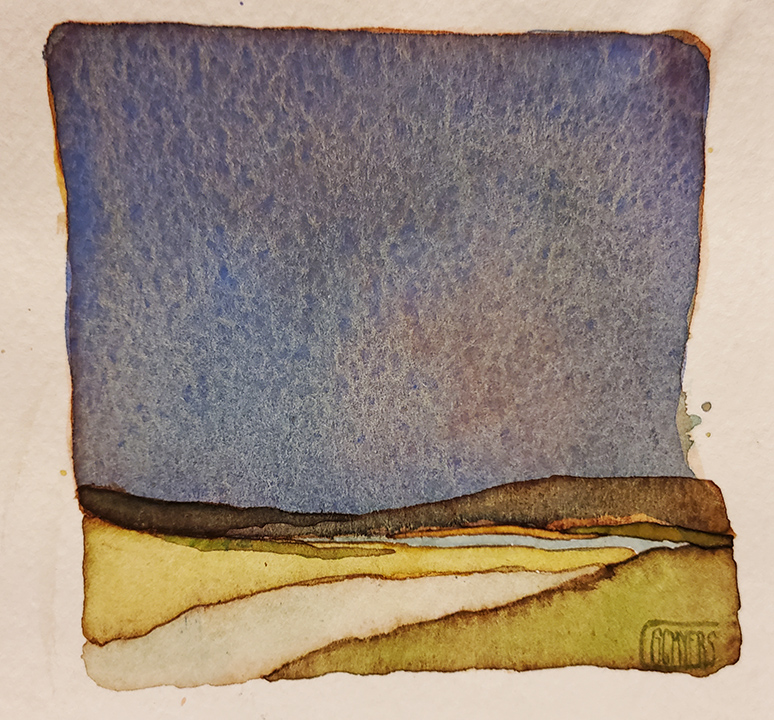
Thought I’d share another older piece, one that also never found its way out of the studio. Some times the reason they stay with me is obvious and other times not so much. This small piece falls in the not so much category.
It’s from mid 1995, not long after I first started showing my work publicly. Across the bottom of the piece of watercolor paper on which it is painted is the title The Sky Is Always the Sky along with the date it was painted in 1995.
Looking at it now, I can’t figure out why I felt it wasn’t worthy to show at that time. I am actually pretty pleased to be able to show it now. It has much in it that I wish would show up in my work now, twenty five years later.
For example, its utter simplicity and the gracefulness of its linework. Well, my definition of gracefulness, anyway. There’s also the way the layers of color go together so well with the grainy pigments of the cobalt blue settling into the shallow pits of the paper above a sepia underlayer.
Looking at it, I realize that many of the changes that took place in the following years in my work were material related. A few years after this I went from employing traditional watercolors in my work to acrylic inks. The difference is that the inks have a more and finer pigments which make their colors more explosive, more impactful. There is a difference in the more subtle aspects of the watercolors that is hard to replicate with the inks. This piece is an example, at least by my analysis.
Another difference was that I also began using a gessoed surface a few years later which also brought dramatic changes to the work. The positives of using gesso outweigh not using it for me but the beauty of cotton watercolor paper and its tactile appearance is undeniable.
The other difference was that the brushes I was using at the time were wonderful Winsor & Newton round brushes that have long since been discontinued. These round brushes had a different brush profile than almost any other round brush I have been able to find since that time. I use a round brush almost all the time in my wet work even when a flat brush might sometimes be a more obvious choice. I like the organic quality it gives the work and the linework it produces. Brush choice has a big impact on how the work appears and I am still trying to find brushes that have the same qualities as those old W&N brushes.
Anyway, looking at this old piece again so closely gives me inspiration, makes me want to revisit those elements that make it work so well for me. We’ll see
Here’s an old Chris Isaak song, a favorite that is centered around a particular blue sky. It’s the tone I would like for this piece. Here’s Blue Spanish Sky.


 A friend of mine has picked up his brushes and is attempting to try his hand at painting. He sent a message saying that he was kind of copying my work and hoped that it was okay with me. I told him that it was perfectly fine. In fact, it was expected and maybe even necessary for someone to “borrow” from others.
 I showed this short video here about six years back, in 2010. It’s a compilation of morphing self portraits from Vincent Van Gogh put together by video maker Phillip Scott Johnson that I found intriguing then and now.

 Redtree Times