Feeds:
Posts
Comments

Was, Am, Will Be

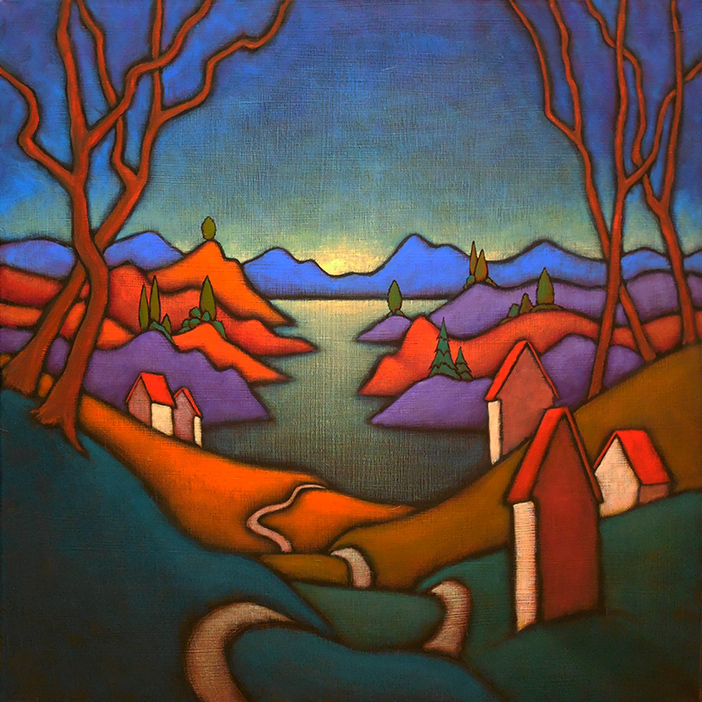
“Light and Wisdom”- Currently at the West End Gallery

“If outer events bring him to a position where he can bear them no longer and force him to cry out to the higher power in helplessness for relief, or if inner feelings bring humiliation and recognition of his dependence on that power, this crushing of the ego may open the door to grace.”

***

“Every test successfully met is rewarded by some growth in intuitive knowledge, strengthening of character, or initiation into a higher consciousness.”

***

“The source of wisdom and power, of love and beauty, is within ourselves, but not within our egos. It is within our consciousness. Indeed, its presence provides us with a conscious contrast which enables us to speak of the ego as if it were something different and apart: it is the true Self whereas the ego is only an illusion of the mind.”

― Paul Brunton, The Notebooks of Paul Brunton


I was surprised to find I have never mentioned Paul Brunton here. I came across his work many years ago in a moment of serendipity at perhaps the lowest point in my life. I don’t think I am exaggerating in saying that without that encounter with his books, I most likely would not be sitting here this morning, writing this blog. Might not be an artist.

Might not even be. Period.

Paul Brunton (1898-1981) was a British writer who traveled to India in the aftermath of his service in World War I and encountered Hindu/Buddhist mysticism for the first time. He wrote several best selling books on his experiences that more or less brought Hindu/Buddhist to the west for the first time.

His magnus opus was published series of 16 of his notebooks, The Notebooks of Paul Brunton, containing observations and experiences. These were the books of Brunton’s that I first came across. As I said, I was at my bottom at that point and my mind was spiraling. I opened one of his notebooks and immediately found something, a short paragraph with his observation on the ego, that seemed to describe where I was at that point, something that I could latch onto.

That simple moment was a huge spark of hope. A beam of light.

I looked at the title page and saw that it was published by a organization located not too far from where I live now, my home area. I was across the country at that time and it was as though these words and that address near my home were telling me that what I needed, what I sought, was at hand, was inside me all the time.

That’s the short version of the story and it will have to suffice for today. I just thought Paul Brunton deserved a mention. He’s part of my path, my story, and when I look at pieces like the one at the top, Light and Wisdom, his words often jump to mind for me. I know that when I get spinning out of control, his words are gentle reminder of where I am now, where I have been in the past and what I was, what I am and what I want to be. 

Was, Am, Will Be.

Just keep trying and have a good day.

Poll Dancers

I was going to write this morning about the death of singer/songwriter Jerry Jeff Walker yesterday at the age of 78. He was an upstate NY guy, born and raised in Oneonta, who moved to and became synonymous with the state of Texas. Most of you will no doubt best know him for his song Mr. Bojangles. Sad to see another favorite pass away.

But I feel compelled this morning to comment on the remarkable turnout taking place at polling locations around the country. Huge enthusiastic crowds lined the streets of nearly every city and town offering early in-person voting. Records for voter turnout are falling everywhere. Even in my home county, the lines yesterday on the first day of early voting in NY were well over an hour long.

I read of a guy who rolled by one such line of waiting voters in his pickup truck and yelled out his window to another guy standing near the end of the line.

“How long you been waiting?” he asked.

“Four goddamn years!” the fellow in line responded as the other people in line responded with loud applause.

I can’t tell you how heartening this turnout and enthusiasm is for someone has long decried the political indifference of so many in this country. This is the dream of democracy, to have the vast majority of people engaged and passionate.

Unfortunately, there are those out there who try to suppress the vote and make voting much more difficult than it was ever intended to be. They reduce the number of polling locations, shorten the hours, use archaic rules for disallowing votes and disenfranchising potential voters and just plain try to stop people from voting. They even try to sabotage the US Postal Service.

Nobody should have to wait four. six, or eight hours to vote. You have to ask why they so want to keep voters from voting. They do not seem to desire a true representative democracy.

But the more they try to suppress the vote, the more it hardens the resolve by those affected to overcome this callous disrespect for them and our system.

And that’s a beautiful thing.

People are getting out there. They wait and wait, sometimes for hours in rain and wind. They bring seats and snacks.

And some bring the music and the fun. At a line in Philadelphia it was pure joy as the crowd and one particularly exuberant dancer moved to Mississippi Cha Cha Slide from DJ Slide. A group from Philly, Joy to the Polls, is providing music and entertainment at polling sites around city. There’s a short clip below of them in action.

And in the one below it, a marching band is providing some stirring entertainment for voters at the Barclays Center in Brooklyn. Just great stuff.

Like I said, it’s heartening to see such response at a time when it is so necessary. So, if you find yourself in line today or sometime this coming week waiting to vote, keep the joy up. There’s some Mississippi Cha Cha Slide at the bottom for you to have on hand if you feel like dancing a bit.

Have a good day and don’t let up, folks.

Breton/ Optimist


I have always had a passion for the beautiful. If the man in me is often a pessimist, the artist, on the contrary, is pre-eminently an optimist.

—Jules Breton (1827-1906)


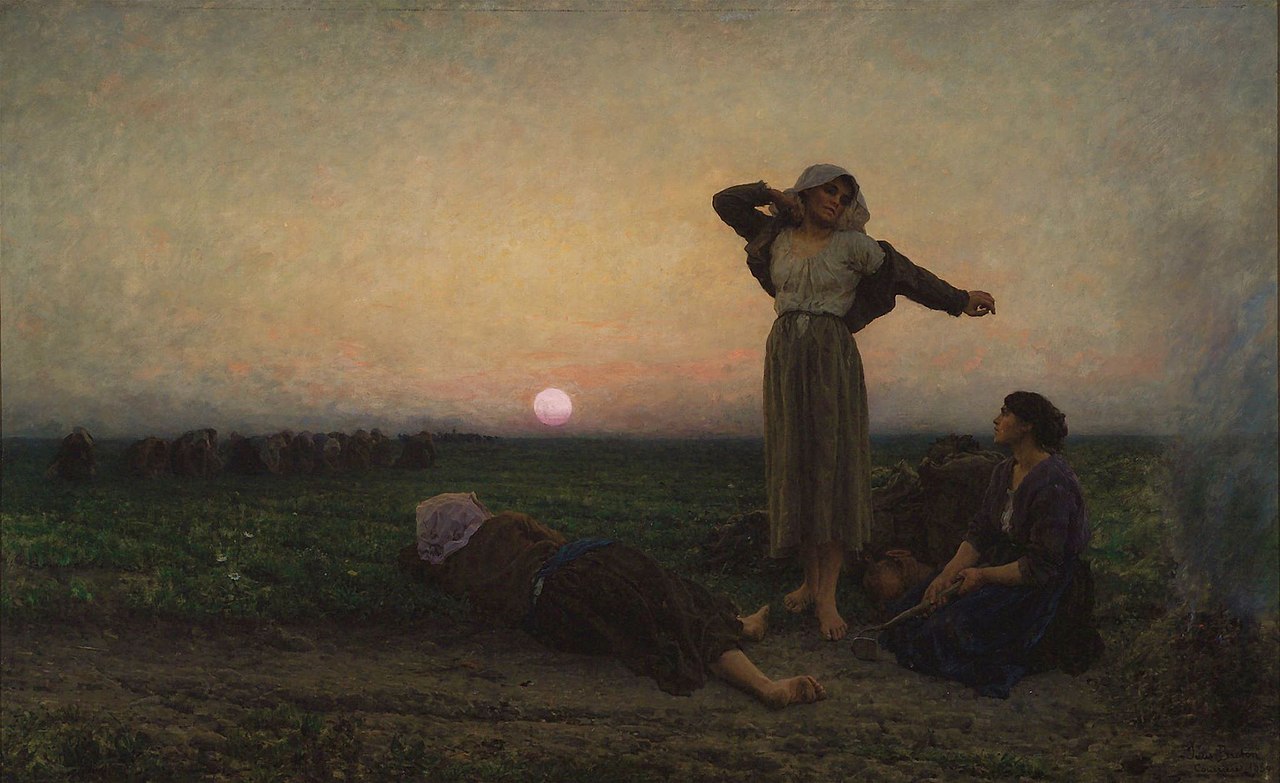
Just a short one today. I’ve used the quote above from artist Jules Breton once before here but it was with another of his paintings. The piece above of his, Le Soir (The Evening), is in the permanent collection of our local art museum, the Arnot Art Museum. It was an important painting for me, really one of the first real pieces of art with which I interacted as a kid.

In junior high school, I would sometimes ride home after school with my father. The junior high I attended was just down the street from the Sheriff’s Department where he worked and the museum was just one block over from that. So, between the end of the school day and my dad’s shift, I had an hour or two to explore a little, trying to stay out of trouble as best I could. Not always successful on that front but I won’t go into that part of the story right now.

Most days I found myself at the Steele Memorial Library which was at that time housed in a beautiful old Carnegie-endowed building. It had such warmth and was a great place to spend several hours at a time searching the stacks. Some days, however, I found myself at the Arnot Art Museum which was not yet expanded. It’s collection wasn’t large but it was quite good, with plenty of classic European paintings from well known artists of the mid and late 19th century. It was the type of work that a wealthy collector of that time would acquire on his yearly sojourn to the continent.

This piece from Jules Breton then dominated the front parlor of the museum, as it still does today. I knew nothing of art then, had only been in one museum at that point. Well, two if you count the Baseball Hall of Fame. But even with that lack of knowledge, this painting spoke volumes to me. The glow of that sun going down behind that far horizon. The tired laborers getting ready to head home from a long day in the fields. The gorgeous blend of colors that made up that sky. 

And the sense of space. It was simple and elegant. Quiet but forceful.

It was the first painting that spoke to me, the first that offered me possibilities beyond my own meager knowledge and limited opportunities. It made me think. And feel.

It remains an important piece for me. So, to see the words of Breton and whole-heartedly agree with them as an artist feels almost like coming full circle back to this painting and the small spark it kindled in me as a kid. It took a while for the spark to grow but it was always there after that.

Okay, that’s enough for today. Maybe too much.

Have a good day. 

Enduring


“To those human beings who are of any concern to me I wish suffering, desolation, sickness, ill-treatment, indignities—I wish that they should not remain unfamiliar with profound self-contempt, the torture of self-mistrust, the wretchedness of the vanquished: I have no pity for them, because I wish them the only thing that can prove today whether one is worth anything or not—that one endures.”

Friedrich Nietzsche, The Will to Power


I paused a little bit before using this quote from Nietzsche this morning. The use of anything from a philosopher whose work, and the book from which this excerpt has been taken, had been appropriated and distorted to justify their own ends , by the Nazis is a little risky, especially in this time of rising authoritarianism here and around the world. For many of us, just the title, The Will to Power, immediately conjures up imagery of invading Nazis goose-stepping through conquered cities in their quest for more and more power.

People naturally assume that that the power to which he is referring is ultimate power, ruling power to be  exercised over others. That is how the Hitler and his ilk interpreted it. But Nietzsche was talking about two separate forms of power which are expressed in German as the words Kraft and Macht. Kraft refers to brute force, both physical and mental, while Macht refers to true power. Kraft is the animal force, that primal element that is possessed in all of us. Macht, on the other hand, is the power to control one’s own kraft and use it in positive ways.

Macht is the overcoming and controlling of the kraft within us.

And that’s where we are now. We have two elements within this nation, one who see the power of this nation as pure animal power, and another who recognizes our power– our kraft— but understands that it cannot solely guide our actions and future. It is unsustainable. History shows that clearly. 

So, the question is how do we emerge from this? Do we have the fortitude to endure this tug of war between these two concepts?

Though I have my doubts on some days, in the long run I think we do have the ability to endure, actually.

And as Nietzsche expresses above, perhaps this struggle is just what we need to really move forward. Maybe we need some real hardship and suffering to understand the responsibility of our power. Maybe we need it to finally recognize that we must at some point sacrifice something of ourselves to a greater good, that our bounty does not come without a price.

Many of us have never had real hardship. I am not talking about normal loss and suffering that comes with being a human being. I am talking about widespread hurt that runs through the nation and touches most every citizen. Most of us have never had to sacrifice much for anyone.

Maybe we need the hurt and the humbling. While nobody wants to willingly take on great suffering, there are lessons to be learned from it. Perhaps that one can overcome and endure great hardship is the greatest of these. That and allowing more of us to develop a greater sense of empathy with those who continue to suffer around us.

Maybe we need to simply learn that we can endure.

Maybe then we can cross the divide between us and work together for some greater good.

Let’s hope, okay? 

Hey, here’s some old Canned Heat from about 50 years back with a fitting message for any time. It’s Let’s Work Together. Now, have a good day.


“Anxiety was born in the very same moment as mankind. And since we will never be able to master it, we will have to learn to live with it—just as we have learned to live with storms.”

― Paulo Coelho, Manuscript Found in Accra


I wasn’t planning on writing about angst this morning. I think most of us are all worn to nubs from the anxiety of this time so unless I have come up with some sort of therapy or special salve that will take it away, my words will have little effect.

Might even make it worse.

But an item popped up on my alerts that piqued my interest and it had to do with angst. Well, angst in the form of one of my paintings. I clicked on the link and there was YouTube music video with a painting that was very recognizable to me as the image illustrating it.

It was from Lithuanian-born musician/composer Žilvinas Smalys for a short composition of his called Growing Angst For 2 Bassoons. It was written and recorded on October 11, 2020 so it is most likely his take on the anxiety of this time in his part of the world.

Angst knows no boundaries.

I am not surprised that he chose this particular painting, The Angst, to accompany his composition. It is one of my personal pieces, a keeper, that has been with me for the past 25 years or so. Whenever I show it, it gets a lot of attention. It was even used in a college level textbook a few years back. It even shows up on the Google search for “angst paintings” right under Munch’s The Scream.

And it works well with this compsotion.

Žilvinas Smalys is a performer, teacher and composer who was, as I wrote, born and raised in Lithuania. His training as a classical musician throughout Europe has been extensive and he has played with orchestras around the globe. He currently resides in Santiago, Chile, serving since 2008 as the principal bassoonist at Teatro Municipal de Santiago as well as being a professor of bassoon and chamber music at Universidad Mayor de Santiago

Smalys has a nice YouTube page that features many of his compositions. I urge you to take a look. His music is lovely. Below is Growing Angst and another short piece, Lament For 2 Bassoons.

Hopefully this will help free up your own angst and you can move on to have a good day.


Finding Reverence


I was tempted this morning to comment on the horror show taking place in the people’s white house. Every day reveals even more new lows. It’s like an unending fountain of plain badness. So it’s understandable that I might want to say a few words about yesterday’s revelations that began with the discovery that government lawyers admit that they can not locate the parents of 545 migrant children separated from their families at the border, effectively making them orphans. Or that I might want to discuss the uncovering of a bank account in a Chinese bank that was not disclosed on his public financial forms, one that saw $15+ millions flow through it in 2017. Or the fact that he paid tremendously more in taxes to China over the last few years than he did in America while his daughter raked in multiple Chinese trademarks that were fast-tracked in the same year.

I was also tempted by his backhanded insult to the people of Erie, PA last night, when he said at a rally there that he wouldn’t have come or even have to be there if it weren’t for the pandemic. I have been fortunate to know the people of Erie for over twenty five years and know the great pride they take in their hometown so I could easily riff on the absolute hurt in those words.

But I can’t this morning. The awfulness that is currently in place is all too self-evident and becomes even more apparent with each new day.

Hell, with each new hour.

So, today I just want to share a beautiful couple of paragraphs from an essay by the great poet/essayist/environmentalist Wendell Berry. I was looking for something to go along with the painting at the top and as soon as I came across his essay I knew it was a perfect fit for this piece and what I see in it.

The painting is Solitude and Reverence, a 24″ by 36″ painting that was painted in 2015. It’s one of those pieces that have a sense of completeness and fulfilled purpose that often make then standout for me. I know this has been a favorite since I put my brush down after finishing it. For me, the message is that this world, this life, is a gift and we have stopped treating it as such. We show little appreciation for the bounty that this planet has gifted us while allowing us to spend our short time upon it.

We treat it like we were spoiled children with no awareness of the advantages and good fortune bestowed upon us. We only feel entitlement.

Gosh, sounds like I am getting around to criticizing the president*** again, doesn’t it?

Well. maybe that’s why I am so drawn to this piece this morning. It is the antithesis to the ugly attitude that has swept across the nation in recent years, the same that elevated him* to office.

It is peace. It is cooperation. It is shared sacrifice. It is humble. It is reverent.

It is understanding.

It is all I ask of my place in this world.

Is that too much to ask?

Here’s a bit from the Wendell Berry essay. Have a good day.


“We have lived by the assumption that what was good for us would be good for the world. And this has been based on the even flimsier assumption that we could know with any certainty what was good even for us. We have fulfilled the danger of this by making our personal pride and greed the standard of our behavior toward the world – to the incalculable disadvantage of the world and every living thing in it. And now, perhaps very close to too late, our great error has become clear. It is not only our own creativity – our own capacity for life – that is stifled by our arrogant assumption; the creation itself is stifled.

We have been wrong. We must change our lives, so that it will be possible to live by the contrary assumption that what is good for the world will be good for us. And that requires that we make the effort to know the world and to learn what is good for it. We must learn to cooperate in its processes, and to yield to its limits. But even more important, we must learn to acknowledge that the creation is full of mystery; we will never entirely understand it. We must abandon arrogance and stand in awe. We must recover the sense of the majesty of creation, and the ability to be worshipful in its presence. For I do not doubt that it is only on the condition of humility and reverence before the world that our species will be able to remain in it. ”

Wendell Berry, The Art of the Commonplace: The Agrarian Essays


“This life therefore is not righteousness, but growth in righteousness, not health, but healing, not being but becoming, not rest but exercise. We are not yet what we shall be, but we are growing toward it, the process is not yet finished, but it is going on, this is not the end, but it is the road. All does not yet gleam in glory, but all is being purified.”

― Martin Luther


Martin Luther wrote the words above in 1521 in his defense against the Papal Bull from Pope Leo X that excommunicated Luther, condemning him as a heretic for his Theses. They were applicable then as they certainly are today.

He had a clear understanding that we are ever-evolving creatures, that our purpose is to attain depth as humans. To continue to grow and learn. 

To follow a road, even as we know that we will never reach a final destination.

I am not a religious person  so, for me, the purification of which he writes is not a religious thing. I see it more as an attainment of wisdom as one travels their road through life. The purification comes in discarding those negative traits that have been doggedly held close during the whole journey. There is a lot of energy expended in maintaining these negative feelings and losing them allows a shift of energy towards more positive thoughts and feelings.

That sounds like an easy thing to do. But those darker negatives stick tight to us, digging in until they appear as part of us. They won’t be tossed aside easily. 

But it is a noble task for us to consider as we travel our endless roads. 

Here’s a lovely version of the great traditional song, The Wayfaring Stranger. There aren’t many bad versions of this song, it’s that  great a song. I’ve played several here over the years. But for today, I thought I’d share this version from the Hayde Bluegrass Orchestra. Listening to their version, it’s hard to believe they are a Norwegian band and not right out of the Appalachians. Lead singer Rebekka Nilsson has that wonderful plaintiveness in her voice that defines this type of music. Just a great version. 

Enjoy and have a good day on your road.


Gang of Weasels


“Violence does, in truth, recoil upon the violent, and the schemer falls into the pit which he digs for another.”

Arthur Conan Doyle, The Adventures of Sherlock Holmes


There was a popular book in the early 1970’s that I enjoyed as a teen that was later turned into a film starring Jerry Orbach and Robert DeNiro. The book was much better than the film. It was from Jimmy Breslin and was called The Gang That Couldn’t Shoot Straight. It told the story of a gang of smalltime NYC mobsters who try to turn the tables on the Big Boss. Unfortunately, every trick and device they tried in doing so turned back on them. 

In this book, as in real life, it seems there is a sort of instant karma for scheming weasels.

I think we will be able to witness this firsthand in the next two weeks. There are those who will stoop to the lowest of lows to try to keep their chosen one in power and they are already at it. They are currently following the same script that the Russians and every fascist autocrat have used in trying to discredit their opponents.

Of course, they have been doing such a lousy job in hiding their intentions over the past few years that their actions are fully anticipated and unsurprising. Plus, the gang that is carrying this out is such a sorry group of miscreants and caricatures (a Kremlin based Russian intelligence officer) that any credibility they sought for their revelations is quickly dispelled. 

If Jimmy Breslin were still alive– he died in 2017– I think this story would be right in his wheelhouse. Might even call his book Gang of Weasels.

The next few weeks will be interesting. The Gang of Weasels will be desperately taking aim at every possible target.

Let’s just hope they only shoot themselves in the process.

Wild World


Bring tea for the Tillerman
Steak for the sun
Wine for the woman who made the rain come
Seagulls sing your hearts away
‘Cause while the sinners sin, the children play
Oh Lord, how they play and play
For that happy day, for that happy day

–Tea For the Tillerman, Cat Stevens


This was one of those days when I had to go against my instincts in choosing a song for my  Sunday Morning Music selection. I came into the studio early this morning and I wanted to hear something louder and more raucous. Not necessarily angry though that wasn’t out of the question.

I first thought of an old Del Fuegos song from the mid-80’s, Nervous and Shaky. It’s a song from a Boston based garage-rock band that had a brief burst of notoriety, looking for a bit like they could be a next big thing. I liked their stuff a lot and this song still pops in my head every so often. I tried finding a YouTube video that captured the sonic boom of the vinyl version but it just doesn’t come through well enough so I moved on.

Then it was Jack White (not quite right today) then late bluesman John Campbell who I featured here ten years ago, writing about being wowed by him in a tiny club opening for the legendary Buddy Guy. Then it the Clash and Little Willie John and on and on. 

Nothing felt right to share.

Then I came across a version of Wild World, the old Cat Stevens song– it’s fifty years old!— performed as a duet by him with the late Chris Cornell.

It instantly felt right. It felt nostalgic since the Cat Stevens albums of that time were among the first I bought for myself as a pre-teen and remained on my playlist for quite a few years after. Plus, being aware that it is indeed a wild world out there is a good bit of advice for anyone. So here is that performance with Chris Cornell plus I threw in the very short title track from the album that it was on, Tea For the Tillerman. It’s a song that always strikes a vibrant chord within me.

By the way, the image at the top is the album cover art for that album, created by Cat Stevens. Most folks who grew up in that time will recognize it immediately.

So, give a listen and have a good day. But remember, it’s a wild world out there.

“The Quarantine House” – Now at the Principle Gallery


“But I must go back here to the particular incidents which occur to my thoughts of the time of the visitation, and particularly to the time of their shutting up the houses in the first part of their sickness; for before the sickness was come to its height people had more room to make their observations than they had afterward; but when it was in the extremity there was no such thing as communication with one another, as before.”

― Daniel Defoe, A Journal of the Plague Year, 1722


I see that we, as a nation, had over 70,000 new cases of covid-19 on Friday. It made me think about how this time has changed so many things in daily lives.

So much isolation, which I know is so difficult for so many of us. Economic pain from job losses and businesses closing. And those that do have jobs continue along with the nagging fear that they are putting themselves at risk every day. 

And that is without even mentioning the actual virus and its effects on the afflicted and their families.

It made me wonder how this compared to other times and other pandemics. I did a little skimming of A Journal of the Plague Year, written in 1722 by the author of the better known Robinson Crusoe, Daniel Defoe. It tells in journal form the story of a man’s life in 1665 in London when the bubonic plague, the Black Death, ferociously struck that city. That particular episode of the Black Death killed over 100,000 Londoners which was abut a quarter of the population at the time. And that was not even close to being the worst case of the Plague. It literally killed hundreds of millions of people throughout Europe and Asia in the centuries when it was at its peak and it still persists in places where conditions allow it to continue. No herd immunity here, folks.

But looking through Defoe’s book and reading sections made me think how horrible it must have been at that time. To be afflicted often meant being boarded in your home. There would be no contact with the outside world. No internet, no cellphones, no Netflix or Instacart or Door Dash deliveries. You would be completely cut off and alone with your painful imminent death as your companion.

It’s a terrifying prospect. I don’t mean to bring you down with this but I just found it interesting. It made me realize how fortunate we are to have the technological connections that we have. I don’t say that easily because I often find myself damning the persistent and invasive nature of the technology even as I use it.

At least now we can get information, as poor and misinformed as it sometimes is. But imagine being ill, sitting in a dark, boarded up home without any idea what might be taking place outside those walls. No news of possible cures or therapies. No idea of whether this would ever end, that relief might come before death. 

I have a hard time imagining the horror of that situation. Nothing in my life, nor in probably most of yours out there, has prepared me for that.

There was another paragraph that sounded familiar:

“But it was impossible to beat anything into the heads of the poor. They went on with the usual impetuosity of their tempers, full of outcries and lamentations when taken, but madly careless of themselves, foolhardy and obstinate, while they were well. Where they could get employment they pushed into any kind of business, the most dangerous and the most liable to infection; and if they were spoken to, their answer would be, ‘I must trust to God for that; if I am taken, then I am provided for, and there is an end of me’, and the like. Or thus, ‘Why, what must I do? I can’t starve. I had as good have the plague as perish for want. I have no work; what could I do? I must do this or beg.”

It made me think again about those folks who have no choice but face the possibility of infection, about those business owners who are at risk at losing everything they have worked much of their lives for. It also reminded me of the foolhardy people who think they are somehow beyond the reach of the virus, that they do not have to concern themselves with the welfare of others. 

I am sure there were those same fools during the Black Death.

I don’t know that there’s a point here except to say that I am grateful for being able to ride this out in this era with our technologies, connections and conveniences rather than any of the pandemics from the past. All things considered, we are fortunate. Maybe not too smart but fortunate.

Perhaps two hundred years in the future some person going through a new pandemic of that time will look back on this in some digital archive and say, “Man, I am so glad I didn’t have to live back then!”

And hopefully, they will also be grateful for their own situation.

Be grateful for what you have and have a good day, folks. To that end, here’s a little William DeVaughn with one of my faves.