Was going to write something new today for Mother’s Day but decided to replay a post from five years back about my own mom, who died close to twenty five years ago now.
*************
I thought I would take the opportunity on this Mother’s Day, to dedicate this week’s Sunday music to my late mom. It’s hard for me to believe but later this year will mark twenty years [25 now] since she passed away after a short but brutal battle with cancer. Needless to say, I miss her very much and wish she could have seen the things that came in the years after she died, such as how well her grandchildren grew up and the great-grandkids she never got to meet or dote on.
For my parts, she never lived to see my work hanging in a gallery or museum, never got to see how it has grown over the years. Looking at two large pieces on easels next to me at this moment, I realize that there is a whole different world of mine she never got to witness.
But I think she would be pleased to know that things worked out okay, that I found something to ease my mind and give me something of a purpose. I would hope she would like the work I’ve done. I know she liked the earliest pieces, the only ones she would know, like the piece at the top. It was one of my earliest efforts in early 1994, long before I had experienced any kind of creative breakthrough. It was gift to her on Mother’s Day of that year and it hangs in my studio now, always reminding me of her.
So, for this bit of Sunday music, I thought I would play one of the songs I know to be a favorite of hers. She always loved Eddy Arnold‘s voice and I have specific memories of this song coming from our old stereo console. The title and the song itself, Make the World Go Away, just seemed to fit Mom so well. For that matter, looking at the alternative world that surrounds me here in the studio, I guess it fits me as well. I am my mother’s child, after all.
“In the life of each of us, I said to myself, there is a place remote and islanded, and given to endless regret or secret happiness; we are each the uncompanioned hermit and recluse of an hour or a day; we understand our fellows of the cell to whatever age of history they may belong.”
― Sarah Orne Jewett, The Country of the Pointed Firs
********************
I’ve been looking at the work for my upcoming Principle Gallery show, Social Distancing, and as the title implies, much of it is concerned with isolation. There is distance and a lot of singularity in the elements of each piece. A lone house. A single tree, One chair alone. There are landscapes without a tree or person or structure. Just the still emptiness. And even in the cityscapes of this show that seem busy and crowded with buildings and lights, it is the emptiness of the streets and the lack of figures in the lit windows that mark them.
It’s familiar territory for me, places and themes I have explored for a long time. However, this current situation brings my familiarity closer to what has become a new normal for some of us.
It will be interesting to see how people react to the work now as opposed to how they have in the past. After all, each of us relates to our isolation and solitude in different ways. For some it is maddening with the sense of imprisonment. For others, it is liberating in a way, freed from social obligations and niceties, free to do things for themselves without guilt.
Unfortunately, for both there is a dark cloud of potential danger hovering always nearby. It’s creates a strain that is difficult in human terms but, in the artistic sense, this adds a desired tension, one that evokes some sort of emotional response.
And in the piece above, Sequester’s Moon, it is the slate blue darkness of the sky and clouds that evokes this tension. With a different sky, this piece might feel pastoral and idyllic. With this sky, some might see it as the scene as ominous. Or they might see the house as a safe place amidst the dangers.
Myself, I see it as a safe place. A place to expand, not contract. I am much like Sarah Orne Jewett’s character above who, in their isolation and solitude, identifies easily with the hermits and recluses of past ages.
So, here in my hermit’s cell of isolation, I am going happily back to work now.
“A writer – and, I believe, generally all persons – must think that whatever happens to him or her is a resource. All things have been given to us for a purpose, and an artist must feel this more intensely. All that happens to us, including our humiliations, our misfortunes, our embarrassments, all is given to us as raw material, as clay, so that we may shape our art.”
― Jorge Luis Borges, Twenty-Four Conversations with Borges: Interviews by Roberto Alifano 1981-1983
*************************
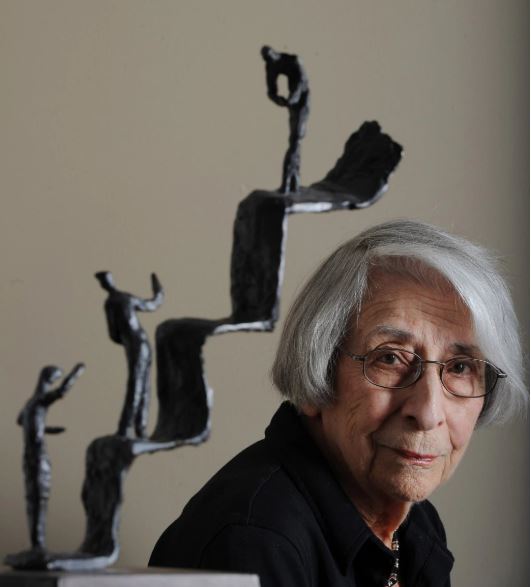
Marilee Shapiro Asher
Interesting article in the Washington Post yesterday about DC artist Marilee Shapiro Asher who at age of 107 is successfully recovering from a rough bout with covid-19. It was so rough that her doctor called her family saying that she would most likely not last twelve more hours. But the doctor underestimated Marilee and probably wasn’t aware she had already beaten another pandemic, having contracted the Spanish Flu in the Pandemic of 1918 at the age of 6.
That’s a great story in itself but for me, I was as interested in the fact that Marilee is still working as an artist at age 107. She began her artistic career as a metal sculptor in her 20’s and had her first show in 1938–82 years ago. Over the years she has worked in sculpture, painting, photography and now in digital art. In her late 80’s, when the physical demands of working with the large metal sculptures she was known for ( she has work in the permanent collection of the Smithsonian) became too much for her she enrolled in a digital art program. Her fellow students were almost all in their early 20’s.
She had her last show of her sculpture at the age of 100 and is looking forward now to a possible new show of her digital creations. At 107.
It’s obvious that art gives her a purpose that fuels her drive to live. It’s not an unusual story. I have encountered a number of stories of artists who have seemingly prolonged their lives through the purpose they find in their art, many productively working into their 100’s.
I find this encouraging.
Marilee had someone in the family to follow in taking up her late interest as a digital artist. Her mother, Bonnie Harris, took up painting at the age of 79 and worked at it until her death at age 92. Self taught, her folk art paintings garnered much notice and are in the permanent collection of several museums, including the Baltimore Museum of Art, the Smithsonian National Collection of American Art, The Phillips Collection and the Folk Art Museum.
Like I said, I find this encouraging. And these days, when there is so much happening that want to make you worry, it’s nice to know that these artist found purpose in their work and used lives that spanned the awfulness of pandemic, war and social upheaval as the inspiration and raw material for their work.
Get well, Marilee, and keep on working. Thanks for the inspiration.
It was the best of times, it was the worst of times, it was the age of wisdom, it was the age of foolishness, it was the epoch of belief, it was the epoch of incredulity, it was the season of Light, it was the season of Darkness, it was the spring of hope, it was the winter of despair, we had everything before us, we had nothing before us, we were all going direct to Heaven, we were all going direct the other way – in short, the period was so far like the present period, that some of its noisiest authorities insisted on its being received, for good or for evil, in the superlative degree of comparison only.
— A Tale of Two Cities, Charles Dickens
**********************
It seems like this current period of time, this year we call 2020, might be memorable. It definitely falls somewhere among those terms that Dickens set out in the opening paragraph of his A Tale of Two Cities.
I’m still waiting for the best of times part but maybe it will eventually show its shining face at some point this year. Got my fingers crossed on that one.
The painting at the top is part of my Social Distancing show that opens 4 weeks from tomorrow, June 5, at the Principle Gallery in Alexandria. As I was working on it, further into the process it felt like it was acting as a marker in some way of this year. It certainly reflected the social distancing in the show’s title.
But there was something more than that to it, something more like the Dickensian ( finally got to use that word!) words above. Perhaps best of times, worst of times sort of stuff.
Season of light and season of darkness, definitely.
I think it’s a fitting piece for this period with its fractured sky and darker, ominous tones set against the light from the sun/moon(?) and the sturdiness of the house.
It is neither optimistic nor pessimistic. Not fearful either nor foolishly filled with hubris. The word I might use is enduring.
Kind of like the final speech from Ma Joad ( played brilliantly by Jane Darwell) that ends the film version of The Grapes of Wrath:
“I ain’t never gonna be scared no more. I was, though. For a while it looked like we was beat. Good and beat. Looked like we didn’t have nobody in the world but enemies. Like nobody was friendly no more. Made me feel kinda bad and scared too, like we was lost and nobody cared…. Rich fellas come up and they die, and their kids ain’t no good and they die out too, but we keep on coming. We’re the people that live. They can’t wipe us out, they can’t lick us. We’ll go on forever, Pa, ’cause we’re the people.”
That speech always moves me because it speaks so strongly to my own survival instincts. There have been times when I wanted to give up but this same drive that Ma Joad describes kicks in.
You take the beating today but you keep plodding forward, doing whatever is needed to see the next day.
Because maybe that’s where the answer will be.
That’s what I see in this painting. Enduring. Resilient. Good time, bad times, fight through the darkness and look for the light. Just keep going on and not giving up.
I am calling this painting, which is 20″ wide by 30″ tall on wood panel, In the Year 2020.
It was somewhat borrowed from the old Zager & Evans 1968 hit In the Year 2525. That time 50 some years back felt as apocalyptic as this moment seems now. I am sure there was a lot of use of the best of times, worst of times at that point. But we did somehow endure the turbulence of that time. There might be much more ahead of us now that we will have to struggle past but we will most likely endure and look back at this year with mixed feelings someday, remembering the awfulness along with the goodness we discovered alongside it.
Here’s a video of that Zager & Evans song set to visuals from the 1925 silent futuristic dystopian classic from director Fritz Lang, Metropolis.
Have a good day and stay strong.
Last July, I wrote here about going up the hill to the old studio that I had worked in everyday for over ten years before moving into my current digs. It was in pretty bad shape back then, with a gaping hole in the roof and the floor heading in several different directions, none of them level. It was a mass of decay and debris but I had found several paintings tucked away that I had overlooked when I was cleaning it out years ago.
There were some I remembered well and had wondered where they were before finding them. It was great finding these pieces, most of them in pretty good shape considering the exposure to the elements– and critters of all sorts– they had faced.
I wandered back up the hill yesterday. There were still a few things there that I needed to bring back down the hill plus I wanted to see how the old structure had fared during this past winter.
Well, the structure was in even worse shape, the walls and floors beginning to part company at some spots and the hole in the roof expanding to let in even more of the weather. Mother Nature was quickly reclaiming everything she could. I gingerly moved through the tilting doorway and picked around in the debris, finding the items I was looking for. As I prepared to leave, I stopped by group of three or four old paintings that I had left last year. They were not good in any way. Kind of embarrassing , actually. Plus, I didn’t even want to waste the time to carry them back down the hill.
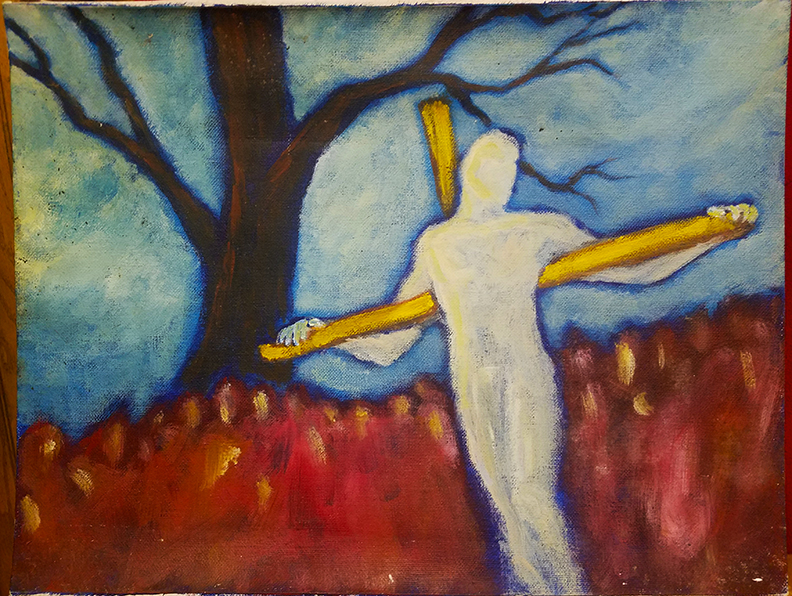
But I went through them again and while I agreed with my decision from last year to leave them, there was one that grabbed my attention. It’s the piece at the top. It was painted about 25 years ago and I remember, even then, not knowing what it was meant to be.
It was an enigma even when I first painted it. I may have painted it but I still don’t get it, don’t fully understand what it’s supposed to say. But I do remember painting it and liking things about it. The colors of the sky the mass of the crowd behind the glowing figure that seems to be reclining on a cross. Not nailed. Like it was his decision to be there.
Maybe it’s saying that we choose the crosses we bear?
I don’t know.
Perhaps it was just the contrast between its colors and the destruction around it, but this piece seemed to ask to be freed from the wreckage. It’s in rough shape from a decade or more of exposure and neglect. It was painted on a cheap canvas panel and the cardboard backing that was now deteriorating and falling apart. But something in it sparked my imagination, made me want to look at it again. Made me save it for another day.
So, I brought it back down to my current studio. It’s been propped up on a chair and I have stopped to examine it several times over the past day. And even now, I am still mystified by it and how I came to paint it.
I am pretty sure I didn’t have a title for it back then and maybe it doesn’t deserve one now. Like I said, I still don’t know what to make of it. But if I were to give it a title I might call it You Can Have the Crown, taken from the title of a Sturgill Simpson song. I think the guy on the cross might understand. Give a listen and see if you do as well.
I am a little intimidated in quoting the words of a man who is believed to have painted the piece shown above, The Torment of Saint Anthony, at the tender age of 12 or 13. Pretty amazing. It’s obvious from this, and almost everything created afterward over his lifetime, that Michaelangelo had both brains and hands– the highest degree of craftsmanship along with thought and feeling that brought his work to life.
But his words ring true for any painter. Painting should not be mere craft, not formulaic process nor exact replication of the reality before them. No, it is beyond that. It is how the artist imbues the work with their own thought and emotion, their own spirit, their own essence that elevates the work above craft. It requires a total investment of the self.
Doing that is the trick. At first glance, it seems both a tall task and a simple one. Giving what you think is 100% of yourself seems easy, right? But not holding back something, not sharing every bit of yourself, makes it a Herculean effort. In the end, it comes down to simply feeling emotion in what you are doing and being willing to openly display it without reserve.
Now, maybe I am misinterpreting Michaelangelo’s words to fit my own subjective view of painting. Perhaps in these ten spare words he was speaking about taking a more scientific or mathematical approach to painting and composition. That I don’t know. But when I read it, it made sense to me because the differentiating quality I see in painting, from self-taught rough-hewn outsiders to the highest level of traditional representational painters, is how much of themselves a painter is willing to invest in their creations.
An investment of the self.
It is the thought process of the artist that makes the painting, not the mechanical process.
*******************
This post is from five years back. and is shared again because I love this youthful piece from Michaelangelo along with his words. Whenever I see this painting, or for that matter, anything from Michaelangelo, I am humbled beyond description. And that’s not a bad thing.
“Numbers do not feel. Do not bleed or weep or hope. They do not know bravery or sacrifice. Love and allegiance. At the very apex of callousness, you will find only ones and zeros.”
― Amie Kaufman, Illuminae
***************************
Today is May 4th. By tomorrow, or even later today, the death toll from the coronavirus here in the US will hit the 70,000 mark. That 70K is a figure, according to the model used by the white house* to forecast the virus, was estimated to be reached on or around August 4.
We are a full three months ahead of this obviously faulty model’s schedule.
For the past month, we have averaged about 30,000 new casesand around 2,000 deaths per day. It has remained steady and is not moving in any sort of downward direction. Not even close to indicating the end of this first wave. And bear in mind that those figures come even while some states have tried to suppress testing as well as public reporting of the deaths caused by the virus there. The reality is that the actual numbers, both of those infected and those killed by the virus, are substantially higher.
What this means is that we have yet to even approach the midpoint of this event.
We have witnessed the white house* beginning to try to normalize these numbers, throwing out higher figures so that anything lower seems somehow better. They never attach faces or personalities to these numbers.
They only see and present them as numbers with the hope that the public will also begin to only view them in that way, as though these simple numbers are distant and totally unattached to their own very real lives. And so long as they see these deaths as mere numbers and not as flesh and blood, they will view these numbers as an acceptable normal.
Numbers are just symbols and tools to be manipulated. They don’t have lives.
Numbers don’t hold the door open for you or smile and wave as you drive by. They don’t bake you a cake. They don’t do you a favor or give you a hug. They don’t hold your baby or pet your dog or send you a card. Numbers don’t give you a hand when you need it. Numbers don’t cry at a sad movie or dance to a slow song. They don’t catch wedding bouquets or sob at a funeral. Numbers don’t beam with pride at the happiness of those they love.
Numbers don’t love, for that matter. Or hate.
Numbers alone simply do not do justice to the lives they represent.
There are going to be a lot more large numbers ahead of us. That is a certainty. And so long as the more selfish among us fail to see the real flesh and blood people represented by these numbers, so long as they feel it is their right to flaunt the small protections we have against this virus, these numbers will continue to grow. Their very actions against being required to sacrifice anything at all will prolong and expand this crisis, will grow the numbers.
We have become a selfish people, indeed. We see only what we want to see. Hear only what we want to hear. We live in an echo chamber of self that doesn’t have much room for the concerns of others outside of what they stack up to as numbers.
I don’t know how to end this diatribe this morning. There is no good way to end it. I am simply frustrated by the callous use of these numbers and the ugly selfish and stupid behaviors being displayed by those who do not recognize the humanity they represent.
*******************
“[Dona Maria] saw that the people of this world moved about in an armor of egotism, drunk with self-gazing, athirst for compliments, hearing little of what was said to them, unmoved by the accidents that befell their closest friends, in dread of all appeals that might interrupt their long communion with their own desires.”
I call this painting Hunkered Down. It’s about 17″ square on paper and is part of my solo show, Social Distancing, that opens in just over a month on June 5th at the Principle Gallery.
Choosing the title for this piece, or for the show for that matter, was not a difficult task. Hunkered down is the term that most often jumps to mind when I think of this time of keeping socially distant.
The fact that this is the normal form of existence for me made it even easier.
Avoiding people and not having to go anywhere is something I have practiced for decades. I never thought of wearing a mask but like the idea of the vague anonymity it provides. Now that it’s acceptable and required, I might continue to wear one even after this thing someday subsides.
That is, if I ever leave my property again.
That’s a big if.
This piece is a return to my older style in transparent inks, more spare in detail which allows the primary elements, the simple forms of sky and land, to carry the larger part of the emotional load. This lack of detail brings a quietness to the whole that speaks volumes, at least for me.
The first song that came to mind when I thought of an accompaniment to this painting was an old favorite from Elvis Costello, Almost Blue. There are several versions of the song that I like so I had some choices. I have played a wonderful version that is an absolute favorite from late jazz great Chet Baker here before so I decided to play a nice simple and spare performance of the song by Elvis himself from a 2005 radio broadcast. I also threw in a version that I also like very much from, Diana Krall, who also happens to be his wife.
“He who does not understand your silence will probably not understand your words.”
― Elbert Hubbard
***********************
The painting above is called Endless Time, from back in 2008. It’s what I might call one of my Big Quiet paintings. Just color and forms. No central objects to garner the focus. No Red Trees or Red Roofs or Red Chairs. Not even a far point that seems like a destination.
I am not passing through, not heading anywhere past this point nor concerned with paths to follow.
In this piece, I’m just there. Now.
It’s a place without words. Pure silence.
The Big Quiet.
I would try to describe it further but unless you know or seek the Big Quiet yourself, as Elbert Hubbard points out above, you probably won’t understand.
Silence and quiet is a subjective thing as our recent isolation has proven. For some, it is a glorious thing without the sounds of traffic and crowds. For others, it is horrifying, maybe a reminder of the stillness of the grave.
“True glory consists in doing what deserves to be written, in writing what deserves to be read, and in so living as to make the world happier and better for our living in it.”
― Pliny the Elder
********************
A couple of days ago I showed a painting in progress, at a point where I believe it had taken on its life force. Even though it was far from complete, it was already exuding some sort of energy.
I can’t speak for other artists but for me, that’s always a great feeling. It energizes the process, makes me eager to see it through, to discover what its final phase will reveal. There’s a sense of gliding. It feels easy and smooth with little resistance, nothing to stop you from soaring forward.
Believe me when I say this is not normally the case. No, it’s not always gliding through a cool sky. Sometimes the process is a slow trudging march forward in the pouring rain. There are multiple periods in the process where everything goes flat and dull, including my own enthusiasm for continuing, and there seems to be no satisfying end in sight.
But the strange thing is that often both of these paths– the soaring as well as the slogging– come to the same final point. Both often result in a piece that speaks on its own, that has its own life, its own energy.
They just get there via different routes.
The beauty in both ways is that both are energizing for me. The easy way, such as this painting followed, excites me and inspires me, throwing me instantly into my next work.
It’s joyful.
The slog, on the other hand, reinforces me. It builds the confidence that I can go deep within myself and get past the next obstacle I face. To just keep moving ahead.
It’s satisfying.
This piece was, as I said, easy. It excited me and inspired me from its very beginning. There’s a cleanness in its energy, its colors and forms clear and easily read. Graceful. The inspiration I felt in painting it hangs to it still. As does its joyful feeling.
It’s what I hope for in all my work.
I call this piece In Gaudium Mundi.
The joy in the world.
It’s an 18″ by 36″ canvas that will be part of my Social Distancing show at the Principle Gallery that opens in June at the Principle Gallery in Alexandria, VA.
 I thought I would take the opportunity on this Mother’s Day, to dedicate this week’s Sunday music to my late mom. It’s hard for me to believe but later this year will mark twenty years [25 now] since she passed away after a short but brutal battle with cancer. Needless to say, I miss her very much and wish she could have seen the things that came in the years after she died, such as how well her grandchildren grew up and the great-grandkids she never got to meet or dote on.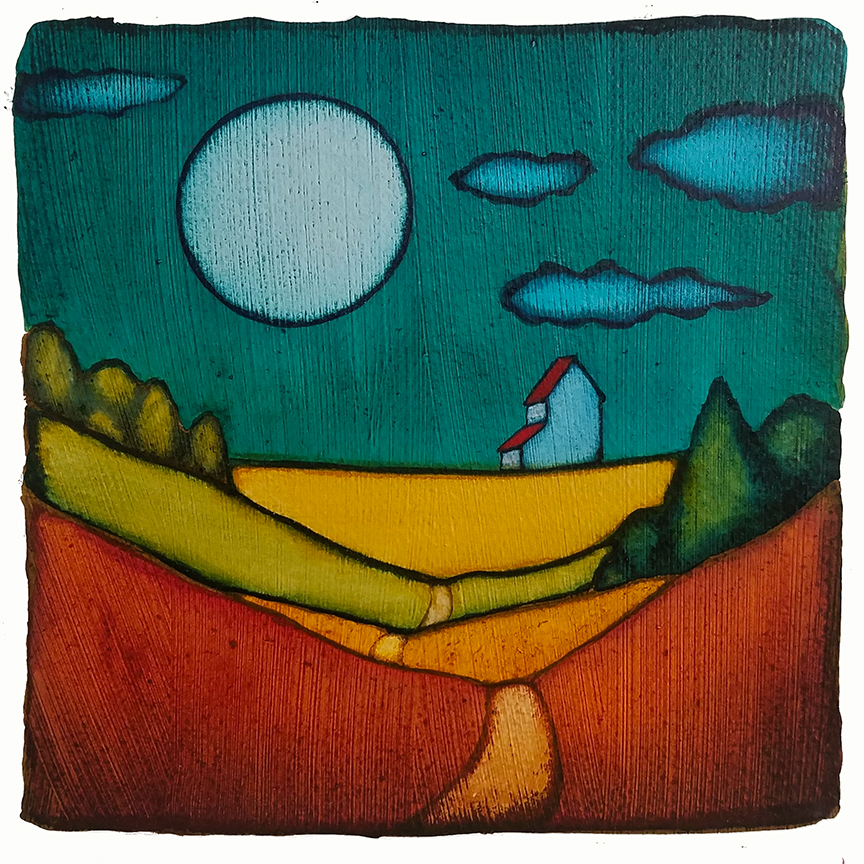




 Redtree Times