Feeds:
Posts
Comments

*******************

“I learned this, at least, by my experiment: that if one advances confidently in the direction of his dreams, and endeavors to live the life which he has imagined, he will meet with a success unexpected in common hours.”

― Henry David Thoreau, Walden: Or, Life in the Woods

*******************

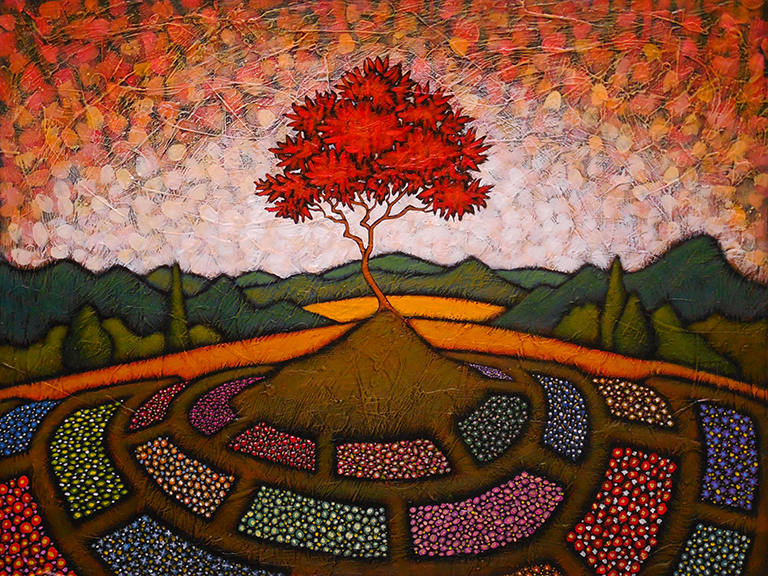
This is a new painting, 18″ by 24″ on panel, that is headed to the Principle Gallery for my upcoming show, Redtree: New Growth, that opens June 7. It’s been one of those pieces that keeps drawing my eye in its direction here in the studio. Maybe it’s the rings of colorful flowers– part of the New Growth from the show’s title–that encircle the Red Tree that attract my eye. They have a gem-like quality in the landscape.

I have mentioned in the past how I view many of my Red Tree paintings as being portraiture as much as they are landscapes, with the Red Tree and the foreground landscape often serving as the head and shoulders of a portrayed figure.  That certainly holds true for this piece, which I have titled  The Pharaoh’s Necklace.

In this piece, I see the Red Tree as a head held high with the colorful bands around the mound– the neck here– transforming from beds of flowers into a sort of necklace like those seen of the pharaohs of ancient Egypt. By the way, for your daily dose of useless facts, that type of necklace is called a usekh or wesekh.

Seeing this painting as a portrait, I see it as a portrayal of the strength and pride of someone who has, as Thoreau describes above, endeavored to live the life they have imagined in their dreams and have met with unexpected success.

More than that, it’s a painting of possibility, one that points out that we all have the potential to realize our hopes and aspirations, That is, if we can first formulate a dream. I sometimes get the feeling that many people have never given their dreams much thought.

As to those who have, I often wonder if many people actually maintain the dreams of their youth into their adulthood. If not, have they convinced themselves that these dreams were foolish and unattainable then finally ceased all pursuit? Or perhaps they had aspirations that didn’t match up with their actual strengths and abilities?

For example, I knew at an early age that my dream of being the ace of the St. Louis Cardinals pitching staff was off the table. And I never had the nerve to be a master thief. I knew my dreams had to focus on the few qualities I possessed and prized if they were ever going to come to fruition, if I was ever going to wear my own pharaoh’s necklace.

And, thankfully, there are some days when I do feel that I am sporting my own gem encrusted usekh. Those are the good days of this life and this painting is how those certain days feel to me.
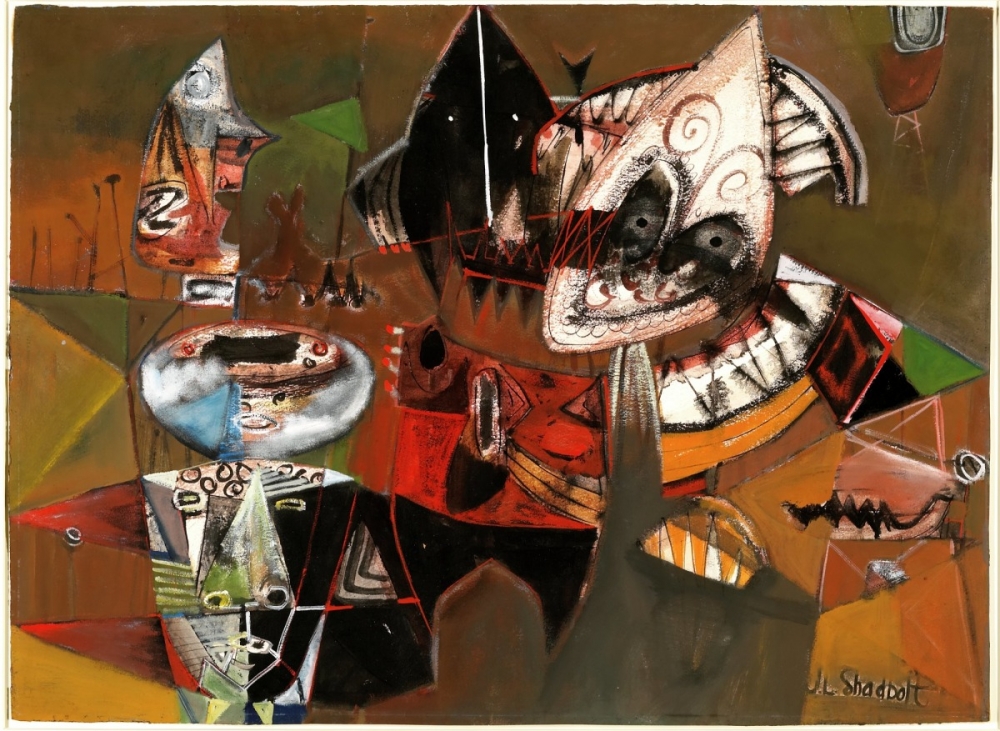


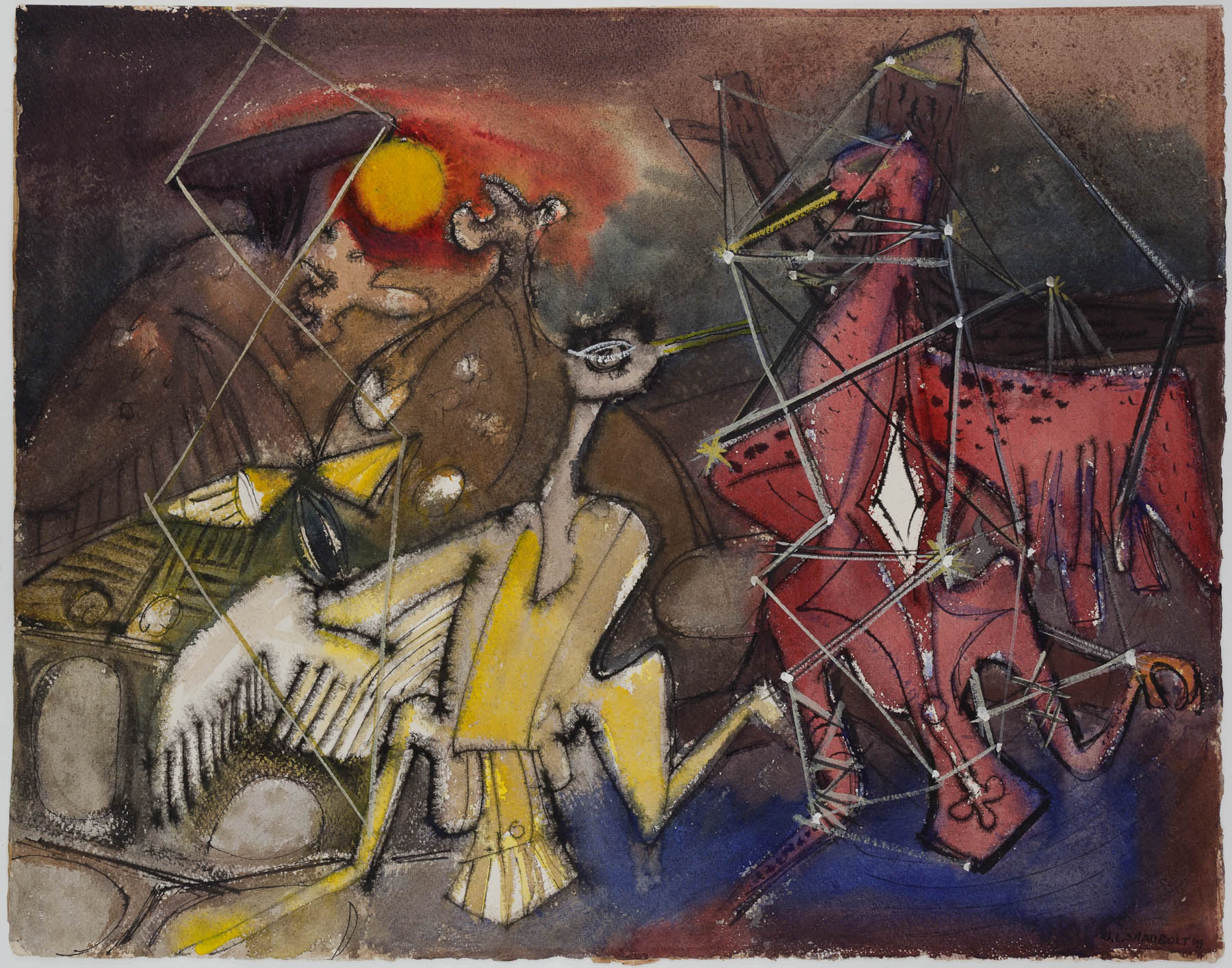
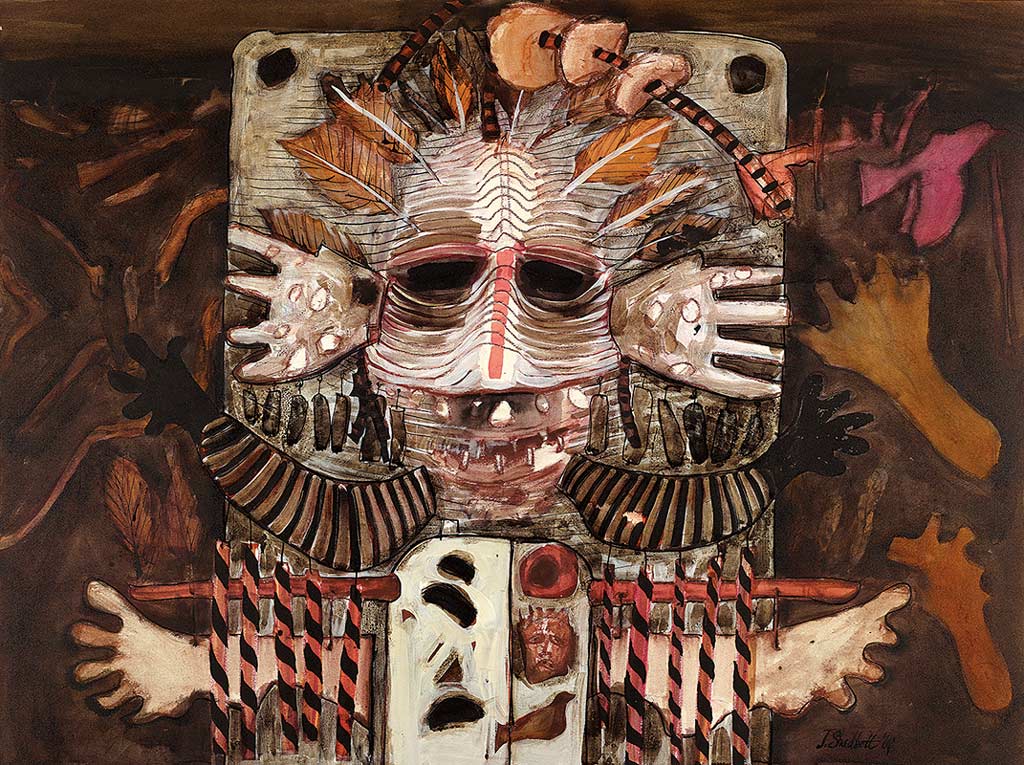
Jack Shadbolt- Presence After Fire – 1950

***********************

An artist is no bigger than the size of his mind.

–Jack Shadbolt (1909-1998)

***********************

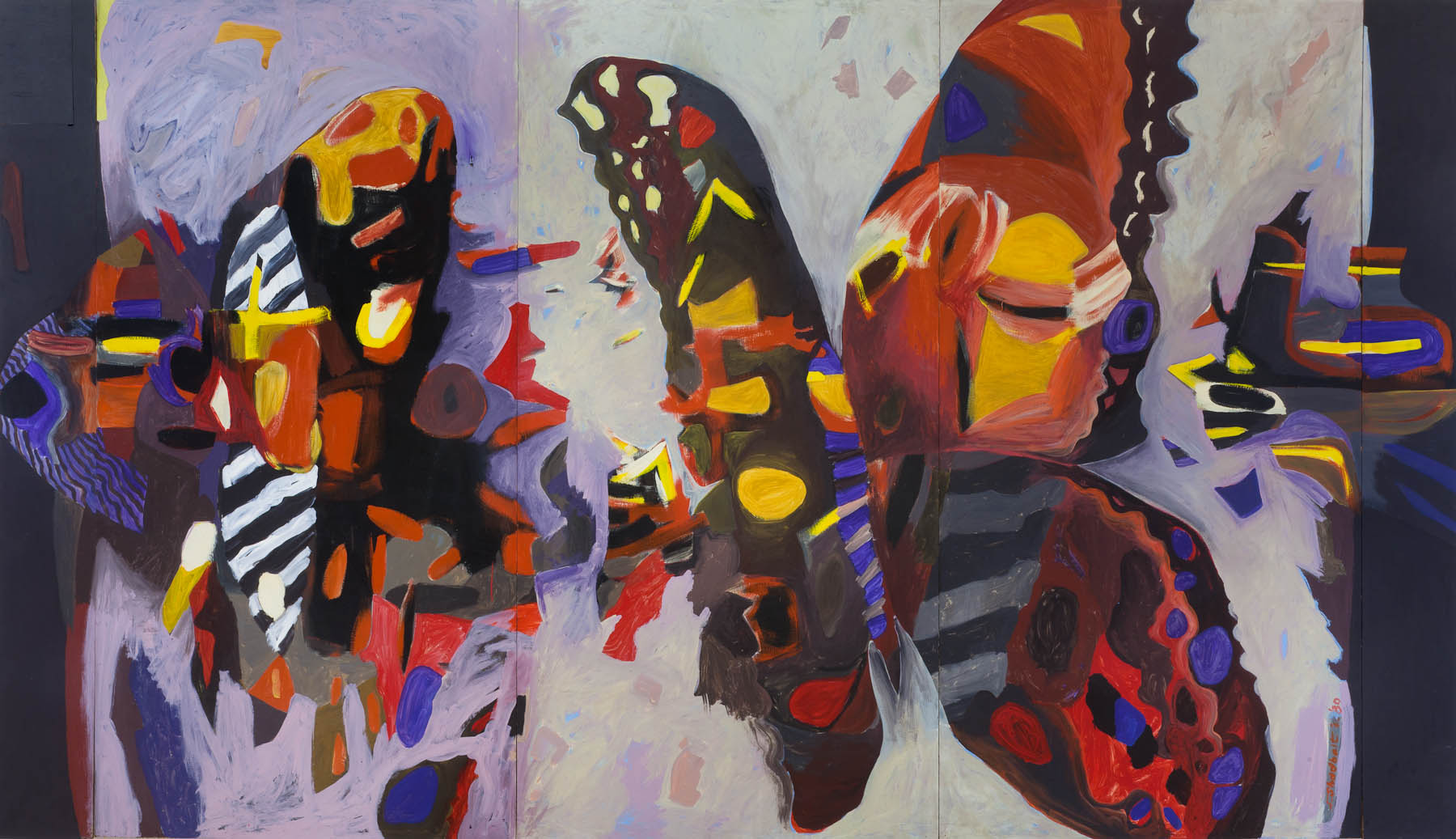
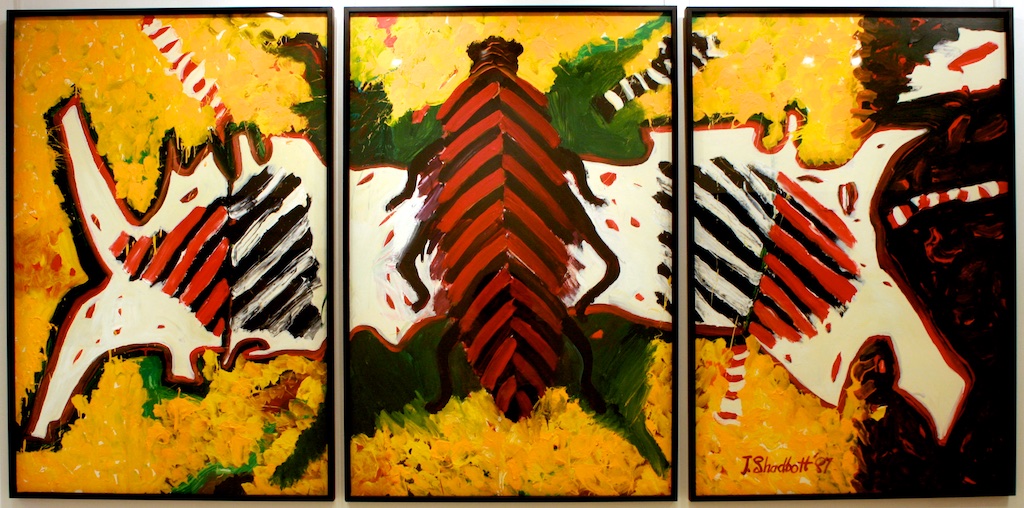
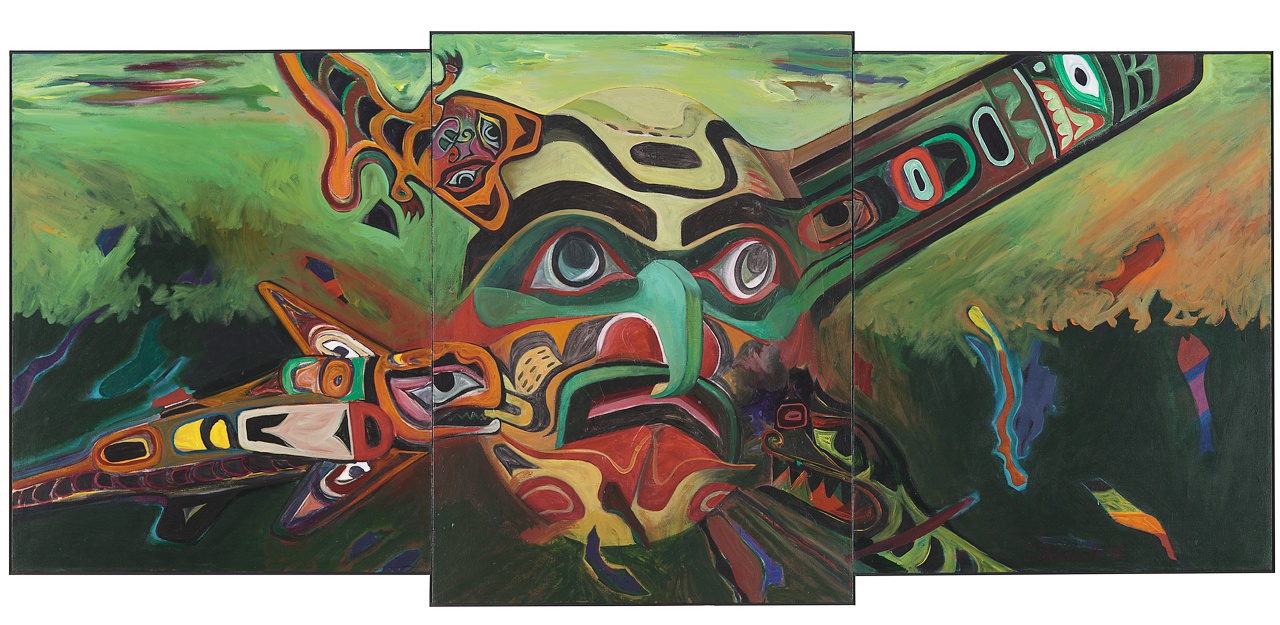
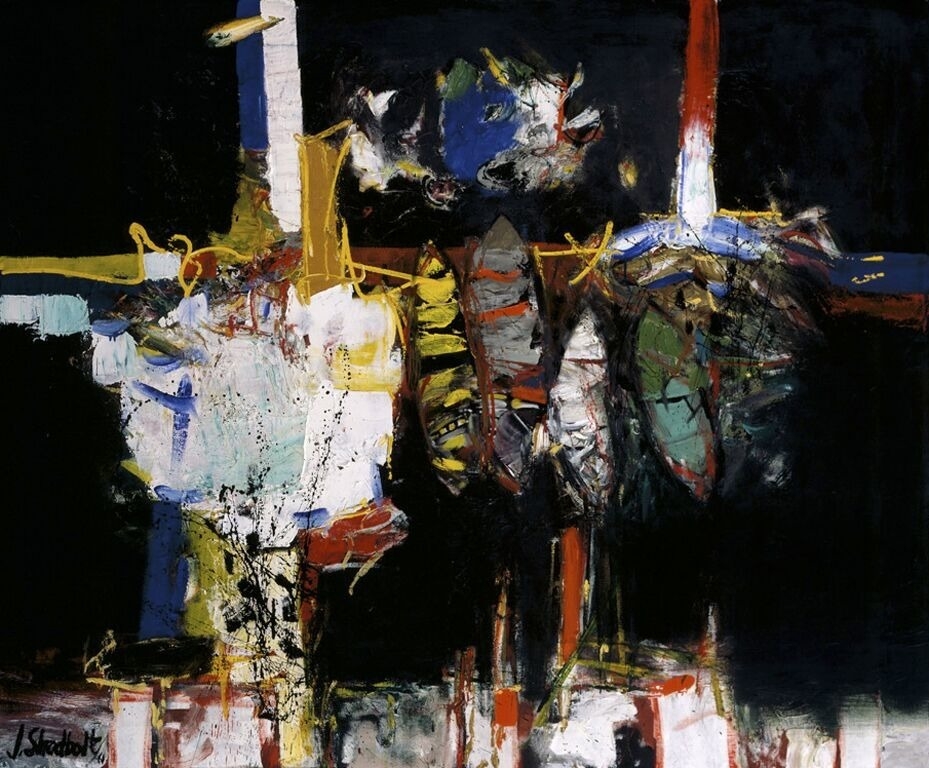
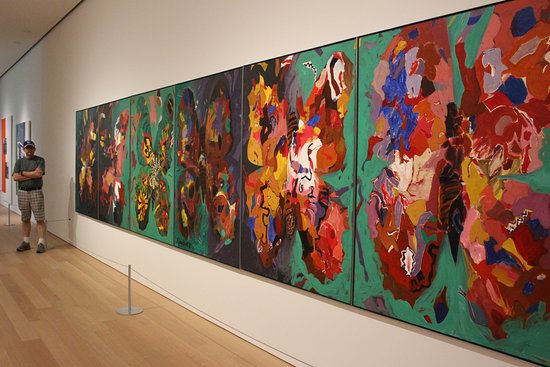
I have to admit that I knew little of the Canadian painter Jack Shadbolt before this morning. But I was immediately taken by his use of bold colors and forms along with an interesting use of symbolism depicted in a blend of representation and abstraction. I was also impressed with the scale of his many triptychs, their size giving the work greater weight. Just interesting work to put it simply.

There is a good short bio of Jack Shadbolt that you can read by clicking on this link. It gives you an idea of the forces, such as his World War II experiences, and people–his friendship with iconic Canadian painter Emily Carr, for example– that shaped his work. It also makes clear the influence his work has in his homeland.

One thing I discovered was that as Shadbolt was suffering at the age of 89 from congestive heart failure, his wife brought him home from the hospital. She set up a hospital bed in the center of his studio in British Columbia so that he might be surrounded by his paintings and be in that place where he had spent most of his time at his life’s work. He died there in his studio several days later.

I thought to myself that would not be a bad way to go. That is, if for some reason I decide to die someday.

But the focus today is on the short quote above, one with which I heartily agree. Whenever speaking to students I try to stress the need to grow their mind, to become an interesting person with something to say. To read more. To watch and listen more. To simply think and continue to learn.

Technique without an active mind behind it bears lifeless work.

At least, that’s my opinion. And Shadbolt said that beautifully and succinctly.

Now, take a look at some of the work of Jack Shadbolt.

Drumbeat

George Grosz- Explosion, 1917

**************************

In time of actual war, great discretionary powers are constantly given to the Executive Magistrate. Constant apprehension of War has the same tendency to render the head too large for the body. A standing military force, with an overgrown Executive will not long be safe companions to liberty. The means of defense against foreign danger, have been always the instruments of tyranny at home. Among the Romans it was a standing maxim to excite a war, whenever a revolt was apprehended. Throughout all Europe, the armies kept up under the pretext of defending, have enslaved the people.

-James Madison, speech at the Constitutional Convention, 1787

**************************

The drumbeat of war has started.

It’s all too predictable.

Here at home, the executive branch is under huge strain as it tries to deflect against any inspection or investigation of its actions. The president* has had historically low approval numbers while his actions seem designed to favor the wealthy few or his most ardent supporters at the expense of the majority of its citizens. He has shown a penchant for punishing those who stand against him and for spewing hateful, divisive rhetoric at rallies.

This same president* has shown a decided preference for foreign dictators and despots over our traditional friends and allies. He has attempted to follow their examples here at home, shattering the norms of democracy by trying to gain more and more power for the executive branch, unburdening himself from any sort of oversight by the other branches. His actions are uncompromising and unilateral, evidence of his desires for the same sort of unfettered power he sees in those autocrats he so admires and fawns over.

He desires unlimited executive power with little or no oversight.

So, as investigations roil around him, as his ambitions become more and more apparent (and attainable thanks to a craven GOP senate and a personal lawyer in the form of the Attorney General) what better way to deflect attention and gain support than use the ancient ruse, as Madison pointed out in his speech at the Constitutional Convention of 1787, of moving towards war against some foreign enemy?

We already have a historic foe in Iran. Our president* has been assisted by foreign autocrats, particularly the Russians and the Saudis, in reaching his lofty perch and appears to be in debt in some way to them now, willing to do their bidding on the world stage.  Iran is already an enemy to one of this president*’s greatest supporters, the Saudi Prince.

Recent unsubstantiated attacks of Saudi and UAE oil tankers (damage made by these unseen attacks was above the waterline, causing no spillage or injury nor made the ships less seaworthy) have the drums beating louder and louder. We have sent a carrier group to the Persian Gulf and plans are being prepared to send up to 120,000 US troops to the region. That is a force of about the same size as when we invaded Iraq. This would also be a unilateral move on the US’s part, with no involvement from our former traditional allies.

It is dangerous moment for us and the world.

A conflict  in this region could cost us dearly. The number of troops who would be sacrificed, and sacrificed is the term I knowing use, is unknown but even one or four or a hundred would be too many for such a misdirected ploy. There has even been talk that if this turned into a full blown war that we would not have sufficient numbers of troops and might need to reinstate the draft.

Or use private armies, an idea I find as reprehensible and financially irresponsible as the idea of private prisons.

Financially, it would cost our nation for decades to come as we know from the debt we still pay for the wars of the early 2000’s. Gas and oil prices would no doubt rise sharply with an ongoing war in that area of the world.

The repercussions throughout the world as far as trade are not known but past experience would point to a global downturn which in turn would strain those countries with already marginal economies. Would-be tyrants would be emboldened and there would be a surge in refugees fleeing such places.

It would be an existential test for a world already under stress.

And all because of a man* who has debts to those who would use him for the worst of reasons.

He is compromised and as a result, we, the people of this nation, are compromised as well. We will all be forced to pay for this compromise, some with money and some with their blood, their limbs, and their lives.

And for what? To divert attention? To change the narrative? To pay off some sort of debt?

And the drum beats on.

Transformation

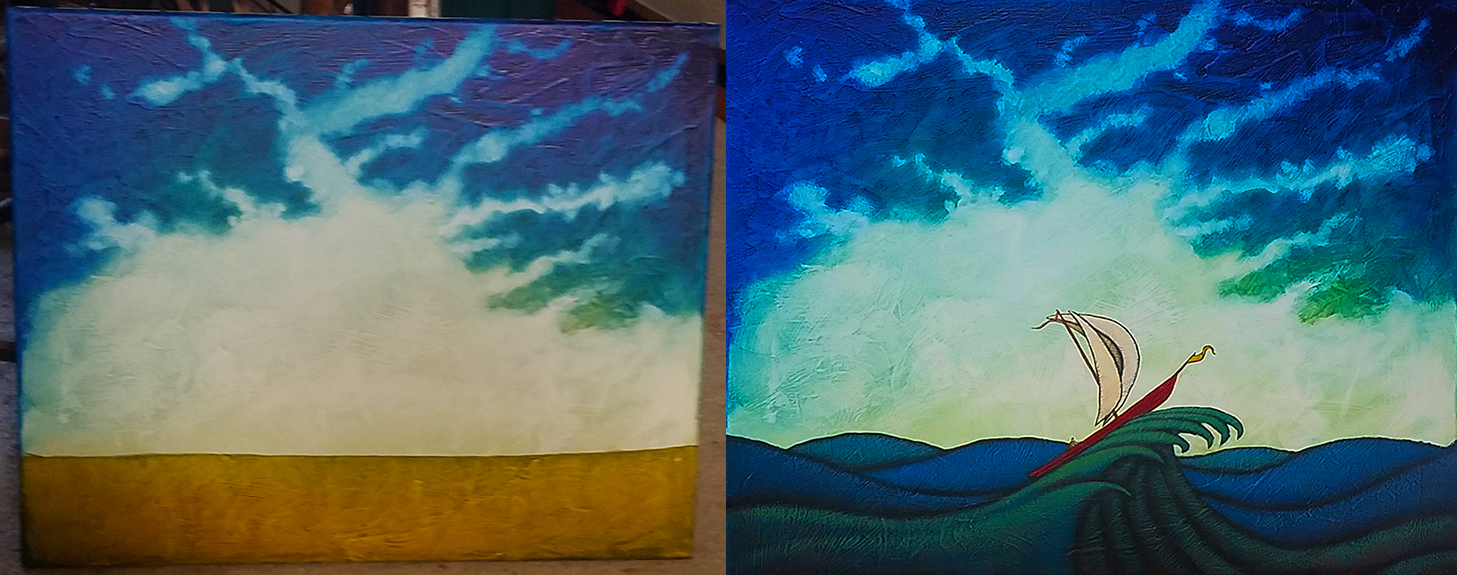
Sometimes I start paintings and somewhere along the way the piece loses its momentum. Or I lose the thread that was initially carrying me along when I started  or I just lose interest in it. The piece above on the left (sorry for the poor image!) might well be an example of all three of these things.

I started this piece a couple of years back and it seemed to just run into a brick wall. I felt like I had painted myself into a corner and didn’t see it going anywhere forward. There was a lot that I like in it. The sky, for instance, and the color of the field. But the way they came together didn’t speak to me and I felt like doing anymore would render an acceptable painting but that would be about it– acceptable.

And who wants to just do acceptable work? That’s not much of an aspiration, especially when so much of my work depends on creating my own interest and excitement in the work.

I thought there should be more to this painting than what it was showing but just couldn’t see it. So it sat. And sat and sat for month after month. I would pick it up periodically and examine it but it still had nothing to say to me as it was. It was irritating.

Then the other day I decided I was going to simply paint over it. Black it out of existence. It wouldn’t bug me anymore, at least. But the idea of blacking it out made me think about altering the whole idea of the painting. Maybe I could save that sky and incorporate it into something different.

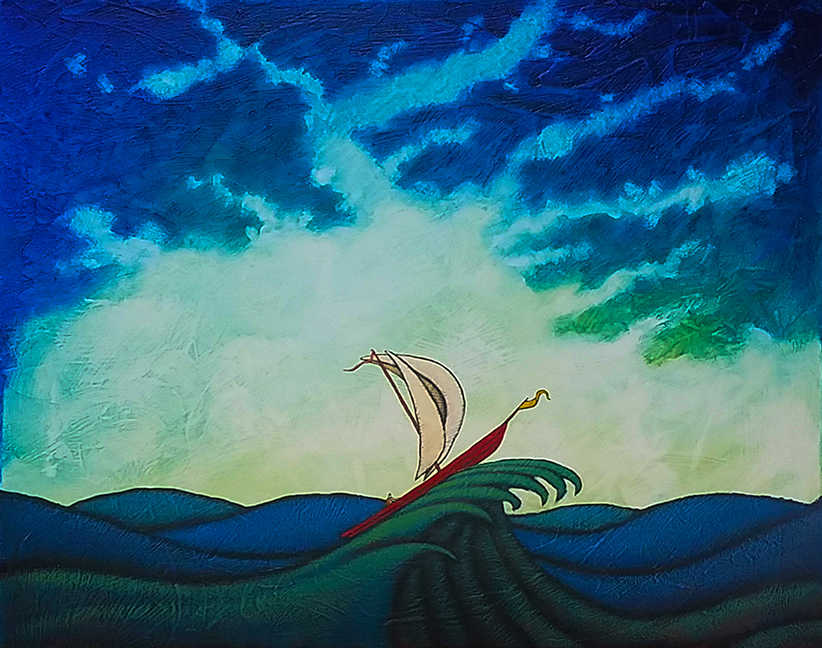
So it moved from a landscape to a seascape. And it seems to have worked as I am pleased with the result thus far.

There is a sense of the scale and power of open water in this piece, maybe more than I have portrayed in past similarly themed paintings. I am not a sailor in any way, never been on a small boat out of sight of land but that feeling of the immensity of the ocean is one that I can easily imagine. There must be both a thrill and a terror in it. And that’s what I am getting– fear and exhilaration– from this piece as the small sailboat teeters on on the curl of a large wave.

That dichotomy of emotion, the yin/yang thing of fear and exhilaration in this case, is something often try to find in my work. And it seems to be strong here. So, maybe the years that piece spent being shuffled around my studio before its transformation were worth it.

I’ll be looking at this one for a bit longer…


Helpless

I wasn’t going to make Mother’s Day the subject of today’s blog but walking over to the studio in the gray,cool drizzle put me in a slightly sad and wistful mood, one that made me think of my own mother on this day. I’ve posted the bit of writing below a couple of times over the years and thought it was worth doing so again this morning.  I ran this post before with an old Eddy Arnold song that I knew Mom liked very much but today I am running it with one she most likely never heard, Helpless, from Neil Young. It’s one of my favorites and one that certainly aligns with the tone of this morning here. Have a good day.

*****************

GC Myers- A Hard PastIt’s Mother’s Day again. You might think the image I am showing today is an odd selection for this day. It’s a small painting called A Hard Past that is from my 2008 Outlaws series. It’s one of a few pieces that I deeply regret ever letting go as it holds great personal meaning for me. I just didn’t realize it at the time.
I know that this may not seem like a flattering thing to say but every time I look at this image I see my Mom’s face. At least, a certain look she had when she was sitting by herself in silence at the kitchen table, drinking a cup of tea and smoking her ever-present Camel cigarettes, those unfiltered beauties that no doubt contributed to the lung cancer that took her life at age 63.

She would sit in stillness for a long period time at that table with a distant and hardened gaze on her face. I always wondered what she was thinking or where she was in that moment. But when you’re a kid you just move through the kitchen without a word or a question.

Oh, the things we leave unsaid and the questions that go unasked.

More’s the pity…

The title, A Hard Past, came from this memory of her. She had a pretty hard life- her mother died when she was three, no school beyond ninth grade, years of toiling in a factory and a long, turbulent and angry marriage to my father. It gave her a hard edge, a toughness that several people commented on after her death back in 1995.

But they also commented on her humor, generosity and willingness to help others who might need a hand– those qualities that I also saw in her. Those qualities that I so miss.

So while this painting may not seem like a flattering tribute, just seeing my Mom in this piece means so much to me, reminding me of all she was to me.

Have a pleasant Mother’s Day…

*************
https://www.youtube.com/watch?v=u7rQvJgTQ9U

*****************

There is always hope, as long as the canvasses are empty.

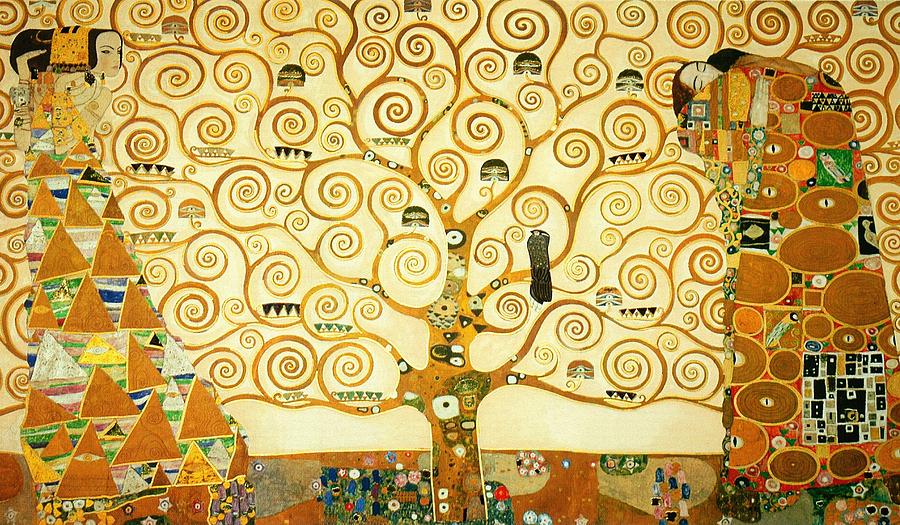
–Gustav Klimt

*****************

This quote from Klimt made me smile this morning, a little knowing smile. When I am getting ready for a show, such as I am now, the studio is initially filled with prepared empty canvasses of a wide variety of sizes, coated with layers of gesso and topped with a thick layer of black paint. They are everywhere, all propped up against any available surface that will support them.

Having them around is comforting, representing possibility. It is the hope of which Klimt speaks. Each blank canvas has the possibility of being a whole new world, a new experience, a new revelation. There is almost a hum of potential life coming from them.

But as the weeks and months pass and many of the canvasses are painted, taking on their new identities, the supply of blank surfaces dwindles down to the point where there is now only a smattering of blank canvasses scattered around the studio. It is at this point when I get anxious, most likely from no longer being surrounded by those empty surfaces that have come to symbolize hope and potential for me.

It is at this point that I can begin to see the end of this painting session, that soon I will have to stop for a bit to ready the work, to photograph, to stain frames and varnish paintings to make them presentable for the show. This makes makes me a little glum because I am usually very hyped up and wanting to do even more, to further explore all the new avenues that are opening up before me in the paintings in which I am working.

Looking around now and seeing just a few empty canvasses is a reminder of that coming point. It makes me pause in for a moment, anticipating that coming shift of gears, and for that moment I am a bit down. But reading Klimt’s words makes me smile, knowing that I just received a new shipment of canvas the other day which is waiting patiently downstairs to be prepped so that it soon can carry all my hopes and possibilities.

And the glumness fades.


************************

The art of an artist must be his own art. It is… always a continuous chain of little inventions, little technical discoveries of one’s own, in one’s relation to the tool, the material and the colors.

–Emil Nolde

************************

I totally agree with the words above from Emil Nolde, the German Expressionist painter who lived from 1867 to 1956. The artist’s personal relationship with their materials defines their creative voice, giving it distinguishing characteristics that allow it to hopefully stand clear of the work of other artists.  The way one handles and choose their paint, the way they treat their surfaces, how they define space and form in the picture plane, how traditional methods are altered and adapted to their own way of seeing and thinking– all of these and so many other elements make that creative voice unique. It is these things that make an individual artist’ work distinctly recognizable.

That’s the truth part of this post. Below is the deception.

Now, there’s nothing controversial in this sentiment but I was hesitant in using the words of Emil Nolde, who has been the subject of much scrutiny lately as his past associations with the Nazi party in Germany have come to light.

Nolde’s situation was an unusual one. He was a well established Expressionist painter in his 60’s when the Nazi’s came to power in Germany in the 1930’s. While he was an ardent supporter of the party and a fervent anti-Semite who flew a swastika flag above his home, Nolde’s work was deemed degenerate by the Nazis and was very much disliked by Hitler. I am not sure but he may well have been the only party member to have his work shown in the sweeping Nazi exhibit of  degenerate art.

During the war, Nolde was forbidden from selling his work without the permission of the Nazi party. But Nolde took that caveat and portrayed it as a complete prohibition of his work and himself, which it was not. He was still able to work and he was not persecuted in any way. Nolde created a series of small watercolors which he claimed were ideas for paintings that he was forbidden from painting. It became the basis for a celebrated show, Unpainted Pictures. This idea of a persecuted artist creating a body of forbidden work in his head became a symbol of artistic resistance that sustained his legacy for many years after the war, a story pushed by the foundation he had formed to manage an archive and museum of his work.

But it was a false story.

Nolde and his foundation hid his Nazi past and his anti-Semitism for decades. Passages from his memoirs that spoke of his complicity with the Nazis and his anti-Semitic leanings were excised and stories that portrayed him as a victim were embellished.  This went on until 2013 when the foundation’s new leadership, sensing that the previous administrators had laundered a dirty past, pushed for transparency and released the entire archives, previously under wraps, to the public.

I am not sure how Nolde will be portrayed or judged going forward, whether it will be on his paintings or on his actions before and during WW II. There was a good article recently on this story in the New York Times. I urge you to take a look as it tells the story much better than I can here.


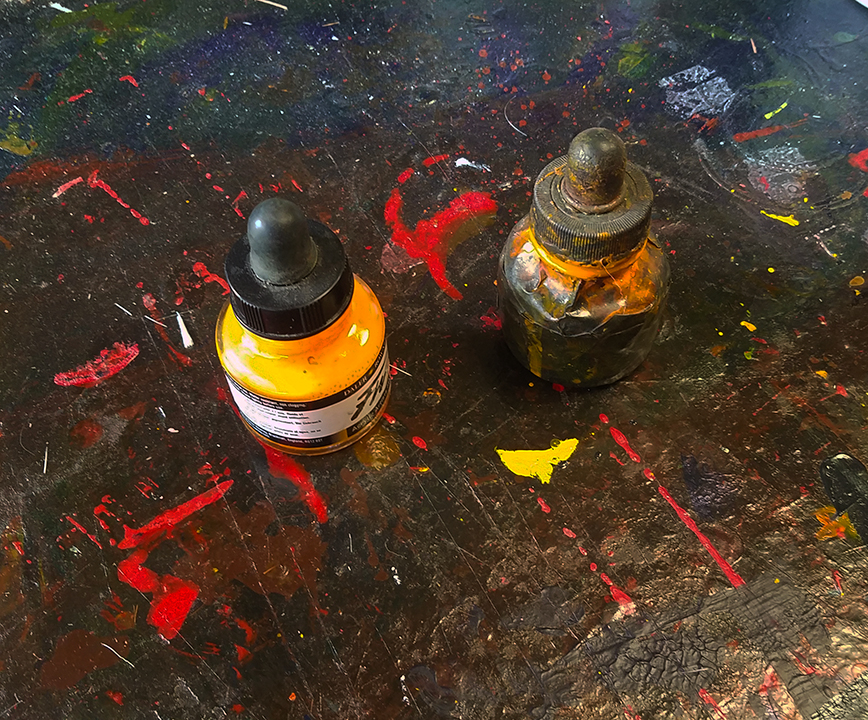
I have started working on some new pieces that are wet work which means I am working flat, on a table, instead of at an easel.  It’s something I don’t do as much as I used to, especially in the early years when my work was all done at a table. My work table is an old Hamilton drafting table with a 40″ by 60″ top that is a monster, built heavy with a steel spring mechanism that lifts and lowers the work surface.

This table been a good soldier over the years and has been the spot where almost all of my wet work on paper has been created. When I am spending more time at the easel it becomes a spot where I amass tubes and bottles of paint and ink, rolls of paper towel, piles of paintbrushes and bits and pieces of paper with crude drawings and scribbles notes about ideas that might someday appear somewhere. Or might not.

I was clearing a space to begin working and I really took a look at the surface of the table. It is covered with a thick vinyl mat, a once pale green sheet  that is now thickly coated with layers of paint and ink from years of use. I used to try to clean the surface periodically, scrubbing at it until much of the pigments lifted. But it has been a very long time since that last happened and it now has a deep dark hue, a mix of all the colors of my palette.

I find it very satisfying in looking at the surface. It is a visual reminder of time spent and efforts made, bringing to mind the Japanese concept of wabi-sabi which emphasizes the finding of beauty in the wear and imperfections of things.

In the photo at the top, I pulled out one of my old ink bottles and placed it on the surface alongside a new bottle of the same color ink. The old bottle should have been discarded years ago but I hold onto it out of some form of nostalgia. It is coated with layers of ink that have become almost black from me handling it with hands stained with many hues for a very long time. Chances are that if you saw any of my work from 2004-2012, this bottle had something to do with it.

Like the surface of the table,which you can see in the photo, the evident wear shown on the bottle speaks to me. It should be trash but it has meaning for me now, it speaks of thousand so of hours standing over that table, deeply engrossed in the work I was doing. Work that has long left me and now reveals what truths they might hold to others now.

Seeing the two bottles reminds me of seeing a war veteran who has been through every battle standing side by side on the battlefield with a raw recruit who has yet to be tested. That worn bottle was a good soldier, one whose small efforts made the larger effort possible. Hopefully, that new recruit will serve as admirably as the old vet.

I am betting it will.

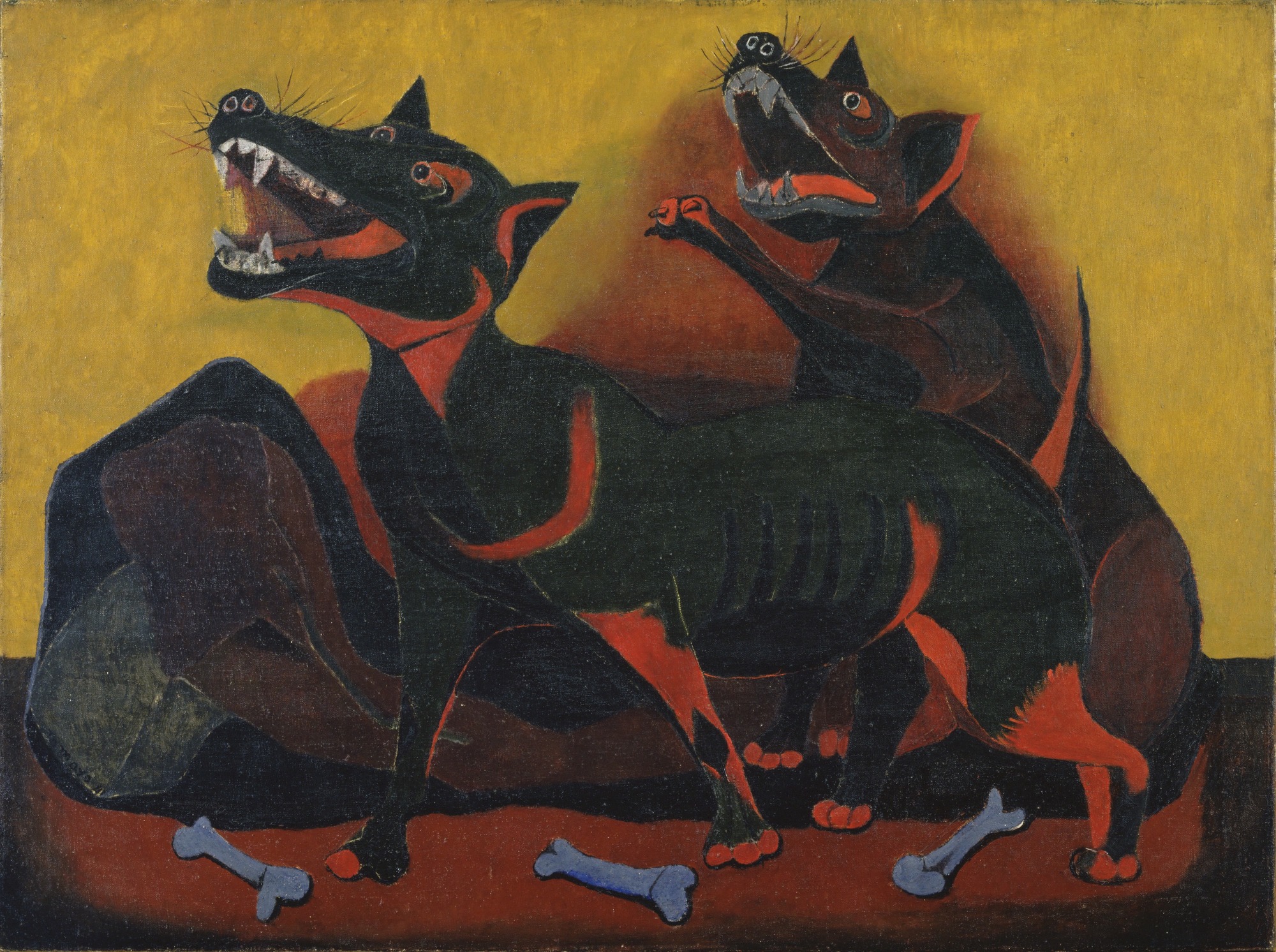
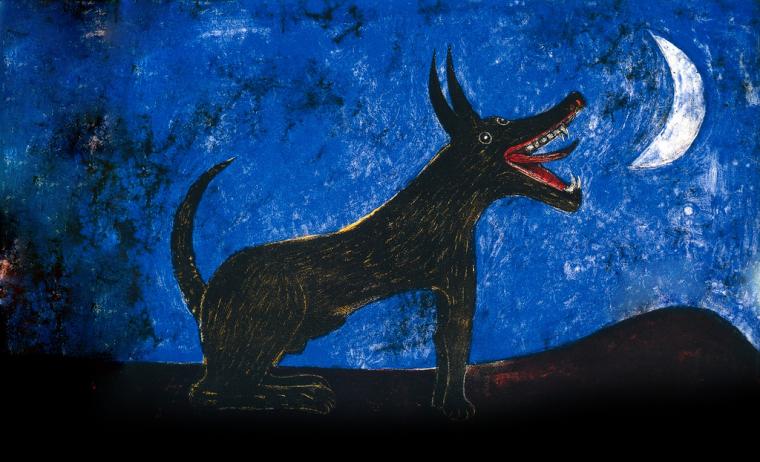
Rufino Tamayo

Just a few paintings and a simple quote today from the Mexican painter Rufino Tamayo (1899-1991). I love his use of color, something for which he was celebrated. He was very prolific through a long career and while his work is easily understood by everybody, everywhere, as he said above, it was often built with the colors and imagery of his homeland.

I am showing just the tiniest sampling of his body of work which, simply put, is good stuff.

**********************
Satisfaction lies in the effort, not in the attainment. Full effort is full victory.

Mahatma Gandhi

********************

I often paint the rows of a freshly cut field in my work. While this creates an interesting visual effect with its pattern of alternating colors, it also satisfies my own need to express the importance — and necessity–of effort for myself and for my work.

I have often pointed out at gallery talks that I spend huge amounts of time alone working very hard in my studio, well over 70,000 hours over the past twenty-plus years. I usually make a joke of this, saying that I enjoy these long periods of solitude and tell people I am hard at work during my time in the studio so they will just leave me alone. Okay, there is a lot of truth there as far as not having people bother me but the fact remains that while I find my time in the studio enjoyable as well as enlightening, it does require great effort and work.

And I wouldn’t have it any other way.

I guess that’s because there is usually a moment after finishing a piece or a group of work for a show when I stop and look at the work in its state of completion. In this moment there is a great sense of satisfaction at the result of my full efforts. And that full effort gives the results a sense of completeness and  that brings me my own sense of personal completeness, a fulfillment of some small purpose that I find necessary in order to persist in this world.

That small moment of satisfaction makes all the work, all the frustration and missteps fade away. That which should have depleted me now serves as nourishment. I find myself strengthened for another day.

Maybe that what I see in this new painting, a 24″ by 24″ canvas which going soon to Alexandria, VA for my upcoming solo show at the Principle Gallery, which opens June 7. It is called A Sense of Satisfaction, of course. It very much reflects what I have written here, with the Red Tree representing someone looking back on the results of a long day of labor. And again, they feel uplifted rather than worn down.

I know it’s not always that way. There have been times when work has been very draining, definitely in my past and occasionally even now. But knowing that special moment of satisfaction that comes along every so often is out there as a reward makes me look forward to the task and the effort ahead.

******************

The post above was written several years back was written about an earlier painting with similar receding fields rows in its foreground. I felt that the message from that earlier post applied equally well to the new painting at the top so I borrowed much of it for today’s post, with a few edits.