Feeds:
Posts
Comments

Nobody Knows…

It’s Easter, again. Since I have never had a religion, Christian or otherwise, even as a child, the holiday probably doesn’t hold the same significance for me than it might for many of you. But I do know and enjoy many of the stories and lesson of the religions.

Among them all, the Resurrection is certainly one of the most potent, even if only in symbolic terms. The idea of rebirth and redemption is a powerful concept, one that many of us who have wronged in the past seek in our own lives.

I am hoping for such a resurrection in this country, one that sees us returning to a code of ethics and a rule of law which finds no one above it. One that places what is best for the most of us over what is best for a chosen few and where we seek to help the neediest rather than the most fortunate among us. One that holds those who hide behind lies and falsehoods responsible for their words and actions. One where those who represent us in our government understand their obligation to serve country rather than party or moneyed interests.

Is that too much to ask?

Maybe. But it sures seems that we, as a nation, are at a point where such a restoration of honor and sanity is sorely needed. Hopefully, the findings revealed this past week will set us on the path to such a thing.

Anyway, for this Easter Sunday, I have selected a song that doesn’t really have anything to do with the day. It’s Nobody Knows (The Trouble I’ve Seen) performed by the great Sam Cooke. It’s a different interpretation of the African-American spiritual that came from the slave era and it soars. I am also sharing the magnificent Mahalia Jackson which has a second gear that is truly uplifting. And that fits this day, doesn’t it?

Hope you have a good day.


I was at the easel even earlier than usual this morning. It was just after 6 AM and there was something I needed to do on a large piece. something that felt like it had to be done immediately or it would blow up my brain. I took care of that pressing issue and thought I would try to write a blogpost.

Turns out that doing that one thing led to another and, even as I sit here, that painting is loudly demanding more attention. Sometimes they are like infants crying out for attention, for nurturing. So, it’s time for to slap some more paint on my baby.

Here’s song that I haven’t heard on many years from Rory Gallagher, the late great Irish guitarist.  You don’t hear much about him anymore–he died in 1995– but he was a big influence on many rock guitarists of a certain age. This is one his songs that is a favorite of mine, A Million Miles Away. Maybe I can use that title for the painting on the easel. It certainly feels like I am a million miles away when I am working in it.

Have a great day.

Road to Nowhere

Too many more productive things to do this morning rather than editorializing, as much as I might wish to do so. So I thought I’d just share the classic Talking Heads song, Road to Nowhere. You can take whatever meaning you wish from this selection.

This is a live version with David Byrne teaming up with singer St. Vincent and a marching horn section. Good and fun performance.

A Day for Paine

********************************

These are the times that try men’s souls: The summer soldier and the sunshine patriot will, in this crisis, shrink from the service of his country but he that stands it NOW, deserves the love and thanks of man and woman. Tyranny, like hell, is not easily conquered; yet we have this consolation with us, that the harder the conflict, the more glorious the triumph. What we obtain too cheap, we esteem too lightly:–‘Tis dearness only that gives everything its value. Heaven knows how to set a proper price upon its goods; and it would be strange indeed, if so celestial an article as Freedom should not be highly rated.

…It matters not where you live, or what rank of life you hold, the evil or the blessing will reach you all. The far and the near, the home counties and the back, the rich and the poor, shall suffer or rejoice alike. The heart that feels not now, is dead: The blood of his children shall curse his cowardice, who shrinks back at a time when a little might have saved the whole and made them happy. I love the man that can smile in trouble, that can gather strength from distress, and grow brave by reflection. ‘Tis the business of little minds to shrink; but he whose heart is firm, and whose conscience approves his conduct, will pursue his principles unto death. My own line of reasoning is to myself as strait and clear as a ray of light.

Thomas Paine, The American Crisis, December 1776

*************************

Today might be a good day to pay attention, both to the events of this day and to the words of Thomas Paine written at a another crucial point in our American history. His words apply to any time.

There have always been and always will be sunshine patriots who will wave flags at parades and enjoy the benefits that this country offers without thought or sacrifice. But now is a time to look hard and think long. To gather strength and speak clearly and loudly. To assert truth.

Paine said it best: The heart that feels not now, is dead: The blood of his children shall curse his cowardice, who shrinks back at a time when a little might have saved the whole and made them happy.

Pay attention, people. Your heart needs to feel NOW.

The Creeper, Again

I’ve been going through some old work for a small exhibit late this summer–I will write more about this at a later date– and have been going through some of the Exiles paintings from the mid- 1990’s. This painting, The Creeper, always jumps off the screen at me and I am hoping to make it part of the exhibit. The post below is from all the way back in 2009. Thought I’d repost it today.

********************
GC Myers- The Creeper

The Creeper is another of the Exiles series although I would have to say he is an anomaly in the series. He does not mirror the sense of loss or suffering of the other pieces. He is not the mournful exile that so many of the pieces in that series depict.

No, he is the menace of dark dreams. He is always there, looming halfway in the bedroom window. While there is almost the hint of a smile on his face, it is not  pleasant or reassuring.

But, while he is a little scary, there is a bit of whimsy in his appearance. He is more cartoonish than the others. When I look at this face I am constantly reminded of the movie parodies from the beloved Mad magazine of my youth, with their Mad Magazine Godfather Parodyoversized, caricatured faces. This softens the whole feel of the piece for me and makes him less terrifying.

Now, whether someone without that same frame of reference will see him in the same way is another question. Without that reference, maybe he is as creepy as his name.

For me, The Creeper always brings back the memory of a young friend who loved this painting and truly identified with everything about it. He saw the humor but felt the darkness of it as well. He was a vibrant whirlwind of energy who knew well about the personal demons as depicted in this painting. He was a tortured personality and took his own life several years ago.

For him, The Creeper was all too real. When I look at this painting now, I see it as that creeping darkness that invades so many minds, keeping them from finding true peace.
GC Myers- The Creeper

The 1969 BBC series, Civilisation, opened with host and art historian Sir Kenneth Clark standing in Paris with Notre Dame cathedral behind him. He stated that the purpose of the series was to give examples in history of man showing himself to be an intelligent, creative, orderly and compassionate animal. He said he couldn’t define civilization in abstract terms but, turning to look across at Notre Dame, felt he would know it when he saw it.

And that might be so true. In the aftermath of yesterday’s fire that destroyed much of that cathedral, it felt not so much like a tragic fire in an old religious space but more like a greater loss of civilization, of history and humanity.

Watching yesterday, it was hard to not see it as being the symbolic burning of down of all things we hold sacred as a civilization. It was a place that for over 800 years had witnessed and survived plagues, wars and revolutions. How could it be so seemingly devastated in these modern times?

It’s burning seemed like the perfect image for the plunge back into the darkness which we often seem ready to take these days.

It was a sad day for us all and a test for our willingness to continue in light as a civilization.

I have never been to Paris, never gawked upon the cathedral. So my connections to that place are limited at best. I did have at least two great-grandmothers going back many generations in my paternal grandmother’s line who were from Paris. They came to North America as Filles du Roi, the King’s Daughters. They were young women with few prospects in France who were recruited in the 1660’s by the French crown to go to New France, which is now Quebec. They were given passage and a dowry in order that they might marry one of many young male settlers and populate that new land.

I can imagine those young women carrying a memory of that cathedral with them as they moved into the new wilderness. They would certainly know of it as it was even then an old cathedral, already 500 years old at that point. They may even have taken communion there. It might well have been the symbol for civilization that they held in their minds. Like Kenneth Clark. And like many of us who just felt a loss of part of our self as humans as we watched it burn.

It will be rebuilt but it will be a long and difficult (and costly) process. It should be a reminder of the fragility of many things that we take for granted and that we should take care of those things that show us to be an intelligent, creative, orderly and compassionate animal, as Mr. Clark put it. Some may rejoice in seeing them in flames but losing them may be a greater loss than any of us can imagine.


*********************

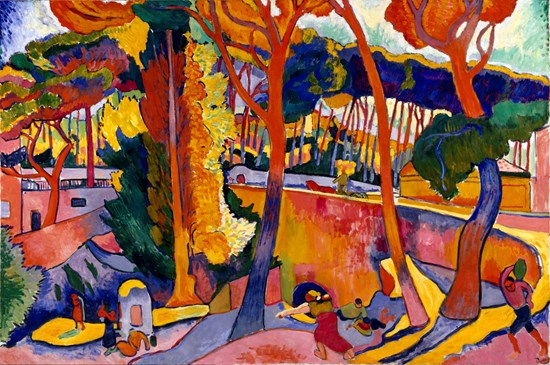
Fauvism was our ordeal by fire… colours became charges of dynamite. They were expected to charge light… The great merit of this method was to free the picture from all imitative and conventional contact.

-Andre Derain (1880-1954)

*********************

Les Fauves translates from French as the Wild Beasts. Fauvism was an art movement in the early 20th century that focused on color, line and a painterly surface, breaking away from both traditional representational painting and the Impressionist movement of that time that maintained many of the same values as traditional realism. It was a short lived movement, lasting only a few years, but its influence down through the years has been great. It was led primarily by Henri Matisse and Andre Derain, both artists who I greatly admire.

Time is short this morning but I wouldn’t miss posting a bit of music on this Sunday morning. It’s a song from Sean Rowe that speaks very much to the desire that some artists have, myself included, to leave something behind. To leave a reminder, even a small one, that they existed and created in this world. That they had eyes and ears and a voice and a mind of their own. That they felt something, that they dreamed in this world.

The song is To Leave Something Behind and with his powerful voice, Sean Rowe certainly creates something here to leave behind. Give alisten and have a great day.


**********************

“You must study the Masters but guard the original style that beats within your soul and put to sword those who would try to steal it.”

El Greco

**********************

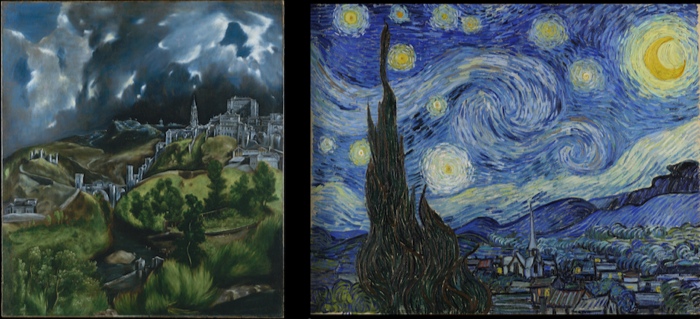
These words from El Greco (1541-1614) certainly were reflected in the influence his work had down through the ages. Many artists through the ages have appropriated his compositions and rendered them in their own original styles. Picasso, for example, was influenced by the elongated figures of El Greco. His View of Toledo is considered one of the first paintings solely focused on landscape, as well as the first cityscape. Below, you might be able to see a connection between it and Van Gogh’s Starry Night.

For myself, in the painting here at the top, The Burial of the Count of Orgaz, a massive painting that is about fifteen foot tall, I was struck by the gold clad figures (St. Stephen and St. Augustine) at the bottom who are lowering the dead aristocrat into his tomb. The colors and positions of the figures had me seeing them as figures in a Gustav Klimt painting.

Looking at the detail below, I could see them as being influences on his The Kiss. I don’t know whether they were an influence, but it certainly jumped into my mind. If so, kudos to Klimt for translating it into his own original style that beats within his soul, as El Greco may have put it.

And that is what influence should be. It is not trying to replicate, to copy, another’s work. It is in taking it in and synthesizing it using one’s own unique voice. I think every artist does this in some form. You just may not immediately notice it in the very good ones.

Detail from “The Burial of the Count of Orgaz”

“View of Toledo” and “Starry Night”

I have a large painting on the easel I want to get to this morning. It’s at a point of transformation which is always exciting and just looking at it now, I am eager to see where it goes. But I wanted to share a post from back in 2012 about a painting done in 1997 or 1998 that has occupied an important place in my heart and mind for a long time. I think it’s a good example of the how an artist’s work often lives with the artist after it has found a new home.

****************************

I was going to write about something different but came across this older image and completely lost my train of thought, this piece replacing everything that I had been thinking. Some pieces have that effect. It’s a smaller painting, maybe 6″ square, that sold many years ago when I was first showing my work at the Principle Gallery in the mid-1990’s. Though not large, this painting has lived in a larger sense in my thoughts ever since.

It’s titled Beauty Scorned and is a relatively simple piece. But there’s something in the washed out quality of the colors and in the the bend of the twisting tree trunk that really speaks to me in a very poignant way, as though it is a pure physical expression of some deep emotion.

Beauty and sorrow.

For me, I see this as being about perceptions of beauty and acceptance. About how we often conform, like the other trees which are so much alike here, and step back from that which is different, seeing not the beauty in it but scorning it because it is unlike us.

The beauty is in its difference.

I remember when I did this piece, feeling that this was symbolic of my own work at that time. It was often quite different from the work of other painters with which I showed and I was still unsure of the validity of my own voice, often feeling that my work was somehow inferior because it wasn’t painted in the same manner, didn’t have the same look as these others. At the time, I felt like my work and my voice was truly tied to this twisting tree and those who dismissed it because it had a different look were missing the beauty and emotion that it may hold.

Just seeing it again summons all of these thoughts in a rush of feeling. It remains a potent piece for me for this reason. It also has a sad memory in it.  When I see this piece I am always reminded of the couple who purchased it and were avid and encouraging collectors that I always looked forward to seeing at shows. They had a knack for choosing work to which I was most keenly attached. This couple later divorced and the wife would still come to the shows, always so happy for and encouraging of my work. Tragically, she passed away in a plane crash this past year [2012] and now, instead of seeing the scorning of beauty in this piece as I once did, I now see the beauty of this young lady’s spirit.

It’s a different painting for me now but no less potent.