Feeds:
Posts
Comments

It has become a tradition for my Gallery Talks at the West End Gallery to have a very portion– a pretty popular one– that involves a drawing for those on hand to win one of my paintings. I have written in the past about how I take this very serious and try to find pieces that have meaning for me and which are, I believe, somehow overlooked. The painting I have chosen for this year’s Talk ( next Saturday, August 4 at 1 PM) definitely fits in that category.

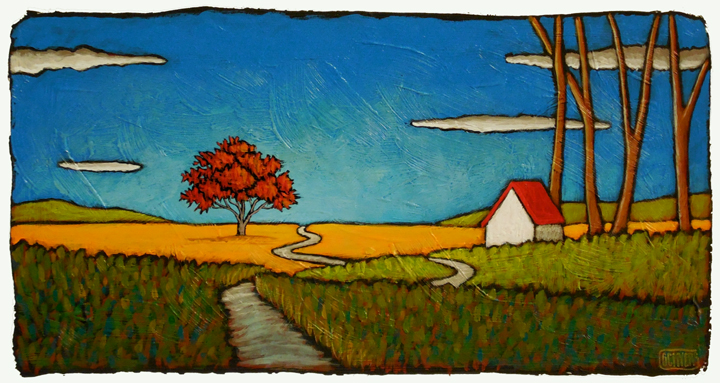
Shown below, it is called Pipedream. I have watched with consternation as it traveled around the country, always coming back to me. You see, it was a favorite of mine from the minute it was done. It just felt right with a warmth and clarity that appealed to me and with its Red Tree and Red Roof, it is very much a signature piece. I wracked  my brain figuring out why this piece hadn’t found a home and all I could think was that this might be one of those cases where the title might be confusing if the viewer wasn’t aware of its origin. And if you knew what it meant, given the opioid crisis in this country, you might find it distasteful.

But I saw it in the best sense of the word, as a perfect dream with solitude, rich fields, clear sunlight and calm blue skies. A perfect retreat from a crazy world. So, to clear things up I am running the post about this painting from a few years back.

Hope you can make it to the Gallery Talk at the West End Gallery on August 4th to have a chance at winning this favorite of mine. Plus, as always, there is a little more at these talks. Put it on your calendar and come grab a seat. It could be fun.
GC Myers- Pipedream sm

Blow up your TV , throw away your paper
Go to the country, build you a home
Plant a little garden, eat a lot of peaches
Try and find Jesus on your own

–John Prine, Spanish Pipedream

*****************************

This is a small new painting that is about 6″ by 11″ on paper. I call it Pipedream after the old John Prine song, Spanish Pipedream. I say old but it ‘s one of those songs that never feels old to me despite the fact that it came out back in 1971, forty three years [47 now] ago. It is old. One hint of its age is at the beginning of the song when he says he was a soldier on the way to Montreal, referring to fleeing north into Canada to avoid the Viet Nam war and the draft. But it’s still such an infectious chorus with a message that so hits the point that I still find myself humming this song quite often.

I guess this painting’s simplicity and cheery feel made me think of this song. There is something very idyllic and charmingly essential in this little guy. It does look a bit like a pipedream, which is one of those words that we often use while not thinking about its origin or meaning. This word, pipedream, is from Victorian era Britain and refers to an improbable fantasy or hallucination that came while smoking opium. Maybe this is an improbable fantasy? It does have a fantasy feel about it but lets hope it is not so improbable.

Now here’s the song  from one of my favorites, John Prine.
Strange Beauty

+++++++++++++++

“Not only is the Universe stranger than we think, it is stranger than we can think.”

― Werner HeisenbergAcross the Frontiers

+++++++++++++++

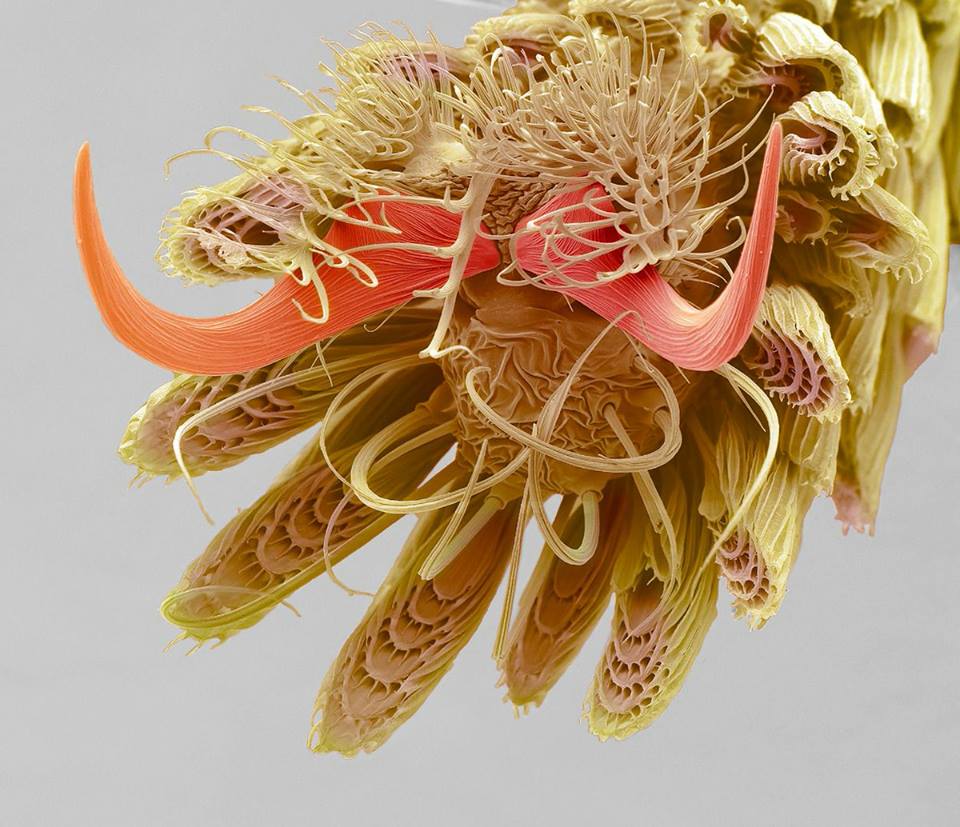
I stumbled across this photo the other day and I have come back several times to look at it. It’s the image of a mosquito’s foot at 800x magnification and there’s a strange organic beauty and weird delicacy to it that draws me in.

The complexity of the individual elements in its design is fascinating. The reddish grabby claws have a certain elegance but I can only think that if a mosquito were the size of a housecat they could latch on to you with those claws and you would never be able to merely swat them off.

Thankfully, I have yet to come across such a mosquito.

I can only think that if something so common as a mosquito can seem so alien, even if beautiful, imagine how strange the truly alien might be. As the physicist Heisenberg points out, are we even capable of imagining such strangeness?

This short snip from a letter Vincent Van Gogh wrote to his brother, Theo, in October of 1883, might be the best piece of advice that any working or aspiring artist could receive. And it most likely applies to any other field of endeavor.

I can’t speak for the experience of most artists but, concerning my own work and abilities, I travel through an internal landscape with soaring peaks of great confidence that often plummet into deep valleys of doubt. One moment and I am high on a peak with a seemingly endless view that shows me all sorts of ways forwards. But in the bat of an eye I find myself in a deep and dark ravine with no indications of any path on which I can climb out.

I begin to doubt my abilities, begin to wonder if I have been the fool in thinking myself an artist. Ideas that just a day or so ago felt special and ready to burst out from me suddenly seem dull and lifeless. Inspiration dissipates like a mist in the sunlight.

But, as the decades doing this have taught, the answer always comes in working.

Empty the mind, push doubts to the side and pick up a brush.

Make a mark. Then another and another. Let it lead you somewhere, let it be the path out of that valley.

Work. Just work.

These words from Adolph Gottlieb, the late Abstract Expressionist painter, ring true for me. I believe that art should acknowledge the presence of powerful forces that guide our lives, good or bad. As he points out, it is this awareness that fueled the myths and symbology that have lived with us since time immemorial.

For me, it is displayed in the underlying darkness of much of my work which is evident in even my most optimistic works. This darkness gives the work, at least to my way of seeing it, a sense of tension, a counterbalance that keeps the work centered. The most optimistic work still has a wariness in this darkness that acknowledges the dangers ahead and the hardships endured in the past.

Triumph of any sort is seen as a transient emotion, one that is to be savored in the moment and recalled in the future but short-lived in the present. The darkness is always hovering nearby, presenting a potential threat or a challenge or even a dramatic change that comes with both the possibility of utter defeat or a new triumph. It is this mystery that makes the darkness so appealing and necessary.

+++++++++++++++++++

GC Myers-  Inner Perception smallThis is a painting from a few years back that has toured around a bit and found its way back to me. Called Inner Perception, it has been one of my favorites right from the moment it came off my painting table. Maybe the inclusion of the the paint brush (even though it is a house painter’s brush) with red paint in the bristles makes it feel more biographical, more directly connected to my own self. Or maybe it was the self-referential Red Tree painting on the wall behind the Red Chair.

I don’t know for sure. But whatever the case, it is a piece that immediately makes me reflective, as though it is a shortcut to some sort of inner sanctum of contemplation. Looking at it this morning, the question I was asked at the Principle Gallery talk a week or so ago re-emerged, the one that asked what advice I might give my fifth-grade self if I had the opportunity. I had answered that I would tell myself to believe in my own unique voice, to believe in the validity of what I had to say to the world.

I do believe that but I think I might add a bit to that answer, saying that I would tell my younger self to be patient and not worry about how the world perceives you. That if you believed that your work was reflecting something genuine from within, others would come to see it eventually.

I would also add to never put your work above the work of anyone else and, conversely, never put your work beneath that of anyone else. I would tell myself to always ask , “Why not me?”

This realization came to me a couple of years ago at my exhibit at the Fenimore Art Museum. When it first went up it was in a gallery next to one that held the work of the great American Impressionists along with a painting from Monet. I was greatly intimidated, worrying that my work would not stand the muster of being in such close proximity to those painters who I had so revered over the years. Surely the greatness of their work would show me to be a pretender.

But over the course of the exhibit, that feeling faded and the intimidation I had initially felt turned to a type of defiant determination. I began to ask myself that question: Why not me?

If my work was genuine, if it was true expression of my inner self and inner perceptions, was it any less valid than the work of these other painters? Did they have some greater insight of which I was not aware, something that made their work deeper and more connected to some common human theme? If, as I believe, everyone has something unique to share with the world, why would my expression of self not be able to stand along their own?

The answer to my question was in my own belief in the work and by the exhibit’s end I was no longer doubting my right to be there. So to my fifth-grade self and to anyone who faces self-doubt about the path they have chosen, I say that if you know you have given it your all, shown your own unique self, then you must ask that question: Why not me?

Oslo

It’s gray and rainy this morning. It’s the same forecast for the next several days here and I am kind of happy about that. While it may put a damper on tourists and sun-seekers, the rain refreshes the pond and cools the forest floor. The vegetation perks up with the greens getting a bit brighter and vibrant. After reading about the many temperature records being broken around the globe in recent weeks (over 90° above the Arctic circle and the highest temp ever recorded on the African continent!) I am all for anything that cools it down for a while.

I though for this Sunday morning’s musical selection I would choose a piece called Oslo from a contemporary Norwegian jazz musician, Mathias Eick, that sounds kind of cool. For me, when I hear the name Oslo I imagine snow and a chill in the air. I may be mistaken in that assumption as I find after checking that it’s near 80° there at the moment.

But I will still cling to my misguided assumption for the moment if only to feel an illusion of coolness. I threw in a new painting at the top, Cool Rising, that is part of my current show at the West End Gallery, to complete the illusion.

Have a cool Sunday…


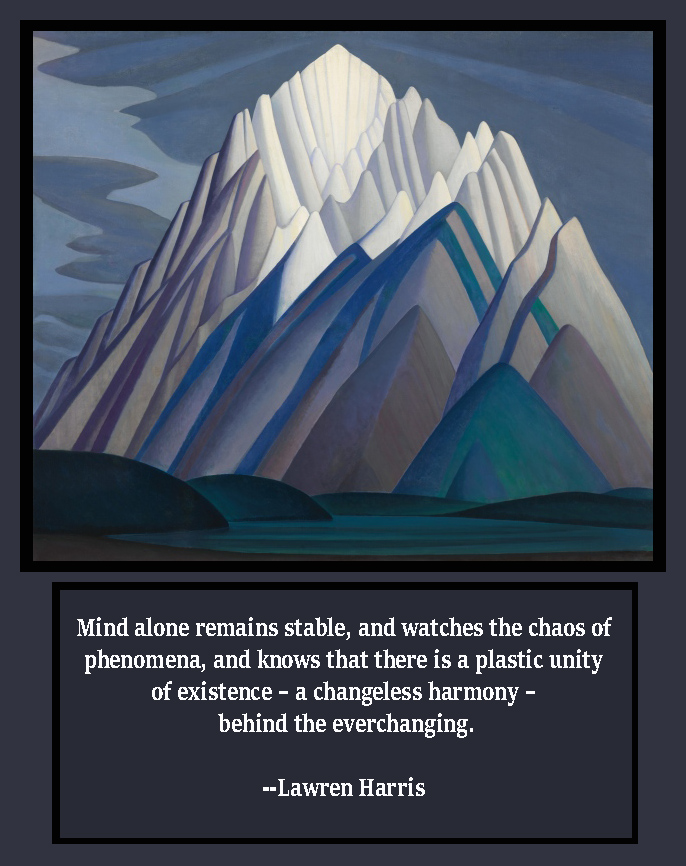
In these crazy times, there is some comfort to be found in art. For me, the paintings of Lawren Harris always fill the bill. His work definitely represents a quality of spiritual harmony, that thing, that force, that universal mind that remains stable even as the world drastically seemingly changes before our eyes.

So, this morning I am taking a few moments and taking in his 1926 painting, Mountain Forms, shown above.

And I feel better already.

Eye to Eye

 “People like you and I, though mortal of course like everyone else, do not grow old no matter how long we live. What I mean is we never cease to stand like curious children before the great Mystery into which we were born.”

Albert Einstein, Letter to Otto Juliusburger, September 29, 1942 

+++++++++++++

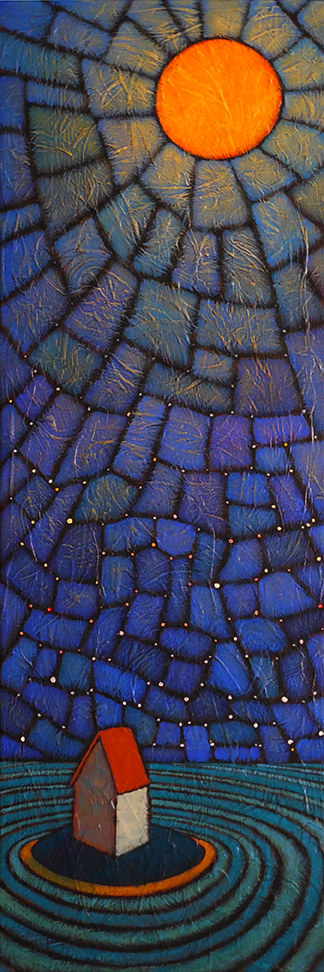
This is a new painting, at 30″ by 10″ on canvas, that is part of my current West End Gallery show, The Rising. I have titled this painting Eye to Eye and was considering at one point adding to Eye to Eye to Eye to Eye, et cetera.

In my mind, the idea of looking out at the stars in the night sky feels sometimes like looking into a multitude of eyes looking back at us, the flash of the whites of their eyes creating the starlight that we see. It is a benign feeling, not tinged with animosity or congeniality.

They are just there, dispassionately looking back at us. Perhaps they are seeing the flash of the light from our sun that reflects on our moon as being our eyes looking out at them. Who knows?

The sense I get from this painting is one of having this connection with the universe even in those times when we might feel absolutely alone in this world. Maybe the connection is in understanding that the Great Mystery, as Einstein calls it, may very well be the same throughout the cosmos. Whether here on Earth or a billion light years away, the night presents us with tangible evidence of this Great Mystery and our desire to know our place in it creates the curiosity that Einstein mentions.

And maybe that curiosity, that feeling that there is always more to learn from this Mystery, is the key in maintaining a youthful mind.

Who knows?

I used the words from Einstein above as they originally appeared in a letter to a colleague. The gist of his words were later paraphrased by others as this popularly quoted piece of advice:

Do not grow old, no matter how long you live. Never cease to stand like curious children before the Great Mystery into which we were born.

I like it better in its original form, not as advice but as simply an observation between friends.


++++++++++++++++++

Charles Burchfield- Sun and Rocks- Albright-Know Art GalleryAn artist must paint not what he sees in nature, but what is there. To do so he must invent symbols, which, if properly used, make his work seem even more real than what is in front of him.

–Charles Burchfield

*********************

I am a big fan of the work of Charles Burchfield (1893-1967), a western  New York painter who lived and painted in the Buffalo area for most of his life. His work was decidedly visionary in its scope, taking the environment that he knew around western New York and embellishing it with a life force and energy that he sensed beneath the surface. That’s what he was referring to in the quote above– taking what you see around you and not simply recording it but painting how it moves you emotionally. To me, his work is as emotionally charged in the same way as that of Van Gogh.

Charles Burchfield- An April Mood- Whitney Museum of American ArtCreating symbols, as Burchfield refers to in the quote, has been a big part of my work. I have long emulated his use of creating a visual vocabulary that moved through a body of work. It becomes a sort of language of its own  that people who take it in and understand it find easy to read and absorb as they move from picture to picture. Those who can’t read it find less in the images and feel less drawn into them. In an earlier post featuring Burchfield, I wrote about an artist friend who just didn’t get Burchfield’s work in any sense.  He just one of those people who couldn’t read the language clearly written in the work.

I also have been influenced by the way Burchfield would constantly go back to earlier work and use it as a new starting point, as though the added knowledge gained through the years would take this work in a new direction. I often do the same thing, constantly revisiting images and motifs from years ago looking for a thread or path to follow anew.

Even this post is a revisitation, going back and looking at an influence, trying to pull that original inspiration from it. With Charles Burchfield, that’s always an easy thing to accomplish.

Charles Burchfield- Childhood's Garden