Feeds:
Posts
Comments

Just a month out from my solo show, Haven, at the Principle Gallery. The work for the show as a whole is shaping up well and I am going through waves of elation and anxiety as I prepare. The elation comes in the way I feel the new work is finishing off and the anxiety in that I fear my judgement might be off base a bit, that what I am seeing and feeling in the work might not come across to others.

That I am working with my head in the clouds.

Fortunately– or unfortunately–that anxiety is not new to this show. I’ve had it in varying degrees for every single show I’ve done over the past two decades. This is my 19th solo exhibit at the Principle Gallery and my 52nd or 53rd solo show overall and I can’t remember ever feeling absolutely confident in how people would react to what I was doing. But so long as I have faith in my own reaction to the work, that I trust that I am experiencing real feeling from it, then I live a little easier with that anxiety, even though it never fully recedes.

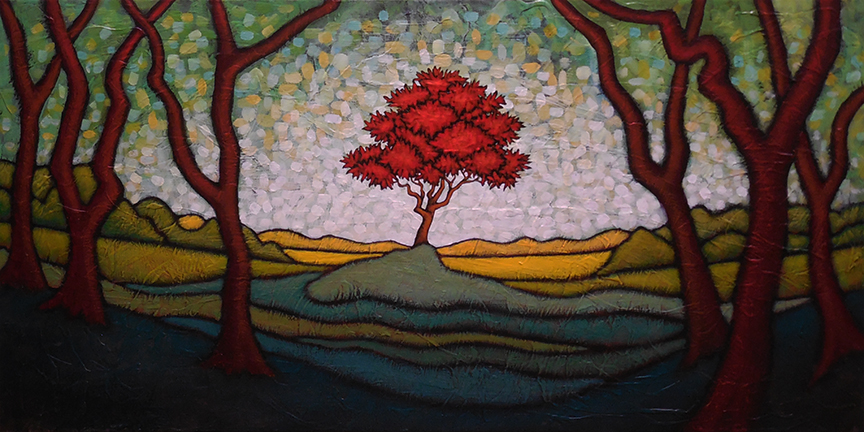
The piece shown here is a new painting, 24″ by 12″ on canvas, that elicits the elation I described above. It checks every box for what I wanted from it. It has an equilibrium of fineness and roughness that appeals to me. There is a cleanness in its design that makes it feel solid and whole to my eye. It draws me in and lets me feel that I am the Red Tree here and it is a fulfilling experience.

It makes me feel good, to put it plainly.

Now, I must note that these are my reactions. You might look at it and feel nothing. That is no less valid a reaction than my own. But because I know what I am feeling is true and genuine for myself, the anxiety of showing it to someone who might not feel anything from it is lessened.

So, with that thought in mind, I must get back to work.

With my head in the clouds.

This painting is titled, of course, Head in the Clouds. I used the quote below from Thoreau just a week or two ago but it fits this piece and this blogpost so well I am using it again:

It is better to have your head in the clouds, and know where you are, if indeed you cannot get it above them, than to breathe the clearer atmosphere below them, and think that you are in paradise.

–Henry David Thoreau

In this case, I think I know where I am…


Ralph Fasanella- May Day -1948

+++++++++++

Today, May 1, is May Day. Some folks see it as a festival of spring  that began as an ancient pagan celebration, complete with May Poles, May Queens and May Baskets. Others recognize it as a day celebrating laborers, trade unions and the working class, otherwise known as International Workers’ Day.

I think that labor unions have been integral to the rise of the American middle class and to many things that we now take for granted. Things like eight hour workdays, weekends, child labor laws, workplace safety, minimum wages, health insurance, paid vacations, retirement pensions and on and on. Things that provide a sense of comfort, security and self-worth for working folks.

I believe that the demise of unions goes hand in hand with the growing chasm in income inequality between the owners and the workers of this world. The owners had the shrewdness and the resources to mount a sustained campaign over the years that constantly painted unions in an unflattering light, to the point that many workers began to side with the owners, often against their own self interest.

It’s the same kind of thought control that makes workers believe that big tax breaks and other benefits reserved for owners will have a magical trickle down effect and will somehow enrich their own lives.

Unfortunately, human nature overrules trickle down economics every time. The benefits that the people in  labor unions fought and died for — yes, died for— are soon under attack from owners who need more and more and more. The labor battles will no doubt have to be fought again at some point and lord knows what ugliness will come from that.

The painting shown at the top and a favorite of mine, is titled May Day and is in the collection of the Fenimore Art Museum in Cooperstown. I thought it was a fitting image for today. It was painted in 1948 by a favorite artist of mine, American folk artist Ralph Fasanella, who I have written about here a number of times. He was a labor organizer in the 30’s and 40’s when the workers’ movement was making the powerful strides that created the mythic middle class that inhabited the America of the 1950’s. I am not going to spend a lot of time describing his career here but will point out that his work often portrayed labor and workers.

It is powerful stuff, to say the least, and pertinent both for its own time and now.

Here is the description for the painting from the museum’s website:

Ralph Fasanella was born in New York City to Italian immigrant parents. He spent his youth helping his father on his ice delivery route, and absorbed the streets, tenements, and people that would later inspire his art. His mother, a literate and socially conscious woman, introduced Fasanella to antifascist and trade union causes. He eventually became a union organizer until he began to paint in 1945. Fasanella was an acclaimed “primitive” painter in the 1940s, and then painted in obscurity for 25 years until his “discovery” in 1972. May Day represents Fasanella’s attempt to capture the spirit of the workers’ movements of the 1930s, focusing upon the huge May Day parades that annually drew up to 200,000 demonstrators to Union Square in New York City. At the left, marchers pour out of the crowded streets and tenements and descend upon New York’s Union Square. Their large banners proclaim support for organized labor and racial unity under the overarching cause of “Peace, Democracy, Security.” At the head of the parade is a magnificent horse-drawn float, complete with May Pole and women in ethnic costumes. The marchers pass a reviewing stand with a backdrop that serves as a shrine to labor heroes. Across a colorful bed of flowers lies the artist’s utopian vision at the right. It is a place where workers, liberated from the burden of twelve- and sixteen-hour shifts, have the freedom to pursue cultural and recreational activities.


Whether this matters in the long term, I do  not know. But for the time being, it gives me the feeling that I am somewhat in control of my narrative. Here’s a post from a few years back that speaks a bit more about artists speaking about their work and the difference between doing so with words that actually say something substantive and those that are mere fluffy word clouds.

.

David Hockney- Mulholland Drive 1980

It is very good advice to believe only what an artist does, rather than what he says about his work.

 –David Hockney

*************************
.
When I first read this quote from the great British artist David Hockney, a painter whose work I admire and always find very interesting, I wanted to be offended. After all, I am an artist who has said plenty about his work through the years– this blog and gallery talks being evidence of that– and have tried to be always transparent and forthcoming when talking about my work. But even so, I nodded in agreement when I read his words.
.
Part of my own desire to be honest and open about my work came from the frustration I felt in reading other artist’s writings that were filled with ArtSpeak, that way of seeming to say something important and meaningful without really saying anything at all. The words danced around all form of meaning and never fully jibed with the images that accompanied the words, leaving me with a single word resonating in my mind.
.
Bullshit.
.
And I know bullshit. I was a longtime bullshit artist. I sold swimming pools and automobiles– yes, I was even a used car salesman!– to the public for quite some time. I knew that you could sell by focusing on the strengths of the product and by dancing around questions about its drawbacks. Fill any voids with words that sounded like they were filled with meaning but really made no commitment to anything.
.
For me, there came a time when I was determined to not deal anymore in that manner of speaking and when I finally came to painting, I knew I didn’t want my work to fall into that pool of bullshit.  I wanted to tightly control how I represented my work and to be completely open about it.  It’s whole purpose for me was my own honest expression and I want

David Hockney- Arranged Felled Trees

ed people to be able to witness that without a crap filter between them and the work.

.
For the most part, I feel that I have been able to maintain that through these last several years.  Oh, occasionally I feel myself straying off the path but I simply remind myself that the product I am representing is the core of my self and once I cross that line I would be betraying everything art has provided for me.
.
But these are just words and maybe you should take them with Hockney’s advice in mind.

1968

The musical Hair opened on Broadway on this date 50 years ago, back in 1968. I grew up listening to this album and most of the songs feel like they are ingrained somehow in my DNA. Hailed as the American tribal love-rock musical, it was a groundbreaking show with songs that permeated the culture and helped define the era. Aquarius certainly feels like that time and that year.

And what a year 1968 was, here and around the world.

There were the tragic assassinations of Martin Luther King Jr and Robert F. Kennedy in April and June.

In a stormy election season, the 1968 Democratic Convention  was an eight-day violent skirmish in the streets of Chicago between police and protesters. Ultimately, Richard Nixon was elected president.

Here and around the globe, student anti-war protesters filled the streets and sometimes, as in the cases of Columbia University and Howard University, took over and occupied buildings.

North Korea captured the American surveillance ship the USS Pueblo and held its crew prisoner for 11 months. North Korea released the crew but kept the ship. It is now an exhibit Victorious Fatherland Liberation War Museum in Pyongyang.

There was the Tet Offensive and the My Lai Massacre in Viet Nam.

You had the Prague Spring that results later in the year with the Russians marching into Czechoslovakia to exert their control.

Before the opening of the 1968 Mexico Olympics, students protested in the streets that the money spent by the country for the Olympics would be better put to use in much needed social programs. The protesters were surrounded by the army and fired on, killing over 200 students and injuring over 1000 more.

The Olympics themselves were memorable with Bob Beamon soaring to an unfathomable record in the long jump. And, of course, there was the iconic image of Tommie Smith and John Carlos on the podium for the medal ceremony for the 200-meter run. Bare-footed with their heads cast downward, both raised gloved fists in the Black Power salute.

That would be enough for most years– maybe most decades. But there was even more that I don’t have time to go in here that make it one of the most chaotic and super-charged years in our history.

And among all that, the subversive sound of Hair played on. Well, it’s been fifty years and the world seems to have rotated back to find us in a similar time of chaos.

Some things never change, I guess.

So, for this week’s Sunday morning music I thought something from Hair would be fitting. So many great choices  but here are a couple of  better known selections, both of which became hits for artists that covered them in the following years. The first is Easy To Be Hard which was hit for Three Dog Night. The second is the title anthem which was #1 hit for The Cowsills.

Give a listen and have a good Sunday.


Balance

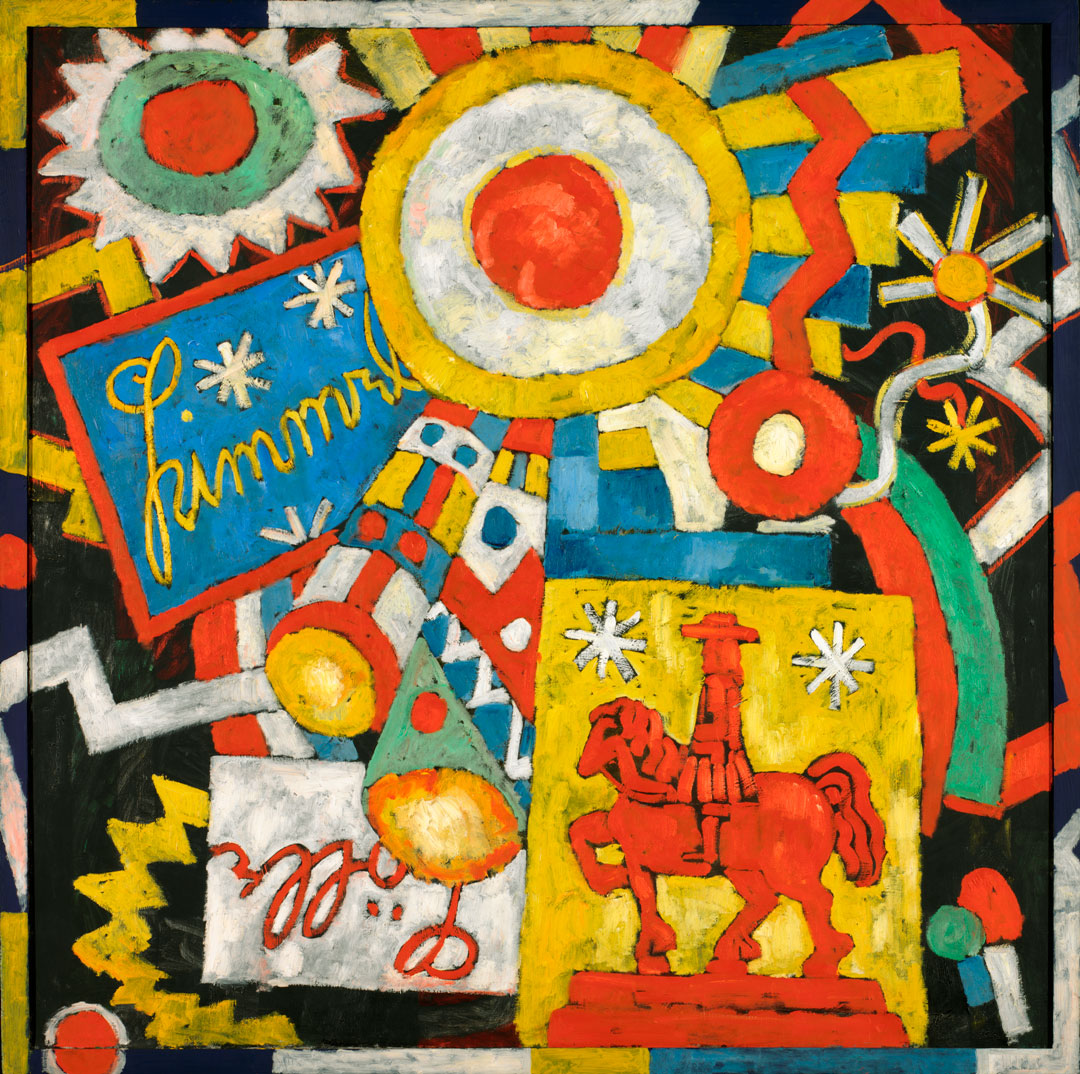
Marsden Hartley- Himmel 1915

++++++++++++++

I have come to the conclusion that it is better to have two colors in right relation to each other than to have a vast confusion of emotional exuberance. . . I had rather be intellectually right than emotionally exuberant.

–Marsden Hartley
++++++++++++++
I have been a fan of the paintings of Marsden Hartley (1877-1943) for some time now. I was reading about him earlier and came across this quote  that caught my attention, making me think about what I hoped to accomplish in my own work.
.
I often speak about creating work that has an immediate emotional impact achieved with colors and forms. But maybe, as Hartley’s words have prompted me to think, this first purely visceral and emotional impact is pure exuberance. Just a gut reaction that comes in that instant before the mind has time to engage.
.
A shout that makes you turn and look.
.
While that is good and desired, it’s doubtful that it can stand by itself and have a lasting effect unless it has an intellectual aspect to engage the viewer’s mind. There needs to be a balance between the mind and the gut.
.
If you turn at hearing a shout and the person doing the shouting is shouting just to make you turn and has nothing more to say to you, you keep moving and soon forget that person. But if you turn and the shouter has something more to offer, you might linger a bit to consider what is being said and engage in a conversation.
.
When you do move on, you take something from this engagement with you, something that will stay with you.
.
I am not sure this an apt analogy but it immediately came to mind on reading Hartley’s words. I don’t exactly know how this mind/gut balance works or how it can be accomplished in reality. Maybe even consciously trying to do so throws the whole thing off kilter.
.
It’s early in the morning and I am just thinking here. Time to go try to put it into action…

Marsden Hartley- Portrait of a German Officer 1914

“We are animals, born from the land with the other species. Since we’ve been living in cities, we’ve become more and more stupid, not smarter. What made us survive all these hundreds of thousands of years is our spirituality; the link to our land.”

Sebastiao Salgado

++++++++++++++++++++

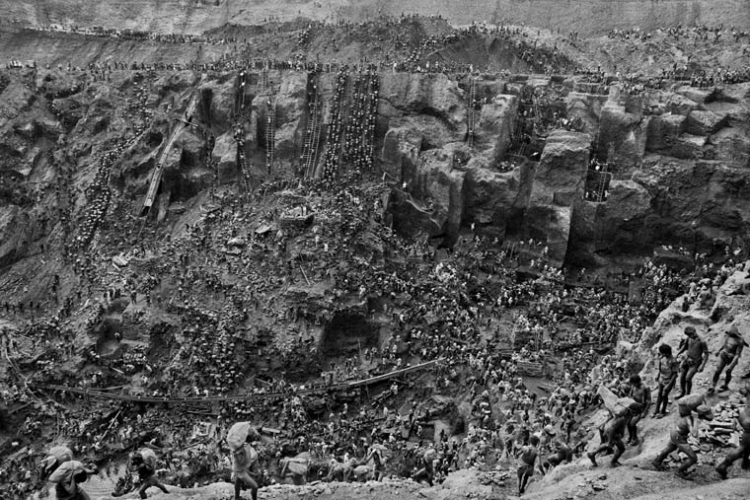
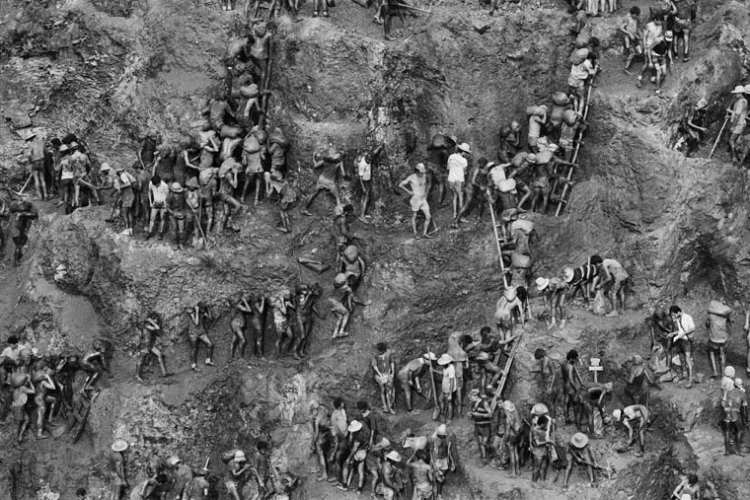
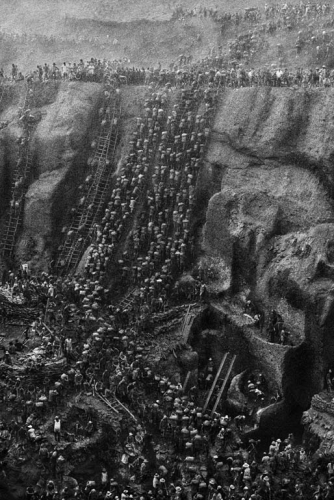
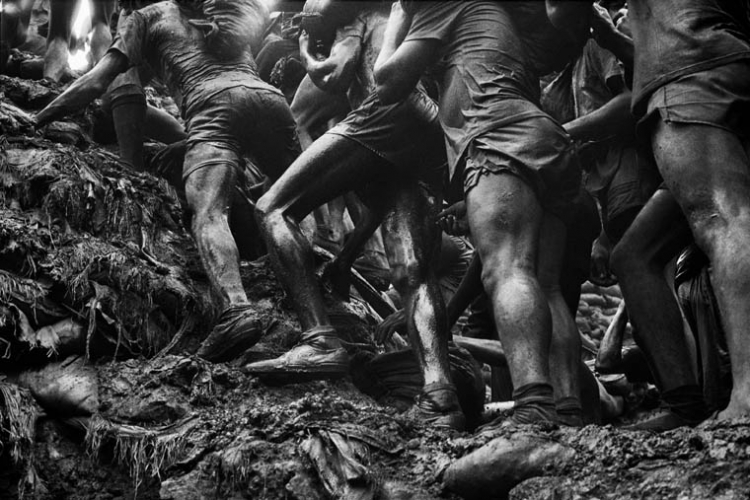
I featured the photos of the Brazilian photographer Sebastiao Salgado here several years back. Originally an economist, Salgado took up photography in his thirties and embarked on an epic journey to document the great beauty and darkness the of this world, photographing grand vistas and wildlife along with refugees fleeing genocide and workers in the grimmest of conditions. He does so in a wondrous fashion that has a way of connecting us in the present day to all the ages that came before.

This feeling of connection definitely hits me every time I come across his photos of the gold miners in Brazil, taken in 1986 and included in his 2005 book, Workers: An Archaeology of the Industrial Age. I love this title. The work has that archaeological feel, like artifacts that will stand as lasting images of our time here on Earth.

These images feel absolutely biblical to me. It takes away any doubt I may have previously held about how man created the ancient wonders that still stand today. The workers shown may be contemporary miners but they could just as easily be slaves in the age of the Egyptian pharaohs. Or lost souls trapped in one of the circles of hell in Dante’s Inferno.

If you get a chance please take a look at some of Salgado’s work. It is amazing imagery and truly human in every sense of the word.

Jacob Lawrence

Jacob Lawrence- This Is Harlem 1943

+++++++++++++++

My belief is that it is most important for an artist to develop an approach and philosophy about life – if he has developed this philosophy, he does not put paint on canvas, he puts himself on canvas.

Jacob Lawrence
+++++++++++++++
Exactly right.
 .
I often echo the advice in these words from the great Jacob Lawrence when speaking to students. Having all the talent and skill in the world doesn’t matter if one doesn’t have a viewpoint or don’t have something to say to the world.
.
Having a philosophy about life and a need to express their viewpoint guides the artist, allowing them to make the most of whatever talents and skills they do possess.

++++++++++++++

Being at ease with not knowing is crucial for answers to come to you.

–Eckhart Tolle
++++++++++++++

This new painting has been sitting within my sight for several days now. I can only speak for myself but I find it really easy piece in which to withdraw, imagining myself in that place, in that moment under that sky. There’s a sense of ease and comfort in it for me.

It just feels right.

Yet there is something enigmatic about it. While there is an air of easiness and acceptance in the painting, there is also a feeling that there is some sort of questioning taking place.

Perhaps a wondering of the why’s and what’s and how’s of this universe and our place in it?

Or the existence of a god or gods? Or the nature of good and evil?

Or perhaps something less weighty.

But even with this questioning there is still a great calmness and ease, as though the Red Tree in this time and place knows that having those answers would not make this particular moment any better.

And perhaps in that moment when a question does not require a response, an answer shows itself.

Perhaps…


Hey Joe, Gotta Go

Running around this morning, trying to get some things tied up but thought I’d share an interesting version of the Jimi Hendrix classic Hey Joe as performed the Joscho Stephan Trio. Stephan is a German guitarist who primarily plays in the gypsy jazz style, as you might deduce from the beautiful guitar he plays. This is a fun and energetic twist on the song, a shot of ear caffeine to get the week off on and running.

I thought I’d throw in this old doodle, an oddity from twenty years or so back.  Done very quickly with a Sharpie and embellished with a little watercolor,  the figure is a simplified and stylized representation of the way in which the figures from my early Exiles series were painted, composed from blocks of color.  It was never meant to be seen outside my studio but I like this for some reason. He looks like he could be playing Hey Joe.

Give a listen and get your motor running.

Earth Day…

Today, April 22,  is Earth Day. It’s an annual event to show support for strong environmental protections and actions to help keep this planet a clean and healthy place in which to live. It was first observed on this date back in 1970 and as it nears 50 years of age, it has never been more needed.

We are in the midst of a deep and vast cleansing but it is not taking place in the environment. No, it is happening in the EPA, the Environmental Protection Agency, where decades of of regulations enacting environmental protections are being flushed down the toilet, all for the benefit of large industries and energy companies.

I am old enough to remember the pollution of the 60’s and 70’s. The thick smog that hovered like a brown blanket above and on the cities. The many rivers so polluted that they were awash with dead fish and the others that were simply on fire. The acid rain that formed from the factories of the midwest and blew east, devastating the Adirondack forests and lakes. Love Canal and so many other Superfund cleanups– paid for by tax-payer dollars– of contaminated sites left by negligent industries. Masses of inefficient cars belching gray smoke and so many other things that contributed to a world that seemed to be built on trash and pollution.

Environmental protections have made huge strides in the past 48 years. If you ever drove through Cleveland in the 60’s and you see it now, you understand what I am saying. These regulations have made great strides toward cleaner skies and waters– outside of the giant Texas-sized islands of plastics that sludge along in our oceans and seas. But this administration has sold the country a bill of goods that says, simply put, that all regulation is bad and unnecessary.

And the gullible among us buy it, as though requiring businesses to operate in a safe and responsible manner somehow impinges on their own personal freedoms, even though there is huge truckload of evidence to the contrary.

There may be some regulations here and there that are not needed or are outdated. But for the most part, each of these arose from a need to stem specific practices that were detrimental to the public good. Are any of us worse off for having cleaner air to breathe, purer water to drink, better cars that get higher gas mileage and spew less smoke, or healthier forests and parks to in which to walk? What citizen benefits by allowing coal sludge to be dumped into waterways?

And as for the argument that these regulations cost businesses more? So what? It is the social responsibility of businesses to operate within our laws and regulations, especially when it concerns the health and welfare of our citizens. It is always passed on to us, the consumer, on a cost-plus basis that actually benefits the businesses. But this added cost passed on to us to avoid pollution and contamination is minimal compared to the bill that that comes due to us when we, the taxpayers, have to clean up things afterwards.

Not only do we have to live with an environment with dirtier air and water, we have to pay for the irresponsible screw-ups that gave it to us.

Okay, I am going to stop now even though I could rant for quite a bit more, especially about the cost analysis of renewable energy versus fossil fuels. I will end by saying that the EPA is doing damage to our regulatory framework and the environment it was designed to protect that may take decades to reverse.

This damage can only be halted by the actions of citizens. Get active. Speak up. For god’s sake, vote for clean air and water and renewable energy. If you can’t vote fot that, then we are in for grimy future.

Here’s this week’s Sunday morning music. It is, of course, the classic plea for the environment from Marvin Gaye, Mercy Mercy Me (The Ecology).

Have a good Earth Day.