Feeds:
Posts
Comments

Wrestling Angels

Life has no meaning unless one lives it with a will, at least to the limit of one’s will. Virtue, good, evil are nothing but words, unless one takes them apart in order to build something with them; they do not win their true meaning until one knows how to apply them.

– Paul Gauguin

***********************

Busy, busy, busy this morning but I wanted to share the quote above from Paul Gauguin. I think it pairs perfectly with the  Gauguin painting above it, one of my favorites, which is titled Vision After the Sermon or Jacob Wrestling with the Angel.

Many of us have noble ideas of how we want to live our lives but all too often we fail to live up to the words that we attach to these aspirations. Virtues such as good, kind, thoughtful and so on. But living up to those words takes, as Gauguin points out, is much more than a matter saying that we are good and kind and thoughtful. It requires the will to put those words into action each new day.

And that struggle is like Jacob wrestling with his angel throughout the night.

That’s a short interpretation but, like I said, I’ve got things to do. But before I get to it I want to share a few more words from Gauguin that made me laugh this morning:

We never really know what stupidity is until we have experimented on ourselves.

Unfortunately, I know from personal experience that this is true. Maybe that’s what made me laugh.

Have a great day.

The Starry Night ~ September 2015

I have a good friend, Linda Leinen, who lives down on the Gulf Coast of Texas and writes two wonderful blogs, The Task at Hand and Lagniappe. In today’s post on her Lagniappe site she write of finding a loving tribute to Vincent Van Gogh tucked beneath a bridge at the Medina River crossing on Texas State Highway 16, just a few feet above the river in a spot where only a handful of folks- swimmers, kayakers and perhaps a fisherman or two– might ever see it.

She documents it’s surprising endurance from September of 2015 until November of 2017, as it has went through a number of flood events that would have seen fast running waters and all sorts of debris brushing by the painting.

I love the idea of this little hidden treasure that is meant to give small dose of unexpected pleasure to unknown folks, people that the person who put it there will most likely never know.

Linda also included a great video that explains the real scientific forces behind Van Gogh’s Starry Night. I ran this video several years  back and enjoyed seeing it again. Take a look at Linda’s post today and see for yourself.  And while you’re at it, take a good look at her site and follow her if you like what you see. I know that I always enjoy reading her work. She writes beautifully and always does a masterful job.

The Task at Hand

Lagniappe

Just Do It

Do not try to do extraordinary things but do ordinary things with intensity.

–Emily Carr
*****************
Emily Carr was one of the first artists that came to mind when I saw the question last week that asked if you name five female artists. She is most likely off many of your radars but I am sure some of my friends to the north in Canada recognize her name very well.
 –
Carr was born in 1871 and died in 1945 in Victoria in British Columbia. Aspiring to be an artist, she was trained in the tradition of classical painting methods early in her life. But the first decade of the 20th century saw her work take a radical turn. After a period of time in Paris, influenced there by the Fauvist and Post-Impressionist with which she met and painted, her work took on bolder colors and more expressive brushwork.
 –
She took this new found energy back to Canada where she opened a gallery in Vancouver in 1912. The gallery faltered as she failed to see the response that she had hoped for. Dejected, she basically put down her brushes for the next 15 years, doing little painting.
However, some influential people were aware of her work, especially paintings she had executed with the native tribes of Canada as her subjects, and in 1927 she was invited to show a group of work in an exhibit about the tribes of the West Coast at Canada’s National Gallery in Toronto. It was here that she met Lawren Harris and  other painters who made up the fabled Group of Seven, which were several great Canadian painters of the time who had distinct modernist styles. I have featured the brilliant work of Lawren Harris here several times.
 –
Encouraged by Harris, who proclaimed her as one of that group, Carr was rejuvenated and for the remainder of her life worked with great vigor, trying to capture the spiritual essence of her native homeland. Like Maudie Lewis, Carr is a Canadian national treasure.
 –
I am enchanted by much of her work and the spirit that is imbued within it. This has been a very cursory look at her life with just the highlights and a few images and a video. Please do some research on your own. It’s well worth the time.


“The whole value of solitude depends upon oneself; it may be a sanctuary or a prison, a haven of repose or a place of punishment, a heaven or a hell, as we ourselves make it.” 

― John LubbockPeace and Happiness

****************************

I had never heard of John Lubbock before coming across the short quote above. He was one of those interesting 19th century British characters,  a titled member of a wealthy banking family who made great contributions to liberal causes and to the advancement of the sciences and math. For example, it was John Lubbock who coined the terms Paleolithic and Neolithic in describing the Old and New Stone Ages, as well as helping to make archaeology a recognized scientific discipline. He was obviously a man who used his position and access to higher knowledge to add to both his own intellect and that of our our collective body.

That being said, his words this morning gave me pause. I have generally viewed solitude as a sanctuary, even in the troubled times of my life. It was a place to calm myself, to gather my thoughts and clearly examine what was before me.

I never really gave much thought to the idea that for some this same solitude could seem like a hell or a prison. What differentiates one’s perception of such a basic thing as the solitude in being alone? How could my place of sanctuary be someone else’s chamber of horrors?

If you’re expecting me to answer, you’re going to be disappointed because I can’t really say.  I would say it might have to do with insecurity but I have as much, if not more, uncertainty and insecurity than most people. We all have unique psychological makeups and every situation, including that of solitude, is seen from a unique perspective.

This is also the basis for all art. What else could explain how one person can look at a painting and see an idyllic scene while another can feel uneasy or even offended by the same scene?

Now, the painting at the top, a new piece titled A Place of Sanctuary intended for my June show at the Principle Gallery, is a piece that very much reflects this sense of finding haven in solitude. For me, it is calming and centering, a place and time that appeals to my need for sanctuary.

Someone else might see it otherwise. They might see something remote, alien and unsettling in it.

I may not understand it but that’s okay, too. So long as they feel something…


Nuit Blanche

Lost time is never found again.

–Benjamin Franklin
*****************

The clocks moved ahead by an hour this morning despite my protests. Even though I have wasted more than my fair share of time in my life, I am at an age where I hate to see an hour just taken from me. That feeling on waking to find that it’s an hour later than I was expecting makes me rush out of bed and my morning begins on a frazzled note.

So this morning–what’s left of it–has found me searching for something to play for this week’s musical selection that would stave off my lost hour panic. Something that would slow me down so that it feels like that hour is still there, somehow.

My search takes me down dead end streets on YouTube with songs that just felt wrong which only served to aggravate me more. But somehow– and don’t ask me how– I spotted this song by a group of musicians unknown to me, a French group called the Tarkovsky Quartet.  It was a composition titled Nuit Blanche (White Night) and, as I listened to it play, felt that it was the right song for this wrong morning.

So, give a listen. Most likely the idea that time springs ahead doesn’t bother you. But if it does, this song is a lovely way to spend a few minutes of time without feeling you’re wasting it.

Have a good day.

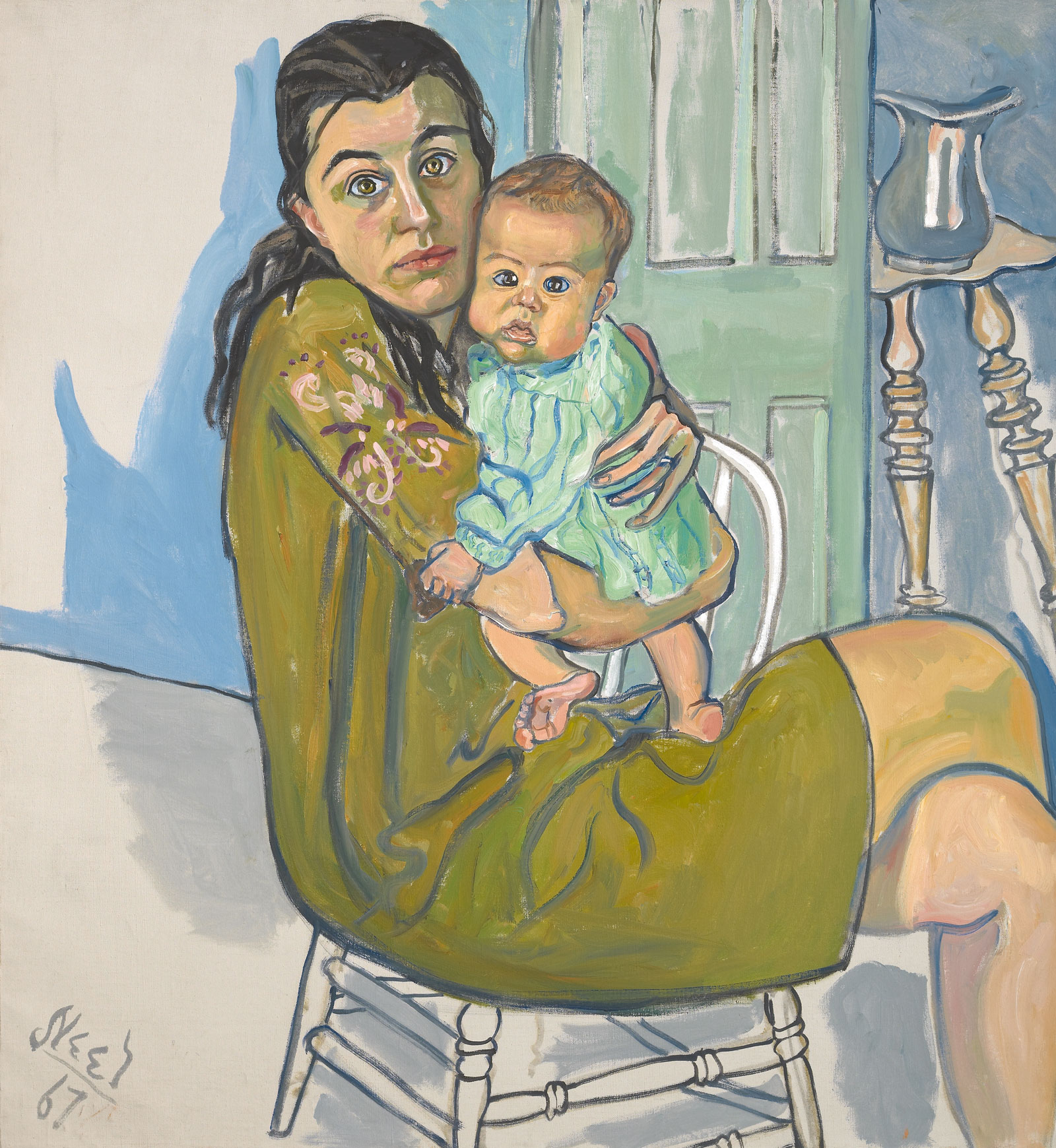
I don’t paint like a woman is supposed to paint. Thank God, art doesn’t bother about things like that.

Alice Neel

******************

Thursday was International Women’s Day and I saw an article on social media that asked if you could name five female artists. It wasn’t difficult for me but this is what I do so I am regularly scanning the work of others, past and present. I see a lot of work by women that is incredible and have been directly influenced by many of these women.

But I could imagine for the casual observer it might be a difficult thing to name five female artists. Any honest person that does a quick scan of the history of art can plainly see that this field has long been dominated by males. But this makes it like most other fields of endeavor and reflects a societal bias that has often long placed less importance on the accomplishments and the self-expression of women.

It is something that must and will change. It is changing before our eyes.  I say that because I have had the great fortune to be associated with a number of galleries that feature increasingly large rosters of female artists. This is not by design. It’s just that more and more interesting and wonderful work is being done by female artists who have finally realized that their voice, their expression, should be secondary to no one.

I have seen the numbers grow substantially over the years and am excited by it, mainly because the things that I see in the art that attracts me are usually perspective dependent, not gender dependent. Anything that broadens the field and gives a wider range of viewpoints and more options is a good thing in my opinion.  The gender, or race or nationality, of the artist should not play a role in our perception of their work unless that work deals directly with these subjects.

Hopefully, soon an artist will simply be an artist. Not a female artist or a black artist or a Latino artist or whatever subtitle people choose to attach before the word artist.

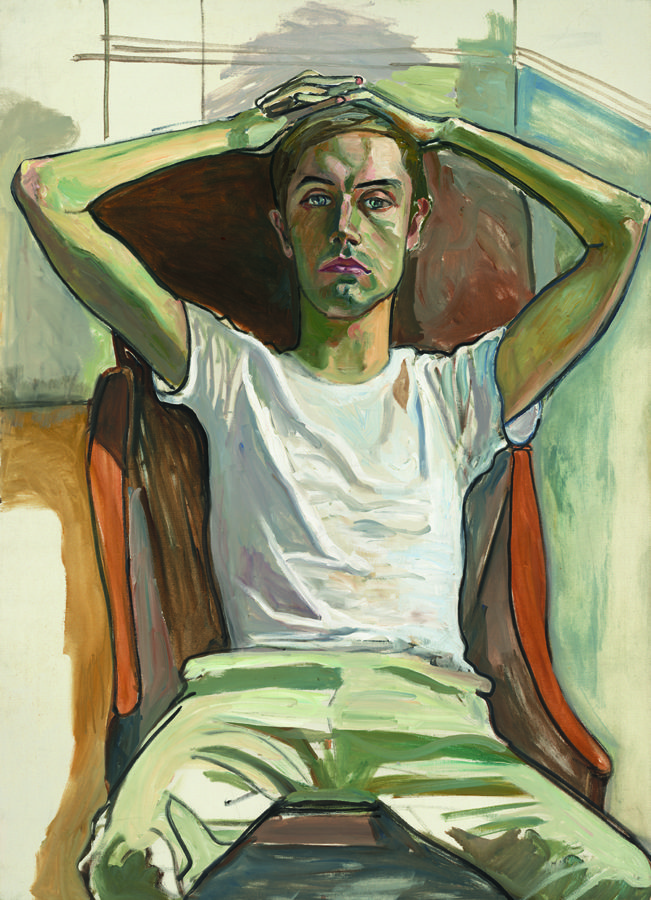
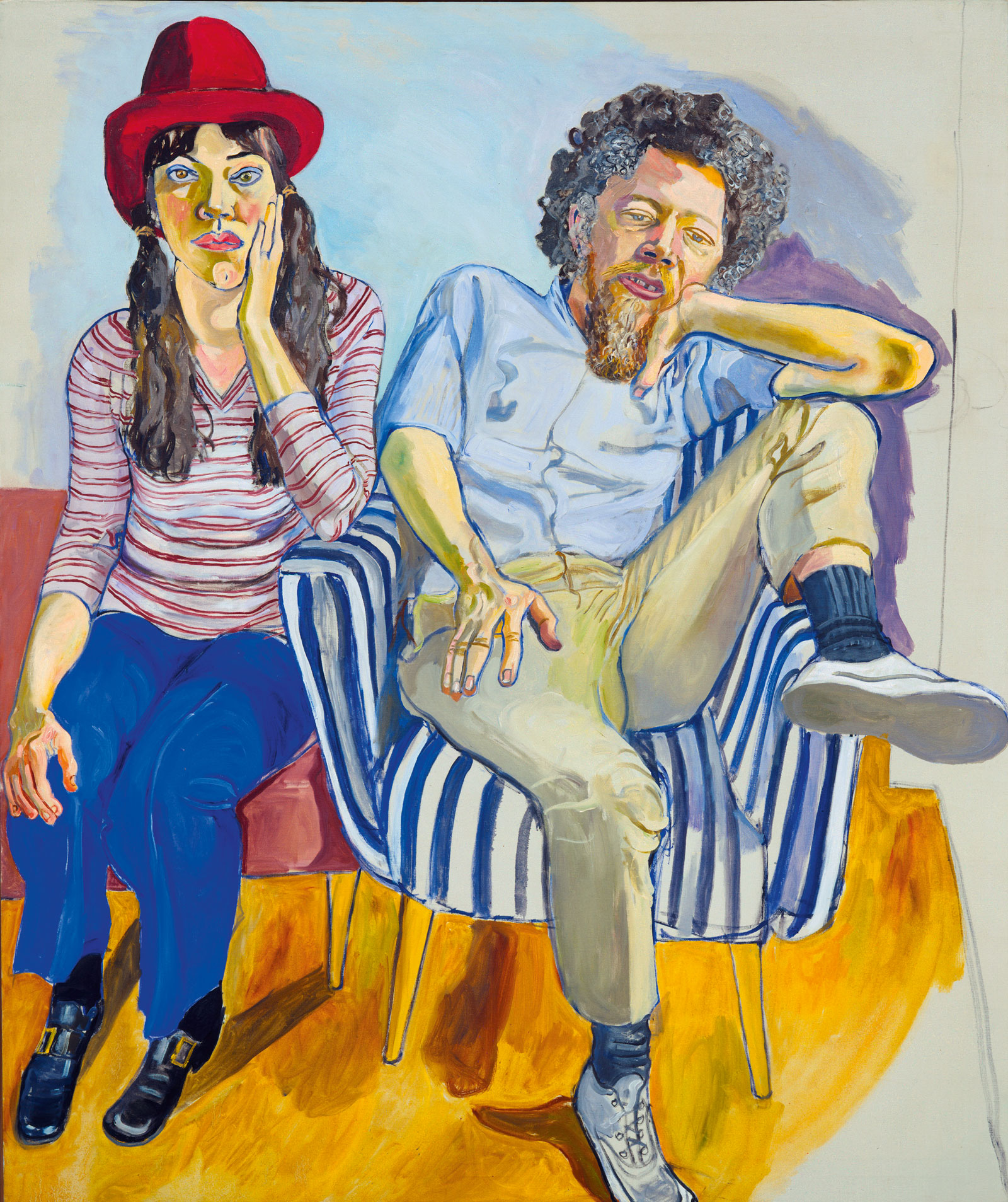
One of the artists that jumped to mind for me when I read the question about naming five female artists was Alice Neel (1900-1984) who was famed for her portraiture. She had a very distinct way of using color and always followed her personal muse, never adhering to any particular genre or school. She was a bold painter in a time when the female artist was still very much underappreciated. In the years since her death she has gained great recognition for he work. I urge you to take a closer look at her work and her life.

Alice Neel. Hartley. 1966. oil on canvas. 127 x 91,5cm. gift of Arthur M. Bullowa. National Gallery of Art Washington.

I came across this blog entry from about seven years back earlier this morning. While the painting remains a favorite of mine for a number of reasons, the thought behind this entry hit a chord with me this morning. It seems that even in 2011, the idea of alternative facts had taken hold and was a dark omen for our current state of affairs. 

This is a new 12″ by 24″ painting that sits in my studio at the moment. It draws a lot of my attention at the moment and I’ve been enjoying it over this time. I find this a very hopeful piece, the whiteness of the house’s reflection of the bright rising light set in contrast to the dark foreground. It’s this contrast that creates the hope I see.  Like many things, hope is relative to the conditions of the situation.

I’ve left the landscape bare of other trees other than those in the foreground which form a stage-like setting for the scene beyond, wanting to create  more focus on the starkness of the house. The path moves from dark to light and also conveys this sense of hope, of moving towards a more illuminated situation.

I’m thinking of calling this Obscurity. I know that this doesn’t convey the hope of which I speak but I have been thinking of a line from John Locke’s An Essay on Human Understanding that has been bouncing around in my head for a week or so. Locke states:

 Untruth being unacceptable to the mind of man, there is no defense left for absurdity but obscurity.

It sounds wonderful. In a perfect world, the absurdity of obvious falsehoods would only exist in the darkest and most obscure corners of humanity. Unfortunately, we live a most imperfect world, leaving me to wonder if, in fact, the opposite might apply to our times: Untruth being acceptable to the mind of man, there is no defense for rationality but obscurity.

This thought has hung hauntingly on me for some time and maybe I see this house as a refuge of some kind for rational thought in what seems an irrational time.

A place of obscurity.

Or maybe it’s just a house. After all, sometimes a cigar is just a cigar.

Hopper- Emotion

Edward Hopper- Pennsylvania Coal Town

***********************

I believe that the great painters, with their intellect as master, have attempted to force the unwilling medium of paint and canvas into a record of their emotions. I find any digression from this large aim leads me to boredom.

Edward Hopper

***********************

Emotion is that intangible quality that separates art from craft. Emotion does not have to be at the extremes of rage or depression or giddy elation. It is often subtle and calm or densely introspective. Hopper’s work was imbued with quiet emotional undertones that make his paintings, even those scenes of the most seemingly mundane moments, truly memorable.

Art is, at its foundation, emotion.


******************

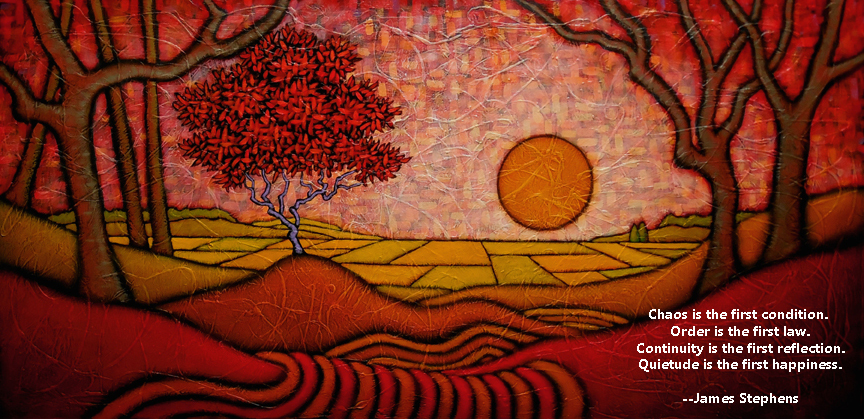
I see the words of James Stephens, an Irish poet who lived from 1882 until 1950, in the painting above, Native Voice.

The sun and sky represents the first condition, Chaos.

The fields represent the first law, Order.

The direct line that runs from the sun and ends at the Red Tree represents the first reflection, Continuity.

The still reflection of the Red Tree is the first happiness, Quietude.

Something to shoot for…