Feeds:
Posts
Comments

Words from Miro

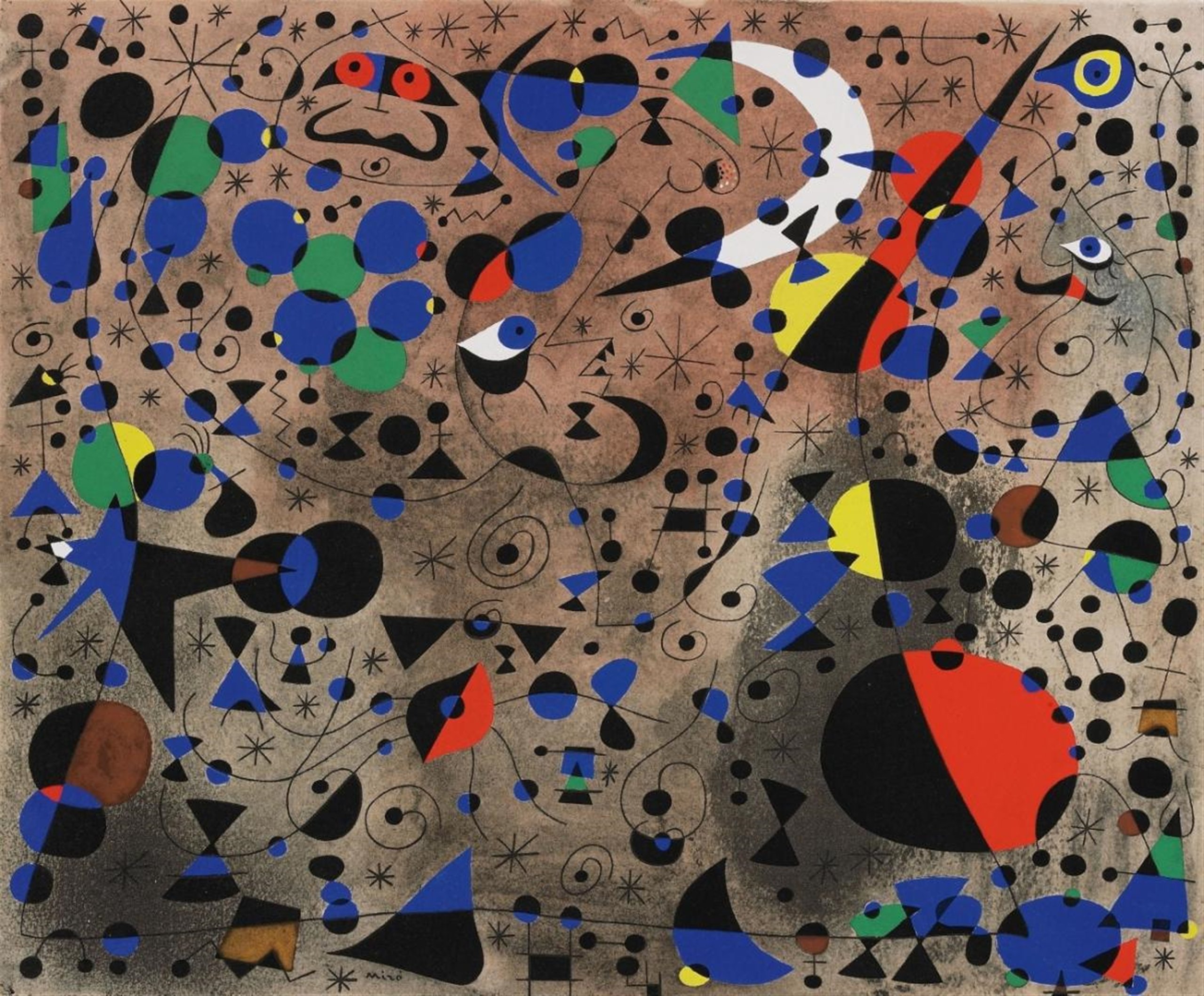
Joan Miro, Constellations 1959

———————-

The older I get and the more I master the medium, the more I return to my earliest experiences. I think that at the end of my life I will recover all the force of my childhood.

–Joan Miro, from 1960 at age 67 

———————–

It’s the young people who interest me, and not the old dodos. If I go on working, it’s for the year 2000, and for the people of tomorrow.

–Joan Miro, from 1975 at age 82

————————-

There are two quotes here from the great Spanish painter Joan Miro (1893-1983) that really strike a chord with me. Both come from him when he was older and both speak very much to the way I feel about my own work.

In the first he speaks about gaining more mastery over the medium through the years while simultaneously moving closer to the vibrant energy that one has in their youth. I have felt the same feelings. The more one gains control over their form of expression, the more they are freed from the constraints of conscious thoughts and decisions. The work becomes reactive to the feel and emotion of the moment.

Now, I will add that with this acquired mastery there is also a new barrier erected to overcome. Well, at least, in my experience. I have found that with years of work, which is, in effect, rehearsal and practice, there is sometimes a loss of spontaneity and passion in the actual making of the marks. They become a little too precise, a little too mannered and a bit too clean and neat. They don’t have that feeling of wanting to burst off the surface. I have found ways to get past this–using bigger brushes and making strokes quicker with more urgency, for example– but every so often I will get near the end of a piece and it just feels too neat, too precise, for the underlying emotion.

It needs the innate exuberance of a child at play.

The second Miro quote, made when he was 82, speaks of painting not for those of his age but for the younger and the future generations. I certainly understand this sentiment. I am most thrilled when children react to my work, knowing then that it is speaking to the aforementioned innate exuberance.

It means I am not dealing with intellect or acquired knowledge or conscious thought. It is a pure and uninformed reaction. It means the work is communicating emotionally across and out of time.

And I think this is important because I believe most artists wants to break free from their own era, to not be consigned to any single period of time. To be known for what they were at their inner and eternal core, not where or how they were categorized in their time.

Maybe like the Miro painting at the top, a single small voice among the multitude of stars and constellations in the universe.

I don’t know but that might be my primary goal in doing what I do.

Why Not?

While writing a reply to comment made on yesterday’s blog early this morning, I stated that for me, there was a connection with energy of these young people that were behind this weekend’s March For Our Lives and that of the presidential campaign of RFK in 1968. I was only 9 years old but was fully aware of RFK , watching intently every day as his campaign was covered on the evening news, in our case NBC’s Huntley-Brinkley Report.

Robert Kennedy campaigning for a seat in the Senate, 1964. Elmira, NY

His youthfulness stood in stark contrast to the other politicians that I saw such as LBJ and Nixon, older stodgy looking men in dark suits. Kennedy looked young enough to be their sons and the crowds that turned out to see him were always filled with kids. Many photos of his campaigns show him standing amid swarms of young people. One of my favorites is from his 1964 senate campaign, with him in a shopping plaza in my hometown that I know well. He is standing in car with his shirtsleeves rolled up with a crowd of kids reaching out to shake his hands.

The idea of dreaming things that never were and thinking they could actually happen still seemed like a possibility in those moments. And why not? We were on the brink of putting a man on the moon, something that only a few years before seemed impossible. We had passed sweeping Civil Rights legislation, overcoming centuries of ingrained prejudice and the darkest efforts of those who claimed supremacy.

Anything was possible.

And that thought is what seems to be taking root in these kids. They don’t feel bound to history. They see only the present and the future and in that, they recognize that they will be the ones occupying the future.

Why simply accept the wreckage we are leaving them as our legacy? Why not make it a time and a place of their own making? Their vision, their world. Not one forged by old men who only see things in terms of money and privilege.

Why not, indeed.


Contrast

It was not hard to see the contrast yesterday between the attitude of the oceans of youth that swarmed cities around this country during the March For Our Lives and that of the nation’s current governing party.

These kids are amazing. Stunning, really. They are smart, focused and savvy in the ways of media that goes well beyond their years. They have boldness and strength, a clear-eyed vision of rightness and a true sense of serving the greater good. There is a guileless purity to them that is refreshing and clarifying.

Now contrast that to the politicians who stand opposed to their agenda. The words that spring to my mind are words like cowardly and greedy and self-serving and evasive and deceptive and amoral. Corrupt in every sense of the word. Their craven attitude is bringing this country to the brink of a disaster, enabling a transformation of our democracy that may be difficult, if not impossible, to reverse.

As Andrew Sullivan deduces in his review this week of the book Can It Happen Here: Authoritarianism in America, it may already have happened and we just haven’t recognized it yet.

It’s hard for me to not think that we at this moment in history are standing on the middle of the yin yang symbol above and we could go either way, into light or into darkness. We need to decide right now whether we want concede our future to those who think nothing of selling that future to the highest bidder and lying to us about doing so.

If the great numbers of people somehow are offended by these kids’ call to action, if they prefer to stand behind the craven cowards in congress and in the white house — neither deserve capital letters in my opinion–then I fear we have already moved into the darkness.

But for today, in the wake of yesterday’s demonstration, I see a little light. I have always been disappointed by the youth vote in this country but I have hope that these kids can take the lead to make it the force it should be. If they can unite behind a few issues they have the numbers and power to change this country. The future is their’s if they choose to take it.

I hope yesterday was the beginning of that recognition in this new generation, as well as in the older generations, like mine, who have been asleep at the switch for much too long.

Okay, for this week’s Sunday morning music I am going back to another turbulent point in our history, the 1960’s and anti-war movement in the wake of the assassinations of MLK and RFK. Here’s some Canned Heat from Woodstock in 1969 doing A Change Is Gonna Come.

Have a good day. But think about which way you want things to go and do something to push it that way. Take a page from these kids– get off your butts and make the world the way you want it.

Towers of Babel

One of my favorite paintings is the one above, a depiction of the biblical Tower of Babel painted by Pieter Brueghel the Elder, the Flemish painter around 1563. It is probably the image that jumps to mind for many folks when they think about that tower. It is an iconic image.

But it also spurred many generations of other artists to render their own vision of how they thought the tower may have appeared. I am fascinated by the hundreds of different, yet in many ways similar, ways in which the Tower of Babel has been depicted and have scanned over numerous iterations.

All are captivating to me, filled with all sorts of compositional possibilities that always seem to have me on the verge of painting my own tower. I may have already attempted and haven’t even realized it, like the characters in Close Encounters of the Third Kind who are compelled to by their visions of Devil’s Tower to recreate that landmark in whatever is at hand, such as the mashed potatoes in the case of the Richard Dreyfuss character.

Here are just a handful of other paintings of the Tower of Babel along with a short video I came across that contains a few more.

Schiele -Eternal

Egon Schiele- Setting Sun 1913


+++++++++++++

Art cannot be modern. Art is primordially eternal.

Egon Schiele

++++++++++++++++


Never Alone

I Am Not Alone

The night, it is deserted
from the mountains to the sea.
But I, the one who rocks you,
I am not alone!

The sky, it is deserted
for the moon falls to the sea.
But I, the one who holds you,
I am not alone !

The world, it is deserted.
All flesh is sad you see.
But I, the one who hugs you,
I am not alone!

Gabriela Mistral

+++++++++++++++++++++++++

Another new piece that just came off the easel, this one a 24″ by 24″ canvas. I think I am going to call this painting Never Alone.

I’ve written about the focused, almost mesmerized, feeling that comes over me when I have been at work on this recent work and this painting was no different. It just pulled me in from the beginning and held me captive. Even when I would stop working on it, I was constantly looking back at it, trying to absorb it as though it were some sort of balm.

And maybe that is just what it is for myself. A soothing balm.

I came across the poem above a number of years ago from the great Chilean poetess and Nobel Prize winner, Gabriela Mistral, and shared it on the blog back in 2010. I wrote then that I felt this poem perfectly paired with a painting I had done at that time. I think the same holds true here.

As I wrote in 2010:  The sense of being alone yet not lonely is an important element in the way I look at my work and one that I sometimes struggle with for fear that it may alienate some who see being alone as only loneliness and not solitude. An important distinction and one that is often misunderstood. 

But we who relish our solitary time understand.

Well, I have some solitary time right now to further absorb my balm.


+

It is the treating of the commonplace with the feelings of the sublime that gives to art its true power.

–Jean-Francois Millet

++++++++++++++++

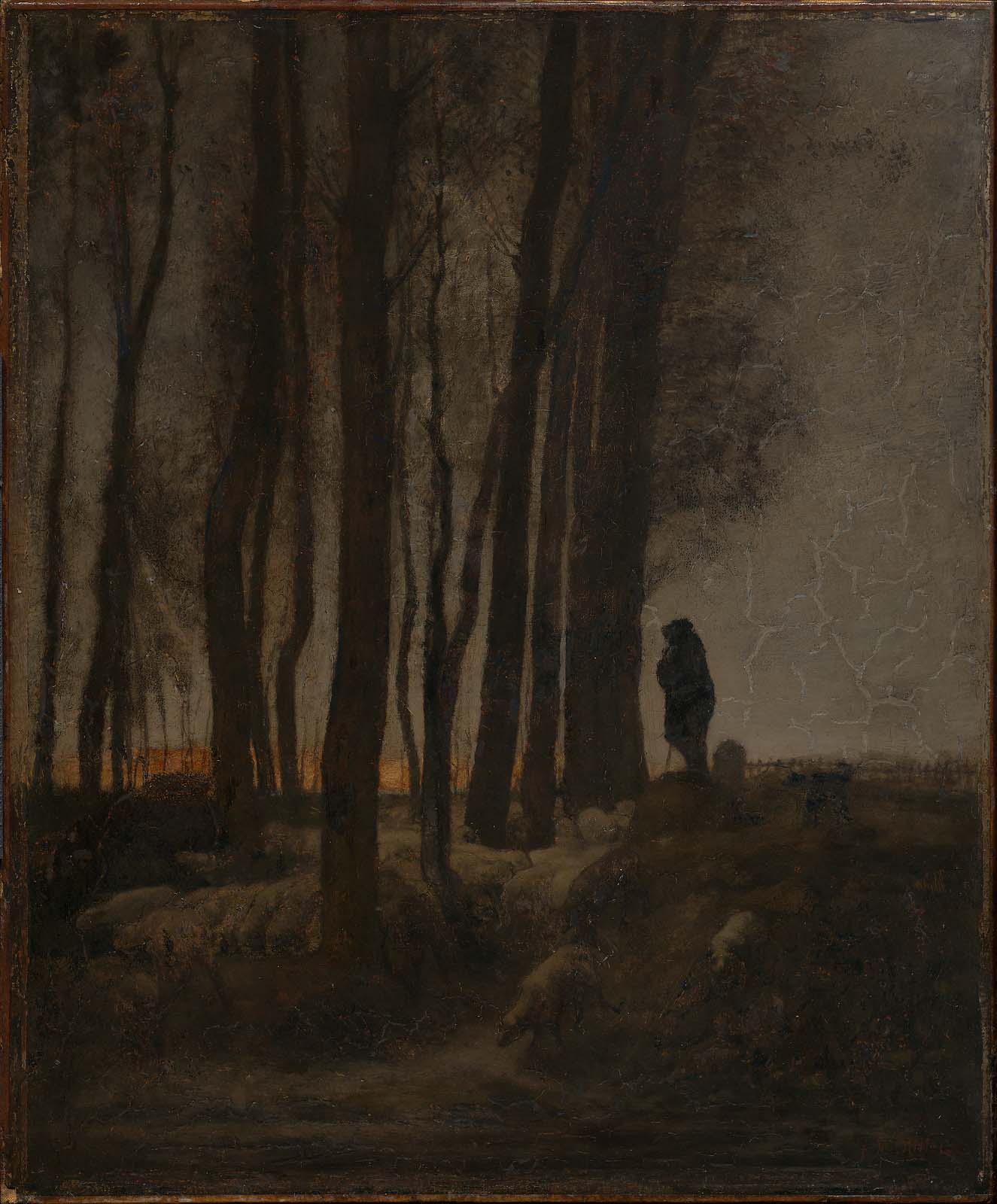
Jean-Francois Millet (1814-1875) is mainly known for his peasant scenes painted in the genre of the Barbizon school, of which he was an originator.  This genre marked the move from Romantic painting to Realism which depicted the reality of all aspects of the world, including the rural working class which were seldom portrayed heretofore.

This work played a huge role in the evolution of modern art as a number of artists from subsequent generations ran with this work , adding their own voice and style to the subject matter. Van Gogh, for example, directly copied a number of Millet works, such as The Sower below, in his own distinct style.

I am not moved by all of Millet’s work. Some of it feels generic but I think that is understandable as its style was so influential that it was emulated, creating a vast body of similar work. But there is something in a segment of his work that I feel is truly visionary in a way that lends credence to the statement from Millet at the top of the page. Here are a few of my favorites.

Brancusi on Fame

++++++++++++++

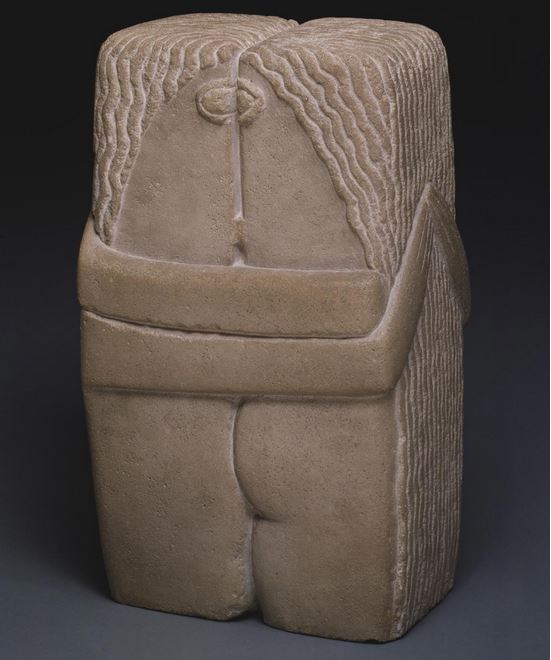
Brancusi The Kiss Phila Museum of ArtOne day in Switzerland, in front of a beautiful mountain there was the most beautiful of cows, and she was contemplating me in ecstasy.  I said to myself, ” I must be someone if even this cow admires me.”   I came closer; she wasn’t looking at me, and she was relieving herself.  That tells you what you need to know about fame.

–Constantin Brancusi

*************************

This was a favorite anecdote of famed sculptor Constantin Brancusi(1876-1957) concerning an incident as he took the long trek on foot from Bucharest to Paris as a poor young man seeking fame and fortune. He found both but the influence of his peasant roots in Romania remained with him.

His story of the unimpressed Swiss cow is a pretty good reflection on the nature of fame, even the type acquired through great deeds. Fame is something created by other people, not something that is displayed on oneself. When all is said and done, we’re all pretty much the same– famous or not– in the eyes of that peeing cow.

It reminds me of when I first began showing my work in a gallery while I was still working as a waiter in a pancake house. I would go to openings and people would praise my work, telling me how great I was. I could barely get in my car to drive home because my head was so big by the end of the evening. But at 6 the next morning, there I was, pouring coffee for truckers and families who were less than impressed by the praise lavished on me the night before.

A big pin prick that brought my head quickly back to a more normal size.

Those folks at the restaurant were my peeing cows.

It’s a lesson that I try to remember when things are going too well and I find myself beginning to believe that I am something more than what I really am– a simple schlub watching a cow pee.

Nocturne/ Starmap

+++++++++++++

Things are as they are. Looking out into it the universe at night, we make no comparisons between right and wrong stars, nor between well and badly arranged constellations.

Alan Watts

++++++++++++++++

I wasn’t planning on showing this newer painting for a while. But I came across this lovely piece of music and this painting seemed to pair perfectly with it, at least to my eyes and ears.

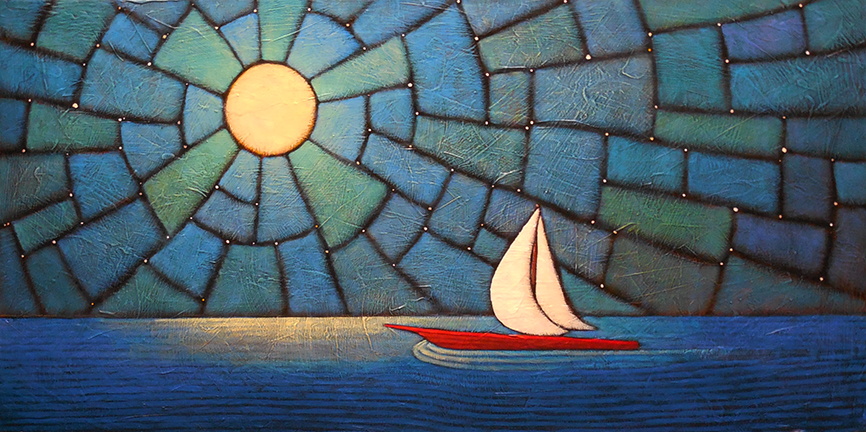
The painting is an 18″ by 36′ canvas that I call Starmap and is part of my annual show at the Principle Gallery in Alexandria which opens June 1.

I have been working on a series of paintings like this, with blocks of color making up the sky and stars as points of light showing at the intersections of these blocks. I love working on these pieces. They require an emptying of the mind with a focus solely on what is before you. There’s this interesting sense of constant problem solving that bounces from making each form correctly and balancing that form within the whole composition. I continually go back and forth from tight focus to wide focus.

I probably can’t properly explain it but for me, it is an exhilarating process as each added form and layer of color, each poke of light from the stars, subtly transforms the piece into something more than I was expecting. It feels more complete and full than the first thoughts and brushstrokes that initiated the painting, leaving me with a giddy kind of satisfaction. I know that this has been the case thus far with each of the paintings in this series.

Now for this Sunday morning music, I thought this wonderful piece, Nocturne, from young Hungarian guitarist Zsófia Boros paired up beautifully with the feeling that this piece creates for myself. I’ve listened to it several times this morning and it just seems right.

Give a listen and have a great Sunday.

++++++++++

Another St. Patrick’s Day, that celebration of all things Irish– parades, pints and more Kelly green than the mind can fully process. They say that well over 30 million Americans claim to have Irish roots.

Growing up, I always believed we did as well because my grandmother was an O’dell, which certainly seems Irish. But doing genealogy over the last decade I have discovered that the O’dell was changed through the years from Odell and before that from Odle and, most likely, before that from Woddell, It turns out that it was not Irish at all.

No, it was British. And for the Irish that is a big distinction.

But I also discovered that my father’s great-grandparents were Irish immigrants during the Great Migration of the middle of the 19th century. It was something I wasn’t sure of before I started my genealogy work. I still haven’t found where they originally came from in Ireland.

Icon: Mary T.

Their’s was a pretty stock story. The father, Michael Patrick Tobin, worked on building the railroads in central New York, ultimately settling in the Binghamton area, where most of his family worked for the next several decades in the tobacco industry there. Most were tobacco strippers or cigar makers.

I am not positive that his wife was actually born in Ireland. There are conflicting accounts but her parents definitely were. She was the subject of one of my Icon paintings from a couple of year’s back shown here on the right. Her story is an interesting one, one that I wrote about on this blog. You can read it by clicking here.

So, it turns out I am one of those 30-some million with a bit of Irish blood, about 25 % according to the DNA tests. I don’t give it much thought except on this particular day and even then, I realize that these folks were not much different than most of my other ancestors from other countries who left the hardships of their homelands for what they hoped would be a better life in America. I can’t say they all found wonderful lives but perhaps they were a bit better off than they might have been had they stayed put.

Okay, here a bit of Irish music for the day, a nice reel, The Glen Road to Carrick, from a contemporary Irish group, FullSet. I like the feel of this- it has a fresh edge that makes me want to drive too fast. By the way, the painting at the top is from a late Irish painter, Paul Henry, who painted primarily in the first half of the 20th century. I am a fan of his work and featured it here a couple of years back.

Have yourself a good day.