Feeds:
Posts
Comments


GC Myers- Jumping Off PointWhenever I am asked to speak with students I usually tell them to try to find their own voice, to try to find that thing that expresses who they really are.  I add that this is not something that comes easily, that it takes real effort and sacrifice.  The great poet e e cummings (you most likely know him for his unusual punctuation) offered up a beautiful piece of similar advice for aspiring poets that I think can be applied to most any discipline.

Or to anyone who simply desires to feel deeply in this world.

I particularly like the line: To be nobody-but-yourself-in a world which is doing its best, night and day, to make you everybody else-means to fight the hardest battle which any human being can fight; and never stop fighting.  That line alone speaks volumes.

Take a moment to read this short bit of advice and see what you think– or feel.


A Poet’s Advice To Students

(e e cummings)

A poet is somebody who feels, and who expresses his feeling through words.

This may sound easy. It isn’t.

A lot of people think or believe or know they feel-but that’s thinking or believing or knowing; not feeling. And poetry is feeling-not knowing or believing or thinking.

Almost anybody can learn to think or believe or know, but not a single human being can be taught to feel. Why? Because whenever you think or you believe or you know, you’re a lot of other people: but the moment you feel, you’re nobody-but-yourself.

To be nobody-but-yourself-in a world which is doing its best, night and day, to make you everybody else-means to fight the hardest battle which any human being can fight; and never stop fighting.

As for expressing nobody-but-yourself in words, that means working just a little harder than anybody who isn’t a poet can possibly imagine. Why? Because nothing is quite as easy as using words like somebody else. We all of us do exactly this nearly all of the time-and whenever we do it, we’re not poets.

If, at the end of your first ten or fifteen years of fighting and working and feeling, you find you’ve written one line of one poem, you’ll be very lucky indeed.

And so my advice to all young people who wish to become poets is: do something easy, like learning how to blow up the world-unless you’re not only willing, but glad, to feel and work and fight till you die.

Does this sound dismal? It isn’t.

It’s the most wonderful life on earth.

Or so I feel.


In the Waiting

GC Myers-  In the Waiting sm… I said to my soul, be still, and wait without hope

For hope would be hope for the wrong thing; wait without love

For love would be love of the wrong thing; there is yet faith

But the faith and the love and the hope are all in the waiting.

Wait without thought, for you are not ready for thought:

So the darkness shall be the light, and the stillness the dancing.

-T.S. Eliot, East Coker, The Four Quartets

********************

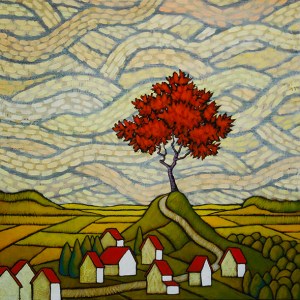
I’ve been in a deep groove lately as I ready work for my upcoming June show, Part of the Pattern, at the Principle Gallery.  Part of finding this groove was returning in the last month or so to process of  transparent inkiness that marked the early incarnations of my work.  An example of this is the piece shown above, a 6″ by 24″ painting on paper that I am calling In the Waiting, taken from the Eliot lines above.

The strength of this wet work, at least for me, is in the way the fluidity of the paint creates the tension and contrast that carries the emotional content of the painting. The duskiness where light and dark comes together is filled with the anticipation of all that is to come, all unknown to the waiting Red Tree who attempts to tamp down its desire to imagine what is coming.

The goal is to put aside any faith or hope or love –as Eliot puts it so beautifully– and simply await the inevitability of what is to come without thought. But that stillness of thought makes the waiting tolerable and allows us to view that which is before without the influence of our desire, to see things as they really are.

But as we all know, that is easier said than done…

It’s My Way

GC Myers- Pacifica smEvery spring the Library of Congress selects 25 recordings that they deem to be “culturally, historically, or aesthetically significant” to be added to their National Recording Registry.  There is a wide selection each year with recordings from all genres of music combined with radio broadcasts. speeches and other spoken word recordings.
For example,this year includes General Marshall‘s 1947 speech at Harvard where he laid out the basis for the Marshall Plan alongside George Carlin’s seminal Class Clown comedy album.  Plus for sports lovers, there’s the recording of the broadcast of the fourth quarter of the historic 1962 game in which Wilt Chamberlain scored 100 points.

There are a lot of things from the list that I could use for this Sunday morning music selection.  There are two versions of Mack the Knife, one from Louis Armstrong and the other from Bobby Darin.  There’s Where Did Our Love Go? from the Supremes, Piano Man from Billy Joel, Cry Me a River from Julie London and too many others to list this early in the morning.  You can see the whole list here.

But the selection that caught my eye was the 1964 debut album, It’s My Way,  from folk singer-songwriter Buffy Sainte-Marie.  If you are of a certain age, you probably remember Buffy Sainte-Marie when she was one of the stars of the folk revival of the 1960’s.  Her Cree Indian heritage and the fact she was one of the few women songwriters in the genre at the time made her stand out and she was staple of variety television shows of the era.  But her profile was less visible going into the 1970’s and she had a 16 year hiatus from recording from the mid 70’s until 1992 although she was still busy as a songwriter.  The song Up Where We Belong which she co-wrote was a huge hit for Joe Cocker and Jennifer Warnes as well as winning the Academy Award for Best Song in the 1982 film An Officer and a Gentleman.

This 1964 album is a pretty remarkable recording and there are a number of her songs from it which I could have chosen to play.  Universal Soldier became a standard as a 1960’s protest song and Cod’ine was covered by dozens of artists, most famously Janis Joplin.  But it is the title track that stands out for me.  It’s a song that seems timeless in its sound, not trapped in its own time like some songs from  significant eras.  It’s a powerful song that builds and builds.

Give a listen to It’s My Way and have a great Sunday.


2016 Smithsonian Photo Contest Winner- The China Red- Jian Wang

2016 Smithsonian Photo Contest Winner- The China Red- Jian Wang

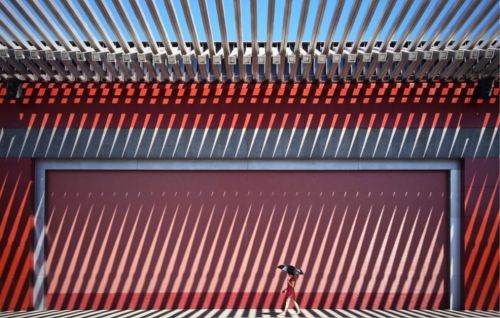
I came across the photo above this morning which is titled The China Red.  It was shot by photographer Jian Wang at Olympic Forest Park in Beijing, China and is the winning image in the Mobile Category of the Smithsonian’s 13th Annual Photo Contest.  I spent about five minutes just staring at it, transfixed by the pattern of the shadows and colors.  Just a great image.

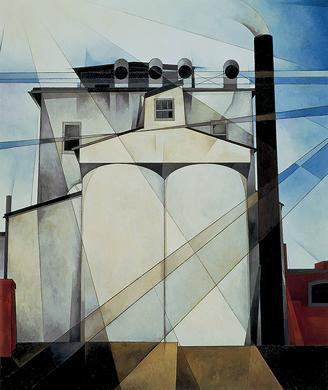
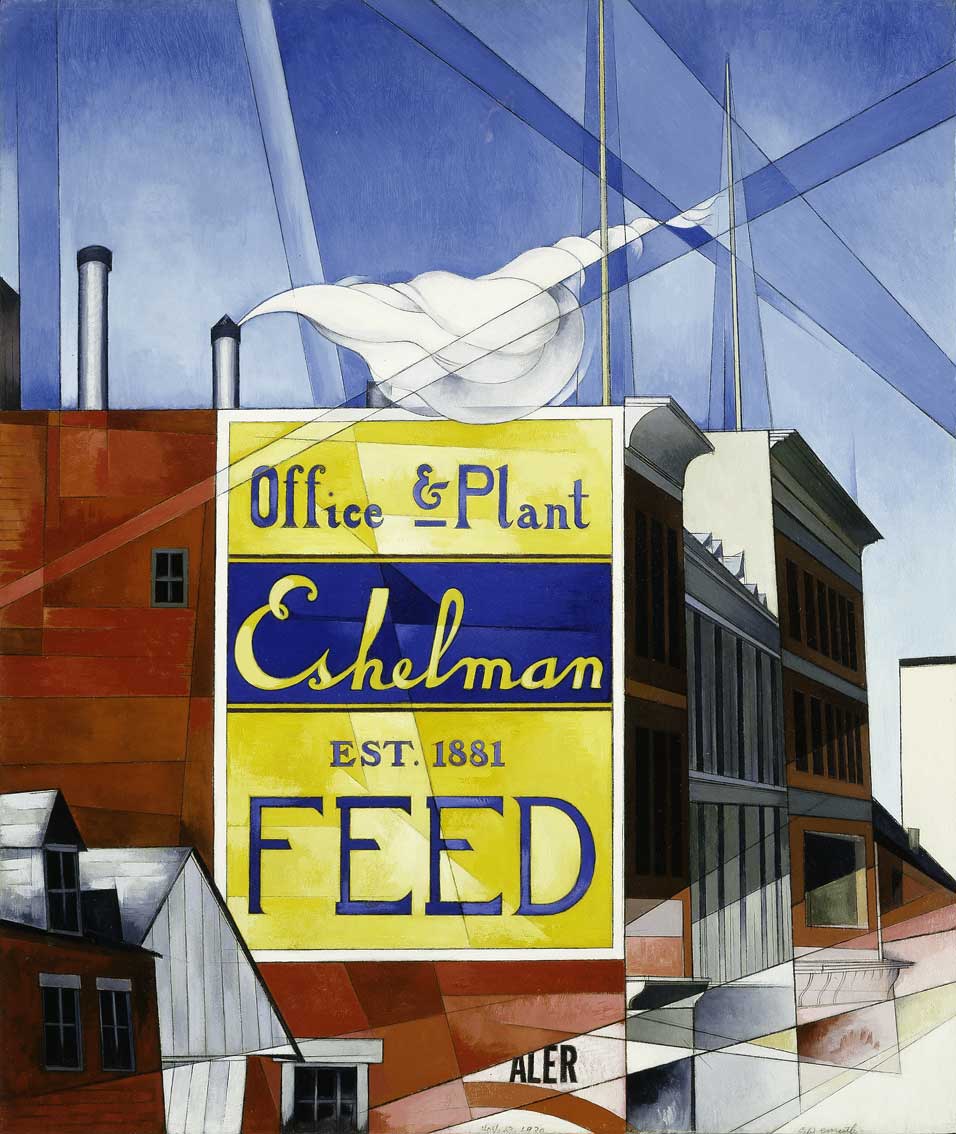
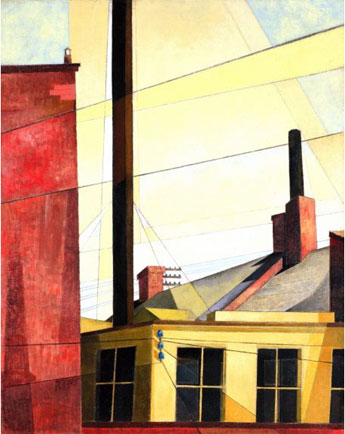
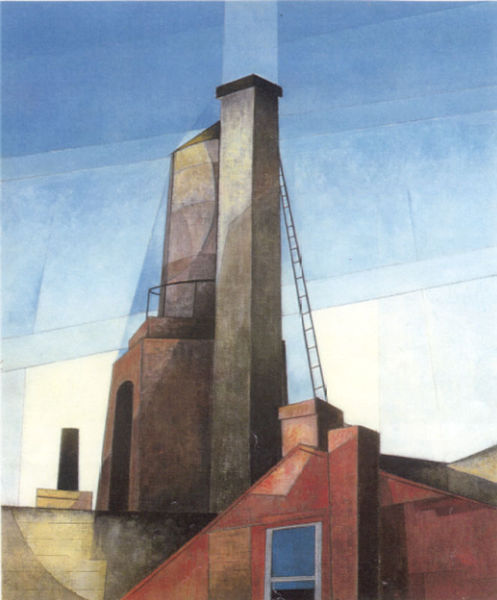
The color and forms incorporated in the photo reminded me of some of the work from the Precisionist painters such as DeMuth and Sheeler.  I thought I would share the following post from back in 2009 about Demuth:

demuth-number-5I’ve been a fan of Charles Demuth since the first time I saw his work.  He was considered a part of the Precisionist movement of the 20’s, along with painters such as Charles Sheeler and Joseph Stella among many others, with his paintings of  buildings and poster-like graphics such as this painting, I Saw the Figure 5 in Gold.  He was also one of the prominent watercolorists of his time and while they are beautiful and deserve praise in their own right, it’s his buildings that draw me in.

Demuth’s work has a tight graphic quality but still feels painterly to me.  There’s still the feel of the artist’s hand in his work which to me is a great quality.  There are photorealist painters out there whose craftsmanship I can really admire but who are so precise that they lose thatdemuth-my-egypt feel of having the artist’s hand in the work.  I like seeing the imperfection of the artist.  The first time I saw one of the Ocean Park paintings from artist Richard Diebenkorn, it wasn’t the composition or color that excited me.  It was the sight of several bristles from his brush embedded in the surface.  To me, that was a thrill, seeing  a part of the process.  The imperfect hand of the artist.  I get that feeling from Demuth.

He also had a great sense of color and the harmony and interplay of colors.  His colors are often soft yet strong, a result of his work with watercolors.  His whites are never fully white and there are subtle shades everywhere, all contributing to the overall feel of the piece.  His work always seems to achieve that sense of rightness I often mention.

His works, especially his paintings of buildings, have a very signature look, marked by a repeated viewpoint demuth-after-all where he views the buildings above him.  His paintings are usually fragments of the building’s upper reaches.  There’s a sense of formality in this view, almost reverence.  I don’t really know if he was merely entranced by the forms of industrial buildings or if he was making social commentary.

Whatever the case, do yourself a favor and take a look at the work of Charles Demuth.  It’s plain and simple good stuff…

Buildings, Lancaster 1930demuth-from-the-garden-of-the-chateau

demuth_charles_aucassiu_and_nicolette_1921

Peaceful Abode

GC Myers- Peaceful Abode

-Isaiah 32:18

*****************

This new painting, a 24″ by 18″ canvas, is titled Peaceful Abode.  and is part of my upcoming June show, Part of the Pattern, at the Principle Gallery in Alexandria, VA.

This piece has a bit of a different look even though it falls easily into my body of work. Maybe it’s the slight change in coloration or the slightly altered perspective from the rise of the hillside behind the lakefront buildings.

I don’t really know and, to tell the truth, I don’t want to think too much about it for fear of over-analyzing it.  I’ve enjoyed looking at this piece for the last week or so and find that it has a peaceful quality in it that is very soothing.

It takes me to a place far away from the rancor of politics, the horrors of violence we inflict on one another and the general chaos of our time.  It is the antithesis of nearly everything I see on the cable news networks.

The whole perspective of this piece seems to be inward looking, seeking that quiet and placid spot.  And looking at this piece, I believe for a brief moment that I have found it.

And that’s a good thing…

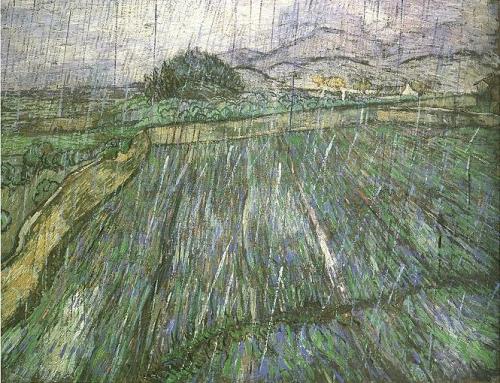
Vincent Van Gogh Wheat Field in Rain 1889If you work diligently… without saying to yourself beforehand, ‘I want to make this or that,’ if you work as though you were making a pair of shoes, without artistic preoccupation, you will not always find you do well. But the days you least expect it, you will find a subject which holds its own with the work of those who have gone before.

-Vincent Van Gogh

***************

I really just wanted to show these two Van Gogh paintings that feature the falling rain as part of the overall composition.  I recently have been particularly interested in seeking out  lesser known Van Gogh paintings.  There is something quite exciting about these more obscure pieces, something that fills in the blanks between the better known work.

But beyond that, the sentiment above from Van Gogh really resonates with me.  Sometimes it seems as though those paintings which you aim at with all your greatest effort fall flat while on those days when you have little idea of where the work will go, something special emerges quite unexpectedly.

It is those days and those painting that you crave as an artist.  Oh, it is gratifying to create work that you feel is well within your body of work.  That is to say, work which follows a path you have trod upon many times before.  But to have those days and those pieces that surprise you– well, that is beyond gratification.  It has an almost religious aspect,  like a confirmation of one’s belief in something greater.

But those days are often rare and come without a hint of what may emerge.  Even sitting here now, I don’t know if today will be one of those days.  But just knowing that it is possible makes me anvious to get at it.

Enjoy the Van Goghs and I am going to move into my day.

Vincent Van Gogh-Landscape at Auvers in the Rain 1890

Amadeo de Souza Cardoso-Corpus Christi ProcessionThere is an exhibit of paintings currently hanging at the Grand Palais in Paris that features the work of the early 20th century Portuguese artist Amadeo de Souza-Cardoso.  It is only the second major retrospective of his work and the first since 1958.  He is another of those artists who are probably not on your radar– I know I was unaware of his work.  But once I found it, I couldn’t shake the memory of it.

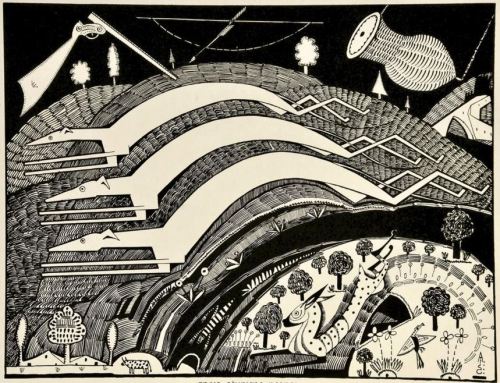
Amadeo de Souza Cardoso-Greyhounds 1911He was born in the north of Portugal in 1887 near the small city of Amarante.  While still a teen he made his way to Paris where he absorbed the fertile art scene that was in place.  He began painting and drawing while becoming close friends with many artists and writers such as Gertrude Stein, Modigliani, Juan Gris  and Brancusi.

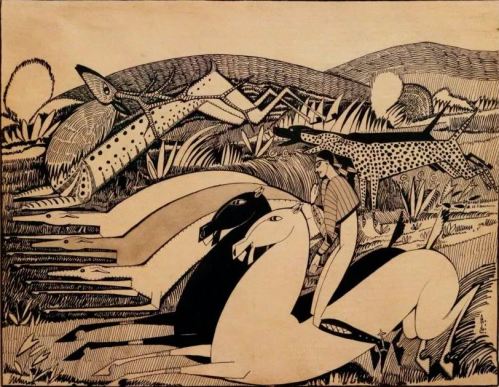
His work encompassed the Cubist, Modernist and Futurist movements, moving seamlessly among them while maintaining his unique voice in whatever style he was working at the moment.  When I viewed a large number of  his work, I was knocked out by the consistency and strength that ran through it.  Whether his work is in paint or in pen and ink, it is both vibrant and fully realized.

During the time of the first World War, Souza-Cardoso’s star was rising quickly.  But like so many other millions of people, he was struck down by the Spanish Flu pandemic of 1918.  He was only 30 years old.

What might have been…

In the fast paced and quickly changing atmosphere of the art world of the era, Souza-Cardoso’s work soon forgotten until a minor awakening in 1952 in his native  Portugal.  In Amarante, his work was given a room in the museum there and in the years since a small museum has been formed to feature it.

Hopefully, the greater public will soon know the name Souza-Cardoso.  I think it’s a name worth knowing.  I am showing just a few  pieces of his work here.  There were so many more that I could have chose.  Just great stuff.

AMADEO_S_CARDOSO-SEM_TIT(CLOWN_CAVALO_SALAMANDRA)191112 Amadeo de Souza-Cardoso-Parto Da Viola Bom Ménage Amadeo de Souza-Cardoso- The Kitchen at Manhufe House 1913

Eduardo Mota digitalizou "Le Saut du Lapin" de Amadeo de Souza-Cardoso

Eduardo Mota digitalizou “Le Saut du Lapin” de Amadeo de Souza-Cardoso

Amadeo de Souza-Cardoso-Three White Greyhounds Amadeo de Souza Cardoso-Le Tigre Amadeo de Souza Cardoso-La Dentate du Cerf 1912

PurpleIn the last few months we lost two of the most unique and transcendent musicians of our time, David Bowie in January and now Prince.  Luckily for us, both had long and prolific careers and left large musical legacies behind.  I admired Prince greatly and I think that is all there is to say, especially after the millions of words written and spoken over the past few days.  I don’t think I can stand to see another tweet on one of the news channels form some celebrity saying that this is how it sounds when doves cry.

So, instead of trying to dig up some Prince that you might not have heard in the last few days, I thought for this Sunday morning music I would go in another direction and play someone who was one of Prince’s early influences, Sly and the Family Stone.  It’s his performance of I Want to Take You Higher at Woodstock in 1969. I’ve played this clip here before but I am going to play it again just because I think it is a great performance and a great piece of film.  I think you can see how Prince took elements of Sly’s work and made it into something distinctly his own.  That synthesis is part of artistry.

Have a great Sunday.

GC Myers- FragmentsOne of the things in my paintings that is often commented on and asked about is the Red Chair.  Sometimes hanging in a tree, sometimes alone on a hilltop or in a field or sometimes on its side on winding path, it is one of those recurring images that I use as a symbol.  It has come to represent ancestry and memory as well as acting for a symbolic stand-in (or sit-in) for humanity’s place in the landscape.

When asked about the time of its origins I always say that I think that it came about later,  several years after I had been showing my work for a time.  I can never give a truly accurate answer because it just seemed to come around at one point or another.  It just started showing up.

But going through some early work this morning I came across this old ink and watercolor piece from mid-1994, at a point when I was still struggling to find voice.  It’s an exercise, an experimental little thing that I would quickly do every so often back then to  jog my mind and play with forms and colors.  It’s kind of a goofy little thing, not something I am particularly proud of or excited by.  I called it Hoedown.

But the thing that jumped out this morning was what has to be the first appearance of that Red Chair.  It’s a little cock-eyed, crude and worn but it is a Red Chair.  So now when I am asked I can say without hesitation that it first popped up before I ever began showing my work in galleries.  It actually precedes the Red Tree now that I think of it.  I guess I will now have to see if that makes an earlier appearance somewhere as well…GC Myers Hoedown 1994

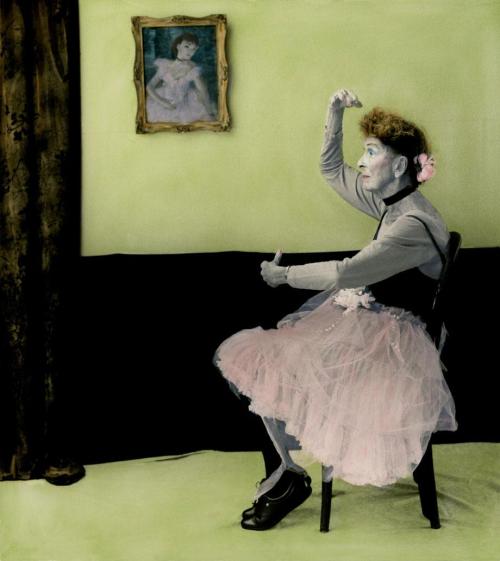
Aline Smithson Arrangement in Green and Black CompilationJames McNeill Whistler- Arrangement in Grey and BlackI have written here in the past about the composition from the iconic James McNeill Whistler painting Arrangement in Grey and Black— better known as Whistler’s Mother.  It’s a beautiful, solidly structured composition that works as a wonderful template for creating a solid visual image of any subject.

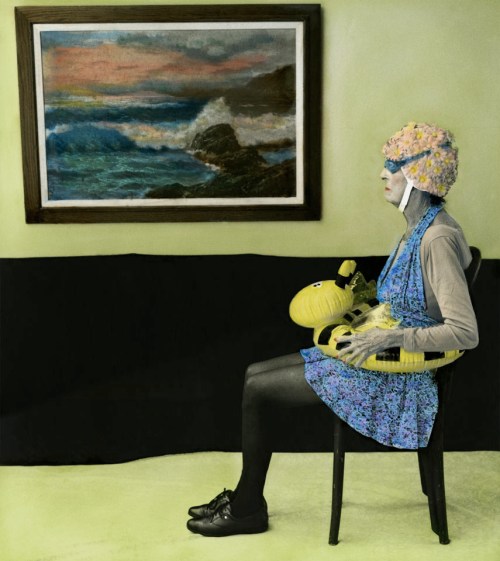
Several years, ago, contemporary photographer Aline Smithson used Whistler’s image as the basis for a series of photos that she called Arrangement in Green and Black: Portraits of the Photographer’s Mother.  Inspired by a print of Whistler’s painting that she found at a rummage sale and using her then 85 year-old mother (an obviously loving and patient woman who unfortunately passed away before seeing the finished series) as the subject, Smithson created 20 images with varied takes on the famous composition.

They are quietly comical individually and as a group. I just find them interesting.  Below are some of my favorites.

For more on Aline Smithson’s work, please follow this link to her website where you will find many more portfolios featuring her distinct eye for observation.  She also has a current exhibit, Aline Smithson: Self & Others, at the Griffin Museum of Photography in Winchester, Massacusetts.  It closes May 1 so if you’re in the area, don’t waste any time in getting to the museum.

Aline Smithson_Arrangement-14 Aline Smithson_Arrangement-11 Aline Smithson_Arrangement-10 Aline Smithson_Arrangement-1 Aline Smithson Arrangement Aline Smithson Arrangement in Green and Black a Aline Smithson_Arrangement-3