Feeds:
Posts
Comments

Posts Tagged ‘Archaeology’

GC Myers- Archaeology- Déjà Vu sm

Archaeology: Déjà Vu— At Principle Gallery, Alexandria, VA


The fields are fair in autumn yet, and the sun’s still shining there,
But we bow our heads and we brood and fret, because of the masks we wear;
Or we nod and smile the social while, and we say we’re doing well,
But we break our hearts, oh, we break our hearts! for the things we must not tell

The Things We Dare Not Tell, Henry Lawson (1867-1922)


A video for this poem popped up in my YouTube feed for some algorithmic reason I can’t comprehend. I am glad it did.

I first encountered the Australian writer Henry Lawson (1867-1922) a few years back when I stumbled across a poem of his, The Wander-Light, that I shared here. It has been a pretty popular post, receiving a number of views on a daily basis. Doing some research back then, I found that Lawson is an Australian icon, considered to be perhaps the country’s greatest poet and short story writer.  He was a brilliant writer and storyteller but struggled with alcoholism and mental illness for much of his life until dying at the relatively young age of 55 from a cerebral hemorrhage.

Watching the reading of the poem below, I began to think about the secrets we all carry. Oh, we may claim or attempt to be transparent, but we all maintain words and deeds and beliefs that we share with no one. Some we don’t share because, to be honest, they are things nobody would care to hear. Some are too shameful or painful or embarrassing to release from our grip.

I probably share too much here and in my talks. More than most. Mainly because I believe that transparency has a liberating effect. But even so, there are things that will no doubt go unshared to my grave. Well, that is, if I ever decide to die. If I don’t, I might break my silence in a couple of hundred years or so.

It makes me wonder what secret things others will carry to their graves, the good and the bad. Will they ever reveal themselves to some future archaeologist or researcher? Are they hidden somewhere, like one of the artifacts in the Archaeology piece at the top, waiting to be unearthed then put together like a strange and wonderful jigsaw puzzle? Small bits that together tell a bigger story?

The other thing that comes to mind is the one line in Lawson’s poem that resonated most with me:

Oh, the world would be such a kindly world if all men’s hearts lay bare!

I believe it but wonder if that is true. Do secrets keep us apart? Would revelation of all things hidden somehow bring us together?

I don’t know the answer. My lack of answers is no secret, that’s for sure.

Maybe we need those secret things just to maintain that feeling of mystery that comes with not knowing everything about everyone. 

Might that mystery be the thing that drives all types of creativity?

Could be. I don’t really know.

Okay, got to run. I have secrets waiting to be buried as well as some to be shared. It’s the sorting out that counts.

Here’s the poem from Henry Lawson along with the whole poem below it.


The Things We Dare Not Tell

The fields are fair in autumn yet, and the sun’s still shining there,
But we bow our heads and we brood and fret, because of the masks we wear;
Or we nod and smile the social while, and we say we’re doing well,
But we break our hearts, oh, we break our hearts! for the things we must not tell.

There’s the old love wronged ere the new was won, there’s the light of long ago;
There’s the cruel lie that we suffer for, and the public must not know.
So we go through life with a ghastly mask, and we’re doing fairly well,
While they break our hearts, oh, they kill our hearts! do the things we must not tell.

We see but pride in a selfish breast, while a heart is breaking there;
Oh, the world would be such a kindly world if all men’s hearts lay bare!
We live and share the living lie, we are doing very well,
While they eat our hearts as the years go by, do the things we dare not tell.

We bow us down to a dusty shrine, or a temple in the East,
Or we stand and drink to the world-old creed, with the coffins at the feast;
We fight it down, and we live it down, or we bear it bravely well,
But the best men die of a broken heart for the things they cannot tell.

— Henry Lawson
Read Full Post »

GC Myers-  In the Pocket of Time sm

In the Pocket of Time, 2014


The crystal sphere of thought is as concentrical as the geological structure of the globe. As our soils and rocks lie in strata, concentric strata, so do all men’s thinkings run laterally, never vertically.

Ralph Waldo Emerson, The Method of Nature (1841)


I came across the passage above from an Emerson essay and decided to look it up to find the context from which it came. It originated in an essay/oration that was written in the 1839-1841 period and was titled The Method of Nature.

I am still trying to glean the exact meaning of the essay but the section that contained the line above speaks about how those who, in any time, claim to have the answers to existential questions or insights into the deepest concerns of mankind eventually reveal themselves to be superficial. Their thoughts seldom, if ever, dig deeply enough to reveal eternal truths that might unify all people and times.

As he put it, their thinking runs laterally, not vertically.

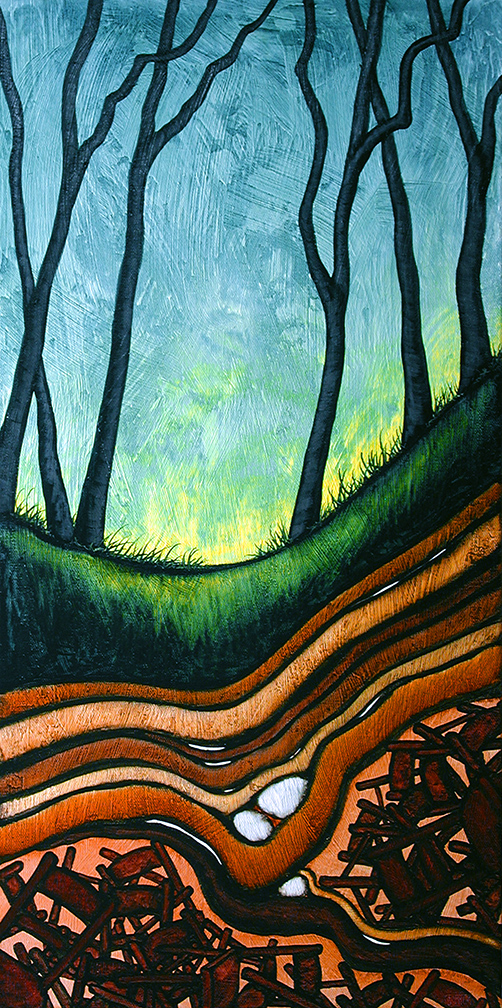
I immediately felt that this might be applied to the painting the top, In the Pocket of Time. It’s a painting (30″ by 24″ on canvas) from 2014 that I brought to the Principle Gallery this past weekend as part of a group of work featured at my Gallery Talk there. It is from a subset of my Archaeology series that I call my Strata work. It is much like the Archaeology pieces without evidence of humans, focusing instead on the layers below the surface.

This particular painting from that Strata series has been with me for a while now. It hung for the last few years in a back bedroom/storage space of my studio. It reminds me of fine wine as it seems to get better with time. I am more and more struck by its surface finish and the rhythm of the strata, as well as how well it transmits its feeling and message from the wall. It’s a piece that speaks directly to me.

Putting Emerson’s thought to it deepened my appreciation of it. I could see in it how we deal always with what is presented on the surface and how seldom we recognize how much more there is to discover if we would only dig a little deeper.

That might be a gross simplification. Or not. Who knows? The words and the mage just seemed to click for me and maybe that’s enough to say.

Let’s tie this up with some music. Here’s a 1992 song from Peter Gabriel titled Digging in the Dirt.  The video is from the same time frame as his Sledgehammer song/video and, like it, this video has some interesting visuals.


Read Full Post »


The past slips from our grasp. It leaves us only scattered things. The bond that united them eludes us. Our imagination usually fills in the void by making use of preconceived theories…Archaeology, then, does not supply us with certitudes, but rather with vague hypotheses. And in the shade of these hypotheses some artists are content to dream, considering them less as scientific facts than as sources of inspiration.

-Igor Stravinsky, Poetics of Music in the Form – Six Lessons


I was looking through some older posts and came across the quote and painting above which caught my eye. It was probably because the painting, Archaeology: The Golden Age, was the last piece I had painted in the Archaeology series and may well be the last of that series.

It is one of those pieces that still live with me here in the studio, having never found a home. While I want it to find a place where it can satisfy someone other than myself, I am happy to have it here. From the time it was completed, I considered it one of the stronger pieces in the series. That might even be the reason it has continued to be the last in the Archaeology series.

Maybe the series had reached its potential, its endpoint, with this painting. I don’t know.

I also was captured once again by Stravinsky’s thoughts on the artistic process, how we use our imagination and what little knowledge we have to fill out the blank spots among our scattered fragments of memory to create something new. He equated it to archaeology which is a similar process, taking bits and pieces from the past and filling in the blanks with imagination and knowledge to create a theory of what might have been. 

As he says archaeology does not supply us with certitudes. There are too many voids to fill before one can deal in absolutes.

And so it is with art. Art seldom deals in strict factual representation. Art comes together as a mixture of the facts of the work, the imagination and process of the artist, and the emotions and imagination of those who take it in. 

It’s as much alchemy as it is archaeology.

Whatever it is, I am happy to deal in this strange world of imagination, one that often offers me more questions than answers.

Reading the older post this morning also reminded me of an old Jethro Tull tune that I haven’t heard or thought of in many years. Probably decades. Here’s a blast from the past, as the old AM deejays used to say. This is Living in the Past.

Have a good day.


Read Full Post »


“The word was born in the blood, grew in the dark body, beating, and took flight through the lips and the mouth. Farther away and nearer still, still it came from dead fathers and from wondering races, from lands which had turned to stone, lands weary of their poor tribes, for when grief took to the roads the people set out and arrived and married new land and water to grow their words again. And so this is the inheritance; this is the wavelength which connects us with dead men and the dawning of new beings not yet come to light.”

― Pablo Neruda


Found myself awake early this morning. So many things racing through my head that it was hard to focus on trying to sleep. Big things and little things- a gnawing worry for this country and tiny nagging reminders of things that need to be done soon. All things that couldn’t be resolved at 2 AM in the woods where I live.

Then it struck me that it was around this time of the morning that my mom died 25 years ago on this very date.

Geez, 25 years come and gone. And there I was, in bed thinking of her death. 

I tried to dredge up memories of her, hoping that it would drown out the other things in the background of my mind, all screaming for attention or at least equal air time. Some memories came easily. Those are the ingrained ones that have become part of the synapses.

But I tried to dig deeper and there were only shadows of memories. Not real recollection. Maybe not even real. I don’t know for sure and most likely never will.

25 years has a way of changing things in your mind.

So, I tried focusing on the traits that I may have inherited from her, some good and some bad. Some neither. They just are what they are.

Some made me laugh. Some made me cry.

Laughter and tears. Quite the inheritance.

There are certainly worse things in this world.

It made me think in bed of the painting above that I recently took out to the West End Gallery. Called From Whence I Came, it’s part of my Archaeology series from back in 2008. I think this piece was only shown once in a gallery before it came back to me. For some unknown reason, it found its way to the back of a closet, where it has been residing for the past 12 years. I pulled it out a few weeks back and it was like seeing it for the first time again. 

It made me think of all the choices and serendipity that it took for me to arrive at this place in the world. It’s the same for all of us. We’re all products of the decisions and events that took place throughout the history of man on this planet. One person succumbing to a virus instead of surviving it a thousand years ago and our whole history as a person would be different. 

We’re all the spearpoints, the leading edges, the very top of the pyramids of all that came before us. We were brought to this point by the bones and blood of thousands of lives before us.

All their strength. All their vulnerability.

I don’t know where I want this to go. Just thinking out loud, I guess, between the laughter and the tears.

Gotta go. Have a good day, folks.


Read Full Post »

Yesterday, I delivered the work for my Icons & Exiles show to the Octagon Gallery at the Patterson Library in Westfield, NY. I have to admit that the gallery isn’t anything like the image of it I imagined when I was approached a couple of years ago to do this exhibit. But seeing the space and the library again put any doubts I had to rest. What a great gallery space! And the library is such a beautiful building! Both the gallery and the library are gems.

I am actually excited to see this group of work in this space.

The work for this show primarily consists of work from my early Exiles series along with my more recent Icons series. There is also a smaller group from my 2006 Outlaws series along with a variety of pieces that don’t fit into any series. They are just favorites of mine, personal paintings that I think are pretty interesting.

There are also two pieces from my Archaeology series including the painting shown at the top, Archaeology: A New History. This painting hasn’t been shown in many years and is, at 36″ by 48″, the largest painting of this series. It is one of my favorites from this series so I am pleased to have it back out in public view as part of this show.

I think this will be an interesting show, one that has a more narrative feel than my typical shows. There are many stories being told in these paintings.

I know that Westfield is a bit out of the way for many folks. For my friends in Erie, where my work has shown at the Kada Gallery there for the past 24 years, it is a 30 mile trek and for those in my home area it’s a few hours drive. But it takes you by lovely Lake Chautauqua and its famous institute and Westfield itself is a peach of a town. Hopefully, this show will make the trip worthwhile.

So, if you find yourself out around Lake Chautauqua or,over a short distance, closer to Lake Erie this Friday, August 23, between 7 and 9 PM, please stop in and take a look at the Icons & Exiles show at the Octagon Library at the historic Patterson Library.

I’ll be glad to tell you some stories.

Read Full Post »

Archaeology: UnburdenedIn these current strange days, I am not quite sure how I feel about Bob Dylan winning the Nobel Prize for Literature.  I think I’m okay with it.  After all, I’ve always though of him as much a writer/poet as a musician. His lyrics have been winding around the world for fifty some years and it’s hard to find any musician just about anywhere who hasn’t been influenced by his words, his music and his social consciousness.

I was trying to pick a song from Dylan for this Sunday’s musical selection and realized what an impossible task it is.  There is just such a vast and varied body of work, spanning so much time and covering so many phases in his career.  You could just play his old folk stuff from before 1965 and you might think that was a whole career.

So today I thought I would play two of my favorites from two distinct periods of Dylan’s career.  One is the early and fun Subterranean Homesick Blues with its well known video while the other is a mid-1990’s Love Sick.  Just plain good stuff from the now Nobel Prize  winning artist and writer.

Enjoy and have a good Sunday…

https://www.youtube.com/watch?v=Abbu5hcH0kk

Read Full Post »

GC Myers- Archaeology- The Golden Age Beyond smThe past slips from our grasp. It leaves us only scattered things. The bond that united them eludes us. Our imagination usually fills in the void by making use of preconceived theories…Archaeology, then, does not supply us with certitudes, but rather with vague hypotheses. And in the shade of these hypotheses some artists are content to dream, considering them less as scientific facts than as sources of inspiration.
-Igor Stravinsky, Poetics of Music in the Form – Six Lessons

******************************

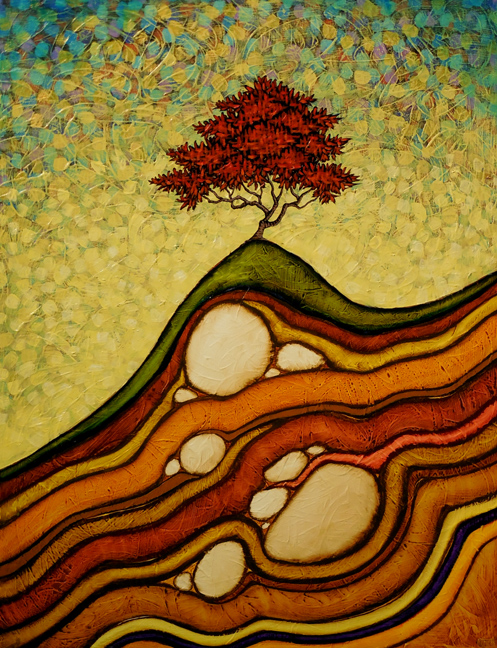
This is a new Archaeology painting that is included in Part of the Pattern, my solo show at the Principle Gallery which opens Friday June 3.  It is titled Archaeology: The Golden Age Beyond and is an 18″ by 24″ canvas.  It is the first new true Archaeology piece that I’ve done in several years and this piece really seems to connect with the original group of this work for me in its narrative element and dramatic effect.

I absolutely love the thought that the great composer Igor Stravinsky shares above.  It seems to fit so well with what I was thinking when I was working on this particular Archaeology painting.  Each bit of detritus seems separate and unconnected with the next yet my mind was always trying to see what the hidden connection between them might be or how they came together in a larger narrative.

It’s that interesting area between what is fact and what is its truth.  We may determine fact but we can’t always know context and connection.  An item may not hold the same meaning in every circumstance.

But we can imagine and create a narrative that seems to make sense of fact and, in many cases, may come close to the reality.

Perhaps archaeology is as much an art form as it is a science.  Or an artist is sometimes a sort of archaeologist.

Hmm, let me think about that.

Anyway, I hope you’ll come out to the Principle Gallery on Friday evening.  The opening reception begins at 6:30 PM at the Alexandria gallery on historic King Street. I look forward to seeing you there.

_________________________

ONLY A FEW DAYS REMAIN TO GET IN ON YOUR CHANCE TO WIN THIS PAINTING!

Enraptured” is a 30″ by 40″ Painting valued at $5000

https://www.crowdrise.com/artists-engaging-nepal

Read Full Post »

GC Myers-Archaeology- Rooted in the Past smOne of the interesting aspects of doing what I do is seeing where the images eventually finds their way. They have ended up in American Embassies in several countries, in magazines and on book covers here and abroad as well as on several CD covers.  One was even included in a recent history text book.  They have found their way to most corners of the globe, making them much more well traveled than their maker.  And in 2016 a couple of images from my Archaeology and Strata series will be part of the annual calendar for the Spanish Society of Soil Science

GC Myers- On the Shoulders of Time smIt’s gratifying for me to see the work spread out as it has.  You hope, as an artist, that your work has a wider appeal, that there is some common denominator in it that speaks across geographic and cultural boundaries.  You never know when you are in front of the easel if your work will be anything more than a blob of pigment on a bit of canvas destined for the trash or will take on a life of its own and move on.  So to see it move around the globe in some small way is a form of validation for the work, making the next crisis of confidence easier to fight through.  And that is no small thing.

Being Sunday it’s time for a little music and I thought I would play a song that kind of jibes with the soil theme of the work here.  It’s one of my favorite songs to sing along with from one of my all-time favorites, John Prine.  It’s called Please Don’t Bury Me and it’s about as upbeat a song on the subject of dying as you’ll ever hear.  Give a listen (and sing along if you know the words!) and have a great Sunday!


Read Full Post »

GC Myers- Archaeology-Rainbows EndThe thing I am most aware of is my limits. And this is natural; for I never, or almost never, occupy the middle of my cage; my whole being surges toward the bars.

–Andre Gide

******************

I chose this week’s  quote from the late French author Andre Gide, who won the Nobel Prize for Literature in 1947, because as an artist I find myself sometimes wondering about my limits, questioning whether I am pushing myself enough into new territory.  Gide uses a cage in his metaphor with his limitations being the bars that keep him from moving forward.  He is not content to simply accept these limits sitting contentedly in the center of his cage. No, he is always pushing and pulling at the bars, seeking to get past them.

In the past, I have expressed this same desire to press past my limits with a metaphor where the artist climbs ever upward until they come to a plateau where they are comfortable and safe.  It is a place where they could easily live out the remainder of their days with little worry, living an easy life by retelling stories that made up the journey up to this point.  Many might not even notice there is still a mountain hovering above them to climb, if they just dare leave the comfort of the easy plateau.

Gide’s cage is my plateau and while he is trying to break through his bars, I find myself still questioning if I have the nerve to start climbing.  Oh, there are first steps, tentative meanders up the path but only far enough that I am within sight and  can return easily to my safe haven on the plateau.

When does the real trek upward begin?  When does one begin to thrash at their bars?

Where are you in your own cage?

******************************

I used a painting from several years,  Archaeology: Rainbow’s End, to illustrate this post.  For one thing, I just like this image.  But more importantly, looking at it seemed to remind me that one’s creative past is often buried and gone from sight.  Or at least, should be if one is going to continue growing.  Like the tree in the painting, you grow from that past existence  being nourished by it.  But you don’t live only in that past.  You must move upward like the Red Tree in this painting to find clear air.

Read Full Post »

Geloven Onderweg CoverI just received a copy of a Dutch magazine, Geloven Onderweg, which loosely translates into English as Go Believe.  I mention this because it contains an image of one of my paintings, Archaeology: Rainbow’s End, as the illustration for one of its articles.  I was approached a few months back about the possibility of using the image in this magazine which is published by the Dominican order in the Netherlands.

The article is written by Jakob Van Wielink and is titled  Archeoloog wit een mild hart which translates as Archaeologist With a Mild Heart.  Beyond that, there is little I can tell you about the article or any of the other writing in this issue.  However, I can tell you that the  theme of this issue is outlined on the cover with Trust and the Future in Dutch under the image of a small boy confronting a Mark Rothko painting.  Interesting image…

They used my painting in a lovely manner with the image in the upper right hand corner of a two page spread with the image also used as a half-tone underlay.  It looks good and I am pleased to be able to have my work exposed in some small way in the Netherlands.

Geloven Onderweg Article 2014


Read Full Post »

Older Posts »