Feeds:
Posts
Comments

Posts Tagged ‘Music’


If at first you don’t succeed, try, try again. Then quit. There’s no point in being a damn fool about it.

-W.C. Fields


I wanted to play another song, I Don’t Mind Failing, from the late folksinger Malvina Reynolds and thought a replay of this post from a decade ago would fit well with it. Not much has changed in these past ten years from the standpoint of failure. The post below, from 2011, was titled Failure, of course


In response to yesterday’s post concerning a very large blank canvas that is waiting patiently for me, I received several very interesting questions from my friend, Tom Seltz, concerning the role that failure and the fear of failure plays in my work. He posed a number of great questions, some pragmatic and some esoteric, that I’ll try to address.

On the pragmatic side, he asked if there is a financial risk when I take on large projects like the  4 1/2′ by 7′ canvas of which I wrote. Actually, it’s not something I think about much because every piece, even the smallest, has a certain cost in producing it that, after these many years, I don’t stop to consider. But a project such as this is costlier as a larger canvas is more expensive right from the beginning simply due to the sheer size of it. The canvas is heavier and more expensive and more of it is used. I use a lot more gesso and paint. The framing is much more expensive and the logistics of shipping and transporting become more involved and costly. It’s larger size and price means the audience of potential buyers is much more limited which means more time trucking it around or storing it.

And while these cost of materials and handling are the larger cost, the biggest financial risk comes in the time spent on such a project. It takes longer to prepare such a large canvas, longer to paint and, if it works out, longer to finish and frame. This is time not spent on other projects. Wasted time is by far the biggest risk in facing such a project and that is something I have to take into consideration before embarking on large projects.

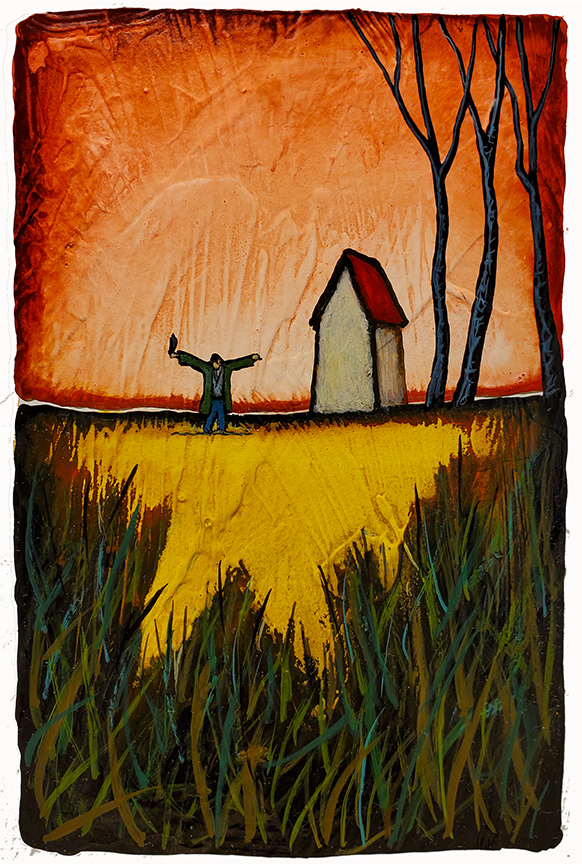
He also asked whether I can reuse the materials if I don’t like what I’ve painted. Sure, for the most part.  Especially canvasses. Actually, the piece shown here on the right was once such a piece. There’s a failure lingering still beneath its present surface.

I had a concept in my head that floated around for months and I finally started putting it down on this 30″ square canvas. I spent probably a day and a half worth of time and got quite far into it before I realized that it was a flawed concept, that I was down a path that was way off the route I had envisioned. It was dull and lifeless, even at an early stage.

It was crap and I knew that there was no hope for it. I immediately painted it over, mainly to keep me from wasting even more time by trying to resuscitate it, and the piece shown here emerged, happily for me.

Tom also asked if I ever “crashed and burned” on a piece or if the worst sort of failure was that a piece was simply mediocre. Well, I guess the last few paragraphs say a bit about the “crashed and burned” aspect, although that is a rarer event than one might suspect. The beauty of painting is that it’s results are always subjective. There is almost never total failure.

It’s not like sky-diving and if your parachute doesn’t open you die. At least, that hasn’t been my experience thus far. I’m still here.

Mediocrity is a different story. That is the one thing I probably fear most for my work and would consider a piece a failure if I judged it to be mediocre. I have any  number of examples I could show you in the nooks and crannies of my studio but I won’t. Even flawed and mediocre, these pieces have a purpose for me and some have remaining promise. The purpose is in the lessons learned from painting them. I usually glean some information from  each painting, even something tiny but useful for the future. Each is a rehearsal in a way. But most times, the mediocre pieces teach me what I don’t want to repeat in the future. A wrong line or form here. A flatness of color there. Just simple dullness everywhere.

But, being art, there are few total failures, and many of these somewhat mediocre pieces sit unfinished because there are still stirs of promise in them.  I can’t tell you how many times I’ve come to what I felt was a dead end for a painting, feeling that it was dull and lifeless, and set it aside. Months and months might pass and one day I might pick it up and suddenly see something new in it. A new way to move in it that brings it new life. These paintings often bring the greatest satisfaction when they leave the gallery with a new owner.

Sometimes failure is simply a momentary perception that requires a new perspective.

Sometimes you need to fail in order to succeed later.

Okay, that’s it for now. I’m sure I have more to say about failure but it will have to wait until a later date. I’ve got work waiting for me that doesn’t know the meaning of the word failure and I don’t want to take the risk that it might learn it.

Tom, thanks again for the great questions.  I’m always eager for good questions so keep it up!


Now here’s I Don’t Mind Failing from Malvina Reynolds. It’s from around 1965 and was written after hearing a sermon called The Fine Art of Failing. Lot of great lines in this one:

I don’t mind failing in this world,
Somebody else’s definition
Isn’t going to measure my soul’s condition,
I don’t mind failing in this world.

Give a listen and if you fail today, don’t worry about it. You’re in good company.


Read Full Post »


To live on a day-to-day basis is insufficient for human beings; we need to transcend, transport, escape; we need meaning, understanding, and explanation; we need to see over-all patterns in our lives. We need hope, the sense of a future. And we need freedom (or, at least, the illusion of freedom) to get beyond ourselves, whether with telescopes and microscopes and our ever-burgeoning technology, or in states of mind that allow us to travel to other worlds, to rise above our immediate surroundings.

We may seek, too, a relaxing of inhibitions that makes it easier to bond with each other, or transports that make our consciousness of time and mortality easier to bear. We seek a holiday from our inner and outer restrictions, a more intense sense of the here and now, the beauty and value of the world we live in.

― Oliver Sacks. New Yorker article 2012


I was thinking this morning about how I would describe the painting at the top, Steady As She Goes. It is included in the Little Gems show at the West End Gallery which opens today. 

At first, I was thinking about sailing but I really don’t much about that subject. I can try to imagine the thrill of the open water, the feeling of untiy with the natural world, but I’m pretty sure it’s not the same as the real experience.

I began to wonder what was the underlying appeal of sailing, of open water. All that came to me was the word escape.

That made sense. You’re free from the ties that bind out there, subject, of course, to the whims of Mother Nature. We can never free ourselves from her her apron strings.

Yes, escape. And that representation of escape might be the appeal of these boat paintings even for us non-sailors. 

I searched for  a few words from others to describe that and came across the excerpt from a 2012 article in the New Yorker from the late Oliver Sacks, who wrote about how we need some form of escape from the day-to-day, an outlet where we are free from the restrictions set upon us by others. 

I was torn between the Sacks excerpt and these words from the great Graham Greene:

Writing is a form of therapy; sometimes I wonder how all those who do not write, compose, or paint can manage to escape the madness, melancholia, the panic and fear which is inherent in a human situation.

It seemed a little more pointed at creative types but made great sense to me. My work certainly does provide me with an escape route from the stresses and pains of the real world. 

I wasn’t sure which quote to use but, in the end, I guess I opted for using both.  After all, this is my blog and I can do what I want. I make the rules.

Maybe this is, in itself, a form of escape?

Maybe I should take up sailing. Since it’s about 8° this morning, that seems unlikely anytime soon. So, let’s listen to a favorite song from Lyle Lovett. It’s If I Had a Boat from his epic 1988 album Pontiac. I listened to this album over and over back then and it was a means of escape at times. It still holds up beautifully to this day.

Hope you find your own escape route and have a good day.


Read Full Post »


The impeachment process is not meant to determine criminality leading to statutory charges.

It is by definition a political act.

It is meant to determine whether the impeached elected official should be removed from office or, if the impeached person is no longer in office, be barred from ever holding public office again.

That’s the simple premise of what we are watching right now in this country.

The Republican senators have made it clear that they have no desire to give any weight to the very real evidence presented on the Senate floor, if they listen or watch at all. There are multiple reports of some reading newspapers and playing video games while the proceedings go on. The majority of them will cast a purely partisan vote to acquit, a decision that was made beforehand for many of them.

The Republican senators will cast their votes on the outcome of this impeachment trial not on a determination of what is right or wrong but based on their own political aspirations and loyalties.

As I said, a political act.

But what we are witnessing goes far beyond the political, beyond one’s own desire for power and future offices. 

No, we are seeing actions, both by the terrorists who stormed the Capitol and those who incited and designed the attack, that are anything but political.

It is pure criminality, from the smaller scale of the personal assaults that took place to the grand scheme to overthrow a lawful election and, by extension, the existing government.

This is an existential choice about our nation’s future. An acquittal is future permission for other would-be dictators to do whatever they want to hold on to power, to use the vast tools at hand to serve their own desires.

These Republicans who believe they could be that next dictator or at least a power player under that person are playing with fire. That kind of power is not controllable or predictable. They might be granting permission and setting the stage for a future coup from forces that they might not be able to envision with their limited imaginations.

Who’s to say that the next violent insurrection– and possibly successful based on lessons learned from this failed attempt– won’t be a leftist revolution? One that gains a toehold in legitimacy via the permissions granted by these Republicans who can barely see past the end of their noses into the future. 

All I am saying here is that this trial needs to transcend the political. It needs to uphold our past and our future. It need to provide accountability.

There needs to be accountability for what has happened. Without that, there can be no reconciliation nor unity going forward. How could there be? Why would anyone trust or unite with those who say that overt incitement to violence is allowed in order to hold on to power? How do you trust someone who says it’s okay for their supporters to attempt to kill you?

I am certainly cynical of the Republicans doing anything but that which fits their personal agenda but I remain hopeful.

There. Like it or not, I have had my say for the morning. Let’s have a song, okay?

This morning, I am playing a song from famed folk singer/songwriter Malvina Reynolds, who you might know her best from her song Little Boxes which was used for the opening credits of the series Weeds. This song is No Hole In My Head and it has to do with how we have to be careful about the info with which we fill our heads. There are a lot of folks who want to fill it with trash, as you know. Maybe me, who knows? It might even be the reason we’re where we are as nation today.

I am playing two versions here, the original from Malvina Reynolds (1900-1978) and a brand new, less folksy one from the evergreen Tom Jones. The man is 80 and still wails the hell out of everything he sings. Plus he still looks to push his art, to stay current and not dwell on his past glories. Check out his other new tune Talking Reality Television Blues, which contains a similar message to No Hole In My Head. in how we are shaped by what we see, hear, and read. He’s a marvel. Gives me hope. 

Pay attention today and in the future. We need everyone to participate. And have the best day you can.


Read Full Post »

“Private Space”- Available at the Principle Gallery, VA


Oh, they tell me of a home where my friends have gone
Oh, they tell me of that land far away
Where the tree of life in eternal bloom
Sheds its fragrance through the unclouded day

Uncloudy Day, Josiah K. Alwood 


Still on a semi-hiatus here on the blog but wanted to continue playing my Sunday Morning musical selection. This week I am going way back with a gospel tune called Uncloudy Day, written by Josiah K. Alwood in 1879. We’re not going back quite that far for this week’s pick but it’s still pretty old, taking us back to 1956 when The Staple Singers first recorded what is probably the definitive version of this song. 

This is a powerfully performed song, with the droning bite of the undertone from the electric guitar of Pops Staples and an emotional vocal lead from Mavis Staples. It’s hard to believe but Mavis was only 16 years old when she recorded this.

It’s reported that this song was a huge influence on a young Bob Dylan. His appreciation didn’t stop at the song as he pursued and proposed to Mavis Staples in the early 1960’s. She turned him down but they have maintained a close friendship and working relationship to this day, recording and touring together periodically over the many decades that followed.

Anyway, it’s a song that always stops me in my tracks and I think anything that makes you stop to listen is a good song to kick off a Sunday. 

Be careful out there and have a good day.


https://youtu.be/qkfCkW_VkTs

Read Full Post »


Think about
Think about how many times I have fallen
Spirits are using me larger voices callin’
What Heaven brought you and me cannot be forgotten

Southern Cross, Stephen Stills, Rick and Michael Curtis


I have a lot to do this morning so this will be brief. At least, that’s my intent. Sometimes it doesn’t work out that way.

Just wanted to show a new small piece at the top, Steady As She Goes, which is headed to the West End Gallery for their annual Little Gems show which opens on February 12. I love doing my boat pieces even though I am not a sailor. And even though the romance of sailing free on the wide expanse of the ocean under endless skies is powerful, I know that will not be a sailor in this lifetime.

My loss, no doubt.

But the boats themselves offer great symbolism for me that translates well in paint and speaks to the non-sailors like myself who understand and envy those who respond to the lure of the open sea.

I thought that a fitting song would be the Crosby, Stills and Nash song, Southern Cross, especially with a video that features the lyrics. Interestingly, Stephen Stills wrote this song with the Curtis Brothers, Rick and Michael, basing it on an existing song from the Curtis Brothers called Seven League Boots, which they had recorded several years before with members of Fleetwood Mac.

Stills explained how their collaboration on Southern Cross came about:

“The Curtis Brothers brought a wonderful song called ‘Seven League Boots,’ but it drifted around too much. I rewrote a new set of words and added a different chorus, a story about a long boat trip I took after my divorce. It’s about using the power of the universe to heal your wounds. Once again, I was given somebody’s gem and cut and polished it.

Well, he did a fine job in polishing it and I like how it attaches to this painting.

Give a listen and have a good day.


Read Full Post »


“They are all in the same category, both those who are afflicted with fickleness, boredom and a ceaseless change of purpose, and who always yearn for what they left behind, and those who just yawn from apathy. There are those too who toss around like insomniacs, and keep changing their position until they find rest through sheer weariness. They keep altering the condition of their lives, and eventually stick to that one in which they are trapped not by weariness with further change but by old age which is too sluggish for novelty. There are those too who suffer not from moral steadfastness but from inertia, and so lack the fickleness to live as they wish, and just live as they have begun. In fact there are innumerable characteristics of the malady, but one effect – dissatisfaction with oneself. This arises from mental instability and from fearful and unfulfilled desires, when men do not dare or do not achieve all they long for, and all they grasp at is hope: they are always unbalanced and fickle, an inevitable consequence of living in suspense. They struggle to gain their prayers by every path, and they teach and force themselves to do dishonourable and difficult things; and when their efforts are unrewarded the fruitless disgrace tortures them, and they regret not the wickedness but the frustration of their desires. Then they are gripped by repentance for their attempt and fear of trying again, and they are undermined by the restlessness of a mind that can discover no outlet, because they can neither control nor obey their desires, by the dithering of life that cannot see its way ahead, and by the lethargy of a soul stagnating amid its abandoned hopes.”

― Seneca, On the Shortness of Life


I was reading an article that referenced the essay De Brevitate Vitae ( On the Shortness of Life) from the Stoic philosopher Seneca that written sometime around 49 AD. The passage above really struck me because it seemed to describe the dissatisfaction so many people have with their lives and the actions that result from this.

I can’t quite put my finger on it but it feels like the underlying current of what we’re seeing take place these days in this country. I have tried to discern what the desired outcome for the insurrectionists is or what drove them to act as a violent mob and I keep coming up with blanks.

What do they want?

They are not the downtrodden nor poor. They are not voiceless or without political power. There’s a high probability that most of them have livelihoods and assets that place them well above that of the average American. They are not trying to gain rights for themselves or others that have been denied. They are not fighting injustice.

And if they succeed, they have no plans for a future. Certainly not a future that will be in any way better.

All they have is anger and dissatisfaction with their lot in life. As entitled and privileged as they are, their lives lack purpose, lack meaning. It is a spoiled and bored existence, devoid of real consequences for bad behavior and fortified by the highs and unreality of video games and action flicks combined with conspiratorial bravado and cosplay costuming.

And that’s a recipe for disaster. 

This is just an observation this morning. Like I said, I am not sure I have a finger on what really is behind it. I am just trying to understand it so that I can begin to make sense of what I am seeing.

Still not there.

Here’s a topical song, Unsatisfied, a favorite of mine from The Replacements and their great 1984 album Let It Be.

Be careful out there and have a good day.


Read Full Post »


For they sow the wind, and they shall reap the whirlwind.

Hosea 8:7


‘Everybody, sooner or later, sits down to a banquet of consequences’

— Robert Louis Stevenson


I don’t usually use Bible quotes to open my blog but this was such an obvious equivalent in meaning to the Robert Louis Stevenson words above that I originally intended to use that I decided to go with it in conjunction with the other. 

Actually, the Stevenson quote is not a sentence he has ever put to paper or spoke, to the best of my knowledge. It’s one of those online citations that catch on and become forever attached to a personality.  This misquote is, however, distilled, from words that Stevenson really did write, this from an 1887 essay, Old Mortality.

This is the bit from which the misquote is derived:

Books were the proper remedy: books of vivid human import, forcing upon their minds the issues, pleasures, busyness, importance and immediacy of that life in which they stand; books of smiling or heroic temper, to excite or to console; books of a large design, shadowing the complexity of that game of consequences to which we all sit down, the hanger-back not least.

In the essay before this excerpt he speaks of an older man walking through a graveyard, looking at the monuments, wondering if that was all that remained of a man’s life when he was gone, the only shadows of lives lived. He then above points out that our creations are the real shadows of our lives, that they speak better and with greater complexity of the part we play while alive. The part where he points out that nobody is exempt from participating in that game of consequence called life. Even those who try to stay in the shadows, the hanger-backs as he calls them, are engaged in this game.

Through the years, Stevenson’s game transformed into a banquet which is basically saying that we must eat the meal we prepare.

We reap just what we sow.

Actions have consequences.

And today we may witness a singular day of great historical consequence. The actions of the past four years, the past year, and the past few weeks may come to a head this day, bearing the consequences of the actions of this past period of time.

It may not be an endpoint and it will no doubt have actions that will have consequences of their own but for now a mighty wind has been sown and its whirlwind approaches.

The banquet table may be finally set and we must eat the meal we have put together.

Every one of us.

We will get through this. 

Here’s song from Rival Sons that is basically paraphrasing both these quotes as far as karmic hammers go. It’s Get What’s Coming. It might be  setting the tone for today and the coming weeks for those who will be called on to answer for their actions: When it comes back around you’re get what’s coming.

Pay close attention. It’s going to be a day.


Read Full Post »


Other arms reach out to me
Other eyes smile tenderly
Still, in peaceful dreams, I see
The road leads back to you, to you, my beautiful Georgia
Georgia, no peace I find
Just an old sweet song keeps Georgia on my mind

Hoagy Carmichael, Georgia on My Mind


Nothing more this morning but a sigh of relief and a big “thank you” to the good people of the state of Georgia. Here’s a strong rendition of the song Georgia on My Mind performed by a collected group of Broadway stars. Lots of talent here.

I was going to play the seminal version from Ray Charles, by far the best known and most powerful single performance of the song which was written in 1930 by Hoagy Carmichael. Willie Nelson also had a sweet quieter version of the song that went to Number 1 on the charts in 1978.

But give a listen and, if you’re so inclined, send out some psychic thanks to our friends in Georgia. 

Have a good day and let an old sweet song keep Georgia on your mind…


Read Full Post »


And now let us believe in a long year that is given to us, new, untouched, full of things that have never been, full of work that has never been done, full of tasks, claims, and demands; and let us see that we learn to take it without letting fall too much of what it has to bestow upon those who demand of it necessary, serious, and great things.

― Rainer Maria Rilke, Letters of Rainer Maria Rilke, 1892-1910


Gosh, I wish Rilke was sending me letters. I always seem to find something in his collected letters that speaks directly to me, something that helps me better understand my own place in the world.

Give me his letters and the Peanuts comic strip and I am all set for advice on how to live my life.

Rilke’s words above on the New Year speak loudly this year. Let us look at 2021 as a clean slate, a tabula rasa, that that is filled with new potential. The time ahead may be filled with hard work and stressful times but we should use every available minute of it in attempting to make 2021 far better than its predecessor. 

I know that these words can sound like empty platitudes but I truly hope they ring true this year and that we don’t waste the gift of time we are given.

Have a happy and quiet New Year’s Eve. Stay safe and perhaps next year at this time, we can truly celebrate the end of a wonderful year.

For those of you who don’t buy into my hopeful look forward and plan on partying your brains out tonight, here’s a song from Wynonie Harris, the great blues shouter who many consider the father of rock and roll. His style, his stage moves and provocative hip gyrations were swiped and adapted by Elvis, who some thought was the G-rated version of Wynonie Harris. His stuff really rocks and this song, Don’t Roll Those Bloodshot Eyes at Me, reminds me of the best work of Louis Prima, which is pretty high praise.

So, enjoy and bid goodbye to 2020 tonight in whatever way you see fit. May we all have a happy New Year in 2021.


Read Full Post »

“Sublime”– Now at the Principle Gallery


Come senators, congressmen
Please heed the call
Don’t stand in the doorway
Don’t block up the hall
For he that gets hurt
Will be he who has stalled
The battle outside ragin’
Will soon shake your windows
And rattle your walls
For the times they are a-changin’

–Bob Dylan, The Times They Are A-Changin’


I’ve heard this Bob Dylan song hundreds of times over the decades since it first came out in 1964 and a particular line in it always jumps out at me, even in idle listening. The line is: Don’t stand in the doorway/Don’t block up the hall/For he that gets hurt/Will be he who has stalled.

I have always read it as being about the inevitability of change and that those who try to stand in its way rather than trying to adapt are the losers in the end. The fact that it is used in a verse that refers to senators and congressmen makes it pointedly topical, especially in times when the present Senate Republican majority leader has been heard telling a group of big donors in recent days that he will oppose and stall every bill put forward by the Democrats, even bills he considers good bills. He said he would not allow them any victories.

That means he also will not allow the American people any victories, any gains, as he darkly tries to stall progress and change. We have seen this act before and have suffered from his mean-spirited intransigence.

But try as he might, change will come, in one way or another. It can be slowed or stalled but it is only temporary and eventually it bursts through all obstacles, usually obliterating them in the process. Like the lines from the Dylan song.

So, for this last Sunday in this monumental and often awful year of 2020, I thought it fitting that I play a version of this song, probably one you haven’t heard before. It’s from a 1969 album called Dylan’s Gospel from a group called The Brothers & Sisters of L.A., which was a group of L.A. based studio backup singers organized to record an album of Dylan covers in a gospel format. The group included some pretty high profile studio singers including Merry Clayton who I have wrote about here in the past. She is best known for her searing vocals on Gimme Shelter from the Rolling Stones. She is the lead on today’s song and knocks it out of the park.

The album was not a commercial success so this was the only effort from the group but it left behind several powerful versions of Dylan’s songs including The Times They Are A-Changin’.  So, let’s wrap up this year with some gospel firepower, brush aside the barriers and let the times a-change as they surely must.

Have a good Sunday.


Read Full Post »

« Newer Posts - Older Posts »