Feeds:
Posts
Comments

Posts Tagged ‘Photography’


2016 Smithsonian Photo Contest Winner- The China Red- Jian Wang

2016 Smithsonian Photo Contest Winner- The China Red- Jian Wang

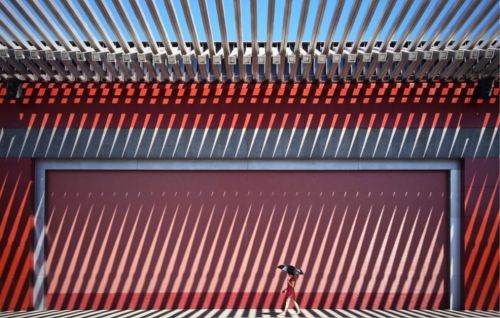
I came across the photo above this morning which is titled The China Red.  It was shot by photographer Jian Wang at Olympic Forest Park in Beijing, China and is the winning image in the Mobile Category of the Smithsonian’s 13th Annual Photo Contest.  I spent about five minutes just staring at it, transfixed by the pattern of the shadows and colors.  Just a great image.

The color and forms incorporated in the photo reminded me of some of the work from the Precisionist painters such as DeMuth and Sheeler.  I thought I would share the following post from back in 2009 about Demuth:

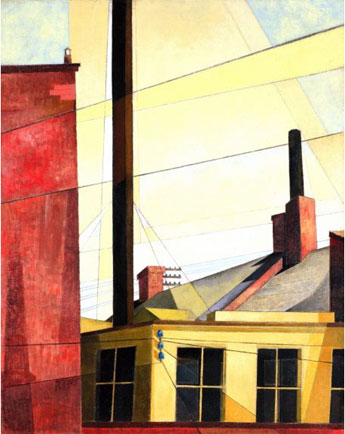
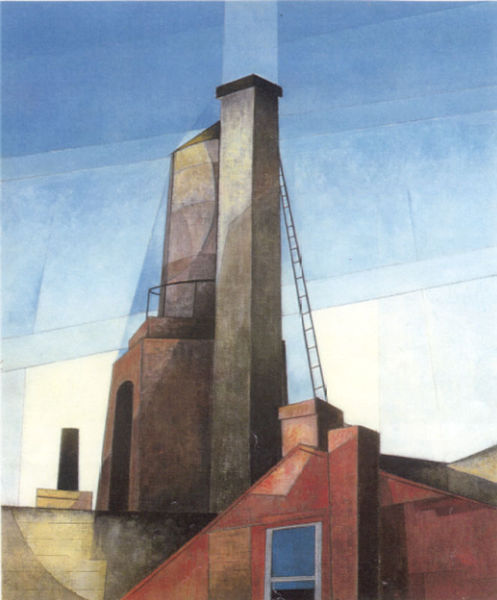
demuth-number-5I’ve been a fan of Charles Demuth since the first time I saw his work.  He was considered a part of the Precisionist movement of the 20’s, along with painters such as Charles Sheeler and Joseph Stella among many others, with his paintings of  buildings and poster-like graphics such as this painting, I Saw the Figure 5 in Gold.  He was also one of the prominent watercolorists of his time and while they are beautiful and deserve praise in their own right, it’s his buildings that draw me in.

Demuth’s work has a tight graphic quality but still feels painterly to me.  There’s still the feel of the artist’s hand in his work which to me is a great quality.  There are photorealist painters out there whose craftsmanship I can really admire but who are so precise that they lose thatdemuth-my-egypt feel of having the artist’s hand in the work.  I like seeing the imperfection of the artist.  The first time I saw one of the Ocean Park paintings from artist Richard Diebenkorn, it wasn’t the composition or color that excited me.  It was the sight of several bristles from his brush embedded in the surface.  To me, that was a thrill, seeing  a part of the process.  The imperfect hand of the artist.  I get that feeling from Demuth.
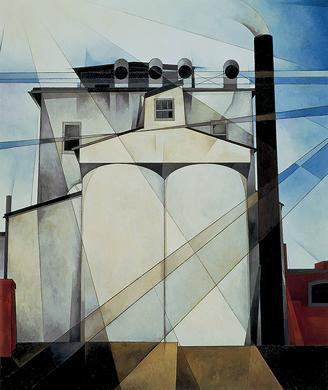
He also had a great sense of color and the harmony and interplay of colors.  His colors are often soft yet strong, a result of his work with watercolors.  His whites are never fully white and there are subtle shades everywhere, all contributing to the overall feel of the piece.  His work always seems to achieve that sense of rightness I often mention.

His works, especially his paintings of buildings, have a very signature look, marked by a repeated viewpoint demuth-after-all where he views the buildings above him.  His paintings are usually fragments of the building’s upper reaches.  There’s a sense of formality in this view, almost reverence.  I don’t really know if he was merely entranced by the forms of industrial buildings or if he was making social commentary.

Whatever the case, do yourself a favor and take a look at the work of Charles Demuth.  It’s plain and simple good stuff…
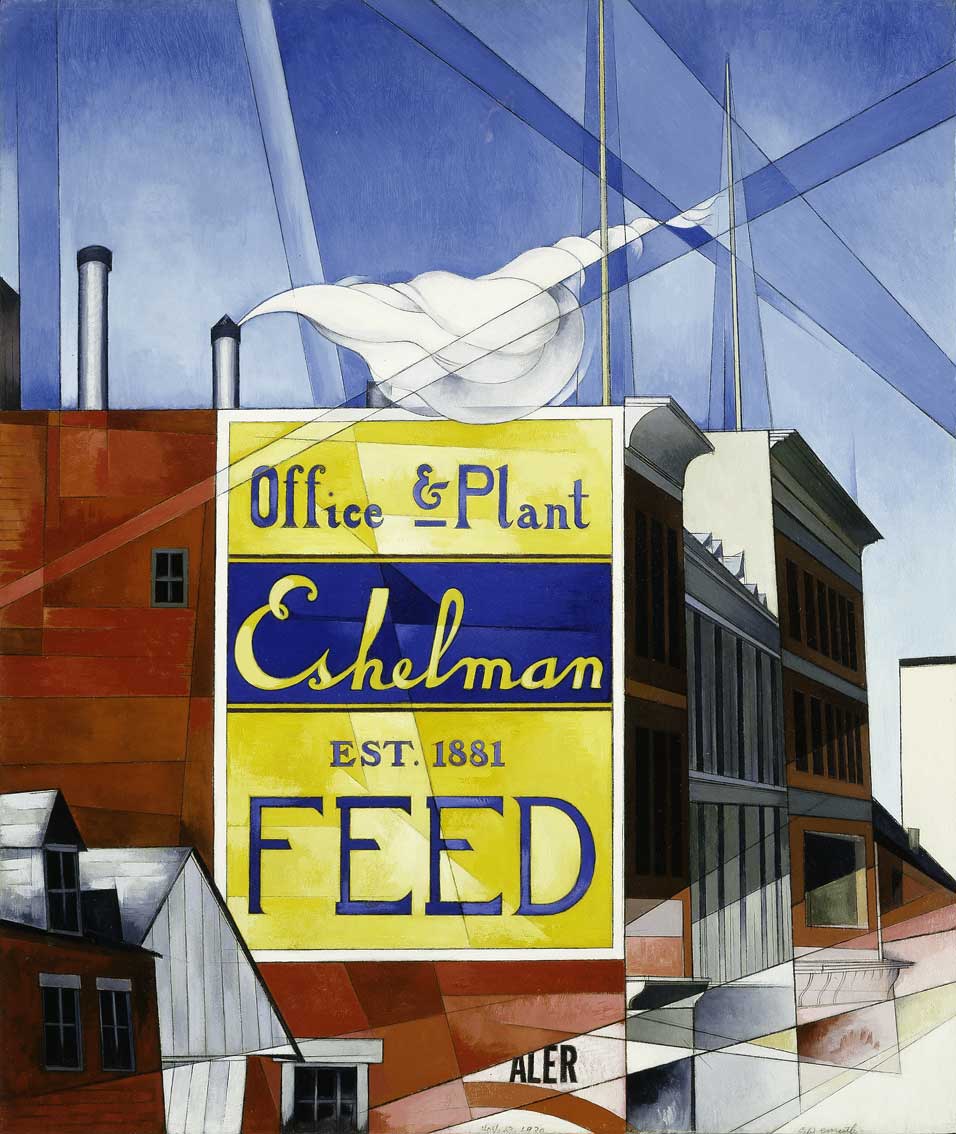
Buildings, Lancaster 1930demuth-from-the-garden-of-the-chateau

demuth_charles_aucassiu_and_nicolette_1921

Read Full Post »

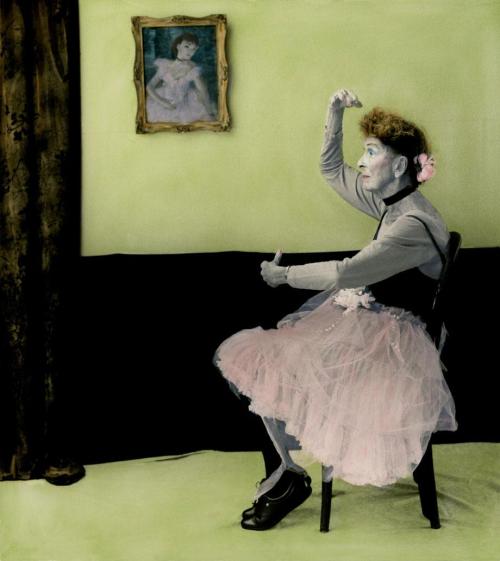
Aline Smithson Arrangement in Green and Black CompilationJames McNeill Whistler- Arrangement in Grey and BlackI have written here in the past about the composition from the iconic James McNeill Whistler painting Arrangement in Grey and Black— better known as Whistler’s Mother.  It’s a beautiful, solidly structured composition that works as a wonderful template for creating a solid visual image of any subject.

Several years, ago, contemporary photographer Aline Smithson used Whistler’s image as the basis for a series of photos that she called Arrangement in Green and Black: Portraits of the Photographer’s Mother.  Inspired by a print of Whistler’s painting that she found at a rummage sale and using her then 85 year-old mother (an obviously loving and patient woman who unfortunately passed away before seeing the finished series) as the subject, Smithson created 20 images with varied takes on the famous composition.

They are quietly comical individually and as a group. I just find them interesting.  Below are some of my favorites.

For more on Aline Smithson’s work, please follow this link to her website where you will find many more portfolios featuring her distinct eye for observation.  She also has a current exhibit, Aline Smithson: Self & Others, at the Griffin Museum of Photography in Winchester, Massacusetts.  It closes May 1 so if you’re in the area, don’t waste any time in getting to the museum.

Aline Smithson_Arrangement-14 Aline Smithson_Arrangement-11 Aline Smithson_Arrangement-10 Aline Smithson_Arrangement-1 Aline Smithson Arrangement Aline Smithson Arrangement in Green and Black a Aline Smithson_Arrangement-3

Read Full Post »

Dorothea Lange Next Time Try the TrainTo know ahead of time what you’re looking for means you’re then only photographing your own preconceptions, which is very limiting, and often false.

Dorothea Lange

*****************

As a fan of Dorothea Lange’s photography, I was very open to her take on what an artist–  in her case, a photographer– is seeking.  I’ve written a lot here over the years about searching for something  in my work but what that thing is, quite honestly, I do not know.  I know that it is not something I can find without releasing a lot of myself including my fears and preconceptions.

Lange’s idea of preconceptions being limiting is one that rings very true to me, coinciding with my constant chorus that  painting is best done without thought, without having an idea of where it might end up.  Preconceptions create expectations and these too are limiting.  The best work often comes when there are no expectations and no idea of what I am trying to accomplish.  Well, it holds true for my painting, at least.

Her idea ( and mine, I suppose) of searching is so devoid of planning or purpose that it actually reminds me of Picasso‘s thoughts on searching:  I have never had time for the idea of searching. Whenever I wanted to express something, I did so without thinking of the past or the future.

They both very much say the same thing but in differing ways.

And I agree with both.

dorothea-lange-depression-inspiration-tractored-out-childress-county-texas

Read Full Post »

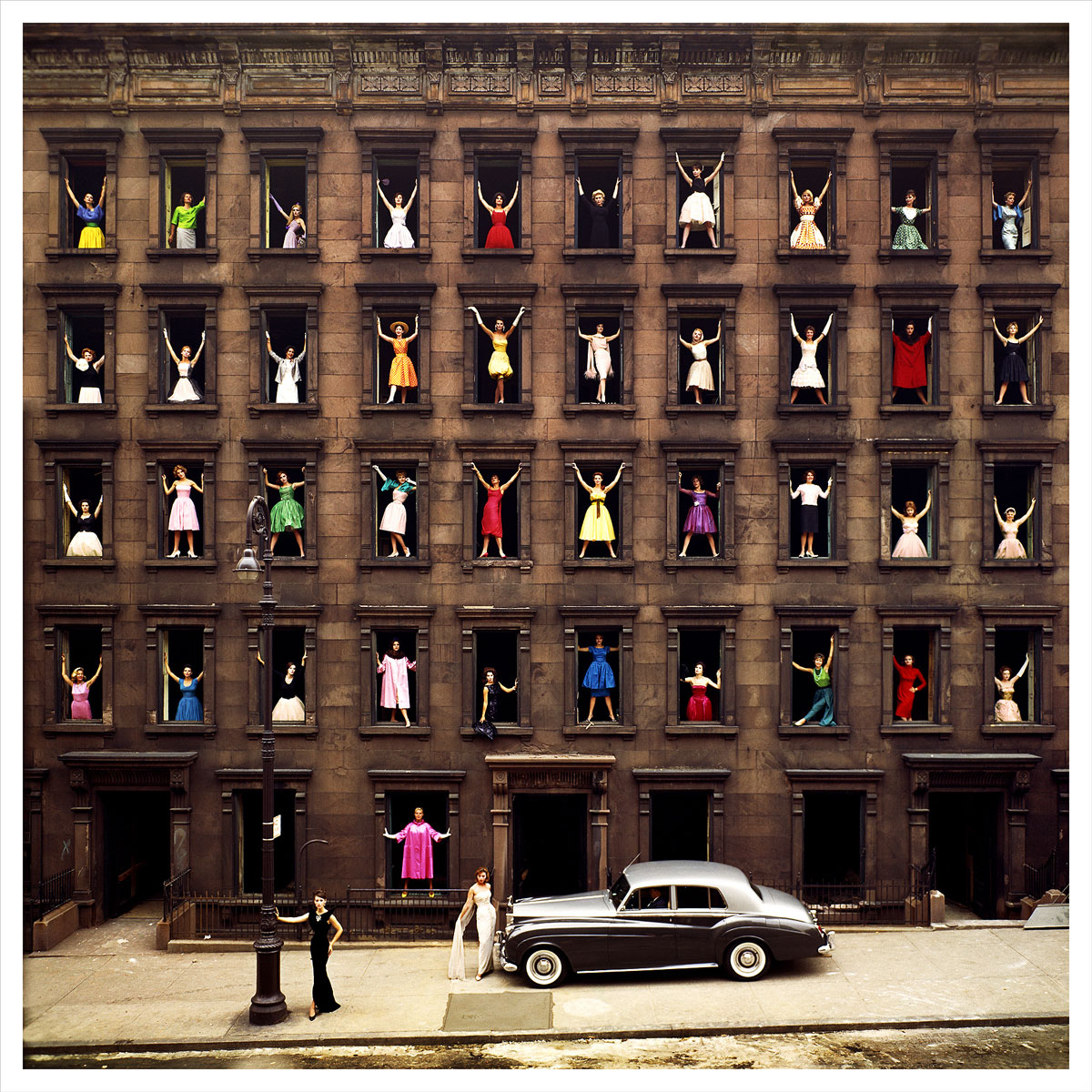
Ormond Gigli  Girls InTh Windows New York 1960 --Stanley-Wise Gallery NYCOrmond Gigli is an American photographer born in 1925 who is famous for his photos of celebrities from the worlds of stage, screen and fashion.  I recently came across his most famous photo (above) which is called Girls In the Windows.  It is considered to be one of the great fashion shots of the 1960’s and just a great photo in any category.

The photo came about in 1960 when a group of brownstones in Manhattan were being demolished across the street from Gigli’s  East 58th Street studio.  Gigli wanted to capture those brownstones on film and had a vision of 43 fashion-clad women adorning the windows.  Working quickly, arrangements were made to get permissions, models and the Rolls-Royce in place so that the photo could be taken during the workmen’s lunch break before the buildings hit the ground.  Some of the models couldn’t stand on the windowsills as they were so crumbly.

It’s a stunning visual.  You never know what will inspire something new in your own work and looking at a photo like this triggers all sorts of reactions within my mind.  I am sure this was the same for others who sort of borrowed from this photo in the years after it was taken.  For instance, I am pretty sure the artist who did the cover for Led Zeppelin‘s 1975 album, Physical Graffiti was inspired in some way by Gigli’s photo to place iconic images in the windows of a crumbling apartment building.

Ormond Gigli has a website devoted to his work and the stories behind some of his more famous shots that you can visit by clicking here.

Led Zeppelin Physical Graffiti Album Cover 1975

Read Full Post »

Calbuco Volcano, Chile- Francisco Negroni April 2015

Every year the National Geographic holds  a photo contest for great images taken around the globe within the past year.  It always produces some incredible imagery and I usually find myself really stunned by many of them.  The contest is still open so if you have  some photos that you think can stand alongside the photo at the top then get your entries in.

That picture was taken in April during the eruption of Calbuco, a volcano south of Santiago, Chile.  It captures the phenomena of volcanic lightning which  has multiple lightning strikes firing throughout the ash cloud as it spews upward.  There is still debate as to what causes this but most believe it is a result of positively charged particles coming from the volcano joining with negative particles in the ash cloud.  Whatever the case, it’s still pretty a damn impressive display of some awesome natural forces.  This photo was taken and submitted by Francisco Negroni,

Another of my favorites from recent submissions is the one at the bottom of terraced rice paddies in the Yen Bai province of North Viet Nam taken by Qu nh Anh Nguyen.  The absolute organic quality of the forms and colors just mesmerize me.  Love this image for completely different reasons than the photo at the top which shows the power of natrure over which we have no control.  This image shows how we can interact with and coexist with this world.  A different kind of power.

You can check up on recent entries ( or enter your own) at the National Geographic site by clicking here.

 Rice paddies

Rice Paddies, North Viet Nam- Qu nh Anh Nguyen 2015

Read Full Post »

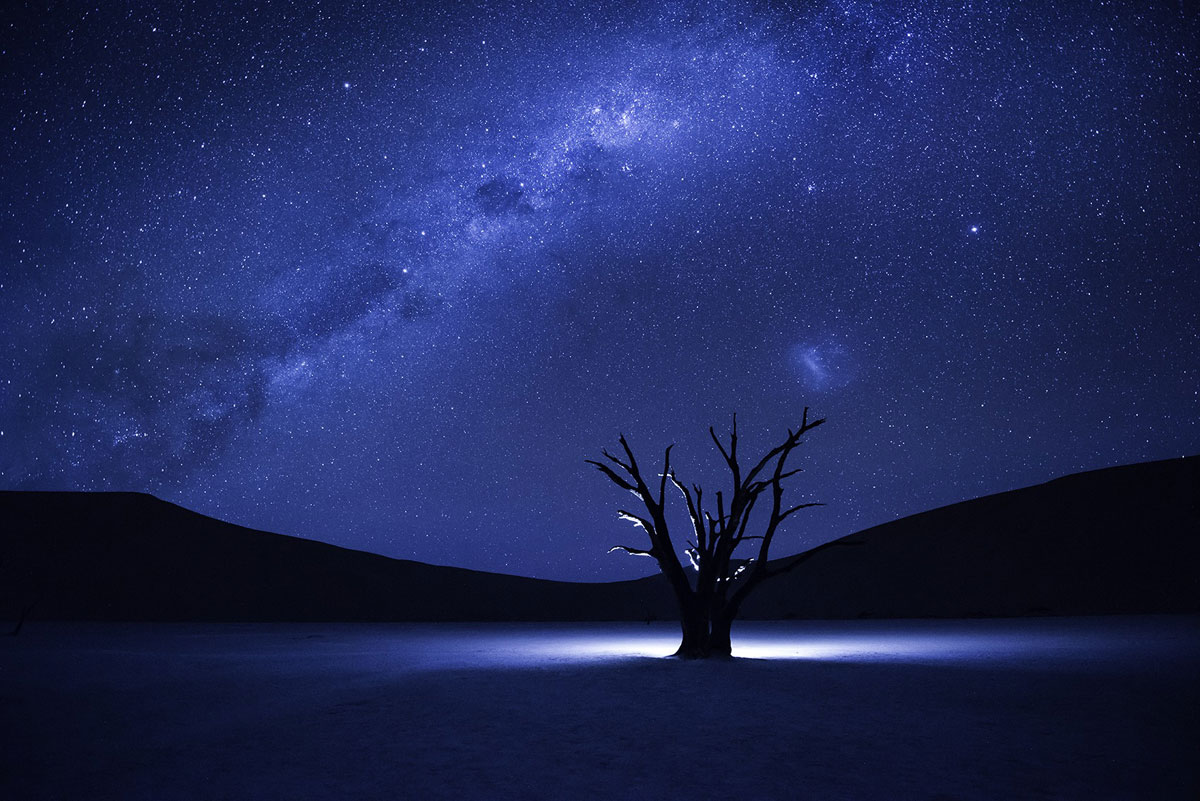
Deadvlei Namibia Photo By Christopher R. Gray- Natl Geo Traveler Photo Contest 2015I came across this wonderfully stark image this morning, an entry in the National Geographic Traveler Photo Contest from photographer Christopher R. Gray.  It is a night scene from an area of the Namib Desert in the African nation of Namibia called Deadvlei.

Located in a region of salt marshes periodically fed by the Tsauchab River, Deadvlei ( which translates as “dead marsh“) was cut off from the river’s feed nearly 1000 years ago from flooding then climate change.  This left  it a huge  dry and hard salt plain nestled among some of the highest sand dunes on the planet, some towering over 1300 feet in height.  The trees, mainly camel thorns,  that were there all those centuries ago remain, darkly scorched tree bones that do not decompose in the arid conditions.

This area’s remoteness also gives it some of the darkest skies on the planet, making visible all the many stars and galaxies that have become invisible to us in the more populated parts of the world.  That night sky makes for a pretty striking image with the single tree set against the silhouette of the sand dunes.

It’s kind of a natural Ozymandias, a reminder of our own mortality set against the eternal nature of the Earth.  Great photo.

Read Full Post »

AERMETRY  - Photographer Nicolaus WegnerThere was an interesting video recently online called Art of the Storm from photographer Nicolaus Wegner that featured a fantastic time lapse of a super cell forming over the Black Hills of South Dakota earlier this month.  While it was beautiful and awe inspirng, it was a link at the end of the video to some of his other time lapse films that caught my eye.  One in particular stood out.

Called AERMETRY,  it features storm and cloud formations and movements that are mirrored as they move across the screen, creating kaleidoscopic images that are fascinating.  Definitely hard to look away, especially if, like me, you are one of those people who try to identify things in random patterns.  There is however a photosensitive seizure warning attached so if you are susceptible to such things please take note.

You can see more of the work of Nicolaus Wegner, including more sensational time lapses, at  his website, Light Alive Photography.

AERMETRY from Nicolaus Wegner on Vimeo.

Read Full Post »

Lost World Photo by Mikko LagerstedtThe other day I came across this luminous photo from Finnish photographer Mikko Lagerstedt.  Titled Lost World, it shows a sailing ship partially sunk in shallow water beneath a densely star-filled sky.  All of the elements of the image– the color, the composition, the reflection on the water and the glow of the sky– give this photo a mysterious and intriguing vibe.  Just a great photo.

Mikko Lagerstedt is a self-taught photographer who specializes in what he terms atmospheric photography with an emphasis on simplistic landscapes and  night scenes.  They have a brilliance in them that plays well off the sparseness of the landscape and the immensity of his skies.  For more images and info, go to his site by clicking here.

I thought I would find a piece of music to go along with it for this week’s Sunday music and one of the first things I stumbled across had the feel that I was looking for.  It’s The Shining by Badly Drawn Boy from back in 2000.  It’s a song that pops up on my playlist every so often and always pulls me in with its opening moments that feature a mix of cello and french horn.

Enjoy.  Hope your Sunday goes swimmingly.  Not exactly sure what that means but I’m sticking with it.

Read Full Post »

Trey Ratcliff - china-deep-in-the-guangxi-provinceSometimes you can look at something and it immediately translates into something for you, something from which  you can take inspiration and  make something new.  That’s what came to mind for me when I came across this great image from photographer Trey Ratcliff.  It’s a panoramic view of a fairytale-like  landscape in the Guangxi region of  China that he took after scaling a peak similar to those you see in the photo.

It’s just a great image, one that gets my motor racing.  I immediately find myself comparing it to my own landscapes, noting  how the forms flow together to create a wonderful rhythm in the image.  There’s so much that will easily convey into my own work that it is in place before I really have time to think about it.  It’s like a jolt of creative electricity.  I just need to get to the easel before it rolls to the back of the line of imagery that is formed in my head.

For more of Trey Ratcliff’s incredible photograph’s from around the world, visit his website Stuck in Customs.  And check out the image shown above on Google+— it’s a 19,000 pixel  high def shot that is fully zoomable so that  you can fly in and out of the little valleys in the distance.  Pretty remarkable.


Read Full Post »

Dorothea Lange- 1936 Daughter of a Migrant Coal MinerI was looking at some of Dorothea Lange‘s classic Depression-era photos recently and came upon this image of a young woman. The label says it is from late 1936 and the young woman was the daughter of a migrant Tennessee coal miner living in a camp on the American River near Sacramento, California.  It is such a compelling image that you can almost feel the weariness and sorrow in her.  I find myself wondering whatever became of that girl, if she ever found happiness or contentment or at least shook off those weary blues that seem to be consuming her in the photo.

Lange had a real genius for extracting raw emotion from her photos–it’s so evident when you scan a page of her work where you can see the images together.  It’s obvious that she connected on a very personal level with her subjects, allowing them to expose themselves and their inner emotions within the trust they extended to her.  And with that trust Lange created photos that showed these folks honestly and with dignity, making  you care about these strangers from another era as much as she did in that moment.

That is an extraordinary gift.

Looking at this photo brings me to this week’s Sunday music.  I chose a cover of the old Hank Williams song Weary Blues but done by modern chanteuse Madeleine Peyroux in a more bluesy style.  You would think old Hank was looking at this photo when he wrote the chorus:

Weary blues from waitin’
Lord, I’ve been waitin’ so long
These blues have got me cryin’
Oh, sweet daddy please come home

Have a great day and hope you can use it to shake any weary blues you might have.

Read Full Post »

« Newer Posts - Older Posts »