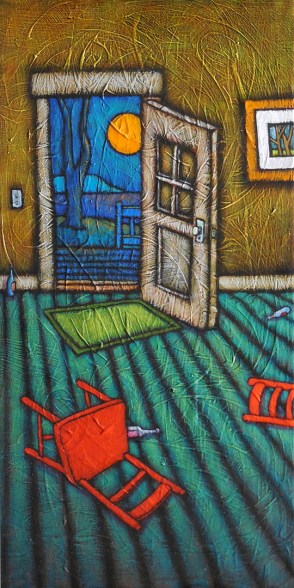
Here is another new piece from my solo show at the Principle Gallery that opens next week, on June 4th. This is another of the interior scenes showing a room in the aftermath of some sort of to-do.
Myself, I don’t know exactly what took place and can only imagine.
I think that’s the point of these paintings, to give an endpoint where the viewer has to use their own imagination as to what has occurred. A final paragraph for a short story that gives you the results but not how it got to this point. It can be as vibrant and wild as your imagination allows.
This painting, a 10″ by 20″ canvas, is titled Full Moon Fever. My own story for what has happened is that this is a cabin where Larry Talbot tried to hide from the moon, to no avail. Larry Talbot was the name of Lon Chaney’s character in the original 1941 werewolf movie, The Wolf Man.
Now, that’s my take. Your own story may not line up with this at all and that’s means you’re using your imagination. That is usually a good thing so long as you realize it’s your imagination and not reality. Wild imaginings that folks perceive as reality are not a good thing as we have all seen in way too many instances in recent times.
I borrowed the title of this painting from a Tom Petty album that bore the same name, Full Moon Fever. Here’s Free Fallin’ from that album to honor the memory of Larry Talbot’s howling freefall that came under every full moon.
If the path be beautiful, let us not ask where it leads.
― Anatole France
The new painting above is the title piece for my new show, Between Here and There, which opens next Friday, June 4 at the Principle Gallery. It is 22″ high by 28″wide in size and is painted on linen.
Like many of my paintings, its meaning lies in a moment captured in a symbolic journey. That moment when one stops to look both ahead and behind and to also savor the moment of pause.
I have sometimes this journey as being like a labyrinth whose twists and turns sometimes gives you glimpses of your far destination even though there is so much more of the pattern to be traveled before reaching it. Soon, you might be at a point where your desired objective seems a million miles away though it seemed so close not so long ago.
The way I see this piece is that the closer Red Tree is at such a moment and sees itself at a future time on that distant hilltop, with an even better view forward into the distance and back into the past. It sees itself there as being a fuller being, wiser and more attuned to the world, than it sees itself here.
That is its desired destination.
But between here and there are obstacles to overcome, hills and mountains to climb and rivers and seas to cross. Battles to be waged and wounds to be healed. People to be found and people to be lost.
Moments of elation and moments of utter despair. Sometimes, the despair so dark and hopeless that the journey seems at an end.
But then, like a twist in the maze, the objective you so desire comes back into view and you stop to take it in. And in this moment as you look forward then look back at all that you have endured, you savor once more this pause.
You are what you are and one day you may be what you desire to be. It may be dark now but tomorrow offers the possibility of light. You remember then that this is how the journey goes, that the trek between here and there is never easy.
Nothing worth having ever is.
That’s my take on it. Your own may and probably should be different. We are, after all, unique creatures.
“The Admiring Pause”- At the Principle Gallery, Alexandria VA
It may be important to great thinkers to examine the world, to explain and despise it. But I think it is only important to love the world, not to despise it, not for us to hate each other, but to be able to regard the world and ourselves and all beings with love, admiration and respect.
― Hermann Hesse, Siddhartha
Even though I am writing this on Saturday morning, this is Sunday and for the first time since last year I am back on the road, delivering my new show, Between Here and There, to the Principle Gallery. The show, my 22nd solo effort there, open June 4.
Maybe because I have become so used to being ensconced in the studio, the idea of any sort of trip, even a daytrip like this, feels unusual. Strange, like I have somehow forgot how to move among people or talk or act around them. In a way, I feel like a convict who has been in solitary for the past year and is suddenly back among the general population.
Just hope I don’t have to shank anybody.
Just kidding, of course. Wink, wink, nudge, nudge.
Okay, time is fleeting and I still have much to do today (yesterday for those of you reading) before I am ready to do anything tomorrow (today) so let me point out the new painting at the top, The Admiring Pause, which is part of the show. There’s a lot I like about this piece. There is a sense of stillness and fullness that I find very satisfying. Makes me want to sit back and admire it for just a brief moment.
The pause that refreshes, as the old Coca Cola slogan goes.
For this Sunday morning music I thought a piece from Dave Brubeck would go well with this painting. I am going with Koto Song. A koto is a Japanese zither-like instrument and this song was from Brubeck’s 1964 album Impressions of Japan. It’s a nice piece of music that has that elemental stillness that marks much Japanese art. Something I have long admired and desired for my own work. You judge for yourself.
An art which isn’t based on feeling isn’t an art at all… feeling is the principle, the beginning and the end; craft, objective, technique – all these are in the middle.
-Paul Cézanne
Since I am a little short on time this morning as I am in the final days of wrapping up my approaching Principle Gallery show before delivery later this weekend, I thought I’d share a thought from Paul Cézanne that pretty much sums up my view on art, that feeling and emotion is the primary driver behind all art.
Here’s a short video of some of of Cezanne’s better known works for you to examine for their levels of feeling.
Out beyond ideas of wrongdoing and rightdoing there is a field. I’ll meet you there.
When the soul lies down in that grass the world is too full to talk about.
― Rumi, 13th century Persian poet
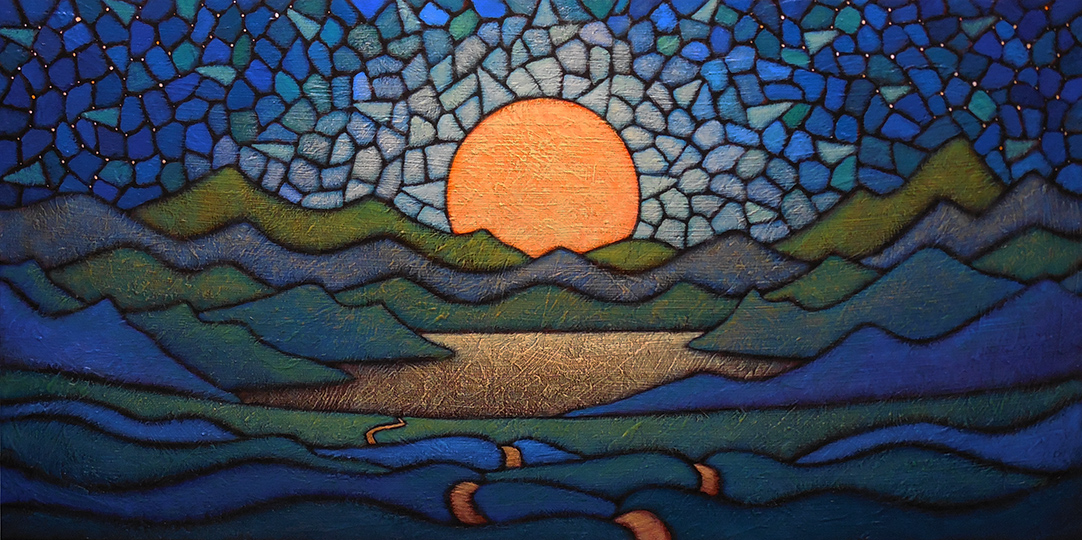
The new painting at the top, titled Symphony of Silence, is an 18″ by 36″ canvas. This weekend, it is headed down to the Principle Gallery as part of my solo show, Between Here and There, which opens June 4th.
I have written in the past about what I see as the connection between painting and music, how I see some of my pieces as simple songs and others as more intricate compositions. Perhaps symphonies or concertos.
This, in my eyes, is one that seems simple at a first glance. It is sparse and without great details. But the more I look at it, the more I see in it. How each element and color plays off the next and how they are fortified by each. It feels like there are rhythms and melodies running through it, from side to side as the terrain flows and up and down with rise of the moon. There is inward and outward movement with the light of the stars and the undulation of the trail. The blocks that make up the night sky seem to swirl and rotate in all directions. The far mountains appear almost as sound waves.
There is seemingly constant movement throughout the landscape and the skyscape. Almost a cacophony.
Almost.
It is silence.
Somehow the movements, the rhythms, and contrasts all run together at some point.
Harmony. Made up of the stars in motion countless lightyears away and the ancient wisdom contained in the stillness of the land and water. Always there but in silence.
It is a simple piece but one that constantly shares something more than it lets on with a mere glance.
Here’s a piece of music to accompany it, a longtime favorite of mine and one that has played a large part in how I came to view my own work. It’s from composer Arvo Pärt and his composition Tabula Rasa. This is the second movement, fittingly titled Silentium. It feels right with this painting.
The title of this new 20″ by 30″ painting is Una Semper which translates from the Latin as Always One. It’s part of the group that will soon be heading down to the Principle Gallery for my annual solo show there. This year’s show is called Between Here and Thereand opens June 4.
This would be what I would call one of my Baucis and Philemon pieces based on the Greek myth that I have documented here on a number of occasions. I have done a number of iterations on this theme over the past decade or so and they remain among my favorite pieces to paint. There something in the dynamic of the two trees intertwining and pushing upward that stirs a feeling within me.
For some reason, the pair tends to bring most any composition to a satisfying fulfillment. These pieces always feel complete and self-contained. And I like that.
This piece has these elements and has a brightness and pop that is really appealing to my own sensibilities. It just seems alive which is a big deal for me.
I thought I’d pair this new piece with this week’s Sunday Morning musical selection. which is from the 2005 album, Devils & Dust from Bruce Springsteen. It was his third acoustic album, and like the other two, Nebraska and The Ghost of Tom Joad, remains a favorite of mine with memorable songs throughout, including the title track. This song is titled All I’m Thinkin’ About and features a falsetto over a driving melody. I am always surprised at how effective his falsetto is in his songs. This is one of those songs that always grabs my attention when it comes on while I am working.
Okay, got to get going because there is still lots to be done as I prep for this show. No rest for the wicked as they like to say. I would like to believe it’s the other way around — no rest for the righteous— but that might just be quibbling.
Now I’m standing in the wake of forty years And from this prison I have broken free and clear And I’m praying that the morning won’t catch me here
— Full Moon, Peter Bradley Adams
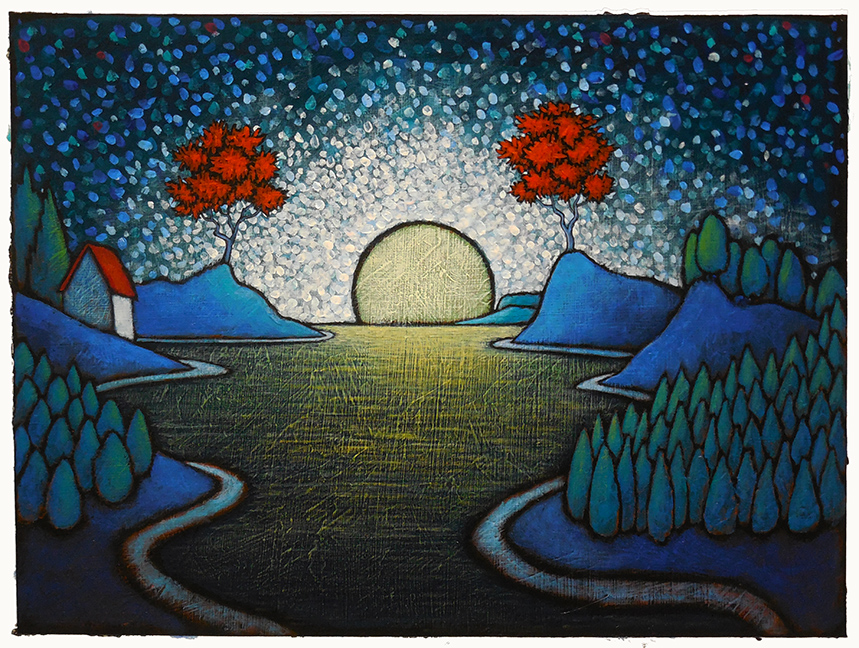
The small painting above is called Under the Blue Moon. It’s headed to the Principle Gallery for my annual show there which open June 4. This year’s show is titled Between Here and There and is my 22nd show at the Alexandria gallery.
It’s hard to believe that it’s been 22 years since my first solo show at the Principle. So much has changed in the world. My work has also changed but it is an incremental thing, one that I would like to believe maintains a consistency even as it changes.
This piece is a good example of it, painted very much in the same style with a similar process to the work I was producing back at that first Principle Gallery show in 2000. But while it maintains its recognizable features, it has changed, with colors that are more intense and a bit more layered and complex. The suns and moons in my work have grown in size over the years, as a result taking on a more prominent role in the composition.
That’s definitely the case here. This piece just feels good for me with the colors and angles of the forms triggering a lot of different responses within me. It has a feeling of the vulnerability of a confession for me, the Red Tree standing in the wide open beneath the unwavering and all-knowing eye of the bluish moon.
What hasn’t it seen? What doesn’t it know?
Makes me wonder and that’s all I ask of it.
Here’s song to go with it. It’s from singer/songwriter Peter Bradley Adams, whose songs, which are classified as being Americana which is a term that says a lot without saying much about what the music really entails in subject or form. I have just recently started exploring Adams’ work and this song felt right this morning. It’s called Full Moon.
I want to be quiet this morning. No, I need, not want, to be quiet this morning.
Need to be quiet.
It’s one of those days when I wake up in the dark of the early morning. My dreams, which evaporate as soon as my feet touch the cool floor, have somehow dashed any facade of confidence I may have been wearing and I am already a bit glum before I have even seen the first light of morning. I slip on my jeans that are covered with paint and as I slide my right leg in, my toe catches a small tear in the pant leg. For some reason, my jeans always tear in this same spot, just above the right knee.
But this morning my toe catches that tear and in the darkness I hear it rip even more. I feel anger and frustration layering on top the glum blueness I woke up with and I want to just let my toe rip the hell out the jeans then throw them across the room in the dark. And scream so hard that my diaphragm aches and my throat burns from the effort.
But I don’t. I restrain myself and just stand there in the dark stillness, taking a long breath of cool air. Then I calmly ease my leg into the torn jeans. My eyes adjust a bit to the dark and I can see out the window that morning light is beginning to sift through the trees. The sun will soon be up.
I tell myself there’s still time for hope. I just need to be quiet and let it find its way here this morning.
I make my way along the path through the woods to the studio and I feel much of the frustration and anger slip away. I am still a bit glum and blue but lying on the kitchen floor with my Hobie, the faithful and loving cat with which I share my space, helps. Her loud purrs of satisfaction are like an elixir. I am tempted to click on the news to catch up and immediately turn it off after about 45 seconds of it make my blood pressure tick up a few notches.
I need quiet but I need some music. I remember this piece from the great jazz pianist Bill Evans, Peace Piece. I put it on and its quietude and gentle tone bring me back. And the music keeps playing and I know I have dodged a bullet of sorts. My blue is okay now. It’s like an old grouchy friend who I know how to deal with.
I can manage this. All I need is some quietness, some light, some hope.
I am showing a new piece at the top, one that I call The Peaceful Stillness. It’s 18″ by 24″ on aluminum panel and is part of Between Here and There, my solo show at the Principle Gallery which opens on June 4.
I wasn’t planning on writing this blogpost for this painting but it seems to work with it. I know I felt an easing of my angst and frustration on seeing this painting. It mirrored my attempts to find that quietness within. So, while I should probably talk about the process or meaning or symbolism in it, I am going to let it stand as is this morning.
It did what I wanted it to do. No, what I needed it to do.
Here’s Peace Piece from Bill Evans if you need some help on your end.
There are seconds, they come only five or six at a time, and you suddenly feel the presence of eternal harmony, fully achieved. It is nothing earthly; not that it’s heavenly, but man cannot endure it in his earthly state. One must change physically or die. The feeling is clear and indisputable. As if you suddenly sense the whole of nature and suddenly say: yes, this is true. God, when he was creating the world, said at the end of each day of creation: ‘Yes, this is true, this is good.’ This . . . this is not tenderheartedness, but simply joy. You don’t forgive anything, because there is no longer anything to forgive. You don’t really love — oh, what is here is higher than love! What’s most frightening is that it’s so terribly clear, and there’s such joy. If it were longer than five seconds — the soul couldn’t endure it and would vanish. In those five seconds I live my life through, and for them I would give my whole life, because it’s worth it. To endure ten seconds one would have to change physically . . . .
― Fyodor Dostoyevsky, Demons
I think I understand what Dostoyevsky was describing in the words above. I imagine –well, hope– that most of you have experienced those fleeting seconds where the harmony of everything suddenly becomes evident to you.
All the things that make up the world, the universe, all the planes of existence, and yourself in that rare moment seem to be just where they should be in relation to all other things. It is as though everything is comprised of floating, constantly shifting plates that periodically find themselves in a position where the perfection of eternity is achieved and revealed to the watchful few.
For a few glorious seconds.
Then the plates resume their shifting and harmony seems, at best, just out of reach. Or, in the case of the other extreme, nowhere to be found as the plates shift to a point of chaos and dangerous imbalance.
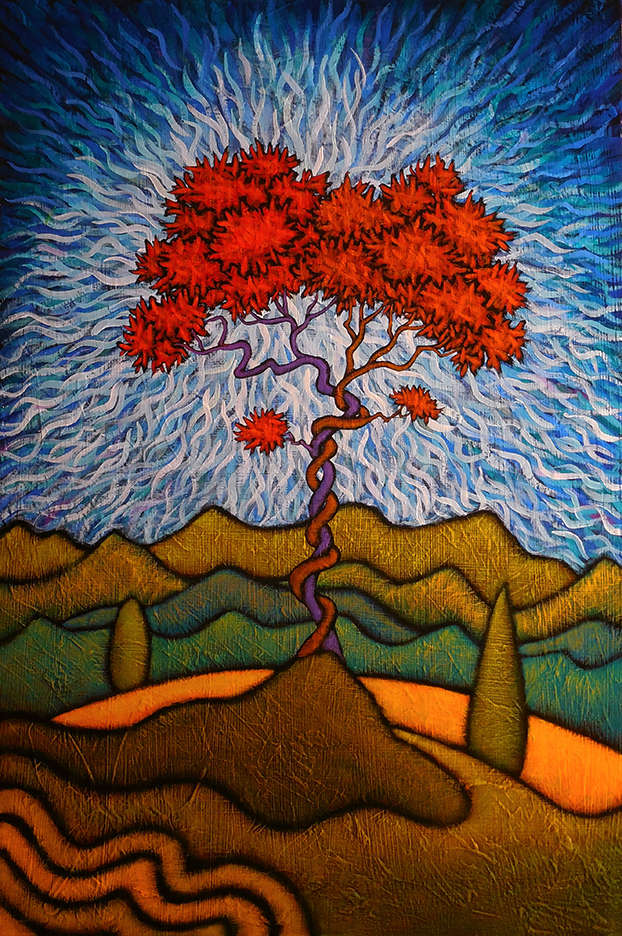
Maybe that rare moment of eternal harmony –as I know it– is what I am seeing in this new painting that is headed to the Principle Gallery for my annual solo show, Between Here and There, which opens June 4. It has a feeling of great harmony for me, of things being in alignment, in place. And of the Red Tree as a central figure being aware of the unity of time and place in which it finds itself.
I believe I have experienced episodes of those four or five seconds of clarity and I see it in this piece. I am calling this new 24″ by 36″ painting Harmonia Aeternam. I chose the Latin translation for Eternal Harmony because I felt this piece deserved a weightier title.
“There is neither happiness nor misery in the world; there is only the comparison of one state with another, nothing more. He who has felt the deepest grief is best able to experience supreme happiness. We must have felt what it is to die, Morrel, that we may appreciate the enjoyments of life. ” Live, then, and be happy, beloved children of my heart, and never forget, that until the day God will deign to reveal the future to man, all human wisdom is contained in these two words, ‘Wait and Hope.”
― Alexandre Dumas, The Count of Monte Cristo
The painting above is another that is included in my show, Between Here and There, that opens June 4 at the Principle Gallery in Alexandria, VA. It is 12″ by 16″ and is also painted on an aluminum panel.
It is titled Pillars of Wisdom: Wait and Hope. This was inspired, in part, by the excerpt above from the classic The Count of Monte Cristo by Alexandre Dumas. As I was painting it, I began call this piece Pillars of Wisdom but after it was completed I came across this bit from Dumas. The idea of seeing these being trees named Hope and Wait and that they represent the totality of human wisdom seemed perfect.
So many of us live with a certainty and assurance that is beyond me. We have yet to learn all there is to know, all the answers to the infinite number of questions that hover over us like so many stars in the night sky. Perhaps one day we will fully be bathed in the light that is all wisdom, but until then all we have are those two words: Wait and Hope.
Hope waits for the light to come and Wait hopes for it.
 Here is another new piece from my solo show at the Principle Gallery that opens next week, on June 4th. This is another of the interior scenes showing a room in the aftermath of some sort of to-do.




 Redtree Times