“A Time For Leaving”- At the Principle Gallery, Alexandria, VA
My famous last words Could never tell the story Spinning unheard In the dark of the sky
–If This Is Goodbye, Mark Knopfler
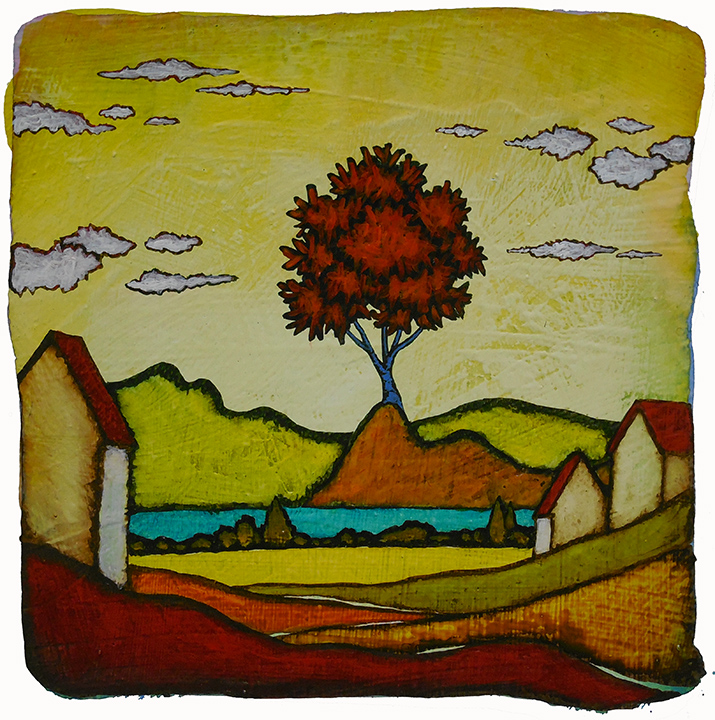
I don’t feel like saying much today so let’s move right on to the music selection for this Sunday morning. I wanted something to fit with the painting above. A Time For Leaving, which is headed down to the Principle Gallery for their upcoming small works show. I went through a lot of music but nothing jumped out at me.
There were two finalists in my mind. One was from the wonderful collaboration between Mark Knopfler and Emmylou Harris, If This Is Goodbye. The other was a track, Leaving the Table, from Leonard Cohen‘s great final album, You Want It Darker. Both did the job for me so I decided to share both.
If you’d like, give a listen. If not, move on. Either way, try to have a peaceful day.
Said it’s a mean old world, heavy in need And that big machine is just picking up speed And we’re supping on tears, and we’re supping on wine We all get to heaven in our own sweet time So come all you Asheville boys and turn up your old-time noise And kick ’til the dust comes up from the cracks in the floor
Singing, “Hard times ain’t gonna rule my mind, brother Hard times ain’t gonna rule my mind Hard times ain’t gonna rule my mind no more”
–Hard Times, Gillian Welch
I was listening to some music as I was going through some images early this morning while trying to figure out what to write for today’s blogpost. The song, Hard Times from Gillian Welch, came on and its chorus– Hard times ain’t gonna rule my mind no more— really jumped out at me. Made me think of how we handle the many adversities of life.
Sometimes it’s a matter of adjusting the way we do things or changing altogether. Proactive measures.
And sometimes its a matter of waiting, just figuring that all things inevitably pass and if you can hang on, it will all eventually work out. This tends to be the way most of us get through. To use a boxing analogy, you go to the ropes and cover up, take the body blows and hope the bell rings before you fall.
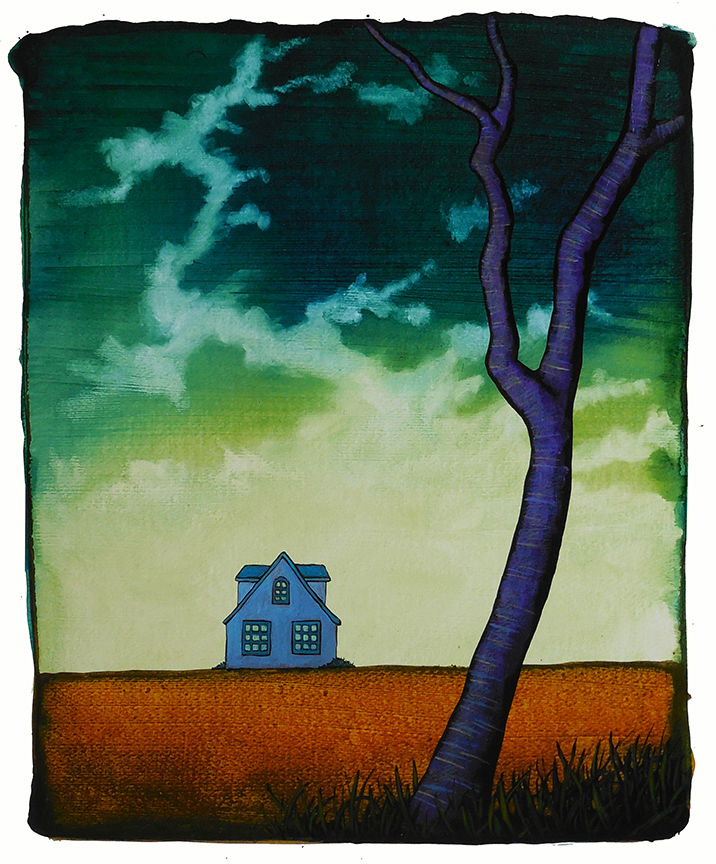
This second way of coping made me think of this new piece, And Darkness Leaves, which is headed to the Principle Gallery in Alexandria for their annual holiday show of small work that opens next Saturday. There’s a lot of symbolism that you can attach to this piece but it comes down to hanging on, waiting for the dark to recede.
Waiting for that bell to ring.
It sure seems like we have taken a lot of heavy body blows as a nation in this latest round. There were moments when we seemed out on our feet and we only held up by the ropes, those institutions and laws that have been the bedrock of this nation since we were first formed. But we held on and regrouped, gathering strength and throwing some big punches of our own.
The bell has rung and we get to face another round. Just as there is always a clearing after every storm. Just as the darkness leaves after every night and we get to face another day.
We’re still in the midst of a fight. But the darkness will inevitably leave and we’ll soon get to stand in the light once more. So keep that chorus close at hand: hard times ain’t gonna rule my mind no more.
Be kind, for everyone you meet is fighting a harder battle.
-Ian Maclaren
The quote above is often misattributed to Plato but was actually the product of Ian Maclaren which was the pen name used by Scottish minister Dr. John Watson (1850-1907) when writing his works of fiction which were highly popular in his time. Regardless of whether it was first uttered by Plato, Ian Maclaren or Peewee Herman, it’s darn good advice and applicable to any time or place.
No matter how low you fall in your life there is inevitably someone in a far worse situation. I know from my own experience that what seems the bottom depths to me might seem a ceiling for others. Life is hard for many of us at some point in our lives but it can be extraordinarily harsh for some other folks on a regular basis, often for reasons beyond their control.
The flipside of this thought is equally as potent a piece of advice. It’s something I keep in mind constantly in loose partnership with the advice above. It would most likely be phrased: Be kind and humble, because there is always both someone worse off than you and someone far greater than you out there.
Just as there is always someone facing greater challenges than you, there is always someone who possesses more talent and ability, more intelligence, more everything than you.
You may never know what the person in front of you in line at the supermarket is going through in their life, what struggles they might be fighting or what their special gifts might be.
So, be kind and humble. It takes so little effort, it doesn’t cost a thing, and doesn’t take anything away from yourself. In fact, it adds to who you are as a person and makes your small part of this big world a little better place.
Kindness often begets kindness, after all. And we could all use a little more kindness these days.
You thought the leaden winter Would bring you down forever But you rode upon a steamer To the violence of the sun
And the colors of the sea Blind your eyes with trembling mermaids And you touch the distant beaches With tales of brave Ulysses
— Eric Clapton/ Martin Sharp, Tales of Brave Ulysses
Today, I thought I’d share the new small piece above, The Voyager, which is headed down to the Principle Gallery for their annual show of small works for the holiday season. These small boat pieces are among my favorites to paint and this particular painting fits in with that trend. There’s something in the simplicity of the compositions that makes it even more fulfilling when emotion is evoked from just a few simple forms and colors.
Like a visual haiku.
For this week’s Sunday morning music, I sought something that would pair up with this piece and decided that we would go back in time a bit, back to 1967. I thought we’d listen to some Cream this morning, from their classic Disraeli Gears album. As some of you may know, Cream was the first supergroup with members– Eric Clapton, Jack Bruce and Ginger Baker— all coming together from other highly successful bands. With their strong personalities, they only lasted a short time but produced some great and lasting music, including today’s song, Tales of Brave Ulysses.
Here’s a little trivia about this song: This was earliest use of the wah-wah pedal by Clapton and the song was a collaboration between Clapton and an artist neighbor who lived in the the same building, Martin Sharp. Sharp heard that Clapton was a musician ( he wasn’t yet a legend at that point) and told him that he had written a poem that he thought might make a good song. Fortuitously, Clapton had been working on some music that was based on a current hit song that was among his favorites. The song was, surprisingly enough, Summer in the Cityfrom the Loving Spoonful.
I had to go back and listen to see if I could see the influence. It doesn’t jump out at you but it’s there, after all.
Anyway, this song became the B-side to Cream’s Strange Brew and has become a classic bit of rock history. And today it’s floating along with the The Voyager at the top. I threw in their Sunshine of Your Love from the same album mainly because it’s a favorite of mine. But it could fit this panting as well. For that matter, Strange Brewmight also fit. You be the judge.
“The Quarantine House” – Now at the Principle Gallery
“But I must go back here to the particular incidents which occur to my thoughts of the time of the visitation, and particularly to the time of their shutting up the houses in the first part of their sickness; for before the sickness was come to its height people had more room to make their observations than they had afterward; but when it was in the extremity there was no such thing as communication with one another, as before.”
― Daniel Defoe, A Journal of the Plague Year, 1722
I see that we, as a nation, had over 70,000 new cases of covid-19 on Friday. It made me think about how this time has changed so many things in daily lives.
So much isolation, which I know is so difficult for so many of us. Economic pain from job losses and businesses closing. And those that do have jobs continue along with the nagging fear that they are putting themselves at risk every day.
And that is without even mentioning the actual virus and its effects on the afflicted and their families.
It made me wonder how this compared to other times and other pandemics. I did a little skimming of A Journal of the Plague Year, written in 1722 by the author of the better known Robinson Crusoe, Daniel Defoe. It tells in journal form the story of a man’s life in 1665 in London when the bubonic plague, the Black Death, ferociously struck that city. That particular episode of the Black Death killed over 100,000 Londoners which was abut a quarter of the population at the time. And that was not even close to being the worst case of the Plague. It literally killed hundreds of millions of people throughout Europe and Asia in the centuries when it was at its peak and it still persists in places where conditions allow it to continue. No herd immunity here, folks.
But looking through Defoe’s book and reading sections made me think how horrible it must have been at that time. To be afflicted often meant being boarded in your home. There would be no contact with the outside world. No internet, no cellphones, no Netflix or Instacart or Door Dash deliveries. You would be completely cut off and alone with your painful imminent death as your companion.
It’s a terrifying prospect. I don’t mean to bring you down with this but I just found it interesting. It made me realize how fortunate we are to have the technological connections that we have. I don’t say that easily because I often find myself damning the persistent and invasive nature of the technology even as I use it.
At least now we can get information, as poor and misinformed as it sometimes is. But imagine being ill, sitting in a dark, boarded up home without any idea what might be taking place outside those walls. No news of possible cures or therapies. No idea of whether this would ever end, that relief might come before death.
I have a hard time imagining the horror of that situation. Nothing in my life, nor in probably most of yours out there, has prepared me for that.
There was another paragraph that sounded familiar:
“But it was impossible to beat anything into the heads of the poor. They went on with the usual impetuosity of their tempers, full of outcries and lamentations when taken, but madly careless of themselves, foolhardy and obstinate, while they were well. Where they could get employment they pushed into any kind of business, the most dangerous and the most liable to infection; and if they were spoken to, their answer would be, ‘I must trust to God for that; if I am taken, then I am provided for, and there is an end of me’, and the like. Or thus, ‘Why, what must I do? I can’t starve. I had as good have the plague as perish for want. I have no work; what could I do? I must do this or beg.”
It made me think again about those folks who have no choice but face the possibility of infection, about those business owners who are at risk at losing everything they have worked much of their lives for. It also reminded me of the foolhardy people who think they are somehow beyond the reach of the virus, that they do not have to concern themselves with the welfare of others.
I am sure there were those same fools during the Black Death.
I don’t know that there’s a point here except to say that I am grateful for being able to ride this out in this era with our technologies, connections and conveniences rather than any of the pandemics from the past. All things considered, we are fortunate. Maybe not too smart but fortunate.
Perhaps two hundred years in the future some person going through a new pandemic of that time will look back on this in some digital archive and say, “Man, I am so glad I didn’t have to live back then!”
And hopefully, they will also be grateful for their own situation.
Be grateful for what you have and have a good day, folks. To that end, here’s a little William DeVaughn with one of my faves.
“Optimism is a strategy for making a better future. Because unless you believe that the future can be better, you are unlikely to step up and take responsibility for making it so.”
― Noam Chomsky
I thought I would focus on being optimistic today.
It’s hard these days but it’s a necessity if you want to ever live in the future of your own desires. Planning and preparation are acts of optimism, carried out with the belief that you will be able to have a say in that future.
I have to admit though that my own optimism, my own capacity for looking and planning forward, has lessened over the course of this year. The future just didn’t seem so sure on most days.
At least, a future with which I was comfortable and at least somewhat satisfied.
But like the words above from Noam Chomsky point out, you have to have some belief that you can shape the future and make it better, even if only in the smallest way.
This sort of optimism is a statement of responsibility.
It says, “I will.”
And that short phrase is enough to begin the process of moving toward that desired future.
Note: Speaking of planning ahead, a film from one of my favorite creative teams, Michael Powell and Emeric Pressburger, is on TCM tonight at 10 PM. It’s The Life and Death of Colonel Blimp, from 1943. It’s a film I wrote about here back in 2009. Like all of the Powell and Pressburger movies, such as The Red Shoesand Black Narcissus, it’s beautifully crafted and thought provoking. The beginning sequence is ahead of its time, feeling like a modern music video. Worth a watch.
Every day you may make progress. Every step may be fruitful. Yet there will stretch out before you an ever-lengthening, ever-ascending, ever-improving path. You know you will never get to the end of the journey. But this, so far from discouraging, only adds to the joy and glory of the climb.
–Winston Churchill
**************************
Just going to leave this thought out there this morning. Progress in any worthy endeavor is never gained easily nor is it ever fully achieved. It is the struggle that makes us fully appreciate the importance of the journey.
“The Solace of Light”- Now at the Principle Gallery
*************************
… I said to my soul, be still, and wait without hope
For hope would be hope for the wrong thing; wait without love
For love would be love of the wrong thing; there is yet faith
But the faith and the love and the hope are all in the waiting.
Wait without thought, for you are not ready for thought:
So the darkness shall be the light, and the stillness the dancing.
-T.S. Eliot, East Coker, The Four Quartets
********************
Whenever I read this passage from T.S. Eliot, I am inevitably moved by his words. The interesting thing is that while my response is always strong, my my personal interpretation of it, how I relate it to my own experience and knowledge, sometimes varies wildly.
And I suppose that is much like looking at a work of art. The day, the moment, the circumstance and context in which we see it– these things and more often dictate our response and our relationship to art.
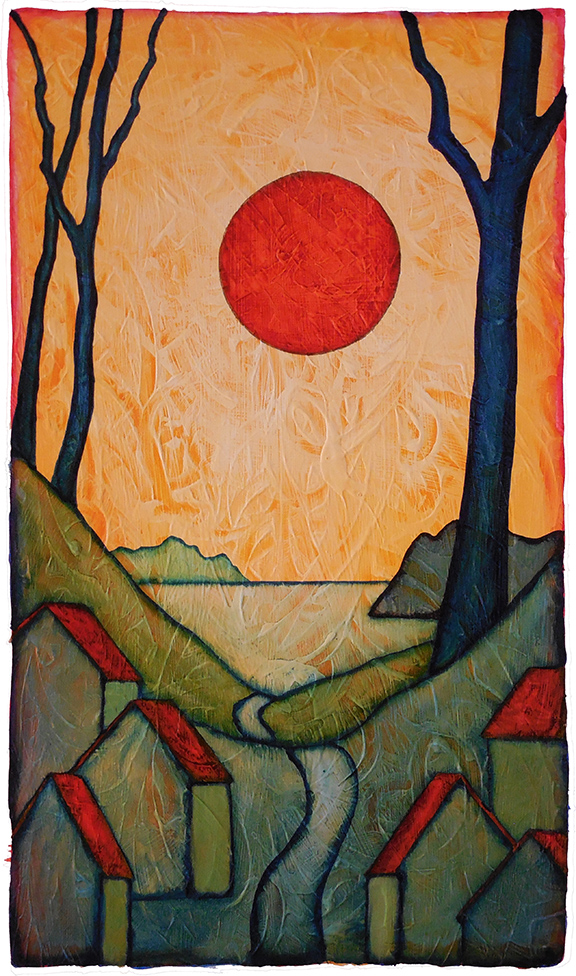
I find this true for the painting shown above, The Solace of Light, which hangs at the Principle Gallery now as part of my current show there. It seems as though each time I look deeply at this piece, my relationship with it changes or, at least, moves to a different place within me.
Sometimes it feels superficial as though I am responding solely to the colors. Other times, it is deeper and I feel drawn into the forms of the scene, barely recognizing the colors. I am in and of that place in those instances.
Closer to where I want to be. Or think I want to be.
Make your interests gradually wider and more impersonal, until bit by bit the walls of the ego recede, and your life becomes increasingly merged in the universal life. An individual human existence should be like a river — small at first, narrowly contained within its banks, and rushing passionately past rocks and over waterfalls. Gradually the river grows wider, the banks recede, the waters flow more quietly, and in the end, without any visible break, they become merged in the sea, and painlessly lose their individual being.
–Bertrand Russell, How to Grow Old
********************************
Bertrand Russell (1872-1970) is one of those names I come across whose words seem to always make incredible amounts of sense. That is, the words and thoughts that my pea-sized brain can comprehend. Russell was one of those multiple threats, with great proficiency and expertise in a number of fields– history, mathematics, philosophy, logic and political activism, to name just a few. I guess you might just call him a deep thinker or a great mind.
The words above are from a short selection, How to Grow Old, from a collection of his essays, Portraits From Memory and Other Essays. It’s a surprisingly down to earth collection of observations about facing the aging process.
It was the section featured at the top that caught my eye. I was entranced by this idea of going through life beginning as a narrow, rushing stream that gradually widens and slows into a river that heads to the gathering of waters that is the sea.
It made me think of my own father’s life and how he never actively tried to widen his course, never sought to expand his interests in his later years. If anything, his stream somehow became narrower, even as it slowed.
That might sound like harsh criticism to some but it’s a simple observation and I think if it were presented to him at a point when he could still understand what you were trying to say, he might even agree. He might not like it and might tell you to mind your own effin’ business but he probably wouldn’t argue the point. Not much interested him as he aged and the things that once brought him a degree of enjoyment, such as sports, no longer interested him.
Not much did. His stream narrowed and slowed.
It is one of the things about my dad’s life that sadden me. On Father’s Day, I see all of the glowing tributes to other people’s dads, about all the good traits handed down to them from their dads and I am a bit embarrassed. Because for all the worthy traits I have inherited– and there are a few– it is the object lessons learned from the deficits in his life, behaviors and traits I want to avoid, that I find most valuable.
And while there are more than a few of these from which to choose and which I will not go into here, this narrowing of one’s stream is the one I seek most to avoid. I think I have been able to do it thus far. But, even so, though there are days when some genetic predisposition start whispering to me to stop paying attention, to show no interest.
To just sit and stare into the void. To slow my stream and narrow the banks.
But I fight that feeling. Fight it hard.
Years ago, I echoed Russell’s words, writing here that I sometimes see myself and my interests and knowledge as a river– a mile wide and an inch deep. I am still as shallow but I am forever trying to carve my course wider and maybe just a bit deeper.
I slept and dreamt that life was joy. I awoke and saw that life was duty. I worked — and behold, duty was joy.
–Rabindranath Tagore
**********************
When I first read the short poem above from the great poet and philosopher Rabindranath Tagore some time ago, it struck a chord with me. It so simply, in just a few lines, put across an observation that takes most of us a lifetime to realize. That is, if we ever do realize it.
Duty was joy.
But what is duty? Is it in being a good parent? A faithful spouse and a loyal friend? Is it in what we do to make a living? Or is it in being decent and caring human being?
Perhaps, it is how our lives touch the lives of others? Could that be a duty?
I don’t know for sure. Most likely joy is not a one size fits all proposition.
My own feeling is that duty is much like having a purpose, a reason for living. I remember reading Holocaust survivor Viktor Frankl‘s transcendent book, Man’s Search For Meaning, which described his time in the Auschwitz death camp. He observed that those who were able to survive the horror were those who somehow had a purpose for their life, who saw a future that they needed to reach ahead for. This purpose, even a modest one, often gave them the drive needed for survival, creating a path forward for them.
In the year after being liberated from Auschwitz, Frankl gave a series of lectures that were the basis for his book. In one he spoke of Tagore’s poem and that final line: Duty was joy:
So, life is somehow duty, a single, huge obligation. And there is certainly joy in life too, but it cannot be pursued, cannot be “willed into being” as joy; rather, it must arise spontaneously, and in fact, it does arise spontaneously, just as an outcome may arise: Happiness should not, must not, and can never be a goal, but only an outcome; the outcome of the fulfillment of that which in Tagore’s poem is called duty… All human striving for happiness, in this sense, is doomed to failure as luck can only fall into one’s lap but can never be hunted down.
In short, lasting joy and happiness cannot be pursued as a goal on their own, without a responsibility to some higher purpose.
I am writing this because sometimes I need to be reminded of this. I have been struggling at times recently in the studio, seemingly fighting with myself to find something that just doesn’t seem to be there. The harder I tried to find it, the further away it seemed. It was like I was looking for something to quell my anxieties and bring me some form of easy happiness. To bring me effortless joy.
I should have known better. Yesterday, I just put down my head and worked without thinking about the end result. I focused solely on my purpose in each moment, the task at hand. Concentrating on doing small and simple things with thought and care was my duty, as it were. As the day went on, my burden felt lessened and I began to feel joy in the work, joy in small aspects that I had been overlooking in prior days.
It was a satisfying day, one that left me feeling that I had moved in some way toward fulfilling a purpose. It may not be a grand, earth-shaking one but it doesn’t need to be. It is mine. My purpose. My duty.






 Redtree Times