Feeds:
Posts
Comments

Posts Tagged ‘Quote’

Look up at the stars and not down at your feet. Try to make sense of what you see, and wonder about what makes the universe exist. Be curious.

–Stephen Hawking

++++++++++++++

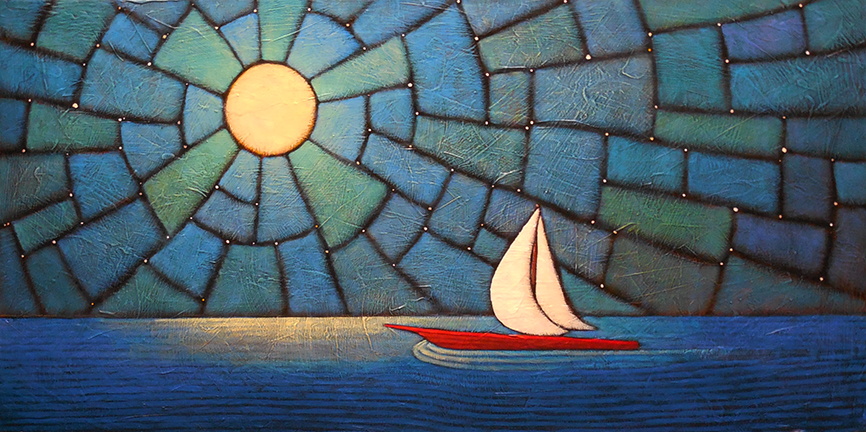
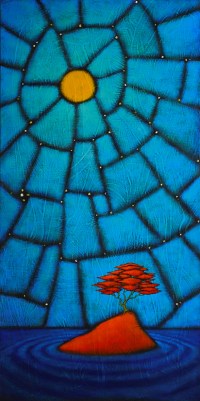
I’ve been working on a series of paintings recently for my June show at the Principle Gallery that feature fragmented skies with stars appearing at their junctures. Some are very geometric and angular while some– like the one, In the Stars, shown here–have more organic shapes with more randomness in their arrangement.

Both satisfy some part in me, in their creation and in the appreciation for them I feel once they reach a point of completion. Maybe it’s that there is a meditative stillness in both aspects. Painting them definitely creates a deep sense of quietude for me that I also find in studying them after they are done.

It is the kind of stillness that spurs wonder and curiosity, the kind that makes one look into the night sky with hopes that extend beyond our present time and place. Are we alone in this vast universe or are we the end-product– the flowers, perhaps — of one of those shining stars?

I don’t know and most likely will never know. But I will always have the need to wonder…


Read Full Post »

Ad Marginem C 1930 Painting by Paul Klee; Ad Marginem C 1930 Art Print for salePaul Klee On Modern Art 1924This excerpt from On Modern Art, the 1924 treatise from the great Swiss artist Paul Klee is a bit more than a quote but since this is about art we’ll be a little flexible in our definition. And that, I believe, would please Klee, whose works often defied definition.

I know for me, he was a big influence if only in his attitude and the distinctness of his work. I always think of his work in terms of the color– sometimes muted yet intense and always having a melodic harmony to it.

It always feels like music to me.

I like his idea that the world is in the process of creation, of Genesis, and that it is not a final form. It allows for visionary work, for imagining other present worlds that extend beyond our perception because, as he writes, In its present shape it is not the only possible world.

And to me, that is an exciting proposition.

Read Full Post »

Read Full Post »

++++++++++++++++++

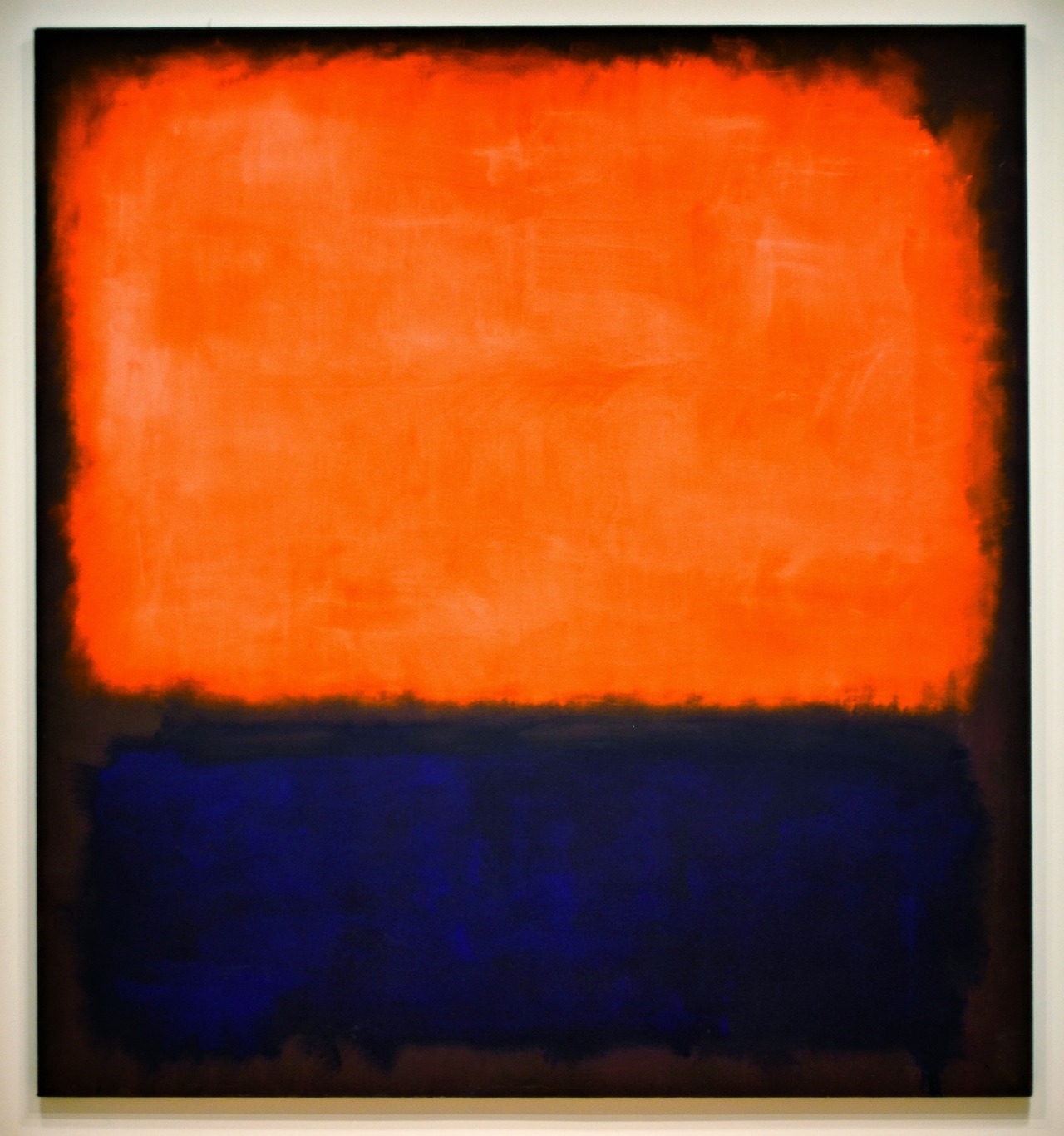
“Art is such an action. It is a kindred form of action to idealism. They are both expressions of the same drive, and the man who fails to fulfill this urge in one form or another is as guilty of escapism as the one who fails to occupy himself with the satisfaction of bodily needs. In fact, the man who spends his entire life turning the wheels of industry so that he has neither time nor energy to occupy himself with any other needs of his human organism is by far a greater escapist than the one who developed his art. For the man who develops his art does make adjustments to his physical needs. He understands that man must have bread to live, while the other cannot understand that you cannot live by bread alone.” 

― Mark Rothko, The Artist’s Reality: Philosophies of Art

++++++++++++++++++

Read Full Post »

Schiele -Eternal

Egon Schiele- Setting Sun 1913


+++++++++++++

Art cannot be modern. Art is primordially eternal.

Egon Schiele

++++++++++++++++


Read Full Post »

+

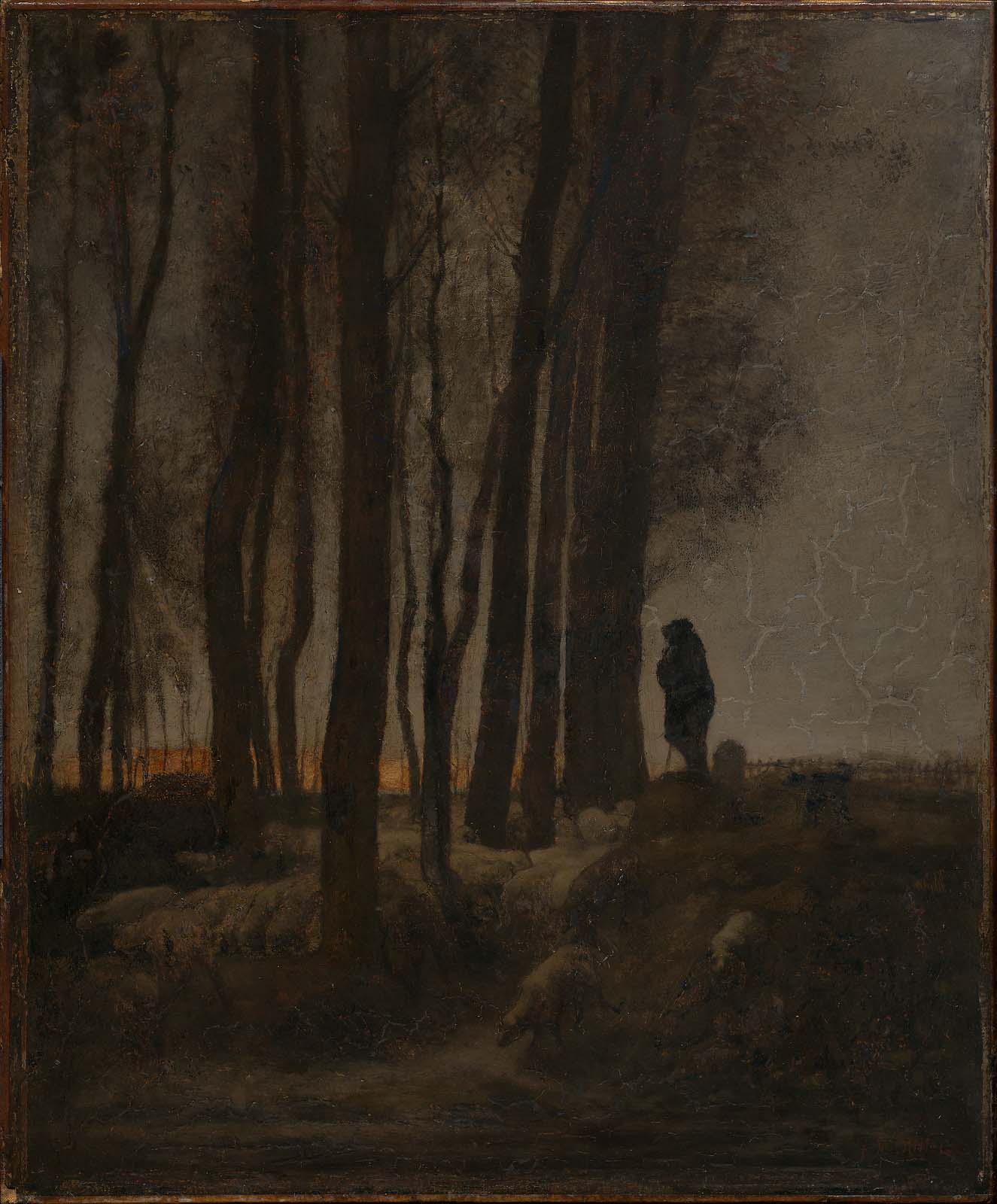
It is the treating of the commonplace with the feelings of the sublime that gives to art its true power.

–Jean-Francois Millet

++++++++++++++++

Jean-Francois Millet (1814-1875) is mainly known for his peasant scenes painted in the genre of the Barbizon school, of which he was an originator.  This genre marked the move from Romantic painting to Realism which depicted the reality of all aspects of the world, including the rural working class which were seldom portrayed heretofore.

This work played a huge role in the evolution of modern art as a number of artists from subsequent generations ran with this work , adding their own voice and style to the subject matter. Van Gogh, for example, directly copied a number of Millet works, such as The Sower below, in his own distinct style.

I am not moved by all of Millet’s work. Some of it feels generic but I think that is understandable as its style was so influential that it was emulated, creating a vast body of similar work. But there is something in a segment of his work that I feel is truly visionary in a way that lends credence to the statement from Millet at the top of the page. Here are a few of my favorites.

Read Full Post »

Brancusi on Fame

++++++++++++++

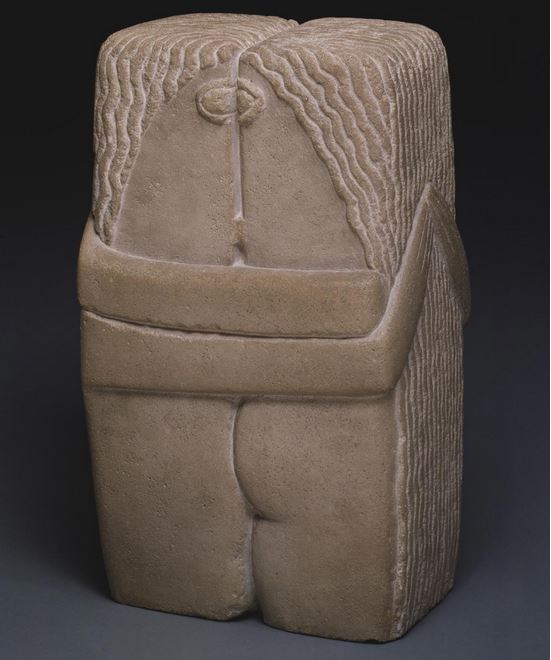
Brancusi The Kiss Phila Museum of ArtOne day in Switzerland, in front of a beautiful mountain there was the most beautiful of cows, and she was contemplating me in ecstasy.  I said to myself, ” I must be someone if even this cow admires me.”   I came closer; she wasn’t looking at me, and she was relieving herself.  That tells you what you need to know about fame.

–Constantin Brancusi

*************************

This was a favorite anecdote of famed sculptor Constantin Brancusi(1876-1957) concerning an incident as he took the long trek on foot from Bucharest to Paris as a poor young man seeking fame and fortune. He found both but the influence of his peasant roots in Romania remained with him.

His story of the unimpressed Swiss cow is a pretty good reflection on the nature of fame, even the type acquired through great deeds. Fame is something created by other people, not something that is displayed on oneself. When all is said and done, we’re all pretty much the same– famous or not– in the eyes of that peeing cow.

It reminds me of when I first began showing my work in a gallery while I was still working as a waiter in a pancake house. I would go to openings and people would praise my work, telling me how great I was. I could barely get in my car to drive home because my head was so big by the end of the evening. But at 6 the next morning, there I was, pouring coffee for truckers and families who were less than impressed by the praise lavished on me the night before.

A big pin prick that brought my head quickly back to a more normal size.

Those folks at the restaurant were my peeing cows.

It’s a lesson that I try to remember when things are going too well and I find myself beginning to believe that I am something more than what I really am– a simple schlub watching a cow pee.

Read Full Post »

+++++++++++++

Things are as they are. Looking out into it the universe at night, we make no comparisons between right and wrong stars, nor between well and badly arranged constellations.

Alan Watts

++++++++++++++++

I wasn’t planning on showing this newer painting for a while. But I came across this lovely piece of music and this painting seemed to pair perfectly with it, at least to my eyes and ears.

The painting is an 18″ by 36′ canvas that I call Starmap and is part of my annual show at the Principle Gallery in Alexandria which opens June 1.

I have been working on a series of paintings like this, with blocks of color making up the sky and stars as points of light showing at the intersections of these blocks. I love working on these pieces. They require an emptying of the mind with a focus solely on what is before you. There’s this interesting sense of constant problem solving that bounces from making each form correctly and balancing that form within the whole composition. I continually go back and forth from tight focus to wide focus.

I probably can’t properly explain it but for me, it is an exhilarating process as each added form and layer of color, each poke of light from the stars, subtly transforms the piece into something more than I was expecting. It feels more complete and full than the first thoughts and brushstrokes that initiated the painting, leaving me with a giddy kind of satisfaction. I know that this has been the case thus far with each of the paintings in this series.

Now for this Sunday morning music, I thought this wonderful piece, Nocturne, from young Hungarian guitarist Zsófia Boros paired up beautifully with the feeling that this piece creates for myself. I’ve listened to it several times this morning and it just seems right.

Give a listen and have a great Sunday.

++++++++++

Read Full Post »

Life has no meaning unless one lives it with a will, at least to the limit of one’s will. Virtue, good, evil are nothing but words, unless one takes them apart in order to build something with them; they do not win their true meaning until one knows how to apply them.

– Paul Gauguin

***********************

Busy, busy, busy this morning but I wanted to share the quote above from Paul Gauguin. I think it pairs perfectly with the  Gauguin painting above it, one of my favorites, which is titled Vision After the Sermon or Jacob Wrestling with the Angel.

Many of us have noble ideas of how we want to live our lives but all too often we fail to live up to the words that we attach to these aspirations. Virtues such as good, kind, thoughtful and so on. But living up to those words takes, as Gauguin points out, is much more than a matter saying that we are good and kind and thoughtful. It requires the will to put those words into action each new day.

And that struggle is like Jacob wrestling with his angel throughout the night.

That’s a short interpretation but, like I said, I’ve got things to do. But before I get to it I want to share a few more words from Gauguin that made me laugh this morning:

We never really know what stupidity is until we have experimented on ourselves.

Unfortunately, I know from personal experience that this is true. Maybe that’s what made me laugh.

Have a great day.

Read Full Post »

Do not try to do extraordinary things but do ordinary things with intensity.

–Emily Carr
*****************
Emily Carr was one of the first artists that came to mind when I saw the question last week that asked if you name five female artists. She is most likely off many of your radars but I am sure some of my friends to the north in Canada recognize her name very well.
 –
Carr was born in 1871 and died in 1945 in Victoria in British Columbia. Aspiring to be an artist, she was trained in the tradition of classical painting methods early in her life. But the first decade of the 20th century saw her work take a radical turn. After a period of time in Paris, influenced there by the Fauvist and Post-Impressionist with which she met and painted, her work took on bolder colors and more expressive brushwork.
 –
She took this new found energy back to Canada where she opened a gallery in Vancouver in 1912. The gallery faltered as she failed to see the response that she had hoped for. Dejected, she basically put down her brushes for the next 15 years, doing little painting.
However, some influential people were aware of her work, especially paintings she had executed with the native tribes of Canada as her subjects, and in 1927 she was invited to show a group of work in an exhibit about the tribes of the West Coast at Canada’s National Gallery in Toronto. It was here that she met Lawren Harris and  other painters who made up the fabled Group of Seven, which were several great Canadian painters of the time who had distinct modernist styles. I have featured the brilliant work of Lawren Harris here several times.
 –
Encouraged by Harris, who proclaimed her as one of that group, Carr was rejuvenated and for the remainder of her life worked with great vigor, trying to capture the spiritual essence of her native homeland. Like Maudie Lewis, Carr is a Canadian national treasure.
 –
I am enchanted by much of her work and the spirit that is imbued within it. This has been a very cursory look at her life with just the highlights and a few images and a video. Please do some research on your own. It’s well worth the time.


Read Full Post »

« Newer Posts - Older Posts »