Feeds:
Posts
Comments

Posts Tagged ‘Ralph Waldo Emerson’

Finis Terrae (Land’s End)— Coming to Principle Gallery, June 2025


Nothing is secure but life, transition, the energizing spirit.

–Ralph Waldo Emerson, Circles (1841)


There is a lot to discuss from the 1841 Emerson essay, Circles, from which the words above are taken, much of which is applicable to the new painting above them. But that will have to wait for another day. Today we’ll focus on just this small part of his essay.

This new painting is 15″ by 30″ 0n canvas and is included in my upcoming solo show, Entanglement, opening June 15th at the Principle Gallery. I chose its title, Finis Terrae (Land’s End), because the term Land’s End, in whatever local language is spoken, is employed in a variety of locales around the world to signify the furthest point one can venture in a particular direction before reaching the sea. I saw that small rocky island with its blue house as being such a place, an endpoint, a place where one has reached the end of one realm and can only proceed by venturing into a different and unknown realm.

A transition point from one state of being into another.

I often think of those first ocean voyagers who left the Land’s End of their countries and proceeded out into the ocean without knowing where they might end up or what might lie in store for them. Theirs was a venture into the unknown and in order to survive and continue their journey, they had to make the transition from a life bound by soil and stone, forests and fields, a land with its own rhythms and cycles, to a watery life ruled by the wave and the wind, one under the unrelenting gaze of the sun and the moon.

Much of what they knew from their prior life on land now meant little in the new world in which they traveled. They lived by different rhythms now with different parameters and concerns. In order to survive, they truly underwent a transition from one state of being to another.

I see a similar kind of transition here. It’s not necessarily about departing land on a sea voyage. No, it’s a different sort of voyage, more of a spiritual quest that seeks a sense of unity with the greater powers of the universe, which is the basis for much of the work in this show. 

For some, there comes a time when they recognize–though they will never fully understand it–the endless power and chaos of the universe and realize that they and everything they see and know are products of that churning tangle of energy. They come to know that at some point they will depart this realm to rejoin with that greater power. 

They will leave this Land’s End and head out into the unknown for a reunion, a homecoming, of sorts.

A transition from one state of being to another.

And that’s what I see in this painting. It is neither sad nor happy. It just is as it is. It has a shifting sense of what it is, one that reflects back to me my own mood at any time. And I like that reflective quality. That may be the source of the vast appeal this piece holds for me. 

As with Emerson’s essay, there’s a lot more that could be said. For now, let’s leave it here with a song from English folk singer June Tabor, whose songs I have shared here in the past. This song is called, of course, Finisterre. It is a beautiful tune and concerns a departure from a port called Santander, in Land’s End, Finisterre, Spain. Wonderful atmosphere in this song. Thought it paired well with this painting.


Read Full Post »


GC Myers- And the River Flows 2024

And the River Flows– At the West End Gallery

Our American character is marked by a more than average delight in accurate perception, which is shown by the currency of the byword, “No mistake.” But the discomfort of unpunctuality, of confusion of thought about facts, of inattention to the wants of to-morrow, is of no nation. The beautiful laws of time and space, once dislocated by our inaptitude, are holes and dens. If the hive be disturbed by rash and stupid hands, instead of honey, it will yield us bees.

–Ralph Waldo Emerson, Prudence (1841)


Just going to share the words of Emerson, the image of a recent painting, and a song that will serve as this week’s Sunday Morning Music. It’s a song that I was surprised to learn was last shared here over ten years ago. I always think that I just recently shared it. Maybe because it so often feels appropriate to the time.

The song is What’s Going On from Marvin Gaye. It is from his 1971 album of the same title that is considered by many as one of the greatest albums of all time. This is a poignant and elegant song of protest that was written by a member of The Four Tops, Renaldo “Obie” Benson, who witnessed a violent confrontation between police and anti-war protesters in Berkeley in April of 1969, while on the band’s tour bus. He couldn’t understand what he was seeing, why the police were brutally beating on those kids, kids much like those being sent every day to fight in Viet Nam. It made no sense to him, and he ended up writing this song based on what he witnessed with Motown songwriter Al Cleveland.

His bandmates vetoed recording the song, saying that they didn’t want to record a protest song. Benson later spoke of his response, saying, “My partners told me it was a protest song. I said ‘No, man, it’s a love song, about love and understanding. I’m not protesting. I want to know what’s going on.’

It’s a great song, mixing great emotional impact with a cool, rational detachment that seeks a calm response to the question, “Why?”


Read Full Post »

GC Myers-  In the Pocket of Time sm

In the Pocket of Time, 2014


The crystal sphere of thought is as concentrical as the geological structure of the globe. As our soils and rocks lie in strata, concentric strata, so do all men’s thinkings run laterally, never vertically.

Ralph Waldo Emerson, The Method of Nature (1841)


I came across the passage above from an Emerson essay and decided to look it up to find the context from which it came. It originated in an essay/oration that was written in the 1839-1841 period and was titled The Method of Nature.

I am still trying to glean the exact meaning of the essay but the section that contained the line above speaks about how those who, in any time, claim to have the answers to existential questions or insights into the deepest concerns of mankind eventually reveal themselves to be superficial. Their thoughts seldom, if ever, dig deeply enough to reveal eternal truths that might unify all people and times.

As he put it, their thinking runs laterally, not vertically.

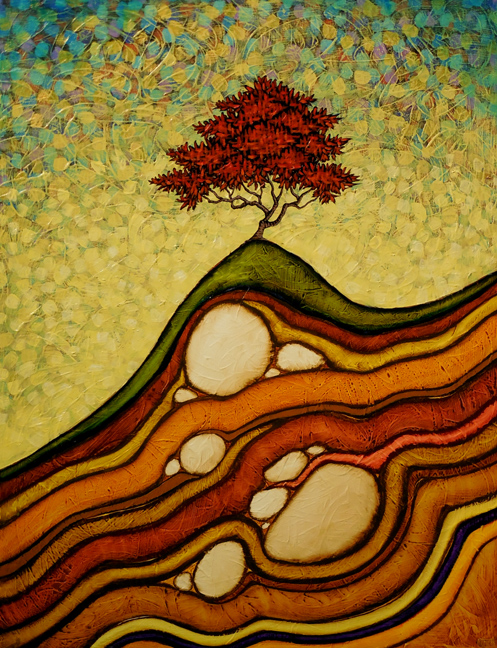
I immediately felt that this might be applied to the painting the top, In the Pocket of Time. It’s a painting (30″ by 24″ on canvas) from 2014 that I brought to the Principle Gallery this past weekend as part of a group of work featured at my Gallery Talk there. It is from a subset of my Archaeology series that I call my Strata work. It is much like the Archaeology pieces without evidence of humans, focusing instead on the layers below the surface.

This particular painting from that Strata series has been with me for a while now. It hung for the last few years in a back bedroom/storage space of my studio. It reminds me of fine wine as it seems to get better with time. I am more and more struck by its surface finish and the rhythm of the strata, as well as how well it transmits its feeling and message from the wall. It’s a piece that speaks directly to me.

Putting Emerson’s thought to it deepened my appreciation of it. I could see in it how we deal always with what is presented on the surface and how seldom we recognize how much more there is to discover if we would only dig a little deeper.

That might be a gross simplification. Or not. Who knows? The words and the mage just seemed to click for me and maybe that’s enough to say.

Let’s tie this up with some music. Here’s a 1992 song from Peter Gabriel titled Digging in the Dirt.  The video is from the same time frame as his Sledgehammer song/video and, like it, this video has some interesting visuals.


Read Full Post »

GC Myers--Facing Mystery 2021


Faith and love are apt to be spasmodic in the best minds: Men live on the brink of mysteries and harmonies into which they never enter, and with their hand on the door-latch they die outside.

–Ralph Waldo Emerson, Letter to Thomas Carlyle, March 1838


I think that the words above from Emerson to Scottish philosopher Thomas Carlyle perfectly fit the vibe I get from the painting above, Facing Mystery, another new painting now hanging at the Principle Gallery.

So often we avoid following the paths of both those mysteries and aspirations that haunt us. We often face, or worse yet, create barriers– here it is a forest of red that seems dark and deep– that we use as an excuse for staying in our safe and consistent space.

Close to home or as Emerson put it, with their hand on the door-latch.

It’s understandable. I don’t fault anyone for wanting to stay in their own safe and secure comfort zone. I might be a prime example of that right now, sequestered in my own dark forest, panicked sometimes at the thought of venturing outside it. Luckily for me, mysteries and aspirations as well as the harmonies to which Emerson refers are close at hand here.

For the most part. But even as I rationalize my own safe existence, I know there are more mysteries and harmonies, with answers and depths to be added to my being, out there to be found if I can only shake free of my own door-latch.

That might be the existential question here: Are we willing to face and follow the real mystery of our lives?

I don’t have an answer for myself yet.

I am hopeful and feel willing but find myself still holding onto that door-latch of that simple little house.


Facing Mystery is part of Between Here and There, my current solo exhibition at the Principle Gallery in Alexandria, VA. The show, my 22nd annual at the Principle Gallery, opened June 4th and hangs there until the end of this month.

ΩΩΩΩΩΩ


GC Myers- Facing Mystery Principle Gallery 2021 Catalog page

Read Full Post »


“At times the whole world seems to be in conspiracy to importune you with emphatic trifles. Friend, client, child, sickness, fear, want, charity, all knock at once at thy closet door and say,—’Come out unto us.’ But keep thy state; come not into their confusion. The power men possess to annoy me I give them by a weak curiosity. No man can come near me but through my act.”

Ralph Waldo Emerson, Essays of Ralph Waldo Emerson


In my Gallery Talk I spoke about the struggle to go inside myself to create in these crazy days. The outer world and its many problems seems to be keeping me from the inner. It’s a frustration that more or less paralyzes me, requiring me to go put in a lot of extra effort just to get down to work.

I am trying to reconcile this, to somehow get past this feeling.

I came across this snippet above from Emerson and it reminded me that I am the one letting the outer world in. Oh, I know you can’t keep it completely out but I was the one opening the door and inviting it in. I was the one who listened to it as it went on about its problems and thought I could somehow help it out, foolish as that idea seems when I write it out. I went, as Emerson writes, into their confusion.

It also reminds me that I get to choose how I respond to the outer world. And being paralyzed is not a choice. It’s a refusal to choose.

So, I choose to shed the paralysis, to get back to work, to explore those inner paths once more. It’s my choice and what I do.

We all have that power to choose how we react to our own forms of paralysis, fear, anger, frustration and so many other negative aspects of our world. Most likely you don’t need to hear this. You probably know this as well as I. But I know I sometimes fall out of rhythm and have to be reminded once in a while.

The painting at the top is from a few years back and lives now with me in the studio. It’s one of those pieces that really hit high notes personally for me right from the moment it took form on the easel. It’s one of those pieces that surprises me in that it hasn’t yet found a home but also please me because I get to live with it for a bit longer. I thought it echoed with the words of Emerson today. It originally echoed with the words from the Rudyard Kipling poem after which it is named, If.

I was going to include the poem here in print but here’s a fine reading of it by actor John Hurt complete with the words shown. And some powerful black and white images.

Have a good day and choose well.


Read Full Post »

****************

“Rings and jewels are not gifts, but apologies for gifts. The only gift is a portion of thyself. Thou must bleed for me.”

Ralph Waldo Emerson, Gifts: An Essay

****************

I came across this essay, Gifts, from Ralph Waldo Emerson which is actually a practical guide to gift giving and receiving, well suited to the time in which it was written in 1844. I particularly like the line that states that rings and jewels are but apologies for gifts.

I have never looked upon a gift as an apology for not giving more of myself but when I really closely I find there is truth there. It is so much easier, so much less revealing to not truly give from ourselves and to simply go to the shops (or online these days) to acquire what often amounts to a poor symbol of what we might really feel for the person receiving that gift.

We’ve become accustomed to accepting these apologies because it excuses our own apologies to others. It’s to the point that we don’t know how give of ourselves nor do we know how to accept or acknowledge a gift that is really a true portion of the giver.

How do you do that? How do you bleed for someone else? Is it in the words of Emerson, as he continued after the quote above: Therefore the poet brings his poem; the shepherd, his lamb; the farmer, corn; the miner, a gem; the sailor, coral and shells; the painter, his picture; the girl, a handkerchief of her own sewing. This is right and pleasing, for it restores society in so far to its primary basis, when a man’s biography is conveyed in his gift…?

I don’t know.

I used to think that giving my paintings were like giving a piece of myself. It certainly fits in with Emerson’s words as he used just that as an example. It certainly seems like it is a piece of the person creating it.

But is it any more than a different sort of apology? Maybe an apology for not giving of my time and self to people directly? An apology for keeping my distance?

Sometimes I think that’s true. But there have been times when I have been given something made by another and I certainly don’t look at it as an apology in any way. I am just touched that they took the time and made the effort to even think of me in any way.

For example, I received a Christmas card from a friend whose two daughter drew red trees inside the card. That is as precious as any gift I could have received.

So where does that leave us?

I don’t know.

I am just thinking out loud this morning. Tomorrow I might look at this and ask myself what the hell I was thinking. You can never tell.

Bottom line: You can’t go wrong by truly giving of yourself. Bleed for someone, okay?


Read Full Post »

The only person you are destined to become is the person you decide to be.

― Ralph Waldo Emerson

***********************

The painting above, a 24″ by 18″ canvas, shares its title with that of my solo show, Self Determination, which opens this Friday, July 14, at the West End Gallery in Corning.

That title, Self Determination, refers to a thought that came to me some years ago. It was that we have a choice in deciding what kind of person we want to be. While we can’t always change circumstance, we have the ability to change our course, our outlook, our reactions and so many other things that pertain to how we are defined.

It’s not an original idea, as Emerson’s concise words above attest. I’m sure I could dig around and come up with the same idea from the time of Socrates or Plato.

No, it’s a universal truth. But it is one that, while seeming  self evident, is overlooked by the majority of people. We often live our lives with little consideration given to our actions and reactions as we stumble through our precious time in this world.

We just accept who and what we are as a given, even when we are less than pleased by what we see.

I know that was the case for me for much of my earlier life. Not that I didn’t think about my choices. No, I just never thought about what my decisions might be if I were the person I wanted to be. Instead I often opted for short-sighted and expedient answers, usually those that required little effort or sacrifice on my part.

I didn’t often like or respect the person I was at those times.

But once I realized I could decide what type of person I wished to be, I began to ask myself conscious questions that set a new course for myself. Gradually, I began to move toward the person I chose to be. Oh, I am still quite a distance from that destination and I still find myself disliking the person I am at times. But I know now that I am headed in a direction that is of my design and not simply living life in a default setting, letting circumstances and the desires of other people dictate my actions.

And maybe that is why I am so drawn to the painting above. I feel it is a great example of what I have been trying to express with my work– that we have an ability to move beyond expectations and circumstances to become better versions of ourselves.

For me, I want to be that Red Tree, simply satisfied with its place in the world.

Read Full Post »

GC Myers- Come TogetherThe reason why the world lacks unity, and lies broken and in heaps, is, because man is disunited with himself.
Ralph Waldo Emerson

***********************

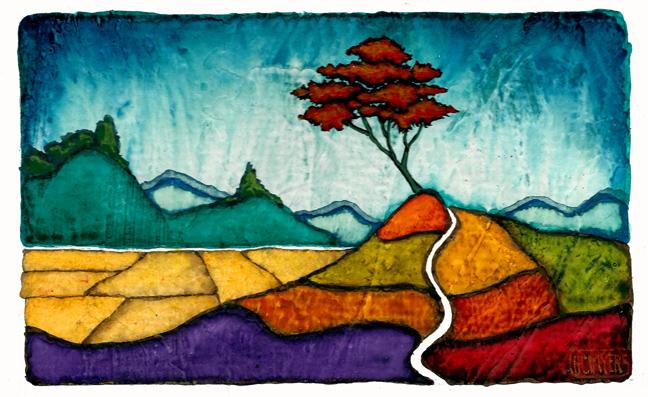
This new painting, a 12″ by 36″ canvas, that is headed to the Principle Gallery with me this weekend is called Come Together.  It’s a continuation of the island theme that has been running through my work as of late.

I think the words of Emerson above fit very much with what I see in this painting.  Though it appears to be two separate islands with trees linked by a bridge, I see them as having been once united and have somehow been separated.  In this case, it may have been the tumult of time where the seabeds rise and the mountaintops fall– many of the high peaks that we know are sedimentary rock, after all, raised from the bottoms of the oceans.

The disunity Emerson was writing about was man separating himself from nature instead of realizing that he is part of nature and operates best when he is united with it through order and reason in a sort of partnership.  It makes sense especially when you consider the way that nature reacts when we try to exercise our belief that we have dominion over it.

In the same essay, Emerson also wrote the following  that I think better puts this into context:

Nature is not fixed but fluid. Spirit alters, moulds, makes it. The immobility or bruteness of nature, is the absence of spirit; to pure spirit, it is fluid, it is volatile, it is obedient. Every spirit builds itself a house; and beyond its house a world; and beyond its world, a heaven. Know then, that the world exists for you. For you is the phenomenon perfect. What we are, that only can we see. All that Adam had, all that Caesar could, you have and can do. Adam called his house, heaven and earth; Caesar called his house, Rome; you perhaps call yours, a cobbler’s trade; a hundred acres of ploughed land; or a scholar’s garret. Yet line for line and point for point, your dominion is as great as theirs, though without fine names. Build, therefore, your own world.

We all have the ability to live within nature and to build our own world that reflects our spirit.  If only we can find unity with the nature that desires to be our partner.

Just remember, your world is what you make it.

***********

This painting will be with me at the Gallery Talk this Saturday, September 17, at the Principle Gallery.  It starts at 1 PM and  should be a good time.  There will be a drawing for the painting, Defiant Heart, which has been shown in the past couple of  posts. Plus there will be a few other surprises as well.  Hope to see you there!

Read Full Post »

Do not go where the path may lead, go instead where there is no path and leave a trail.

–Ralph Waldo Emerson

*************************

GC Myers- Trailblazer  I chose this little gem of advice from Emerson as the Quote of the Week because I thought it fit so well with the small painting above, a Little Gem itself.  It’s a small 4″ by 6″ painting that is called Trailblazer and is part of the Little Gems exhibit that opens tomorrow night at the West End Gallery in Corning.  I also chose it because those words fits so well for my own experience at the time I began showing my work for the first time, at this very same exhibit twenty years.

I was thrilled to have an outlet in which to show it publicly but was still in the process of finding a singular voice of my own–how my work would be styled.  Part of that process of finding this  was in determining what path I would follow with the work, whether I try to emulate the work of other painters I knew and admired.  That seemed like a natural path to follow, wide and well defined.

 But the path was also crowded.  Sometimes it was hard to distinguish yourself  and find a foothold among so many companions.  But if I set out on my own  that would not be the case.  On the the well-trodden path,  I would always be subject to comparison  and immediate critique.  Blazing my own trail would allow me to set my own pace and destination, define my own objectives.

Plus it would be my path alone.  And that was no small thing. In fact, it was a primary goal of  mine.   I had determined from my visits to museums that the work that stood out most for me was the work of artists who you could identify immediately from across the gallery space.  Looking at the shelves in front of me, most of the books are of the works of such artists, all who eventually set out on their own trails and created work from a world that was their’s alone.

I’m still on my path.  I’d like to think it departed from that wider, more traveled path sometime ago.  I can’t be the judge of that.  So I plug ahead with words of Emerson ringing in my ears and hope for the best.

Read Full Post »

In different hours, a man represents each of several of his ancestors, as if there were seven or eight of us rolled up in each man’s skin, — seven or eight ancestors at least, — and they constitute the variety of notes for that new piece of music which his life is.
―Ralph Waldo Emerson

*******************

GC Myers- Family Lines smThis is another newer painting that is headed to Erie for my show, Into the Common Ground,  in December at the Kada Gallery.  This 30′ by 40″ canvas is titled Family Lines with the Red Tree serving as the symbol of a family tree and the Red Chair acting as an offspring of it.  The broken segments of the winding path leading up to it represent for me the often arduous task of finding your connection to this tree while the light of the sky represents ultimate discovery and illumination.

I’ve often felt as though I had little definition of myself or my connection to the world through my ancestors.  My work as an artist has helped change this in many ways, giving me a portal for displaying who I am or  at least aspire to be in definition.  But my connection to my ancestors was always vague and hidden away beyond my knowledge.  I wondered who they were, what their stories held  and what traits they fed forward  through time to me.  I began to study my genealogy, hoping to discover some form of connection with the past that might help me better understand who I was in the present.  To discover what worlds the winding path that led to my own life traveled through.

It’s been a wonderful process that has given me greater connection with the past and with the history of this country and with those countries that gave birth to my ancestors.  Naturally, I am always drawn to the grand stories that are uncovered, the heroic and celebrated ancestors that I find myself hoping have somehow contributed some of their positive traits to my DNA.  But I am equally intrigued and touched by the simple and sometimes tragic tales that are uncovered.

I had earlier written of a great grand uncle who had lived his whole life in a county home for the infirmed. He was described in the censuses during his life as “feeble-minded” and he was unceremoniously buried  in an unmarked grave there at the county home.  I recently came across his death certificate and they listed him as a lifelong sufferer of epilepsy.  It made the story even more tragic in that this was perhaps a person who had a condition that would be treatable today.

I think of this person quite often.  His story is as much a part of that tree as those of  its more celebrated members.  It may not be the most beautiful leaf on the branch but it is there.  As Emerson says, we represent in some form a number of our ancestors and whose to say what part this ancestor plays in that piece of new music that is my life.

Read Full Post »

Older Posts »