Feeds:
Posts
Comments

Archive for December, 2009

This is the image I was searching for the other day when I was distracted by the portrait of Willie Nelson.  This is a scene from the very early 20th century at the railroad station in Forestport, NY, in the lower part of the Adirondacks.  It’s where my great-grandfather had his logging operations back then and maintained a home as well as a couple of other businesses.

As I’ve read about that area and that time I am struck by the contrast between then and now.  If you drive through the Adirondacks you encounter town after small town, all sleepy little affairs with hardly anyone around except for the seasonal tourists.  Forestport is one of those towns.  But back in the day, Forestport was a buzzing, vibrant town.  It had numerous mills, processing the trees coming from the Adirondack wilderness to supply the lumber to build the growing cities of the northeast.  There were huge numbers of loggers going into the forests every day — my gr-grandfather had 250 lumberjacks working for him at one time.  There were canal workers that transported the lumber with mules and horses down the Black River Canal to the Erie Canal.  There were boat-builders there who built the barges that traveled the canals and carriage builders to make wagons to haul logs and people.  These workers spawned a whole support network that created cheese factories, breweries, retail stores, restaurants and taverns, all employing numbers of other workers.

Everything was local, nearly everything produced nearby.  Ironically, the very canal and later highway system that allowed the town to ship out the resources that allowed it to grow were the beginning of the end, as new products from outside the local area were now easily shipped in on these transportation portals.  Products became more regional then national and most of the products consumed were no longer local in any sense of the word.

As the forests depleted from the voracious cutting, there were fewer and fewer loggers.  Fewer and fewer mills.  The canal was replaced by the railroad at first then the highway so the canal workers and boatbuilders became obsolete.  The newly popular car and truck replaced the local carriage builders.  And with the loss of these workers came the end of the need for the businesses that supplied and supported them.  The cheese factories closed.  The stores and restaurants were boarded up.  Slowly, the town dwindled until all that remained was sleepy little burgh that wouldn’t be recognizable to the residents from that time.

I’m not saying this time or that time was better or that it’s a crying shame that this place no longer is the same.  Things change.  For many reasons.  There are thousands of places like Forestport throughout the northeast and spreading through the midwest of this country, towns that are like little dying planets whose heyday has passed.

The interesting thing for me is that bustling, life-filled world is barely remembered, only existing in a few photos and a few writings.  Makes me wonder how what we view now as the centerpoints of our lives will change and if, a century from now, this time will exist only in memories and images that may be of little interest to the citizens of that time.

Of course, Ted Williams, Walt Disney and I will be there to remind the people then of this time, after they revive us from our cryogenically induced naps.

Read Full Post »

This is a painting that is currently being displayed at the Kada Gallery in Erie, PA.  It’s a 36″ by 48″ piece on masonite that is part of my Archaeology series, titled Archaeology: A New History.

It has a real aged, sepia-tone feel that is different than most of the pieces in the series, a feel which is central to my own feelings on the group.  I see the items under the surface as a type of old family photos, evidence of time here on this earth.

The fairly large size of the painting gives it a bit of oomph and emphasizes the simplicity of the overall composition, letting the tree do all the speaking from across the room.  But as you close in the subterranean objects begin to take shape and tell their own stories.  The whole idea is to present a variety of items and let the reactions of the viewer form a narrative for the underground part of the painting.  Hopefully this jibes with the overall feel of the piece for the viewer.

Well, that’s the idea…

Read Full Post »

A Face

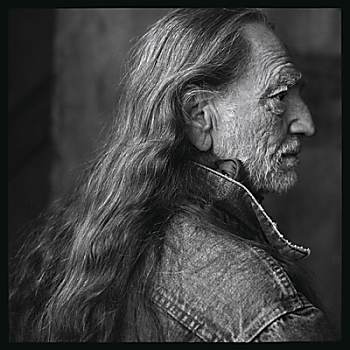
I was looking online for an image for today’s blogpost when I came across this image of Willie Nelson photographed by the great Annie Leibovitz.  I completely lost my train of thought and was completely entranced by this image.  What a face.

It immediately reminded me of a post from the other day, Unafraid, that was about a simple painting of mine with a tree blowing in silhouette against a colorful sky of slash strokes.  The post was about how the lack of details let the image tell its own story, create its own feel without filter of extraneous information.

Just like this face.

This face is a national treasure, a compendium of tales.  Every moment of hard living is etched into that face, out there for all to see.  Unafraid.

I’ve always been interested in how people’s lives are reflected in their faces.  When I worked at the restaurant we would try to guess if  incoming guests would want to sit in the smoking or non-smoking section.  The smokers, particularly the women, were usually pretty easy to spot with the many small vertical wrinkle that formed around their mouth and the way the smoking affected their skin in general.  It was usually drier and lacked robust color.

You can tell Willie’s smoked just a bit in his time.

I look at that face and I feel a little better about the increasing number of folds and creases I find every new day in my own face.  Each line is a testimony to a little more time spent here, another day of experience.  In this culture of constantly seeking the appearance of youth, I see them as badges of honor and hopefully I can wear them with pride, unafraid.

Here’s a little Willie…

Read Full Post »

I came across this old photo from the early 70’s and was instantly sent back in time. The two gents in the shot from a Christmas season long ago are my Uncle Joey (holding the Seagrams 7 bottle– I’m not sure that he was just mugging for the camera) and Jack Reynolds, who everyone called Fat Jack , Jackboy or, as my Dad would say, Jackeee. You needed at least three e’s to get the full effect.

In 1972, we moved from one edge of our county to the other, to a little remote brick house on a hilltop plateau where the wind always swirled and the view went for dozens and dozens of miles, across the hilltops down into northern Pennsylvania. It was exquisitely quiet there, often many hours passing before a car might appear on the narrow road.

My aunt Norma and her husband, Bob, ran a dairy farm just over the ridge and Fat Jack would often be seen there tinkering with the equipment, his short, round body rolling around in the dirt under tractors in his ever present bib overalls, crudely cut off at the cuffs to accommodate his short legs.

Jack and his dad lived at the bottom of the hill in a home that his father had started building in the 1950’s. At the time when Jack’s mom died, they had only finished the basement and that is where they stopped. Jack and his father lived in the small walkout basement, a place that had a dark and dank appearance when you drove by.

Jack was in his 20’s when we first met him in the early 70’s and didn’t have a driver’s license. He could seen chugging up the hill on an old Ford tractor pulling a trailer with a large collection of his tools. Jack absolutely loved tools of any sort. Any spare money he earned went directly towards buying tools, the tool department at Sears being the primary recipient of his spending.

Jack couldn’t read or write very well, if at all, but he had a natural ability for figuring out how things worked. He couldn’t read the words but he could read diagrams and schematics like they were his first language. This ability made him a valuable asset to a farm where there are always things in need of repair. Bob was always asking him to work on this or that at the farm.

But if Jack didn’t want to do something for whatever reason, he would just say “Nope” with a grin and pick up his tools. But he’d stick around.

When we moved up on the hill, Jack started coming to our house to do a few repairs there. He took an instant attachment to my dad and I my dad took to him as well. He became a regular fixture at our house, often eating dinner with us or drinking a beer with Dad. Jack was not big on hygiene and was always carrying a little– no, a lot of dirt and grease on his clothing from playing with machines. Night after night he would plop himself in one of my mother’s upholstered chairs to the point that there was a dark, greasy line on the arms of the chair where his belly would rest. It drove Mom crazy and she would yell at him ( she wasn’t shy about yelling in her house) but she would never think of not letting him sit there or at our dinner table.

Bob, my aunt Norma’s husband and a constant needler of people, called Jack my dad’s third son and would often ask when stopping in, “Where’s the fat son?”

Eventually, after his own father died, Jack parked his tractor and started driving an old yellowish Ford Econoline van packed with his tools. He didn’t have a license but that didn’t stop him from buzzing around the hills around us, being well known to most of the farms in the area. Dad, who was with the Sheriff’s Department, turned a blind eye although a few years later he would help Jack get a driver’s license and assist him in finding work as a maintenance man at a local nursing home. He seemed to be thriving.

Fat Jack passed away sometime in the 1980’s when his Econoline slid off the road and hit a viaduct. In the impact,  his tools were thrown forward against him. He probably would have appreciated the irony of it. Might have even been happy that it was his tools that ended his life.

His basement home is no longer there, long ago bulldozed over and there remains no trace of Fat Jack anywhere but in the memories of a handful of people who got to know this strange little character. I know I haven’t fully captured the man here but I just felt that he deserved a few moments of recollection.

Everybody does…

Read Full Post »

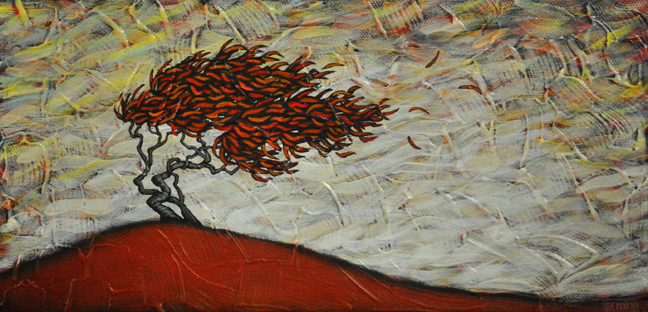
This is a painting titled Unafraid, that has been showing at the Principle Gallery in Alexandria, VA.  I was looking through some recent work and this smaller piece ( it’s a 6″ by 12″ canvas)  caught my eye.

Maybe it was the fact that I had been looking at older work earlier as I was scanning some older slides to my computer and this reminded me of some of that earlier work.  It had the simplicity of much of that work and the brushwork in the sky harkens back to earlier pieces, as well.

It’s a fine line to walk when you’re dealing with extremely simple compositions, trying to pull out emotion and feel from a minimal number of elements.  If it’s not done right, the piece ends up bland, saying little.  It might have an appealing appearance but it lacks depth and staying power.  It’s like a writer finishing a chapter that is well written but ultimately says nothing that moves the narrative or the reader.  Unsatisfying.  But when a simple piece works, meaning that it is full of feeling and a sense of completeness, it is strikingly dynamic.  The message and meaning is just right there to be seen without filtering through layers of obscuring detail.

I think that’s why I like this little piece so much.  It is what it is.  Unafraid.  It says what it has to say to the viewer quickly and boldly.  Those who feel it will read it  and understand it immediately.  And if the viewer didn’t connect, this painting has the feeling that it doesn’t care.  It’s not trying to make people like it.  It is what it is and it’s not afraid to be such.

Unafraid…

Read Full Post »

It’s a slow day waking up and I don’t have a lot to say.  I felt like hearing a quiet song this morning and came across The Wexford Carol, an 11th century Irish carol from Yo Yo Ma and Allison Krauss.  It’s a beautiful song that flows slowly and evocatively along.

I chose this older piece from several years back to accompany it.  The title, Night Flow, seems to fit and I could almost hear the distant sound of the pipes and strings when I looked at it.

Enjoy…

Read Full Post »

I’ve mentioned before that I enjoy doing genealogical research, digging back through layers of history, trying to put together a sometimes very complicated puzzle to reveal certain connections.  One of the great pleasures I take in doing this is coming across the life stories of ancestors that are just plain good tales.

One such is from my wife’s family, the story of the lady they called the Flying Angel.  Her maiden name was Magdalena Dircksen Volckertsen and she was born in New Amsterdam (now Manhattan) in the 1630’s, her father a builder of the earliest homes there for the Dutch West Indies Company.

Her first husband ( not in my wife’s family line) was a privateer for the Dutch West Indies Company.  That is to say, he was a pirate hired by the company to attack foreign ships and competitors in the area.  Called “Captain Caper” for his daring, he was killed in an Indian attack that was the beginning of the Indian Wars of 1655.  Magadalena was left a young widow with an infant child.

Two years later she married Herman Hendricksen Rosenkrance, called “Herman the Portuguese.”  The name came not from his nationality ( he was from Norway) but from his service as a mercenary for the Dutch company in Brazil where they forced their way into sugar growing areas controlled by the Portuguese.  Finally repelled from Brazil, Herman and his cohorts were sent to New Amsterdam to engage the Indians there.  Herman stayed on as a settler, supposedly running a tavern of low repute called the Flying Angel, the origin of Magdalena’s nickname.

Magdalena had quite the temper.  On her wedding day to Herman, after downing some beers, she was walking with her sister just above what is now Wall Street in NYC when she passed and insulted the fire warden.  What was termed a street riot broke out and several weeks later  she was yellow-carded by Peter Stuyvesant, meaning she was expelled from the settlement, sent back to Holland where she and Herman bided their time for two years until they were finally allowed to come back, provided they did not open a tavern or sell spirits.

The following years were a series of adventures involving Indian Wars  (one that had Herman being captured and staked out in the sun before he was able to escape), various  legal troubles, some involving Magadalena throwing beer in the faces of a number of  men, stabbings and accusations of selling liquor to the native Indian population.  They ended up living up the Hudson, near Kingston, where Magdalena lived into her 90’s.

It’s rumored that in her later years, she would chase Indians from her property by running out at them, yelling and shaking a large growth on her neck at them.  How could she not live to 90?

It’s just an interesting footnote in our history and the early settlement of NY, one that you don’t hear much about.  I’m always excited when I come across such stories, especially when there is a small personal connection.  Magadalena and Herman would be my wive’s 8th generation grandparents.

I’m not sure how proud she is…

Read Full Post »

After the Party

Well, I gave my talk at the Christmas party yesterday.  It was a strange setting for me and I was less than thrilled with my own performance but the group there was very receptive and seemed to glean some things from it even though it was very spotty on info.

It was the first time I had spoken to a group who, for the most part,  didn’t know my work, outside of some student classes at local high schools and colleges.  At least with the students they were in art classes and were focused on art so it was easier to engage with them.  Here, I never gained any rhythm in my talk.  I was in between a singer with piano accompanist who belted out several carols and Santa Claus.  Tough spot.  I’m not sure I ever gave them a full account of my work and how it came about but they seemed appreciative of the effort.

Whew!  That’s over so I’m on to other things such as getting ready to turn it on in early January.  Lot of things fermenting and I’m about ready to go.  I’ll be talking about that at some point, of course.

Read Full Post »

Party Lights

I’m getting things around this morning for a gallery-type talk that I’m doing today for a group at a Christmas party at a local country club.  It’s a little different from gallery talks I’ve done in the past where the people in attendance are there specifically to hear me speak and I’m surrounded by examples of my work .  These folks are there to celebrate the holidays so I’m just a bit nervous about how well I will be able to grab their attention.

But I will certainly give it a try.

I will mainly focus on the story of how I came to be a painter rather than how I paint, leaving technique for other venues.  I figure this will be more biographical, trying to emphasize some of the elements that have a bit of inspiration.  I will probably talk  a little about attitude and serendipity, stemming from some great opportunities for my career that arose from my days as a waiter at a Perkins Restaurant.  I don’t really have a speech or anything like that.  I usually just get up and start talking and let it go, hoping that it will grow organically like one of my paintings.  Most of the time this works.

I hope it does today.

I wonder if they’ll have an open bar?

Read Full Post »

Upcoming

Well, I’ve firmed up a couple of things that I will be doing in the next few weeks.  First, tomorrow I will be giving a talk about my work  for a group at, of all things, a Christmas party.  It’s an annual event given by a longtime collector of my paintings who first became acquainted with me while I was still waiting tables back in the 90’s.

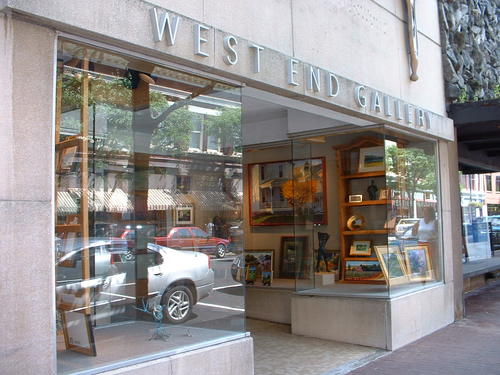
Then I will be guest-sitting at the West End Gallery in Corning from the day after Christmas until  December 30.  I haven’t done something like this for some time and am looking forward to it.  I’ve been looking for something to shake up my perspective and the opportunity to be surrounded by art and talk about it seemed like a perfect fit.  I did this once before, about 11 or 12 years ago, and it was really enlightening to get a different view on how people look at art and what matters to them, something that gets lost in the isolation of the studio.  It also creates an energy that will carry over into the studio in January, when I start really focusing on the shows for that year.

I’ll be talking a little more about this in the next week or so.  It’s a great chance, if you have questions about the work, to ask them outside the night of an opening when time is very limited.  I’m planning a few other special things so if you’re in the area, please stop in to shoot the breeze and take a look at the work in this wonderful gallery.

Read Full Post »

« Newer Posts - Older Posts »