Feeds:
Posts
Comments

Archive for May, 2015

GC Myers Breakthrough smWho in the world am I? Ah, that’s the great puzzle.

-Lewis Carroll, Alice’s Adventures in Wonderland

************************************

I think the lines above spoken by Lewis Carroll’s Alice fit this new painting very well.  In the book, she has has just grown to a very great size and frightened away the White Rabbit which has her suddenly realizing that Wonderland is a very puzzling place.  But even more puzzling is how the changing perspectives of herself she encounters in Wonderland have left her questioning her own identity, her own sense of self.  The solution to navigating her way through Wonderland is in finding out her own identity.

And that is a truth for almost anybody, anywhere.

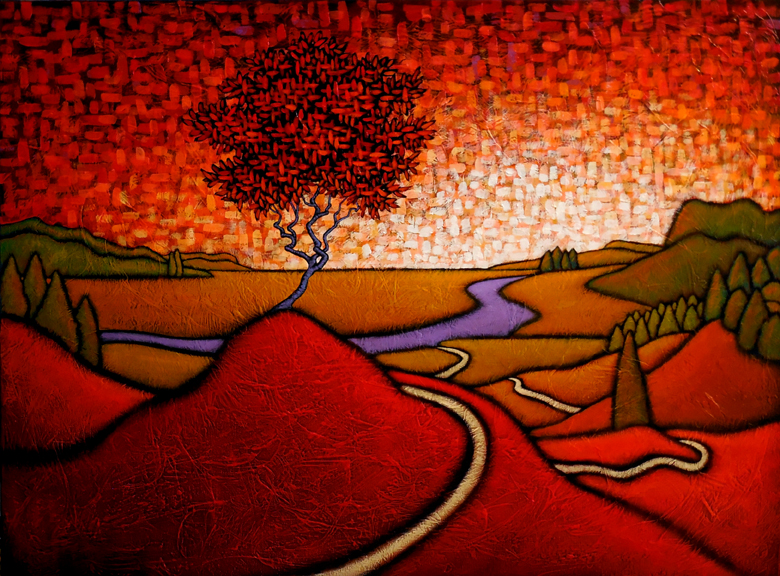
And that’s what I see is this painting, a 30″ by 30″ canvas that I call Breakthrough.

The foreground with the cryptic forms of its fields sets the tone for piece with darker tones and tempting colors.  The path runs through these labyrinth-like segments toward a sky that has a burst of light from the sun pushing forward, symbolizing the breakthrough alluded to in the title.  And at the furthest inward point is the Red Tree.  Like Alice, it is attempting to shed the many differing perspectives of itself it has run across to get to this moment, a moment in which it feels it has reached a solution to the puzzle of who or what in the world it truly is.

The path forward is much easier to travel once you have solved that great puzzle, as Alice called it.

This painting is part of my annual solo show, this year titled Native Voice, at the Principle Gallery in Alexandria VA which opens on June 5, 2015.

Read Full Post »

bb_king_lucille-4Times continually passes on and takes some of our friends along with it as it goes.  Thursday,  that friend was the great BB King.  He was the ambassador and face of the blues for the last half century, a genial presence who crossed over into the mainstream yet maintained the same intensity and integrity as when he was carving out his legend in the 1950’s playing clubs across the country as he toured almost non-stop.

By the time I was in my teens, he had transcended the blues and was part of popular culture.  The Thrill Is Gone was a mainstream hit, winning him a Grammy in 1970, and he maintained a visibility on the television, always accompanied by Lucille, his black Gibson guitar which has become probably the only guitar that most people can recognize by name.   And if they didn’t know her name they most likely knew the sound of her voice. Everybody knew who BB King was.

But my real introduction to BB King came when I was going through the used bin at a local record shop and found a  beat up copy  of  his Live at the Regal Theater from a show in Chicago in late 1964.  It was well worn as though whoever had owned it before had played the hell out of it.  From the second the needle on my turntable snapped into the groove, I understood why  that was so.

Pure electric, a perfect storm of time, place and people made every moment of that record crackle.  One listen and you knew it was about as good as it gets.  I still get shivers when I hear it.

So to honor the passing of our friend, this Sunday’s music is a song that was a favorite of that Regal Theater crowd (and mine as well), How Blue Can You Get?  But the performance I am showing is from a different venue.  It’s from a Thanksgiving show in 1972 from NY’s Sing Sing Prison with BB King, The Voices of East Harlem and Joan Baez.  I think this is a great version of the song and seeing the inmates respond really adds something to it.

So, give a listen to our friend and have yourself a great Sunday.

Read Full Post »

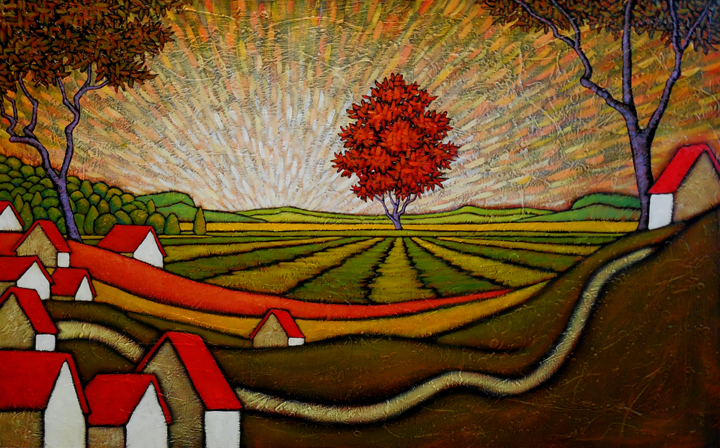
 Myers- Solitude and ReverenceSilence and solitude seem to be the theme this week on the blog.  Well, most weeks, I guess. Today, I am featuring a new painting that will be part of my Native Voice exhibit opening three weeks from today on June 5  at the Principle Gallery in Alexandria.  It is a 24″ by 36″ canvas and is titled Solitude and Reverence.

It’s a painting that has really hung with me here in the studio, my gaze often going to it through the day as I work on other things.  There’s a sense of fullness and completeness, a quality I can’t fully describe here,  in it that pleases me, that makes me want to study it and absorb it a bit longer.

Perhaps it is because I feel that this painting is even more personal and self-referential, seeing myself as the Red Tree, isolated in the solitude of my work which is symbolized by the field rows between me and the  houses and road in the foreground.  It is a pleasant isolation, a voluntary withdrawal from the rest of the world.

I suppose I should say the world of man because there is no withdrawal from the world.  In fact, there is a more intimate relationship with the natural world which brings about the reverence referred to in the title.  I see it in this painting in the landscape spreading out in the distance and the radiating light and color of the sky which seems symbolic of the greater power and mystery of the natural world.

I sit here now and there is so much more I could write about this piece but it all seems so futile when I can just look at it, knowing everything in a glance that I could struggle for hours to say so poorly with words.

And maybe that is the message here– that we should simply shut up and take in the world in a reverent quietude.

I will do that now…


Read Full Post »

GC Myers Eternally FreeAll of humanity’s problems stem from man’s inability to sit quietly in a room alone.

–Blaise Pascal, Pensées 

************************

This week’s quote continues the theme of silence that showed itself in yesterday’s post where poet Wendell Berry advised us to sit alone and to be quiet, to accept those things we might find in the silence.  This oft-quoted line from  French mathematician/philosopher Blaise Pascal from back around 1660 shows us that even in that world without smartphones and the constant crackle of 24/7 electronic and social media the idea of sitting in silence made most people anxious.

It’s an interesting thing to ponder.  As I sit here, a little before 7 AM in my quiet studio, I can hear the thump of a bass from someone’s car stereo probably almost a mile away as it goes down the road.  That is someone who obviously isn’t ready to embrace silence and believes that they are doing everyone else a favor by breaking it up so we won’t be bothered by it.

Hard as it is to admit, I was that guy at one point in  my life.   Noise was a way of making my presence, my existence, known.  

The lion’s roar.  The barbaric yawp.  

It was all an existential scream that tried to break through the ever-growing wall of sound from the outside world that threatened to obscure everything, melding all the noises into a huge suffocating drone of anonymity.

But my noise made no difference.  No single sound, no one angst-filled scream could break through and show that I was indeed alive, that I mattered.

No, existence was found sitting quietly in a room alone.

It wasn’t always easy.  In the silence there is nowhere to hide from every random thought, every fear, every diminishment of yourself. But silence provides the gift of acceptance after a time and every relived thought and moment, good or bad,  becomes equally part of the make-up of your self.  You come to realize that proof of your existence is in this acceptance and not in that barbarous scream that you once thought would scar the world as that proof.

It sounds too simple, I know.  But simplicity is sometimes very difficult and I still find myself struggling to stay in the silence, to not revert to screaming out.

But most days I find that it is worth the effort.

Read Full Post »

GC Myers- Trio:Three SquaresI came across this poem from author Wendell Berry on Maria Popova‘s wonderful site, Brain Pickings.  It’s a lovely rumination that could apply to any creative endeavor or to simply being a human being.  I particularly identified with the final verse that begins with the line: Accept what comes from silence.  I’ve always thought there was great wisdom and power in silence, a source of self-revelation.  Perhaps that is why so many of us shun the silence, fearing that it might reveal our true self to be something other than what we see in the mirror. Berry’s words very much sum up how I attempt to tap into silence with my work.

At the bottom is a recording of Wendell Berry reading the poem which gives it even a little more depth, hearing his words in that rural Kentucky voice.  It’s fairly short so take a moment and give a listen.

HOW TO BE A POET
(to remind myself)

Make a place to sit down.
Sit down. Be quiet.
You must depend upon
affection, reading, knowledge,
skill — more of each
than you have — inspiration,
work, growing older, patience,
for patience joins time
to eternity. Any readers
who like your poems,
doubt their judgment.

Breathe with unconditional breath
the unconditioned air.
Shun electric wire.
Communicate slowly. Live
a three-dimensioned life;
stay away from screens.
Stay away from anything
that obscures the place it is in.
There are no unsacred places;
there are only sacred places
and desecrated places.

Accept what comes from silence.
Make the best you can of it.
Of the little words that come
out of the silence, like prayers
prayed back to the one who prays,
make a poem that does not disturb
the silence from which it came.

Wendell Berry

Read Full Post »

pablo_picasso_les_femmes_d_alger_  Photo by ChristiesThis is Les Femmes d’Alger (Version “O’), a 1955 painting from artist Pablo Picasso.  It created quite a stir yesterday when it became the most expensive artwork ever sold at auction when it went for a cool $179.36 million at Christie’s.

And while that might seem like an unfathomable amount of money to pay for any piece of art- or a small town for that matter- it is only the tip of the iceberg for extravagance in the recent art market.  At the same auction, a life size sculpture, Pointing Man, from Alberto Giacometti became the most expensive sculpture sold at auction when it fetched $143.3 million.

Paul Gauguin- When Will You Marry?

Paul Gauguin- When Will You Marry?

And keep in mind that these records are for pieces sold in auction, not those sold privately by dealers or other collectors.  In February, When Will You Marry? from Paul Gauguin sold privately for a whopping $300 million to a Swiss collector.  There are rumors of many other similar private sales with fantastic sums of money attached.

It’s always interesting to see the prices that these pieces bring and how we, the public, respond to these over the top sales, almost like a cheering crowd at the big game rooting the bidders to go ever higher.  We do like a spectacle. The shame is that the focus becomes all about the money and less about the artwork.  But then again, these big sales really have little to do with the actual art.  These exhibits of extreme affluence have become performance art in themselves with the artwork a mere prop that acts as a catalyst in setting off a series of actions that result in prices that boggle the mind of the average person.  It’s the Picasso and Gauguin now.  In time they will be replaced by a new crop of props designed to set off the same reactive chain.

Do I believe these works deserve these incredible prices?  Well, I do believe they are great pieces of art, high in the pantheon of art history with stories behind them that deserve telling.  They would be great without those prices attached to them.  No, these prices aren’t the value of the work itself– they are the price someone is willing to pay to attach their own name and ego to the history of the piece.

It’s kind of a reverse provenance.  Normally, an artist’s work is validated and gains value when it becomes part of a prestigious collection.  In this scenario, it is the collector who is trying to gain prestige and validation through the attainment of the artwork.  And at the moment, the going price to get that kind of thing is well over a 100 mil.

I think both Picasso and Gauguin would be more than a little amused at these prices.  And probably a little pissed off that they missed out on this kind of loot in their own lifetimes. For myself, I don’t give a damn what someone else paid for the work.  I would prefer that someone with those kind of resources would try to use them in helping others rather than conspicuously consuming but that is not my decision, is it?

In the end, it is what it is, as they say…


Read Full Post »

GC Myers- Epiphany smI call this new painting, an 18″ by 18″ canvas,  Epiphany.  There’s just something in the way the Red Tree stands against the burst of light in the sky behind it that reminds me  of those rare moments of  revealed insight, when you realize something that forever changes your perception of the world and perhaps sends you down an unexpected new path.

This was an interesting piece to paint, one that evolved in a different way than most of my work.  As it built from the bottom, the sky was painted in a transparent deep yellow wash.  IT was okay but it just didn’t have that sense of rightness, didn’t fill the emotional void that was present.  So I blacked out the sky and went to my other process of building up the paint which is unusual for me as I seldom mix the two processes except in detail work.

The sky took on a greater role with this incarnation, becoming the engine that moved the piece forward.  As I finished the work on the Red Tree, the corona of light around its crown took on an almost religious aspect and the whole thing began to look like a stylized portrait of a saint with a halo and red cloak.  And that made the title seem even a bit more appropriate, using a different definition of the word where epiphany is used to describe a manifestation of the divine– a supernatural being.

And maybe that is what all epiphanies are– manifestations of the divine.  I have had a  moment or two in my life that I view as epiphanies. Whether they truly were is subject to debate– they certainly were personal breakthroughs in perception– but in those moments I certainly felt closer to some sort of  divinity than I ever had before.  And that’s what I am reminded of in this piece — the blood red of the physical earth and tree becoming one with the ethereal in the light of the sky.

Read Full Post »

GC Myers Mothers Day 1994 smI thought I would take the opportunity on this Mother’s Day, to dedicate this week’s Sunday music to my late mom.  It’s hard for me to believe but later this year will mark twenty years since she passed away after a short but brutal battle with cancer. Needless to say, I miss her very much and wish she could have seen the things that came in the years after she died, such as the great-grandkids she never got to dote on.

For my parts, she never lived to see my work hanging in a gallery or museum, never got to see how it has grown over the years.  Looking at two large pieces on easels next to me at this moment, I realize that there is a whole different world of mine she never got to witness.

But I think she would be pleased to know that things worked out okay, that I found something to ease my mind and give me something of a purpose.  I would hope she would like the work I’ve done.  I know she liked the earliest pieces, the only ones she would know, like the piece at the top which was one of my earliest efforts in early 1994, long before I had experienced any kind of creative breakthrough,  It was gift to her on Mother’s Day of that year and it hangs in my studio now, always reminding me of her.

So, for this bit of Sunday music, I thought I would play one of the songs I know to be a favorite of hers.  She always loved Eddy Arnold‘s voice and I have specific memories of this song coming from our old stereo console.  The title,  Make the World Go Away, just seemed to fit Mom so well.  For that matter, looking at the alternative world that surrounds me here in the studio, I guess it fits me as well. I am my mother’s child, after all.

Have a good Mother’s Day.

Read Full Post »

GC Myers Envoy  small 72Many people have asked me over the years to explain the Red Tree that so often appears in my work, to describe its meaning and purpose.  It’s not always an easy question to answer because the Red Tree has served many purposes for me.

On the most basic level, it has served as a focal point in my paintings, drawing the eye to an area around which everything in the scene revolves.  The flaming red crown of the tree is almost like a small sun with the other elements in the painting swirling in their own revolutions around it.

Or I sometimes describe it as a symbol for the individual being, one with which the viewer, myself included, can hopefully find  common ground so that they can see themselves in the circumstances of the scene.  It is an actor in this definition, performing a part for an audience.

Or it is a world symbol.  The Family Tree.  The Tree of Life.

And sometimes it is just a tree, a simple element in nature that we all see every day but perhaps don’t really notice the significance of the part they play in this world.

But in my mind the most important part that the Red Tree plays for me is as an intermediary between my inner world and the outer world.  It is my ambassador, my envoy, who acts as a welcoming figure inviting the viewer into the world portrayed on and beneath the surface.   It acts as greeter and a guide, an often warm presence that reassures the viewer that it is safe to enter.  I think the new painting at the top is a perfect example of this definition with its welcoming stance, almost like it is opening  a door for one to proceed into the rich golden fields beyond.

Fittingly, I call this new 30″ by 40″ painting Envoy. It will be part of my June show, Native Voice, at the Principle Gallery in Alexandria, VA.

Read Full Post »

Caspar David Frederich- Abbey Among Oak Trees

Caspar David Frederich- Abbey Among Oak Trees

A picture must not be devised but perceived. Close your bodily eye, that you may see your picture first with the eye of the spirit. Then bring to light what you have seen in the darkness, that its effect may work back,  from without to within.

–Caspar David Frederich

***********************

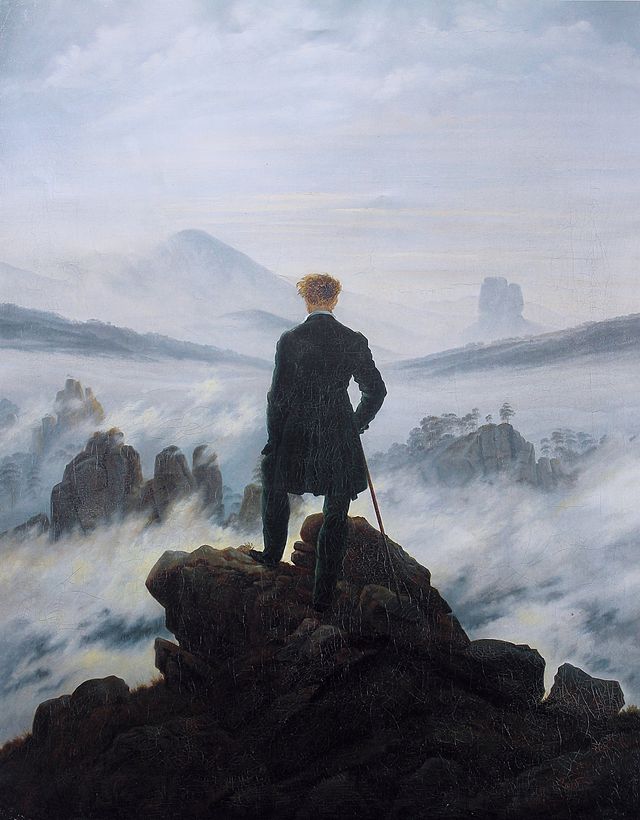
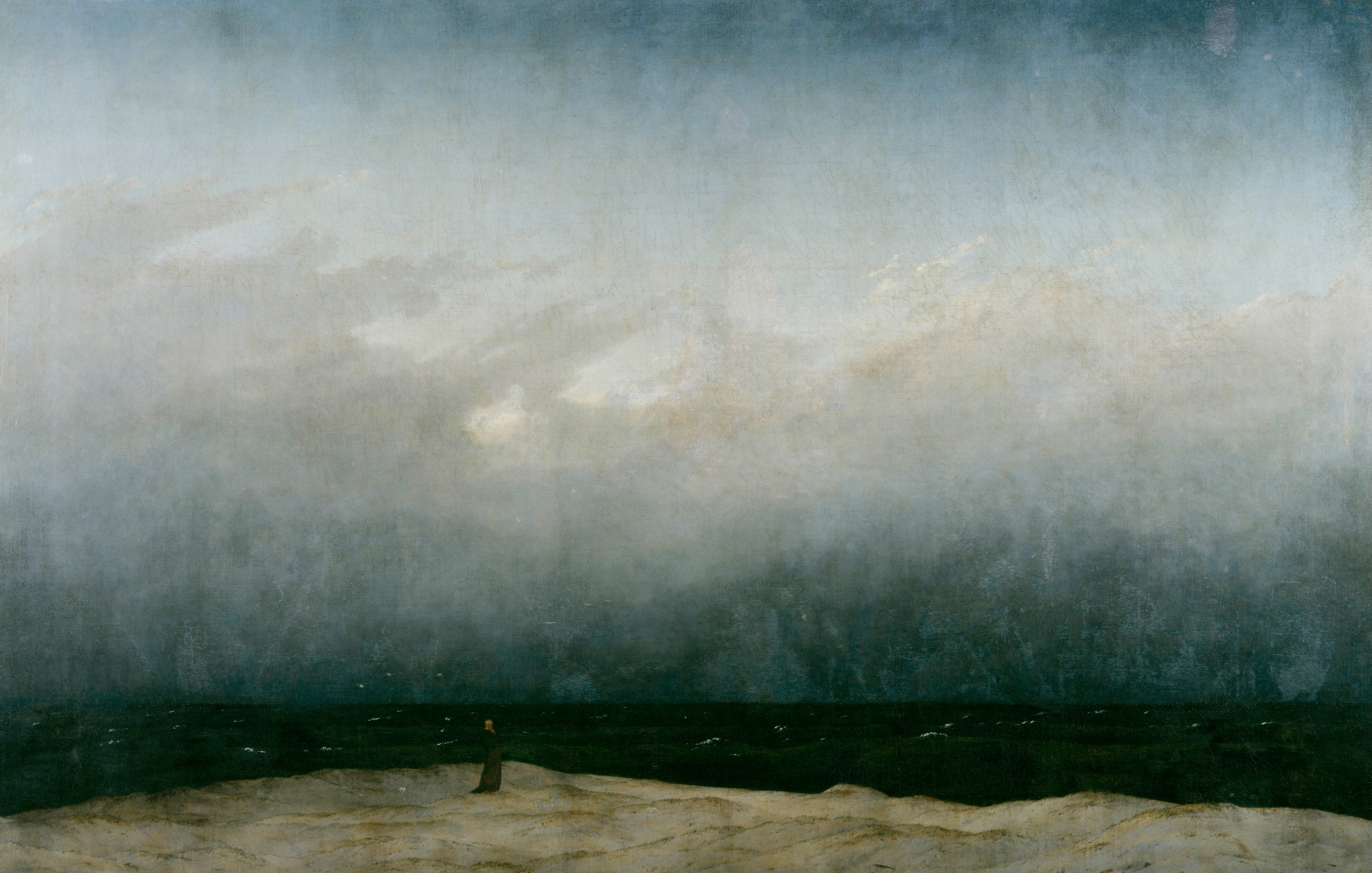
I find myself identifying strongly with the words and work of the 19th century German painter Caspar David Frederich (1774-1840).  His work often takes a symbolic stance with expansive landscapes that overwhelm the human presence in them and much of it moves toward the metaphysical.  He , along with his British contemporary JMW Turner, were at the forefront of the movement from Classicism  to  work that reflected the inner emotional reaction of the individual to the world around them.

It was said of Frederich that he was “a man who has discovered the tragedy of Landscape.”  I see this in his often moody and contemplative work.  It is not painting of only a place or scene– it is more a painting of emotion, of some inner vibration triggered by what is before the painter.  His brilliance is in capturing that inner element and revealing it to the viewer.  It’s a rare thing, one that I think most painters aspire to obtain in their own work.  I know that I do.

Caspar_David_Friedrich_-_Wanderer_above_the_sea_of_fogFrederich’s work fell from favor in the latter stages of his life but the coming of modern art movement whose many painters were greatly influenced by Frederich,  brought him back to great recognition through the first few decades of the 20th century.   Unfortunately for Frederich, in the 1930’s, his work was associated with the Nazis who mistakenly saw his work as being nationalistic in its symbolism. I know that the piece shown here on the right, Wanderer Above the Sea of Fog,  is often associated with Friedrich Nietzsche‘s idea of the Übermensch or Superman.  Even though Frederich died years before Nietzsche was born and almost a century  before the Nazis usurped his art, it took several decades before his work regained the stature it lost due to this association.

But the inner message of his landscapes persevered and his paintings still resonate with their timeless qualities today.  As they should.

Caspar David Friedrich- Monk by the Sea

Caspar David Friedrich- Monk by the Sea

Read Full Post »

« Newer Posts - Older Posts »