Feeds:
Posts
Comments

Archive for May, 2018

++++++++++++++++

“A philosopher once asked, “Are we human because we gaze at the stars, or do we gaze at them because we are human?” Pointless, really…”Do the stars gaze back?” Now, that’s a question.” 

― Neil Gaiman, Stardust

+++++++++++++++

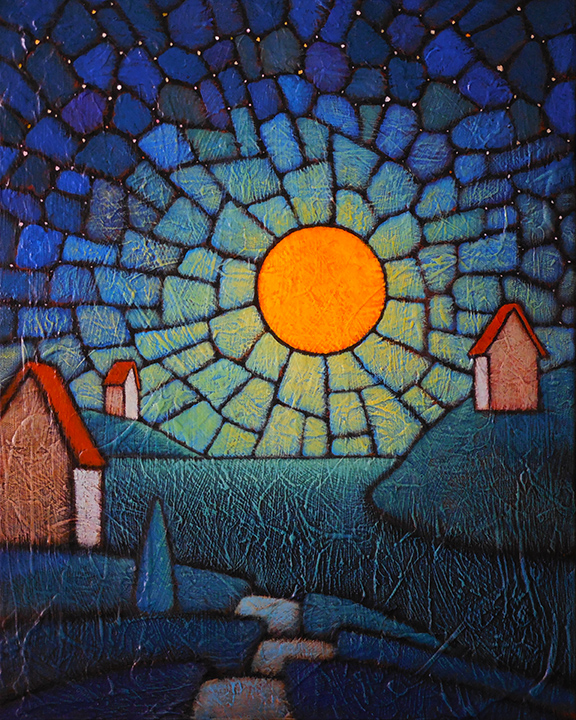
Above is a new painting that is going with me down to Alexandria for my show, Haven, at the Principle Gallery, opening June 1. I am calling this 20″ by 16″ canvas Stars and Satellites. It’s a continuation of a series of recent works that are primarily stark nightscapes with skies composed of shards of color in an almost stained-glass manner. At the junctures where shards meet are points of bright color— the light of the stars and the planets of the night sky.

I think I have written here about the meditative effect of painting these pieces, how there is a feeling of both intense concentration and non-thought that blocks out all other things. If the television is on or music is playing, I don’t really hear it. If delivery vans or cars come up my driveway, I am totally unaware even though they directly pass in front of the large windows before which I work.

It’s like I am in that space in that time, especially in the first stages of composing the picture. All is quiet and all that moves through my mind is the simple geometry of placing blocks of red oxide in a way that makes sense in that part of my brain that is scanning the whole of the composition. It’s one of my favorite parts of my process of painting, this state of being so mentally attached to the surface of the painting.

Another favorite part comes later as the painting evolves from its red oxide skeleton. This moment comes after layer after layer of color is added and the painting crosses a tipping point where it suddenly becomes a fully fleshed being, an entity with its own life force and its own voice.

That is a really gratifying moment, one that makes me think of Carl Sagan describing the Voyager space mission and how it would travel through time and space as a reminder of our existence as a people and a civilization long after our Sun had turned our planet into an ember, long after we had ceased to walk this earth.

And in a way many of those stars in the night sky serve that same purpose. Many are the final traces of light from stars that have been extinguished eons ago yet remind us of their existence.

This piece has, for me, a feeling of an interdependence between the moon, the stars and we here on earth. We each need the other in order to be seen, to serve as a reminder that we have existed in this universe, if only for short time.

Like John Lennon sang in Instant KarmaWell, we all shine on/Like the moon and the stars and the sun…
Read Full Post »

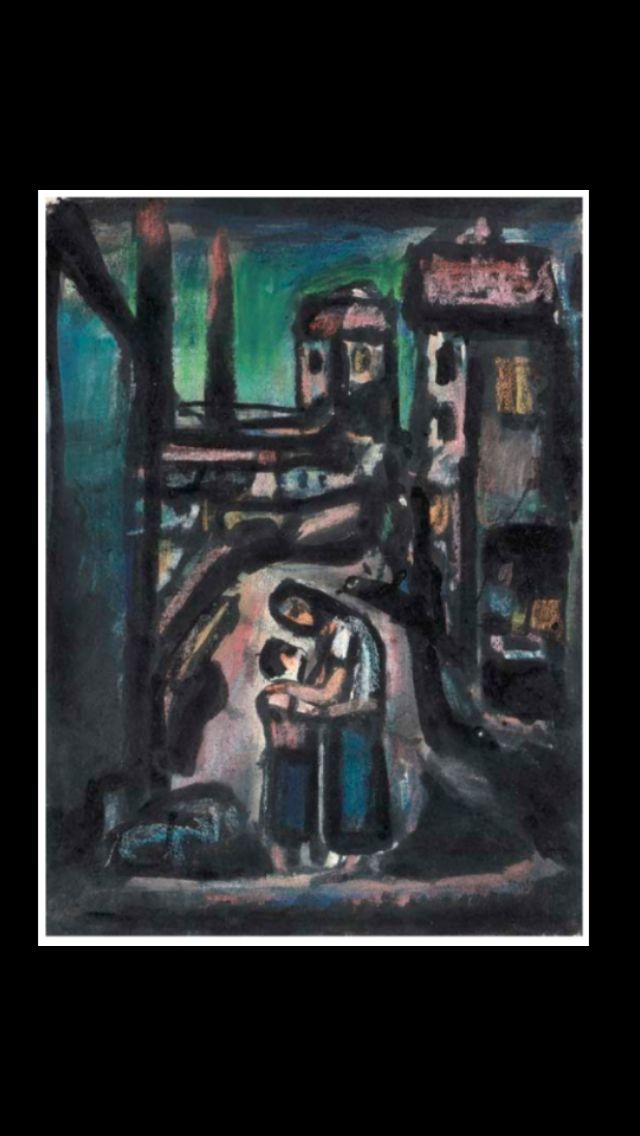
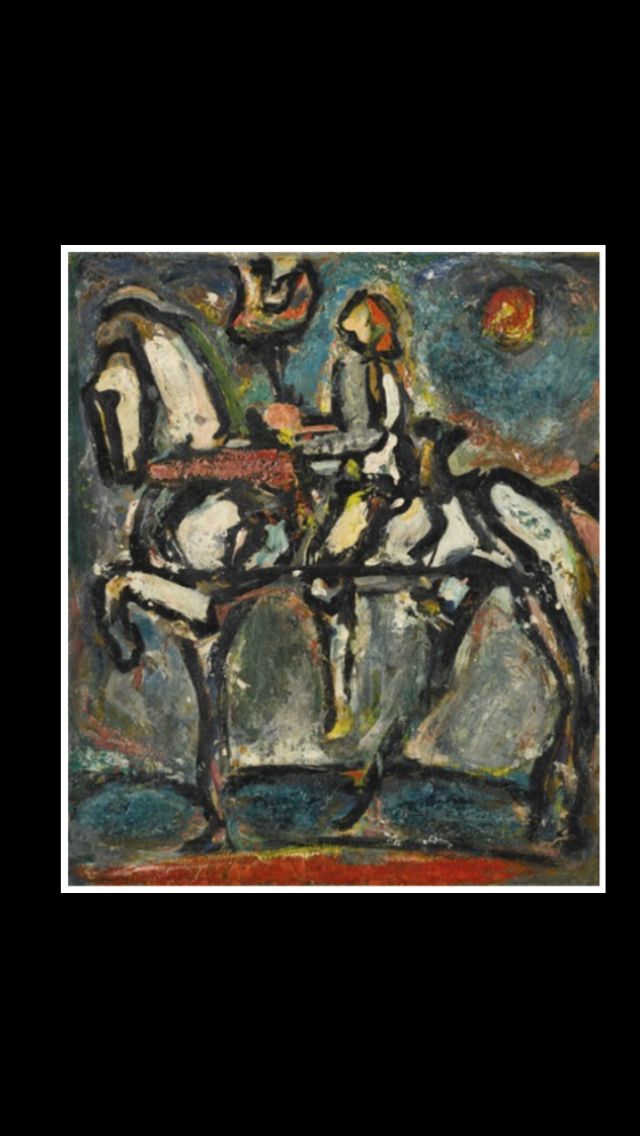
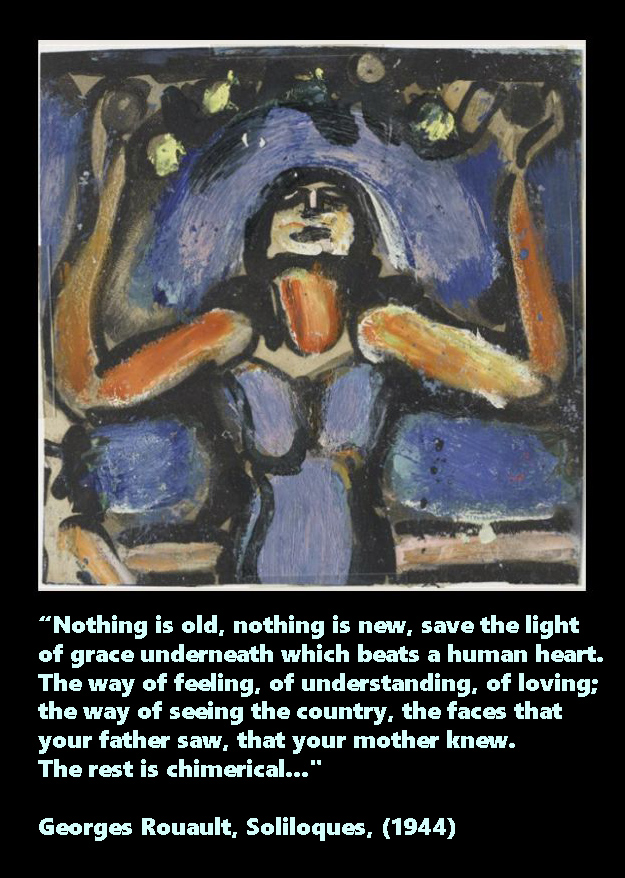
Too busy this morning but I can always find a few minutes to take in some work from Georges Rouault (1871-1958). His work has for me a real sense of rightness, a certitude that makes even his roughest brushstrokes seem both perfectly placed and necessary.

Read Full Post »

Watching the murmurations of starlings is a fascinating and hypnotic thing to see, indeed.  Murmuration is the word for the starling flock and for the intricate dance in the sky performed by these huge groups of birds which often number in the tens of thousands.

The murmurations move gracefully and quickly, creating constantly shifting forms that seem derived from some higher levels of geometry and quantum mechanics than my simple mind can comprehend. I get the feeling when I watch them that I am seeing some essential base element of our universe made visible.

We have never really fully understood the hows and whys of these complex movements. Researchers have found that these displays are almost always set off by a predator such as a falcon near the edge of the group. The group responds as a single unit without an actual leader in order to avoid and distance the group as a whole from the predator.

Researchers believe that this done with something called scale-free correlation which allows birds at any point in the group to instantaneously sense and react to what any other bird in the group, no matter how far away, might be experiencing. Any information moves through the group instantly and without any degradation of the message. It’s like an incredibly complex version of the telephone game. With people passing a simple message along in this game, the message is often garbled beyond recognition within a relatively short time. Here the message is passed tens of thousands of times without missing a word, a comma or inflection.

How they do it remains a mystery. Maybe that’s why they remain so fascinating, to remind us that we still know so little of the grand scheme of things.

For this Sunday morning music here’s a piece, On Reflection, from contemporary composer Max Richter. It is accompanied here by a video of the murmurations of starlings. The music and the flowing motions of the birds create a hypnotic and soothing effect. Give a listen and relax. Maybe you can imagine being part of that murmuration.

Read Full Post »

“You stumble into the forest and wend through the pines that finally open up, and there–before you, above you, around you–a sea of granite soars straight off the talus, stunning for its colors and sheer bulk; and terrible for the emptiness that sets in your gut as your eyes pan up its titanic corners and towers…

We were over 2500 feet up the wall now, into the really prime stuff. Here the exposure is so enormous, and your perspective so distorted, that the horizontal world becomes incomprehensible. You’re a granite astronaut, dangling in a kind of space/time warp. And if there is any place where you will understand why men and women climb mountains, it is here in these breezy dihedrals, high in the sky.”

– John Long, Nose In A Day, First person to climb El Capitan in single day, 1975

+++++++++++

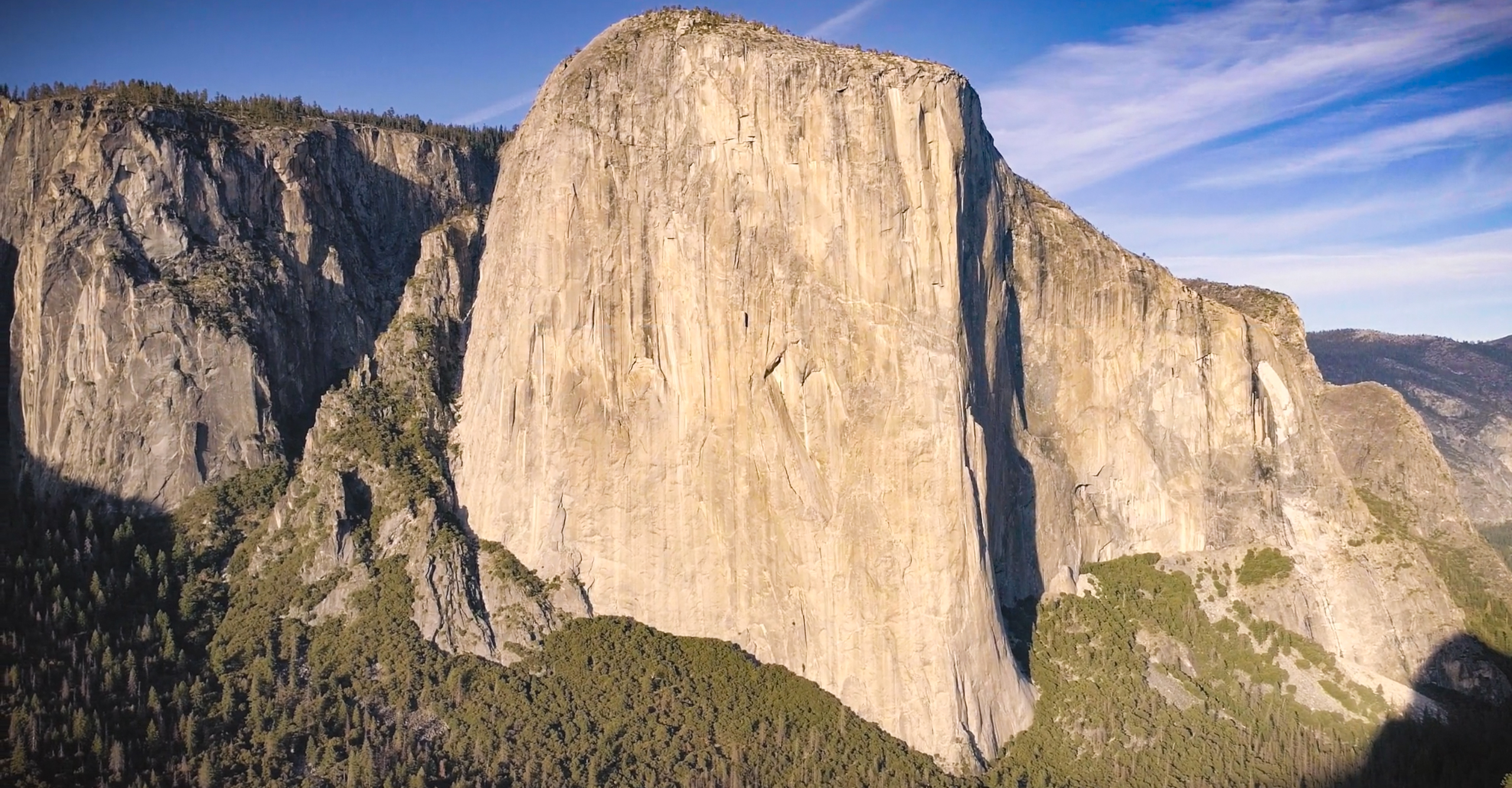
It’s a really busy morning but I did find time to watch a film on the record breaking climb up the face of El Capitan in Yosemite that took place in October of last year. Climbers Brad Gobright and Jim Reynolds scaled the granite icon, once considered an impossible climb, in a mind boggling 2 hours 19 minutes and 44 seconds. To give you an idea of the speed we’re dealing with, most climbers, who must be very experienced just to make such an attempt, spend 3-4 days on the wall before reaching the summit.

Pictures don’t do justice to the sense of awe El Capitan inspires. The idea of someone walking up to its formidable base and basically just climbing up it seems ridiculous. The imagery in the film brings a sense of scale, with the climbers appearing like mites running along the back of a huge hairless beast. It also gives you an idea of how many people are on the face of this monolith at any given time even though it appears completely devoid of life from a distance. I had to laugh to see these two men as they seemingly fly by traffic on the wall.

Take a look. There is something very mesmerizing, even centering, in this short film. Not a bad way to start your own busy Saturday.

Read Full Post »


++++++++++++++++

How well do we know our own shadows?

Read Full Post »

Knowing Klimt

+++++++++++++

Whoever wants to know something about me – as an artist which alone is significant – they should look attentively at my pictures and there seek to recognise what I am and what I want.

Gustav Klimt

+++++++++++++

Read Full Post »

Just a month out from my solo show, Haven, at the Principle Gallery. The work for the show as a whole is shaping up well and I am going through waves of elation and anxiety as I prepare. The elation comes in the way I feel the new work is finishing off and the anxiety in that I fear my judgement might be off base a bit, that what I am seeing and feeling in the work might not come across to others.

That I am working with my head in the clouds.

Fortunately– or unfortunately–that anxiety is not new to this show. I’ve had it in varying degrees for every single show I’ve done over the past two decades. This is my 19th solo exhibit at the Principle Gallery and my 52nd or 53rd solo show overall and I can’t remember ever feeling absolutely confident in how people would react to what I was doing. But so long as I have faith in my own reaction to the work, that I trust that I am experiencing real feeling from it, then I live a little easier with that anxiety, even though it never fully recedes.

The piece shown here is a new painting, 24″ by 12″ on canvas, that elicits the elation I described above. It checks every box for what I wanted from it. It has an equilibrium of fineness and roughness that appeals to me. There is a cleanness in its design that makes it feel solid and whole to my eye. It draws me in and lets me feel that I am the Red Tree here and it is a fulfilling experience.

It makes me feel good, to put it plainly.

Now, I must note that these are my reactions. You might look at it and feel nothing. That is no less valid a reaction than my own. But because I know what I am feeling is true and genuine for myself, the anxiety of showing it to someone who might not feel anything from it is lessened.

So, with that thought in mind, I must get back to work.

With my head in the clouds.

This painting is titled, of course, Head in the Clouds. I used the quote below from Thoreau just a week or two ago but it fits this piece and this blogpost so well I am using it again:

It is better to have your head in the clouds, and know where you are, if indeed you cannot get it above them, than to breathe the clearer atmosphere below them, and think that you are in paradise.

–Henry David Thoreau

In this case, I think I know where I am…


Read Full Post »

Ralph Fasanella- May Day -1948

+++++++++++

Today, May 1, is May Day. Some folks see it as a festival of spring  that began as an ancient pagan celebration, complete with May Poles, May Queens and May Baskets. Others recognize it as a day celebrating laborers, trade unions and the working class, otherwise known as International Workers’ Day.

I think that labor unions have been integral to the rise of the American middle class and to many things that we now take for granted. Things like eight hour workdays, weekends, child labor laws, workplace safety, minimum wages, health insurance, paid vacations, retirement pensions and on and on. Things that provide a sense of comfort, security and self-worth for working folks.

I believe that the demise of unions goes hand in hand with the growing chasm in income inequality between the owners and the workers of this world. The owners had the shrewdness and the resources to mount a sustained campaign over the years that constantly painted unions in an unflattering light, to the point that many workers began to side with the owners, often against their own self interest.

It’s the same kind of thought control that makes workers believe that big tax breaks and other benefits reserved for owners will have a magical trickle down effect and will somehow enrich their own lives.

Unfortunately, human nature overrules trickle down economics every time. The benefits that the people in  labor unions fought and died for — yes, died for— are soon under attack from owners who need more and more and more. The labor battles will no doubt have to be fought again at some point and lord knows what ugliness will come from that.

The painting shown at the top and a favorite of mine, is titled May Day and is in the collection of the Fenimore Art Museum in Cooperstown. I thought it was a fitting image for today. It was painted in 1948 by a favorite artist of mine, American folk artist Ralph Fasanella, who I have written about here a number of times. He was a labor organizer in the 30’s and 40’s when the workers’ movement was making the powerful strides that created the mythic middle class that inhabited the America of the 1950’s. I am not going to spend a lot of time describing his career here but will point out that his work often portrayed labor and workers.

It is powerful stuff, to say the least, and pertinent both for its own time and now.

Here is the description for the painting from the museum’s website:

Ralph Fasanella was born in New York City to Italian immigrant parents. He spent his youth helping his father on his ice delivery route, and absorbed the streets, tenements, and people that would later inspire his art. His mother, a literate and socially conscious woman, introduced Fasanella to antifascist and trade union causes. He eventually became a union organizer until he began to paint in 1945. Fasanella was an acclaimed “primitive” painter in the 1940s, and then painted in obscurity for 25 years until his “discovery” in 1972. May Day represents Fasanella’s attempt to capture the spirit of the workers’ movements of the 1930s, focusing upon the huge May Day parades that annually drew up to 200,000 demonstrators to Union Square in New York City. At the left, marchers pour out of the crowded streets and tenements and descend upon New York’s Union Square. Their large banners proclaim support for organized labor and racial unity under the overarching cause of “Peace, Democracy, Security.” At the head of the parade is a magnificent horse-drawn float, complete with May Pole and women in ethnic costumes. The marchers pass a reviewing stand with a backdrop that serves as a shrine to labor heroes. Across a colorful bed of flowers lies the artist’s utopian vision at the right. It is a place where workers, liberated from the burden of twelve- and sixteen-hour shifts, have the freedom to pursue cultural and recreational activities.


Read Full Post »

« Newer Posts