Feeds:
Posts
Comments

Archive for April, 2019

I’ve been going through some old work for a small exhibit late this summer–I will write more about this at a later date– and have been going through some of the Exiles paintings from the mid- 1990’s. This painting, The Creeper, always jumps off the screen at me and I am hoping to make it part of the exhibit. The post below is from all the way back in 2009. Thought I’d repost it today.

********************
GC Myers- The Creeper

The Creeper is another of the Exiles series although I would have to say he is an anomaly in the series. He does not mirror the sense of loss or suffering of the other pieces. He is not the mournful exile that so many of the pieces in that series depict.

No, he is the menace of dark dreams. He is always there, looming halfway in the bedroom window. While there is almost the hint of a smile on his face, it is not  pleasant or reassuring.

But, while he is a little scary, there is a bit of whimsy in his appearance. He is more cartoonish than the others. When I look at this face I am constantly reminded of the movie parodies from the beloved Mad magazine of my youth, with their Mad Magazine Godfather Parodyoversized, caricatured faces. This softens the whole feel of the piece for me and makes him less terrifying.

Now, whether someone without that same frame of reference will see him in the same way is another question. Without that reference, maybe he is as creepy as his name.

For me, The Creeper always brings back the memory of a young friend who loved this painting and truly identified with everything about it. He saw the humor but felt the darkness of it as well. He was a vibrant whirlwind of energy who knew well about the personal demons as depicted in this painting. He was a tortured personality and took his own life several years ago.

For him, The Creeper was all too real. When I look at this painting now, I see it as that creeping darkness that invades so many minds, keeping them from finding true peace.
GC Myers- The Creeper

Read Full Post »

The 1969 BBC series, Civilisation, opened with host and art historian Sir Kenneth Clark standing in Paris with Notre Dame cathedral behind him. He stated that the purpose of the series was to give examples in history of man showing himself to be an intelligent, creative, orderly and compassionate animal. He said he couldn’t define civilization in abstract terms but, turning to look across at Notre Dame, felt he would know it when he saw it.

And that might be so true. In the aftermath of yesterday’s fire that destroyed much of that cathedral, it felt not so much like a tragic fire in an old religious space but more like a greater loss of civilization, of history and humanity.

Watching yesterday, it was hard to not see it as being the symbolic burning of down of all things we hold sacred as a civilization. It was a place that for over 800 years had witnessed and survived plagues, wars and revolutions. How could it be so seemingly devastated in these modern times?

It’s burning seemed like the perfect image for the plunge back into the darkness which we often seem ready to take these days.

It was a sad day for us all and a test for our willingness to continue in light as a civilization.

I have never been to Paris, never gawked upon the cathedral. So my connections to that place are limited at best. I did have at least two great-grandmothers going back many generations in my paternal grandmother’s line who were from Paris. They came to North America as Filles du Roi, the King’s Daughters. They were young women with few prospects in France who were recruited in the 1660’s by the French crown to go to New France, which is now Quebec. They were given passage and a dowry in order that they might marry one of many young male settlers and populate that new land.

I can imagine those young women carrying a memory of that cathedral with them as they moved into the new wilderness. They would certainly know of it as it was even then an old cathedral, already 500 years old at that point. They may even have taken communion there. It might well have been the symbol for civilization that they held in their minds. Like Kenneth Clark. And like many of us who just felt a loss of part of our self as humans as we watched it burn.

It will be rebuilt but it will be a long and difficult (and costly) process. It should be a reminder of the fragility of many things that we take for granted and that we should take care of those things that show us to be an intelligent, creative, orderly and compassionate animal, as Mr. Clark put it. Some may rejoice in seeing them in flames but losing them may be a greater loss than any of us can imagine.


Read Full Post »

*********************

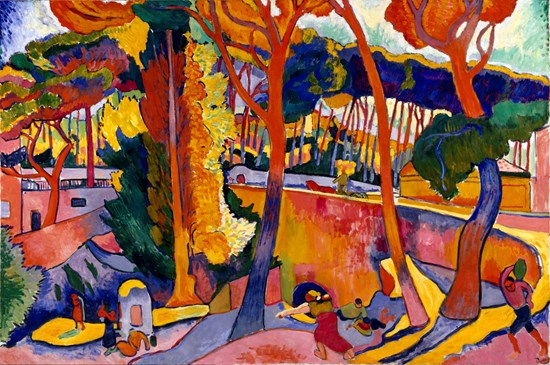
Fauvism was our ordeal by fire… colours became charges of dynamite. They were expected to charge light… The great merit of this method was to free the picture from all imitative and conventional contact.

-Andre Derain (1880-1954)

*********************

Les Fauves translates from French as the Wild Beasts. Fauvism was an art movement in the early 20th century that focused on color, line and a painterly surface, breaking away from both traditional representational painting and the Impressionist movement of that time that maintained many of the same values as traditional realism. It was a short lived movement, lasting only a few years, but its influence down through the years has been great. It was led primarily by Henri Matisse and Andre Derain, both artists who I greatly admire.

Read Full Post »

To Leave Something Behind

Time is short this morning but I wouldn’t miss posting a bit of music on this Sunday morning. It’s a song from Sean Rowe that speaks very much to the desire that some artists have, myself included, to leave something behind. To leave a reminder, even a small one, that they existed and created in this world. That they had eyes and ears and a voice and a mind of their own. That they felt something, that they dreamed in this world.

The song is To Leave Something Behind and with his powerful voice, Sean Rowe certainly creates something here to leave behind. Give alisten and have a great day.


Read Full Post »

**********************

“You must study the Masters but guard the original style that beats within your soul and put to sword those who would try to steal it.”

El Greco

**********************

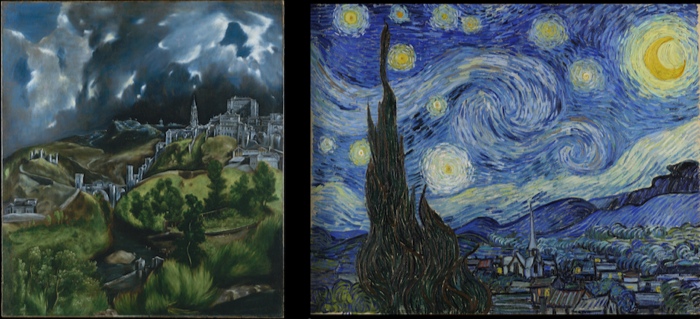
These words from El Greco (1541-1614) certainly were reflected in the influence his work had down through the ages. Many artists through the ages have appropriated his compositions and rendered them in their own original styles. Picasso, for example, was influenced by the elongated figures of El Greco. His View of Toledo is considered one of the first paintings solely focused on landscape, as well as the first cityscape. Below, you might be able to see a connection between it and Van Gogh’s Starry Night.

For myself, in the painting here at the top, The Burial of the Count of Orgaz, a massive painting that is about fifteen foot tall, I was struck by the gold clad figures (St. Stephen and St. Augustine) at the bottom who are lowering the dead aristocrat into his tomb. The colors and positions of the figures had me seeing them as figures in a Gustav Klimt painting.

Looking at the detail below, I could see them as being influences on his The Kiss. I don’t know whether they were an influence, but it certainly jumped into my mind. If so, kudos to Klimt for translating it into his own original style that beats within his soul, as El Greco may have put it.

And that is what influence should be. It is not trying to replicate, to copy, another’s work. It is in taking it in and synthesizing it using one’s own unique voice. I think every artist does this in some form. You just may not immediately notice it in the very good ones.

Detail from “The Burial of the Count of Orgaz”

“View of Toledo” and “Starry Night”

Read Full Post »

I have a large painting on the easel I want to get to this morning. It’s at a point of transformation which is always exciting and just looking at it now, I am eager to see where it goes. But I wanted to share a post from back in 2012 about a painting done in 1997 or 1998 that has occupied an important place in my heart and mind for a long time. I think it’s a good example of the how an artist’s work often lives with the artist after it has found a new home.

****************************

I was going to write about something different but came across this older image and completely lost my train of thought, this piece replacing everything that I had been thinking. Some pieces have that effect. It’s a smaller painting, maybe 6″ square, that sold many years ago when I was first showing my work at the Principle Gallery in the mid-1990’s. Though not large, this painting has lived in a larger sense in my thoughts ever since.

It’s titled Beauty Scorned and is a relatively simple piece. But there’s something in the washed out quality of the colors and in the the bend of the twisting tree trunk that really speaks to me in a very poignant way, as though it is a pure physical expression of some deep emotion.

Beauty and sorrow.

For me, I see this as being about perceptions of beauty and acceptance. About how we often conform, like the other trees which are so much alike here, and step back from that which is different, seeing not the beauty in it but scorning it because it is unlike us.

The beauty is in its difference.

I remember when I did this piece, feeling that this was symbolic of my own work at that time. It was often quite different from the work of other painters with which I showed and I was still unsure of the validity of my own voice, often feeling that my work was somehow inferior because it wasn’t painted in the same manner, didn’t have the same look as these others. At the time, I felt like my work and my voice was truly tied to this twisting tree and those who dismissed it because it had a different look were missing the beauty and emotion that it may hold.

Just seeing it again summons all of these thoughts in a rush of feeling. It remains a potent piece for me for this reason. It also has a sad memory in it.  When I see this piece I am always reminded of the couple who purchased it and were avid and encouraging collectors that I always looked forward to seeing at shows. They had a knack for choosing work to which I was most keenly attached. This couple later divorced and the wife would still come to the shows, always so happy for and encouraging of my work. Tragically, she passed away in a plane crash this past year [2012] and now, instead of seeing the scorning of beauty in this piece as I once did, I now see the beauty of this young lady’s spirit.

It’s a different painting for me now but no less potent.

Read Full Post »


Floyd and Lucille Burroughs; Walker Evans (American, 1903 – 1975); 1936


******************

Whether he is an artist or not, the photographer is a joyous sensualist, for the simple reason that the eye traffics in feelings, not in thoughts.

Walker Evans

******************

I am a big fan of the photos of Walker Evans. Some of my early Exiles paintings were inspired by his Depression era work, many of which were captured in a landmark book, Let Us Now Praise Famous Men,. Written by James Agee, the book is a document of the two men’s journey through the American south during that trying time.

I came across this quote from Evans and it made me appreciate his work even more. The idea that the eye traffics in feelings and not in thoughts is a simple one but it cuts right to the truth as any artist knows it to be. Art, whatever medium in which it takes place in, comes far before thought. It is that reaction, that feeling that hits you before your brain even begins to fully process what you are seeing that is the engine of art.

It is the feeling that bring on real thought afterwards. Allan artist can hope for their work.

I like seeing it put that way. And Mr. Evans certainly trafficked in feelings as the artist and joyous sensualist he was.

Here are just a tiny bit of his works.


Digital Photo File Name:DP264548.TIF
Online Publications Edited By Michelle Ma for TOAH 11_23_15


Read Full Post »

*****************

I never made a person look bad. They do that themselves.

-August Sander

*****************


I came across a video this morning that I want to share. It is a PBS produced film called What This Photo Doesn’t Show and delves into the backstory and meaning of the photo shown here, Three Farmers on Their Way to a Dance, taken by the German photographer August Sander in 1914.

It’s an a provocative photo, one that provides plenty of material for one to create narratives in their imagination. So, to learn more about the young men and the story behind the photo adds an additional layer of interest.

August Sander (1876-1964) was considered the most important German photographer of the of the early 20th century. Sander was widely recognized for a collection of portfolios of his portraits taken over a couple of decades. Titled People of the 20th Century, it contained hundreds of his photos that documented a wide spectrum of the German people of that era, from the working classes to the more privileged classes to the homeless and forsaken.

He also produced a book in 1929, Face of Our Time, that contained a group of 60 of these portraits. Under the Nazi regime a few years later, this book was banned and the printing plates for it destroyed. He was allowed to continue working as a photographer but kept under the radar. His son, as a Socialist, was sentenced to ten years in a German prison, where he died in 1944, near the end of his sentence.

That same year, 1944, a bombing raid destroyed Sander’s studio, destroying many of his negatives. Two years later, an accidental fire destroyed the remaining archived negatives of his work. It was said there were around 40,000 negatives at that time. Sander basically stopped working as a photographer at that time until his death in 1964.

The August Sander Archive, even with the great loss of the fires, contains about 5000 photos and 11,000 negatives.

If you have about 9 minutes, take a look at this video. I think you’ll find it interesting and informative.


Read Full Post »

Watching the news and I can feel my blood pressure rising as I sense both my dread and rage. I am not going to vent here.

What’s the sense in that? You have eyes and ears. You’re witness to a new dark chapter being written in our history. If you read it as I do, you feel the same dread and anger. If you’re pleased with what is happening, then most likely you’re not reading this nor would my words mean anything to you as your version of what you believe is the truth no doubt diverges from my own.

Lately, I keep coming back to a passage from a 1995 book, The Demon-Haunted World: Science as a Candle in the Dark, from scientist Carl Sagan.  The book was a defense of science and rationality and an indictment of pseudo-science and religious extremism. He had a premonition for the future and it appears that the pattern he was seeing at that time is coming to bear now.

“Science is more than a body of knowledge; it is a way of thinking. I have a foreboding of an America in my children’s or grandchildren’s time — when the United States is a service and information economy; when nearly all the manufacturing industries have slipped away to other countries; when awesome technological powers are in the hands of a very few, and no one representing the public interest can even grasp the issues; when the people have lost the ability to set their own agendas or knowledgeably question those in authority; when, clutching our crystals and nervously consulting our horoscopes, our critical faculties in decline, unable to distinguish between what feels good and what’s true, we slide, almost without noticing, back into superstition and darkness.

The dumbing down of American is most evident in the slow decay of substantive content in the enormously influential media, the 30 second sound bites (now down to 10 seconds or less), lowest common denominator programming, credulous presentations on pseudoscience and superstition, but especially a kind of celebration of ignorance”

A celebration of ignorance.

That may be the defining term for this age.

I’m going to let you chew on that while I try to calm myself with a little music from a long time ago. It’s Itchycoo Park from the Small Faces in 1967. The frontman for the band at that time (pre-Rod Stewart) was Steve Marriott. Probably not a name many of you know but he was highly influential in the history of modern rock and roll. For example, Robert Plant was an ardent Marriott fan sometimes errand boy for the band. He and Led Zeppelin owe a lot to the stylings of Marriott, who died at the age of 44 in 1991.

Anyway, it’s a favorite song and one that eases my mind a bit on days like this. Give it a try for yourself.

https://www.youtube.com/watch?v=14ViwvgtvbA


Read Full Post »


**********************

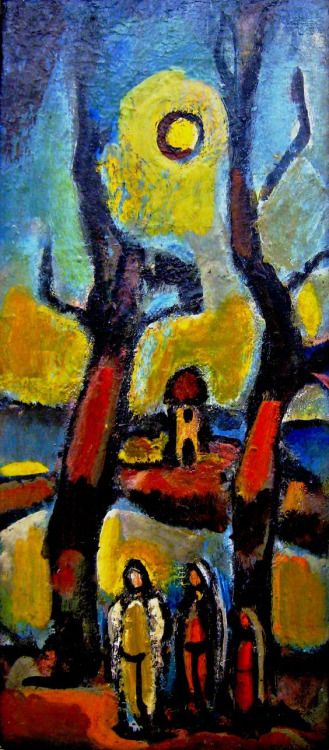
A tree against the sky possesses the same interest, the same character, the same expression as the figure of a human.

Georges Rouault

**********************

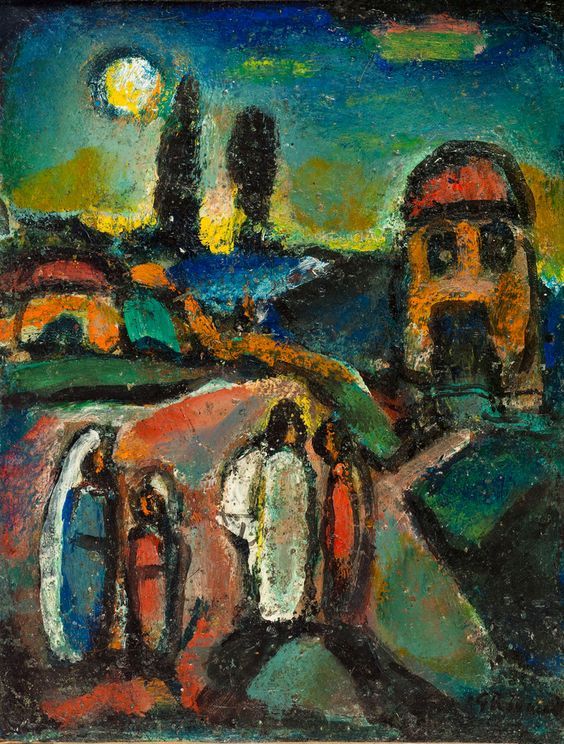
Georges Rouault (1871- 1958) has been a favorite of mine for a long time and the quote above certainly falls in line with my own feelings about the image of a tree. I have used the tree, the Red Tree to be more exact, for the past twenty years as a surrogate for the human figure in my paintings. You could pretty much insert a human figure in place of the Red Tree in many paintings and not lose much of the emotional content of the painting.

It would be a different painting, that’s for sure. The presence of the figure would focus everything on the specific human aspects portrayed in it. Is it a man or a woman? A child? Tall or short? Thin or wide? The interpretation of the painting becomes much more narrowly defined.

Using the Red Tree, on the other hand, allows for a broader reading, allows the viewer to see it in whatever terms they desire. It can be their own surrogate in the landscape. Or it can take on the characteristics of someone with meaning for them or someone expressing feelings that they share.

Or it can simply be a tree.

So, while I like being able to give the viewer those choices,I see the trees in my work, as Rouault says, as having the same interest, the same character, the same expression as the figure of a human.

Wouldn’t have it any other way.

Read Full Post »

« Newer Posts - Older Posts »