Feeds:
Posts
Comments

Archive for the ‘Painting’ Category

*******************************

I don’t know much about sailing. I do know the difference between port and starboard but that’s just mnemonics — port has four letters like left.

But I don’t know a sloop from a schooner, a ketch from a cutter. Can barely tie my shoelaces let alone some intricate nautical knot. Never felt the spray from the waves and can only imagine the feeling of being out in the middle of the sea, alone with only a sail and the rhythm of the currents to move me.

But the lure and romance of the sailboat and the act of sailing is not lost on me. The idea of attuning oneself to the awesome natural power and grace of the waves is an enticing proposition and just watching a skilled sailor handle a boat, even from the shore, is fascinating.

It’s all there, the same elements that I most often use in my landscape paintings. Natural power and high domes of sky. Wide horizons with the rhythms of the landscape replaced by the rhythms of the waves. The same sort of quietude and focus. A sense of purpose.

I think that’s what makes my sail boat paintings some of my favorites to paint. They are a chance to exercise my own imagination in trying to envision the experience of riding the rhythms of the ocean. I have been thrilled over the years when those folks who can call themselves sailors tell me how much they like these pieces. Makes me think I must be getting some aspect of it right, even if it only comes from my imagination.

The piece above is from my upcoming show, Social Distancing, that opens June 5 at the Principle Gallery. I call this painting, a 17″ by 17″ piece on paper, Running on Rhythm. Hopefully it feels right in some way for my sailing friends.

Here’s a song that is not really about sailing but it uses sailin’ in its title and chorus and is just a song that sticks with me. The song is Sailin’ Shoes from Little Feat. I am including two versions, both sung by the late great Lowell George. The first is the original from their 1972 album of the same name, a slower bluesy version. The second is from their incredible 1978 live album, Waiting For Columbus, who was by all accounts a sailor. This version is a bit more raucous and unrestrained. I like both.

Give a listen and have a good day.

Read Full Post »

**************************

“I told myself: ‘I am surrounded by unknown things.’ I imagined man without ears, suspecting the existence of sound as we suspect so many hidden mysteries, man noting acoustic phenomena whose nature and provenance he cannot determine. And I grew afraid of everything around me – afraid of the air, afraid of the night. From the moment we can know almost nothing, and from the moment that everything is limitless, what remains? Does emptiness actually not exist? What does exist in this apparent emptiness?”

Guy de Maupassant, The Horla

**************************

This is another new piece, a smaller painting on paper that is part of my Social Distancing show that opens June 5 at the Principle Gallery in Alexandria, VA. I am calling this piece The Emptiness.

The title is taken from The Horla, one of the last short stories written by Guy de Maupassant, the 19th century French master of the short story. It’s a tale of horror about an alien being — an invisible organism, actually– called the Horla that comes to earth with the intention of subjugating the human race. This unseen invader has the power to enter and sway the minds of its victims. The narrator of the story describes his emotions, the vast emptiness that overtakes him, as he realizes what is happening and his powerlessness in the face of the threat.

A few years later, tragically, de Maupassant tried to commit suicide by slitting his own throat but survived, dying in a sanitarium a year later, in 1893 at the age of 42. Apparently, the emptiness of the story’s narrator was very much the same emptiness as that of  the writer.

I thought this painting would fit well into this particular show, which is concerned with social isolation, from that which has been caused by the pandemic to all other forms of isolation. For some, isolation can bring solitude. For others, it brings the emptiness that de Maupassant described.

This painting leans toward that form of isolation. Maybe it’s the bilious green of the interior walls or the spare details of the room. Or the looming moon seen through the window, a large alien eye always there, always watching.

It feels like an unusual piece for me, even though it fits neatly into my body of work. It feels complete and there’s a pleasant, even comfortable, feel to it. But it’s an uneasy comfort, maybe like that experienced by those whose minds have unknowingly been infected by the Horla.

Or maybe it’s the uneasiness that comes with the normalization and acceptance, by a lot of people, of behavior that was once considered repulsive by the majority of us. It feels like the same kind of infection of the mind is taking place. Watching this take place now must surely be like the experience of the narrator watching the Horla affect those around him.

It certainly creates its own emptiness.

Read Full Post »

*******************

“When I pronounce the word Future,
the first syllable already belongs to the past.

When I pronounce the word Silence,
I destroy it.”

Wisława Szymborska, Poems New and Collected

*******************

“When I pronounce the word Silence, I destroy it…”

I love that line from the late Nobel Prize winning poet Wisława Szymborska. It so well sums up my own forays into writing as a young man when I found myself trying futilely to write about silence and places of silence. My words always seemed to defeat my purpose.

You can’t really write about silence.

Using words to describe silence is like using hate to demonstrate love or war to peace.  It doesn’t really work well.

No, you can’t write about silence.

You can only be silent.

Silence is a way of being.

That brings me to the painting shown above called Song of Silence.

This painting, Song of Silence, is being included along with a small group of vintage pieces in my upcoming show, Social Distancing, that opens at the Principle Gallery on June 5. Most of the early work for this show comes the mid 1990’s but this is the latest of the vintage pieces, from 2007.

It is a fairly large piece at 32″ x 32″ on paper and its size seems to accentuate its quietness. I did a number of similar pieces in the mid 2000’s and they were some of my favorites to paint. There was something special in the delicacy and restraint of these pieces. Their simplicity would lead you to believe they were simple to paint but capturing such an ephemeral feelings with minimal elements made them real challenges. Anything even slightly askew could make the whole thing fall apart.

For me personally, when these pieces worked, when they came together in that special way, they felt like magic. They transported me to a different state of being, to that place of silence, if only for a few short moments.

This is one of those pieces for me.

It’s been quite a while since I exhibited this type of work and I am eager to see what sort of response this brings in the gallery.  We’ll see.

The title, Song of Silence, seems like it might contradict my words at the beginning of this post but wordless music often has the ability to convey silence. As an example I am including a selection below from one of my favorite pieces of music, Tabula Rasa, from composer Arvo Pärt that I believe does this effectively. This music, as performed by violinist Gil Shaham, served as a large influence on much of my early work.

***********

Read Full Post »

*************************

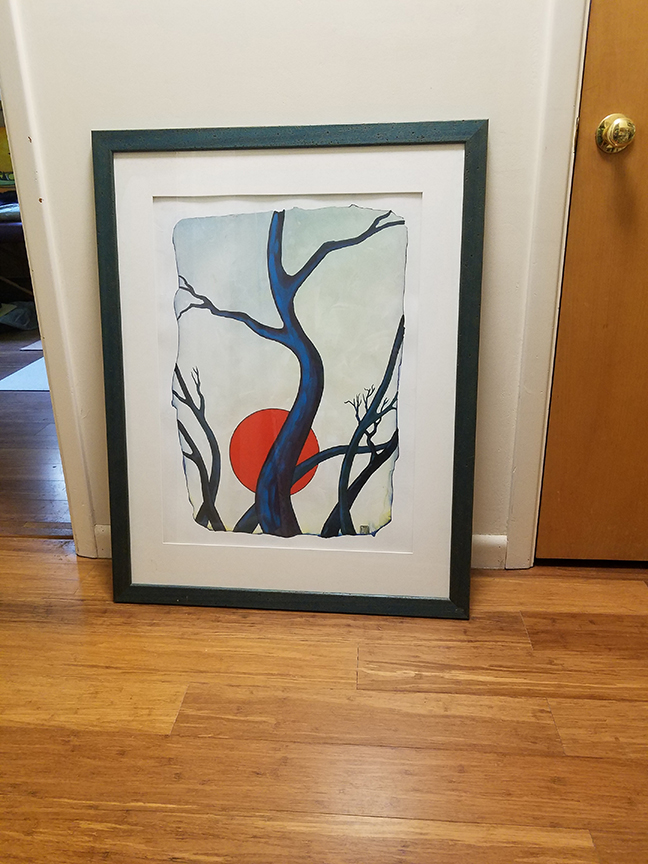
I am putting the finishing touches on the work for my upcoming show, Social Distancing, that opens June 5 at the Principle Gallery in Alexandria. In addition to the new works, I am putting together a small group of what I would call vintage work, early paintings from the 1990’s and a couple from the early 2000’s. Most of these haven’t been shown in over twenty years, if they have even been shown at all. I chose this time to share these pieces because I felt they fit well with the theme of this show, which is the isolation brought on by the covid-19 crisis.

The piece at the top is one that I am still trying to decide if it will be part of the show. It’s called Dance of Joy from 1996. It has been hanging in my studios for over twenty years now, from my first rustic studio that is in the process of being absorbed into the forest floor to my current more spacious and well appointed digs.

You wouldn’t think that you would include a piece called Dance of Joy in a show devoted to social distancing but I think you have to include the more hopeful and happy aspects, as well. After all, those moments still exist for most of us even in this state of suspended animation in which we now exist. The things that brought me joy before this still bring me joy now and almost all of them don’t depend on any changes in my form of isolation.

But beyond that aspect, I found an interpretation in the painting that I am sure wasn’t intended when it was first painted. I think at that time I saw the trees as dancers celebrating the rise of the red sun in a bacchanalian manner. But looking at this piece yesterday, I saw it an the dance of joy when we finally overcome the virus, that time when we find a way to safely control and manage, if not eradicate, it. I saw the red disc not as a sun or a moon on the rise but as the virus on the decline.

That will bring a time for dances of joy, a time to celebrate those times of shared communal enjoyment.

Until that time, we must be patient and careful in order to contain the damages and the deaths caused by this virus. But we can still do our dances of joy until we experience that real bacchanal that will hopefully come sooner than later.

For this Sunday morning’s musical selection, I am turning to the world of Klezmer music and the acclaimed clarinetist Giora Feidman.  Feidman is an Argentine born Israeli who is considered the King of Klezmer.  He was chosen by Steven Spielberg to perform the clarinet solos for his film Schindler’s List. The song I have chosen is titled, The Dance of Joy. But you knew that, right?

I love the infectious ( bad choice of word) energy of klezmer and this song has it at its highest level. I can see the trees in this painting moving wildly to this music. So, give a listen and try to find some moments of joy today, something that makes you do your own dance of joy. Have a good day.

**************

Read Full Post »

**********************

“Let me not pray to be sheltered from dangers,
but to be fearless in facing them.

Let me not beg for the stilling of my pain, but
for the heart to conquer it.”

― Rabindranath Tagore

**********************

This is another new painting headed to the Principle Gallery for my Social Distancing show there, opening June 5. It is 22″ by 28″ on canvas and is titled She Glides Through the Fractured Night.

Though the theme for this show concerns itself with the social distancing and isolation that we have experienced in recent months, it is also about perseverance and the will to endure. And that is what I see in this piece.

I hadn’t intended to do this type of piece for the show, with the single figure paddling a longboat under a broken sky. But I really felt a compulsion, a need for this painting, and once I set out on it, it fell into place easily, almost without effort. At every step in the process, it felt complete and ready to send out its message. It didn’t have the highs and lows that normally come in painting a piece. By that, I mean in most paintings there are phases where the piece dulls and flattens out, muddying up the destination that I had began to see in it.

No, this was an incredibly satisfying piece to paint. It just had to be done.

I think the history of what we are going through will tell two different stories: those who did what they must to endure and those felt they shouldn’t have to do anything differently in a world that has presented us with a new way of existence, at least for the short term.

Those that adapt easily to change will glide through this to the other side of this fractured night. They will endure.

I can’t say what will happen to those whose minds remain inflexible and unwilling to adapt to a new of being. Only their actions and time will write that history.

Read Full Post »

I came across an article this morning that had been forwarded to me by a friend several years ago in response to a blog post.  Appearing in the online magazine Psyche, it was written by three researchers ( Julia Christensen, Guido Giglioni, and Manos Tsakiris) and was largely about how creativity and wellness were often boosted by allowing the mind to wander. It’s an interesting article that discusses the neuroscience behind their research into the wandering mind.

While those that daydream have often been chided through history as being lazy and counterproductive, there has also been a school of thought that encourages random thought and rumination. The Germans had a phrase for this, ‘die Seele baumeln lassen,’– ‘let the soul dangle.

One part of the article that struck a chord with me discusses how art causes biological responses and often serves as a prop for emotional catharsis. As they put it:

“…art can help us adapt to the immediate source of pain by acting as a prop for emotional catharsis. We all know the strange, pleasurable, consoling feeling that comes after having a good cry. This experience appears to be precipitated by the release of the hormone prolactin, which has also been associated with a boosted immune system, as well as bonding with other people. The arts are a relatively safe space in which to have such an emotional episode, compared with the real-life emotional situations that make us cry. Even sad or otherwise distressing art can be used to trigger a kind of positive, psychobiological cleansing via mind-wandering.”

I immediately responded to this point as this is something that I experience on a regular basis. I often am moved to tears by artistic stimulus while in the studio, most often in the form of music, film or the written word. It is such a common occurrence that I have come to use this response as a barometer for how emotionally invested I am in the work I am doing at that time. I have found that the work that I feel is my best comes at times when I am on this edge of induced emotional catharsis. I feel most immersed in the work at that time, both open and receptive, even vulnerable. And that is normally when I produce my best work.

It’s something that has taken place with me for decades now and it’s interesting to see that there might be a neurological component behind my response. I think I am going to go now and see if I can produce some more prolactin this morning.

Click here to go to this article. It’s a relatively short read plus there is a an audible version available on the page if you would rather listen.

**************

The painting accompanying this post is a small piece that I call The Daydream. It is part of my solo show, Social Distancing, that opens June 5 at the Principle Gallery.


Read Full Post »

********************

“Beyond the edge of the world there’s a space where emptiness and substance neatly overlap, where past and future form a continuous, endless loop. And, hovering about, there are signs no one has ever read, chords no one has ever heard.”

Haruki Murakami, Kafka on the Shore

*******************

I call this painting, a 24″ by 24″ canvas, At the Edge of the World. It’s included in my annual solo show Social Distancing which opens June 5 at the Principle Gallery in Alexandria.

It’s an odd thing to promote a show during these strange times. While I know there will be a show, we still don’t know if there will be a reception. And even if there somehow is a reception, we don’t know what the logistics for it would be. I am pretty positive that I would not be attending in either case  which is odd as this has been an annual keystone event for me for the past 20 years.

Like many things these days, everything for the show has seemed out of rhythm and discordant.

I know getting into the groove for this show was difficult in the earlier part of this year as the pandemic took hold. I am not the kind of painter who can just fall back on my built in process and trust that it will carry me through. My process is always changing and is often quite different, even from day to day. The process used is often simply whatever is at hand that best allows me to express whatever the emotion well inside is gushing out on that given day.

For me, painting is almost always about the emotion of the moment. So, at a time when my emotions are flying all over the place, finding a painting groove took a while to locate. Before I found it, I felt like I was always fighting against myself. But now I’m in that groove and it feels good to create work that consistently meshes with my internal feelings.

We’re in a time that has shaken our rhythms and forced us to look at things in different ways, to reexamine what forces have brought us to this point and where we will be when this is all over. I think the work for this show distinctly reflects this time of social distancing and the air of anxiety and uncertainty that surrounds all of us. While some of it feels darker at first glance, there is most always a duality in the work that brings a feeling of hopeful possibility and endurance.

I know that is what I am seeing in this painting. It reflects the fact that we are at a place and time that we have never encountered before. We are at the edge of the world now. We don’t really now for sure what is in store for us beyond that visible edge. We fear the worst and hope for the best. The reality most likely is somewhere between those two poles but nobody can truly predict that future with any degree of certainty.

In this painting, I believe the focus is on the positive aspects of this near future that dwells over that edge. Much like the short snip from Murakami’s novel at the top, there is the possibility of that which is new and unknown to us. New chords to hear. New patterns to see. A new way of thinking.

This is about seeing this time as a moment of reinvention, with the possibility to forge a future that is markedly better than the past.

That’s my reading. You may see it differently and that is just as it should be.

Take care and have a good day.

Read Full Post »

*************************

It was the best of times, it was the worst of times, it was the age of wisdom, it was the age of foolishness, it was the epoch of belief, it was the epoch of incredulity, it was the season of Light, it was the season of Darkness, it was the spring of hope, it was the winter of despair, we had everything before us, we had nothing before us, we were all going direct to Heaven, we were all going direct the other way – in short, the period was so far like the present period, that some of its noisiest authorities insisted on its being received, for good or for evil, in the superlative degree of comparison only.

— A Tale of Two Cities, Charles Dickens

**********************

It seems like this current period of time, this year we call 2020, might be memorable. It definitely falls somewhere among those terms that Dickens set out in the opening paragraph of his A Tale of Two Cities.

I’m still waiting for the best of times part but maybe it will eventually show its shining face at some point this year. Got my fingers crossed on that one.

The painting at the top is part of my Social Distancing show that opens 4 weeks from tomorrow, June 5, at the Principle Gallery in Alexandria. As I was working on it, further into the process it felt like it was acting as a marker in some way of this year. It certainly reflected the social distancing in the show’s title.

But there was something more than that to it, something more like the Dickensian ( finally got to use that word!) words above. Perhaps best of times, worst of times sort of stuff.

Season of light and season of darkness, definitely.

I think it’s a fitting piece for this period with its fractured sky and darker, ominous tones set against the light from the sun/moon(?) and the sturdiness of the house.

It is neither optimistic nor pessimistic. Not fearful either nor foolishly filled with hubris. The word I might use is enduring.

Kind of like the final speech from Ma Joad ( played brilliantly by Jane Darwell) that ends the film version of The Grapes of Wrath:

“I ain’t never gonna be scared no more. I was, though. For a while it looked like we was beat. Good and beat. Looked like we didn’t have nobody in the world but enemies. Like nobody was friendly no more. Made me feel kinda bad and scared too, like we was lost and nobody cared…. Rich fellas come up and they die, and their kids ain’t no good and they die out too, but we keep on coming. We’re the people that live. They can’t wipe us out, they can’t lick us. We’ll go on forever, Pa, ’cause we’re the people.”

That speech always moves me because it speaks so strongly to my own survival instincts. There have been times when I wanted to give up but this same drive that Ma Joad describes kicks in.

You take the beating today but you keep plodding forward, doing whatever is needed to see the next day.

Because maybe that’s where the answer will be.

That’s what I see in this painting. Enduring. Resilient. Good time, bad times, fight through the darkness and look for the light. Just keep going on and not giving up.

I am calling this painting, which is 20″ wide by 30″ tall on wood panel, In the Year 2020.

It was somewhat borrowed from the old Zager & Evans 1968 hit In the Year 2525. That time 50 some years back felt as apocalyptic as this moment seems now. I am sure there was a lot of use of the best of times, worst of times at that point. But we did somehow endure the turbulence of that time. There might be much more ahead of us now that we will have to struggle past but we will most likely endure and look back at this year with mixed feelings someday, remembering the awfulness along with the goodness we discovered alongside it.

Here’s a video of that Zager & Evans song set to visuals from the 1925 silent futuristic dystopian classic from director Fritz Lang, Metropolis.
Have a good day and stay strong.

Read Full Post »

The_Torment_of_Saint_Anthony_(Michelangelo)

***********************

A man paints with his brains and not his hands.

-Michaelangelo Buonarroti

***********************

I am a little intimidated in quoting the words of a man who is believed to have painted the piece shown above, The Torment of Saint Anthony, at the tender age of 12 or 13. Pretty amazing. It’s obvious from this, and almost everything created afterward over his lifetime, that Michaelangelo had both brains and hands– the highest degree of craftsmanship along with thought and feeling that brought his work to life.

But his words ring true for any painter. Painting should not be mere craft, not formulaic process nor exact replication of the reality before them. No, it is beyond that. It is how the artist imbues the work with their own thought and emotion, their own spirit, their own essence that elevates the work above craft. It requires a total investment of the self.

Doing that is the trick. At first glance, it seems both a tall task and a simple one. Giving what you think is 100% of yourself seems easy, right? But not holding back something, not sharing every bit of yourself, makes it a Herculean effort. In the end, it comes down to simply feeling emotion in what you are doing and being willing to openly display it without reserve.

Now, maybe I am misinterpreting Michaelangelo’s words to fit my own subjective view of painting. Perhaps in these ten spare words he was speaking about taking a more scientific or mathematical approach to painting and composition. That I don’t know. But when I read it, it made sense to me because the differentiating quality I see in painting, from self-taught rough-hewn outsiders to the highest level of traditional representational painters, is how much of themselves a painter is willing to invest in their creations.

An investment of the self.

It is the thought process of the artist that makes the painting, not the mechanical process.

*******************

This post is from five years back. and is shared again because I love this youthful piece from Michaelangelo along with his words. Whenever I see this painting, or for that matter, anything from Michaelangelo, I am humbled beyond description. And that’s not a bad thing. 

Read Full Post »

I call this painting Hunkered Down. It’s about 17″ square on paper and is part of my solo show, Social Distancing, that opens in just over a month on June 5th at the Principle Gallery.

Choosing the title for this piece, or for the show for that matter, was not a difficult task. Hunkered down is the term that most often jumps to mind when I think of this time of keeping socially distant.

The fact that this is the normal form of existence for me made it even easier.

Avoiding people and not having to go anywhere is something I have practiced for decades. I never thought of wearing a mask but like the idea of the vague anonymity it provides. Now that it’s acceptable and required, I might continue to wear one even after this thing someday subsides.

That is, if I ever leave my property again.

That’s a big if.

This piece is a return to my older style in transparent inks, more spare in detail which allows the primary elements, the simple forms of sky and land, to carry the larger part of the emotional load. This lack of detail brings a quietness to the whole that speaks volumes, at least for me.

The first song that came to  mind when I thought of an accompaniment to this painting was an old favorite from Elvis Costello, Almost Blue. There are several versions of the song that I like so I had some choices. I have played a wonderful version that is an absolute favorite from late jazz great Chet Baker here before so I decided to play a nice simple and spare performance of the song by Elvis himself from a 2005 radio broadcast. I also threw in a version that I also like very much from, Diana Krall, who also happens to be his wife.

Have a good Sunday. Be careful out there, okay?

****************


Read Full Post »

« Newer Posts - Older Posts »