Feeds:
Posts
Comments

Archive for the ‘Quote’ Category

Ralph Fasanella Bread and Roses

Ralph Fasanella- Bread and Roses


This past week was the beginning of May and May Day, the first day of the month which is a holiday of several stripes, from a pagan celebration of the coming of summer to one that celebrates the rights of workers around the world. For me, it always reminds me of the late folk artist Ralph Fasanella. Before becoming a painter, he was a union organizer throughout his life and it is represented in much of his work. The painting at the top, Bread and Roses, for example, depicts the long and often violent 1912 labor strike against the textile mills in Lawrence, Massachusetts. The striker was called the Bread and Roses strike because the strikers demanded both better pay and benefits– the bread– as well as respect and recognition– the roses.

But when I think of Fasanella, beyond his labor and baseball paintings, I am also always reminded of a story about his response to a suggestion from someone about this painting. I have talked about it in posts here before but thought it would be a good story to share once more.

Anyone who does anything that people look at, listen to or read is always susceptible to a host of well-meaning folks who want to share ideas on how whatever it is that you do can be done better. It usually starts with some simple phrase: What you really need to do is… Or it could  be You should really try to… 

I generally listen politely and say something like I’ll look into that or Maybe I will try that sometime. Some of the suggestions are quite good and if I were so inclined might well be something I would do. But that is the key thing here: if I were so inclined.

If it’s not something that I want to do with great energy or excitement, if it’s not something that fits in with how I work and see things, then it ain’t getting done.

Another suggestion is that the artist or author should try to do something like other artists. That always hits a sour spot with me. It usually starts with Your work reminds me so much of… or Have you tried painting like….

I know when I was starting that a goal was to not have my work constantly compared to others so when I talk with young artists I try not to tell them that their work reminds me of another artist. There are exceptions to this, say when an artist is very new to the process and needs the affirmation that they are capturing something in the same way as a well known artist. But unless I know what the artist is trying to do and say with their work, it’s not my place to tell then how they should change their work or how it reminds me of other artists.

That brings me back to my Fasanella story. I am replaying a bit from when I first posted it here ten years ago. The portion with the Fasanella story is from a blog post from the Fenimore Art Museum which has a great folk art collection and whose president, Paul D’Ambrosio, was a friend and chronicler of  Fasanella’s work and life.

Here’s that post from 2011:


Over the years, I have been approached by several people who think they are doing me a great service by telling me that I should change the way I paint in some way or that I should try to paint more like some other artist. Early on, when I was first exhibiting my work, I had another more established artist tell me that I should change the way I paint my figures, that they should look the way other artists paint them. I responded to this artist and the others who offered me their advice with a smile and an “I’ll look into that.”

But that one time, I also mistakenly heeded the older painter’s words, being inexperienced and seeking a way as I was, and stopped painting figures for a while before realizing that this was not good advice at all. My style, after all, was my own and didn’t need to conform to what others thought were rules.

Here’s the post about Fasanella and his response to such advice.

Ralph Fasanella had trouble painting hands. A lot of trained artists do too, so it is not surprising that a union organizer who turned to drawing suddenly at the age of 40 would struggle with hands early in his career. But he did have something that proved better than years of formal training: he believed that he was an artist and that what he was doing – painting the lives of working people – was a calling that deserved his complete attention and all-consuming passion.

And that made him react when anyone suggested that his paintings weren’t up to snuff. He said that he was painting “felt space,” not real space. His people and the urban settings he placed them in were not realistic in the purest sense of the word, but they sang with spirit and emotion. As Ralph said, “I may paint flat, but I don’t think flat.”

Rembrandt Hands

His most memorable quote, and the one that says the most about him, occurred very early in his artistic career, when someone told him that his hands looked like sticks. He ought to study Rembrandt’s hands, they said, in order to get it right.

His response is priceless: “Fuck you and Rembrandt! My name is Ralph!”

I may not really adopt Ralph’s approach but you can bet his words will be echoing in my head the next time someone says “You should paint like…”


So, those are some of my thoughts on suggestions. Now I am going back to my work, doing it in the only way I know or can. If you have some suggestions for me, well… I’ll look into it.

Read Full Post »

GC Myers- Pillars of Wisdom- Wait and Hope sm


“There is neither happiness nor misery in the world; there is only the comparison of one state with another, nothing more. He who has felt the deepest grief is best able to experience supreme happiness. We must have felt what it is to die, Morrel, that we may appreciate the enjoyments of life.
” Live, then, and be happy, beloved children of my heart, and never forget, that until the day God will deign to reveal the future to man, all human wisdom is contained in these two words, ‘Wait and Hope.”

Alexandre Dumas, The Count of Monte Cristo


The painting above is another that is included in my show, Between Here and There, that opens June 4 at the Principle Gallery in Alexandria, VA. It is 12″ by 16″ and is also painted on an aluminum panel.

It is titled Pillars of Wisdom: Wait and Hope. This was inspired, in part, by the excerpt above from the classic The Count of Monte Cristo by Alexandre Dumas. As I was painting it, I began call this piece Pillars of Wisdom but after it was completed I came across this bit from Dumas. The idea of seeing these being trees named Hope and Wait and that they represent the totality of human wisdom seemed perfect.

So many of us live with a certainty and assurance that is beyond me. We have yet to learn all there is to know, all the answers to the infinite number of questions that hover over us like so many stars in the night sky. Perhaps one day we will fully be bathed in the light that is all wisdom, but until then all we have are those two words: Wait and Hope.

Hope waits for the light to come and Wait hopes for it.

Wait and Hope. What more do you need to know?


Read Full Post »


Fanny spoke her feelings. “Here’s harmony!” said she; “here’s repose! Here’s what may leave all painting and all music behind, and what may tranquillise every care, and lift the heart to rapture! When I look out on such a night as this, I feel as if there could be neither wickedness nor sorrow in the world; and there certainly would be less of both if the sublimity of Nature were more attended to, and people were carried more out of themselves by contemplating such a scene.

― Jane Austen, Mansfield Park


GC Myers- Tranquilium smThis is a new painting that is included in my new solo show, Between Here and There, which opens June 4 at the Principle Gallery. It is titled Tranquilium and is 10″ by 20″ painted on an aluminum panel.

I have recently started painting on aluminum composite panels which are two layers of aluminum sandwiched over a polyethylene core. They are rigid, acid-free and extremely durable which means that a painting done on one of these panels should be long-lasting.

The durability and  stability of my work is something I have thought about since my earliest days as an artist. While I have no control over how my work moves into the future after it leaves my hands, I can at least give it a chance to survive while maintaining the look and integrity of the original painting.

I don’t know if my work will live on but if so, I want it to look as good as possible. I believe work painted on these panels have the best chance at doing just that.

Plus, I like painting on them, Every surface– canvas, wood panel, or paper– has its own feel under the brush. A stretched canvas has an appeal for me in that there is often a drum-like feel and cadence as the brush bounces off the taut surface. It adds to the meditative quality of the process. Paper has a softness that comes through even when it is covered with multiple layers of gesso.

Much like wood or masonite panels but far more stable and unaffected by moisture, the aluminum panels have a unmoving solidity that lets me know how my brush will react as it meets the surface. That helps for my process. I know what is going to happen at that moment. And that’s a good thing.

This piece, Tranquilium, has satisfied something within me. It has a stillness and placidity that feels timeless so it’s natural that I would like to think that it will live a longer life than my own. Hopefully, it has something in it, perhaps that which Jane Austen’s Fanny described above, that will speak to someone in the future as it does to me in the present moment. Lifting the panel with this painting, feeling its weight and solidity and the way the image comes off the surface, it certainly seems like it might.

I will never know but at least I am giving it a chance.

Read Full Post »

Paul_Gauguin_-_D'ou_venons-nous


What still concerns me the most is: am I on the right track, am I making progress, am I making mistakes in art?

–Paul Gauguin


I run this post every few years, usually when I am at a low ebb, when self-doubt is really nagging at me. Right now, as I prep for my upcoming Principle Gallery show, I am bouncing from highs to lows each day which is normal for me in my process. It’s during these times that I ask myself questions like those above that Gauguin posed for himself. However, this morning I feel pretty good. Fairly confident, feeling that my work is very much progressing and evolving in a positive way. But time has taught that by this afternoon I may be racked with doubt about my abilities or my own judgement of them. 

So, I try not to dwell on it and attempt to simply work through it. That. usually provides the answer to my questions and doubts. That’s what I am going to do right now, thank you.


At one of my gallery talks a year or two ago, I was asked about confidence in my work. I can’t remember the exact wording but the questioner seemed to imply that at a certain point in an artist’s evolution doubts fade away and one is absolutely certain and confident in their work.

I think I laughed a bit then tried to let them know that even though I stood up there and seemed confident in that moment, it was mere illusion, that I was often filled with raging doubts about my voice or direction or my ability. I wanted them to know that there were often periods when I lost all confidence in what I was doing, that there were days that turned into weeks where I bounced around in my studio, paralyzed with a giant knot in my gut because it seemed like everything I had done before was suddenly worthless and without content in my mind.

I don’t know that I explained myself well that day or if I can right now. There are moments (and days and weeks) of clarity where the doubts do ease up and I no longer pelt myself with questions that I can’t answer. Kind of like the painting at the top, Where Do We Come From? What Are We? Where Are We Going?, the masterpiece from Paul Gauguin. Those are tough questions to answer, especially for a person who has little religious belief.

And maybe that’s the answer. Maybe my work has always served as a type of surrogate belief system, expressing instinctual reactions to these great questions. I don’t really know and I doubt that I ever will. I only hope that the doubts take a break once in a while.

There was another quote I was considering using for this subject from famed art critic Robert Hughes:

The greater the artist, the greater the doubt. Perfect confidence is given to the less talented as a consolation prize.

I liked the sentiment but it felt kind of self-serving, like saying that being aware aware of your own stupidity is actually a sign of your intelligence. While I would really like to believe that all those times when I realized I was dumb as a stump were actually evidence of my brilliance, I have real doubts about the logic. If it is true, there are a lot of geniuses out there operating under the guise of stupidity and overwhelming self-doubt.

However, if Hughes is correct then I may be one of the the greatest artists of all time and a genius to boot.

But, at the moment, I have grave doubts about that.


Read Full Post »

GC Myers- Show's Over, Folks


Everything is going to be fine in the end.
If it’s not fine it’s not the end.

― Oscar Wilde


My solo show, Between Here and There, which opens June 4th at the Principle Gallery, has a group of smaller paintings featuring Red Chairs in interior scenes are mostly scenes of the aftermath of prior proceedings. I’ve shown a few here already and thought I would share another today. The one above is titled Show’s Over, Folks.

Kind of like a cop at a crime scene saying, “Shows, Over, folks, Nothing more to see here. Move on.

I enjoy these pieces in many ways. I like composing and painting them. I enjoy looking at them because while they often make me smile, they often make me think as well. There’s usually a fair amount of atmosphere in them to take in and interpret. Sometimes my take on a piece like this will change from view to view. Perhaps it’s dependent on my own mood at the time that I am looking.

Right now, this one makes me smile. The show might be over for the night and that might be sad but it ain’t the end. Like Wilde’s words at the top– if it’s not fine it’s not the end.

Here’s song that kind of goes with this piece. It’s an old Kinks favorite, Till the End of the Day. With lyrics like: Yeah, I get up/And I see the sun up/And I feel good, yeah/’Cause my life has begun how can things not be fine?

Now, off to work.


Read Full Post »


GC Myers- Hiding in Plain Sight

“Hiding in Plain Sight”- Bid for it on the SPCA Fundraiser


What makes a hero? Courage, strength, morality, withstanding adversity? Are these the traits that truly show and create a hero? Is the light truly the source of darkness or vice versa? Is the soul a source of hope or despair? Who are these so called heroes and where do they come from? Are their origins in obscurity or in plain sight?

– Fyodor Dostoevsky


I want to let everyone out there know that the painting above, Hiding in Plain Sight, is currently part of the online auction to benefit our local Chemung County SPCA. This painting is 10″ by 14″ on paper which is matted in a 16″ by 20″ frame. It is valued at $1500 and the current high bid is $1050. It is Auction Item #14.

This virtual fundraising event which takes place tomorrow, Saturday, May 1, runs from 4-7 PM on Facebook Live with the auction for all items ending at 7 PM. It also has a variety of entertaining musical performances though out the event. You can check out or bid on this painting or any of the many donated items by  clicking on this link for its Facebook page, SPCA Virtual Facebook Fundraiser and scrolling down through the items. As I said, this painting is Auction Item #14.

I hope you will take advantage of this opportunity to help out a worthy organization, our SPCA, and perhaps take home an original painting.

For me, this painting has message that aligns well with what Dostoevsky questions above. What makes a hero? What is beauty? What are we seeking? Is it beyond us or is it in plain sight?

My guess is that all that we seek and all that we are or need is always right before us, in plain sight.

So, come out of the shadows and stake your claim to heroism by helping the SPCA continue to help out the animals here in Chemung County. Like so many other things, those in need are often in plain sight, waiting for a helping hand.

Read Full Post »

Diebenkorn Ocean Park 67

Richard Diebenkorn- Ocean Park #67


When I am halfway there with a painting, it can occasionally be thrilling… But it happens very rarely; usually it’s agony… I go to great pains to mask the agony. But the struggle is there. It’s the invisible enemy.

–Richard Diebenkorn (1922-1993)


I am in the middle of painting and preparing work for my upcoming shows, the first being my annual solo show at the Principle Gallery in Alexandria in June. This is my 22nd show there so there is a definite pattern of behaviors and responses that occur during this process of putting together a show.

Some are quite good, resulting in me feeling a sense of purpose or worth. Then there are others that have me wondering why I am doing this or if I am good enough. It’s a rollercoaster ride of highs and lows, sometimes both taking place within hours of each other.

Sometimes a new painting will elicit both elation and doubt. I sometimes finish a piece being totally enamored of its effect on me then begin to doubt my own feeling. Is the appeal I feel real and from the piece itself? Or is it something else? Does my own bias blind me to its flaws?

I had that happen yesterday as I finished a piece that had me very satisfied at its completion. I just loved it, thought that it captured what I felt and needed to say in it. And did so in a bold way. But within hours, my doubts dispensed with all good feelings. I felt like maybe I was seeing things in it that would not be visible to others.

I ended the day not sure what to think of it and not trusting any reaction I felt.

The words from the late painter Richard Diebenkorn above ring very true for me at times like this. There is a constant struggle in the process for me during this time of my painting year. I am up one minute and down the next. At least, I know and accept this so I don’t mistake it for something else, like a psychotic episode.

There might even be something to be gained from this struggle. Maybe it keeps down that form of blind confidence that ultimately stifles the work’s growth.

Conversely, maybe the doubt prohibits growth?

I don’t know and don’t know that I ever will. But I continue the struggle, day in and day out. And cherish the highs and persist through agony of the lows.

It’s all I know how to do.

Time to get on the rollercoaster.

Read Full Post »

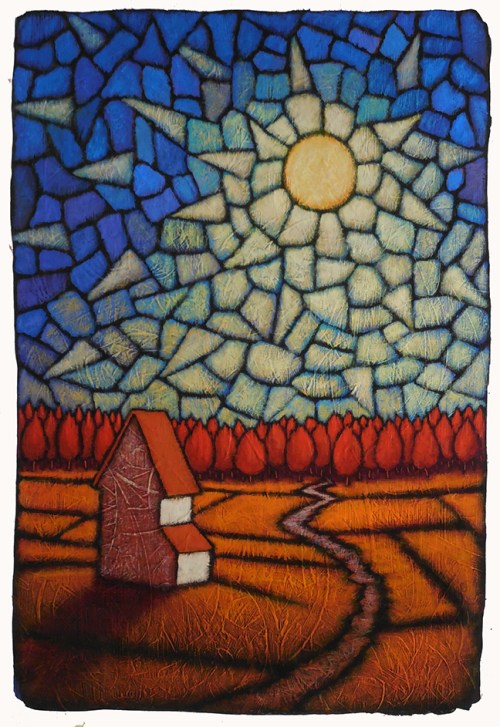
GC Myers-The Burning Secret a sm

The Burning Secret


Nothing whets the intelligence more than a passionate suspicion, nothing develops all the faculties of an immature mind more than a trail running away into the dark.

― Stefan Zweig, The Burning Secret


The new painting above is part of my June solo show, Between Here and There, at the Principle Gallery in Alexandria. Its title, The Burning Secret, is borrowed from a Stefan Zweig short story. The Austrian Zweig (1881-1942) was a giant of literature in the 1920s and 30’s, his books among the biggest best-sellers and most translated of the time. But he has not come forward in history with the same impact as some of his contemporaries such as Hermann Hesse and Thomas Mann, though there was new interest in his work after director Wes Anderson made Zweig’s The Grand Budapest Hotel into a wonderful film.

I am not going to get into Zweig here but the short excerpt form the story at the top seemed to fit so well with what I was seeing in this new painting. The forest of Red Trees has a feeling of danger and menace yet also beckons. I know that, as one possessed of an immature mind despite my quickly advancing age, that the danger possessed in mystery is an attractive thing for this unnurtured sort of mind.

You know you stay out of that place but there is something in there that needs to be found, some mystery to be exposed.

The fractured sky above appears to shed light and clues and the house seems to almost stare into the dark of the forest. Though it is apparently night the light on the fields is surreally mysterious and shadowy.

Yet, even with its evident potential for peril, there is something in this that tells me that the core of this mystery, the secret waiting to be uncovered, is not to be feared. The fear only comes in not knowing which allows the immature mind to run wild.

The more mature part of the mind feels that behind the mystery there may be answers. Perhaps even answers to the larger questions that have plagued one’s mind.

It makes me want to follow that path, that trail running away into the dark.

Who knows what lies beyond?


The Burning Secret is 13″ by 19″ on paper and is matted and framed in an 18″ by 24″ frame. It is included in my solo show, Between Here and There, which opens June 4, 2021 at the Principle Gallery in Alexandria, VA.

Read Full Post »

20210331_055939 The Memory of That Time sm


I can only note that the past is beautiful because one never realises an emotion at the time. It expands later, and thus we don’t have complete emotions about the present, only about the past.

― Virginia Woolf, Diary, March 18, 1925


This new painting at the top is titled The Memory of All That and is part of my upcoming solo show, Between Here and There, at the Principle Gallery. The show opens June 4, 2021.

This piece has held the feeling of deep memory for me since it was completed. Maybe it’s the burnished edge of darkness that runs around its perimeter, like looking through an old film cell that has aged and darkened. You hold it up to the light and the brightness from behind brings the central image to life once more while seeming to put the peripheral imagery in shadows. They’re still there, just not as distinct.

The Virginia Woolf quote at the top seems especially applicable here. I see the Red Tree taking on  the role of a being who returns to the their past, gazing at the old homestead. The memories that flood in take on an emotional feel that is often deeper and more pronounced than was evident at the actual moment being remembered.

The present is often incomplete. It sometimes lacks the context which comes from pertinent future events that add the emotional depth and flavor we feel when we later revisit it as memory.

I know that this is something I often see in my own memories. Even those that had emotion at the moment in which they occurred are often deeper and many times felt with completely different emotions upon recall. For example, take some incidents of the petulant anger of youth. I might remember the initial incident and anger but the memory now might contain a bit of embarrassment at my lack of self-control, naivete and wrongheadedness.

Or what might have been a fun moment then now contains feelings of familial love or even a sense of loss.

As I said, the present is seldom complete. And future events– changes within ourselves and in the circumstances our lives–will continue to change our memory of it.

That’s what I am reminded of in this piece. The Red Tree will grow larger and its perspective will change, as will the homestead and everything around it. Our memories sometimes seem like they are set in concrete but they often shift and change in ways that we barely perceive.

After all, we live in an impermanent world. Memory sometimes gives us the feeling of permanence, even though it may only illusory.

Okay, enough. I have lots to do today and its time to get to work.


Read Full Post »

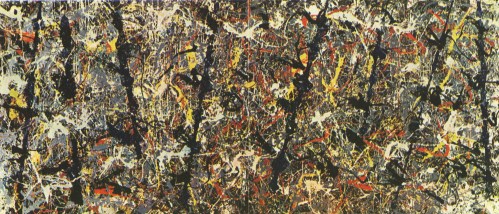
pollock-blue-poles-1953-jpeg


It doesn’t make much difference how the paint is put on as long as something has been said. Technique is just a means of arriving at a statement.

–Jackson Pollock


I am sure there are plenty of artists who would argue this point made by Jackson Pollock. Like religion, many would most likely defend their chosen means of expression as the best.

But I think he is saying there is no one right way, no one technique that ranks above all others in putting forth an artist’s voice and statement. Each artist’s individual voice comes through their own chosen technique. Their statement–their truth or belief, if you will– arrives via that technique.

I know that’s been my experience when I am looking at art. I am generally looking for a statement of some sort from an artist in their work, something that displays their own truth regardless of how it is expressed. It doesn’t have to be a world shaking or any sort of grand statement. Just something that tells me about this artist’s situation in the world, how they see and feel it. I am mainly looking for something that makes me feel the need to look at it, to engage with it.

It can be in any style, stretching from the most refined painting created by a classically schooled artist down to an untrained folk artist who uses their local mud as their painting medium because that is all that is at hand. So long as each is earnestly created (and that is an important distinction) and provokes a true emotional response, any and all technique is valid.

To bring it back to the religious analogy, the earnest belief of the lone person sitting in a decrepit hut somewhere may be as valid as that of a priest in the grandest cathedral.

Art, like religion, is diminished when we fail to see the validity of all other voices.


This ran several years ago. Maybe it’s my own attempt to validate my own work which doesn’t fully fall in any traditional category. I like to think it’s more about validating anyone who has the need to express but feels like their lack of training or materials diminishes in some way. Honest expression always rules the day.

Read Full Post »

« Newer Posts - Older Posts »