Feeds:
Posts
Comments

Archive for the ‘Quote’ Category

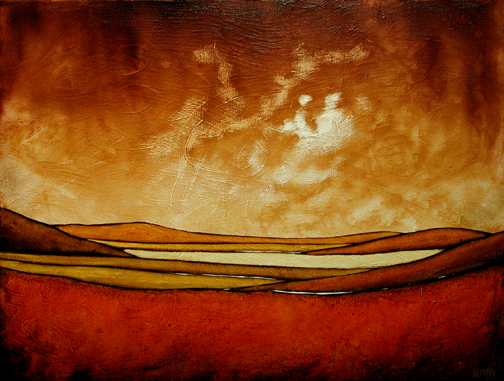
GC myers-Sanctuary A couple of days ago I wrote about the theme behind my upcoming Home+Land show at the West End Gallery, briefly describing that feeling of feeling at home in a place.  This homing instinct has been noted by others including a passage in the book Desert Solitaire from late author/environmentalist Edward Abbey.

Written in 1968, the book tells of his time as seasonal park ranger at Utah’s Arches National Park in the 1950’s and has been compared to Thoreau‘s Walden for the philosophical ruminations that run alongside his stories of working the park.  I read it probably well over thirty years ago and had forgotten this short passage until running across it on another site.  It fit so well into the other day’s post that I thought I would share it:

Every man, every woman, carries in heart and mind the image of the ideal place, the right place, the one true home, known or unknown, actual or visionary.  A houseboat in Kashmir, a view down Atlantic Avenue in Brooklyn, a gray gothic  farmhouse two stories high at the end of a red dog road in the Allegheny Mountains, a cabin on the shore of a blue lake in spruce and fir country, a greasy alley near the Hoboken waterfront, or even, possibly, for those of a less demanding sensibility, the world to be seen from a comfortable apartment high in the tender, velvety smog of Manhattan, Chicago, Paris, Tokyo, Rio or Rome—there’s no limit to the human capacity for the homing sentiment. Theologians, sky pilots, astronauts have even felt the appeal of home calling to them from up above, in the cold black outback of interstellar space.

I know that this homing instinct, the need to be peacefully at ease in a place, has been a prime motivator in many parts of my life and it shows itself in my work on an a regular basis.  The example at the top very much reflects this sense of home and is called, fittingly, Sanctuary.  It is part of my show Native Voice which hangs now at the Principle Gallery and ends July 6.


Read Full Post »

I wasn’t going to write anything today.  Getting ready for the new show at the West End Gallery has kept me exceedingly busy but I came across a clip from a Viktor Frankl lecture that I liked and wanted to share.  Frankl ‘s book, Man’s Search For Meaning, has been an important book in my life and his ability to find hope in the darkest of times always provides inspiration.  The clip, from 1972, shows this optimism and even though it is from 1972, it speaks for any time.  Honestly, the idea that this man who has experienced the worst side of mankind can find hope for mankind makes me slightly ashamed at the cynicism I sometime find in myself when I consider the future of this planet.

You can find Frankl’s book on YouTube as a free audiobook by clicking here.

To preface the clip I thought I would share a blogpost and painting from five years back:

GC Myers- LifebloodWe who lived in concentration camps can remember the men who walked throughout the huts comforting others, giving away their last piece of bread. They may have been few in number, but they offer sufficient proof that everything can be taken away from a man but one thing: the last of the human freedoms — to choose one’s attitude in any given set of circumstances, to choose one’s own way.

———-Viktor Frankl

************

I don’t know why this came to mind today but it did.  Viktor Franklwas an Auschwitz survivor who, after the war, createdlogotherapy, one of the important schools of psychotherapy alongside those of Freud, Adler and Jung.  It was a therapy based on finding meaning in one’s life, a reason to struggle onward.  In his best known book, Man’s Search For Meaning, he recounts his time in the concentration camp and how he and others who survived  seemed to have something in common– the discovery of a purpose and meaning in living.  It might be love. It might  be the will and drive to create.  Just something to set on their horizon to pull them ahead despite the horror around them.

Maybe it was this painting, Lifeblood,  that brought back Frankl for me.  I had come across his work a number of years ago and and his words and example have helped me through some desperate, foundering times of my own.  There is a certain power in knowing that we all are fated to suffering of some sort, just by the sheer nature of existence.  There will be pain, there will be death.  No one is exempt from the distresses of  life.  But these can be endured through the knowledge that we have the choice in how we react to such events, how we perceive the deprivations of our lives.  We can choose to wallow, to give in,  or we can forge ahead.

Maybe that’s how I see this painting, as a path through the pains of living, symbolized by the blood red of the ground.  All the leaves, everything it had,  have been stripped from the tree yet it still stands.  It reaches for the light above, seeks a meaning for its suffering.

I didn’t see it that way when I first painted this.  It was simply color and form.  Simplicity and harmony.  But sometimes there’s an associative power to a piece that gnaws at you, begs you to look deeper and find what it’s trying to say.  And maybe the ideas of Viktor Frankl hide in this piece for me…

Read Full Post »

GC Myers Home+Land smThe ache for home lives in all of us, the safe place where we can go as we are and not be questioned.

–Maya Angelou

*****************

This is the title painting, Home+Land,  for my next solo show which opens July 17 at the West End Gallery in Corning.  It’s a pretty large painting at 36″ high  by 48″ wide on canvas and one that fairly represents my feelings on how we are tied to the land, how we identify home with a sense of place.  This is the theme for this show as well as for much of my work in general.

I have long equated the idea of home with the landscape, with how we are shaped by those places that we know from an early age.  The rhythm, the shapes and the perspectives of the landscape that surrounds us becomes part of who we are , something that travels with us throughout our lives. Wherever we go, we look for similarities to that feeling of our home landscape.

It might be in the actual landforms or the way in which the vegetation interacts with the land and the structures of the homes there. It simply looks like home.  Or it might be just in the way the light strikes the land or the rhythm and flow of movement within the landscape that create a level of comfort that equates to that feeling of home.

I know, for myself, that there have been places where I have been where the landscape has been so different from the hills and fields surrounding my original home yet I still feel a sense of being at home.  And there are other places that, while similar in shape and having beauty and charms of their own, leave me uneasy and feeling out of place.  And there are places in which I immediately feel out of place in an alien way, places to which I could never fully adapt.  Definitely not at home.

I guess what I am trying to say is that home is a mix of feeling and place.  It is that place where you feel as comfortable and satisfied in place as the Red Tree in the painting above.


Read Full Post »

paul-gauguin-the-alyscamps-in-arlesDo not paint too much after nature. Art is an abstraction; derive this abstraction from nature while dreaming before it, and think more of the creation which will result than nature.

-Paul Gauguin

******************

Although I wouldn’t probably call Paul Gauguin one of my favorite artists, I do admire and respect much of his work.  More importantly, there are a lot of things I’ve taken from his work over the years, including the advice offered in the above quote.  The idea that the painter could paint the landscape not exactly as it were before them but, rather, in how they felt they saw it was a mind expanding thought.  It meant that the artist could take liberties with color, space and form to find their own expression of nature.

Another thing I culled from looking at Gauguin’s paintings was his use of multiple colors within his surfaces.  I remember seeing an exhibit quite a few years ago at the MFA in Boston.  Looking closely at some of his Tahitian scenes, I noticed that while one would say the overriding color of each piece might be green there were other colors among the greens of the tropical landscape, most noticeably large flecks of vermillion, that gave the overall color so much more depth and interest.  I knew that I needed to increase the complexity of my own colors.

I’ve also talked quite a bit about Native Voice, about painting in a way that was purely natural and distinct like a signature to the artist.  Gauguin’s work is to me a perfect example of this native voice.  His ease in being himself on his surfaces made it easier for me to be myself.  Whenever I get a chance to look closely at his work I take the opportunity because I almost always find something in it that helps me in my own work.

 It always has something to say and share.  And that in itself is an influence and a hope for my own work.

Paul Gauguin A Farm in Brittany

Read Full Post »


Helen Frankenthaler -Sirocco

Helen Frankenthaler -Sirocco

I received a nice letter yesterday from the American Ambassador to Kuwait, Douglas Silliman,  expressing thanks for the loan of a painting of mine to hang at their residence at the embassy in Kuwait City.  In describing  how they came to choose the works that hang there, he mentioned that one of the other pieces in the embassy exhibit was Sirocco from the late Helen Frankenthaler.

This really interested me because she was an artist whose unorthodox use of materials greatly influenced my own thoughts on how I worked.  It brought to mind a quote from her that I have used several times here in the past that expresses just this point.  One time I used this quote was from a post from over two years ago that I would like to rerun today, called Willingly Off Balance:

gc-myers-feb-2013-smThis is a new piece that I started over the weekend.  It’s a fairly large canvas, 24″ by 48″,  gessoed and blackened before I began to lay out the composition in the red oxide that I favor for the underpainting.   I went into this painting  with only one idea, that it have a mass of houses on  a small hilltop.  That is where I began making marks, building a small group of blocky structures in a soft pyramid.   A little hilltop village.  From there, it went off on its own, moving down the hill until a river emerged from the black.   An hour or two later and the river is the end of a chain of lakes with a bridge crossing it.  We’ll see where and what it is when  it finally settles.

I like this part of the process, this laying out of the composition.  It’s all about potential and problem-solving, keeping everything, all the elements that are introduced, in rhythm and in balance.  One mark on the canvas changes the possibility for the next.  Sometimes that possibility is limited by that mark, that brush of paint.  There is only one thing that can be done next.  But sometimes it opens up windows of potential that seemed hidden before that brushstroke hit the surface.  It’s like that infinitesimal moment before the bat hits the pinata and all that is inside it is only potential.  That brushstroke is the bat sometimes and when it strikes the canvas, you never know what will burst from the rich interior of the pinata, which which is the surface of the canvas here.  You hope the treats fall your way.

One of the things I thought about as I painted was the idea of keeping everything in balance.  Balancing color and rhythm and compositional weight, among many other things, so that in the end something coherent and cohesive emerges.  It’s how I view the process of my painting.  Over the years,  keeping this balance becomes easier, like any action that is practiced with such great regularity.  So much so that we totally avoid problems and when we begin to encounter one, we always tend to go with the tried and true, those ways of doing things that are safest and most predictable in their results.

It’s actually a great and safe way to live.  But as a painter who came to it as a form of seeking,  it’s the beginning of the end.  And as I painted, I realized that many of my biggest jumps as an artist came because I had allowed myself at times to be knocked off balance.  It’s when you’re off balance that the creativity of your problem-solving skills are pushed and innovation occurs.

It brings to mind a quote from Helen Frankenthaler that I used in a blogpost  called Change and Breakthrough from a few years back:   There are no rules. That is how art is born, how breakthroughs happen. Go against the rules or ignore the rules. That is what invention is about. ”  

 You must be willing to go outside your comfort zone, be willing to crash and burn.   Without this willingness to fail, the work becomes stagnant and lifeless, all the excitement taken from the process.  And it’s that excitement  in the studio that I often speak of  that keeps me going, that keeps the work alive and vitalized.

It’s a simple thing but sometimes, after years of doing this, it slips your mind and the simple act of reminding yourself of the importance of willingly going off balance is all you need to rekindle the fire.

This is a lot to ponder at 5:30 in the morning.  We’ll see what this brings in the near future.  Stay tuned…

*********************

By the way, this is the end product of the painting started above, Game of Life.

GC Myers- Game of Life 2013

GC Myers- Game of Life 2013

Read Full Post »

Vincent Van GoghWhy does one not hold on to what one has, like the doctors or engineers; once a thing is discovered or invented they retain the knowledge; in these wretched fine arts all is forgotten, and nothing is kept.

Vincent Van Gogh

Letter to his brother Theo 1888

*****************************

When I read this quote from Van Gogh, I flashed back to a conversation I had several years back with an artist friend who was urging me to begin filming my painting process.  He said that a deer could jump in front of my car going home from the gallery that night and nobody would ever know how my  paintings came about.  He  thought would be a loss.

That made me think but I still didn’t follow his advice and protected my process, except for small glimpses here and there, for years like an alchemist greedily withholding their found knowledge.  It was one of several reasons for my lack of enthusiasm for teaching.

But time normally changes all things.  I began to realize that it was a fool’s mission in keeping my process to myself.  The  process was tool for expression– it was not the expression.

An artist often has individual expression that transcends subject, material and technique.  For example, an artist painting exactly like me– same trees and process– would produce work that would be different than my own.  It would have a different soul, if it had one at all.  If this artist’s purpose was mere copying, it would not.  I can say this because I’ve seen this before.

So, after a bit, I came to understand that showing or teaching my process would not diminish my work in any way.  In fact, I began painting the way that I do because I initially wanted to see paintings that I wasn’t seeing anywhere else.  Wouldn’t it be great to spur that same thing in others?

To that end, as I announced earlier, I am teaching my first two day workshop,  September 17 & 18,  at the Arts Center of Yates County in Penn Yan, NY.  It’s a lovely town sitting at the end of scenic Keuka Lake, one of the Finger Lakes, famed for their beautiful vistas and multitude of wineries.

I am pretty excited about this and am starting to put together just how I want to teach this.  I don’t want to spend any more energy  hiding my process and I plan to fill each of the  two days with as much info as I can get across while still making it entertaining and educational.  So if you want to spend a couple of late summer days in a beautiful setting learning a form of expression that might spur other good things for you, contact the Arts Center of Yates County.

Hope to see you there.

Read Full Post »

GC Myers Time to Reflect  smIt is very dangerous to go into eternity with possibilities which one has oneself prevented from becoming realities.  A possibility is a hint from God.  One must follow it.  In every man there is latent the highest possibility, one must follow it.  If God does not wish it then let him prevent it, but one must not hinder oneself.  Trusting to God I have dared, but I was not successful; in that is to be found peace, calm and confidence in God.  I have not dared: that is a woeful thought, a torment in eternity.

–Søren Kierkegaard

*******************

There is nothing I can add, except to point out that the image at the top is another new painting, a smaller 9″ by 12″ canvas called Time to Reflect, that is part of my Native Voice exhibit which opens on June 5 at the Principle Gallery.

Read Full Post »

He knows all about art, but he doesn’t know what he likes.

–James Thurber

******************

James Thurber Cartoon Art CriticThis may not technically qualify as a quote but who cares?  The message in this cartoon from the great James Thurber is so simply put and true and that’s what I am looking for in a good quote.

 And art.

That’s what I like.

In the past I’ve talked about how many people are intimidated by the idea of art, feeling that they don’t know anything about art.  This leaves them not trusting their own eyes and their own reactions to any given piece of art.

And that is a pity because art is mainly about the reaction to it.  Art is a reactive agent, reaching out and stirring something in the viewer.  All of the knowledge in the world about a piece of art cannot make you like that piece of work if it doesn’t first strike that chord that raises some sort of emotional response within you.

And I think most of us know within a few moments whether a work of art speaks to us or leaves us cold.  The trick comes in recognizing this realization and feeling okay with it.

I’ll admit that there are many celebrated works of art out there that do absolutely nothing for me.  They may have historical importance or elements of beauty or great craftsmanship in them but they simply don’t raise any emotional response within me.

I might be able to appreciate them but the bottom line is that I don’t like them, plain and simple.  That doesn’t mean I’m right or wrong.  It just means I know what I like.

And I accept that criteria from anybody, even with my own work.  While it would be nice to think that it speaks to everyone, I know this is an impossibility.  I’ve had people tell me that they didn’t like my work– in polite and respectful terms, thankfully– and I’m okay with that.

They know what they like.  And that’s good enough for me.

Read Full Post »

GC Myers Breakthrough smWho in the world am I? Ah, that’s the great puzzle.

-Lewis Carroll, Alice’s Adventures in Wonderland

************************************

I think the lines above spoken by Lewis Carroll’s Alice fit this new painting very well.  In the book, she has has just grown to a very great size and frightened away the White Rabbit which has her suddenly realizing that Wonderland is a very puzzling place.  But even more puzzling is how the changing perspectives of herself she encounters in Wonderland have left her questioning her own identity, her own sense of self.  The solution to navigating her way through Wonderland is in finding out her own identity.

And that is a truth for almost anybody, anywhere.

And that’s what I see is this painting, a 30″ by 30″ canvas that I call Breakthrough.

The foreground with the cryptic forms of its fields sets the tone for piece with darker tones and tempting colors.  The path runs through these labyrinth-like segments toward a sky that has a burst of light from the sun pushing forward, symbolizing the breakthrough alluded to in the title.  And at the furthest inward point is the Red Tree.  Like Alice, it is attempting to shed the many differing perspectives of itself it has run across to get to this moment, a moment in which it feels it has reached a solution to the puzzle of who or what in the world it truly is.

The path forward is much easier to travel once you have solved that great puzzle, as Alice called it.

This painting is part of my annual solo show, this year titled Native Voice, at the Principle Gallery in Alexandria VA which opens on June 5, 2015.

Read Full Post »

GC Myers Eternally FreeAll of humanity’s problems stem from man’s inability to sit quietly in a room alone.

–Blaise Pascal, Pensées 

************************

This week’s quote continues the theme of silence that showed itself in yesterday’s post where poet Wendell Berry advised us to sit alone and to be quiet, to accept those things we might find in the silence.  This oft-quoted line from  French mathematician/philosopher Blaise Pascal from back around 1660 shows us that even in that world without smartphones and the constant crackle of 24/7 electronic and social media the idea of sitting in silence made most people anxious.

It’s an interesting thing to ponder.  As I sit here, a little before 7 AM in my quiet studio, I can hear the thump of a bass from someone’s car stereo probably almost a mile away as it goes down the road.  That is someone who obviously isn’t ready to embrace silence and believes that they are doing everyone else a favor by breaking it up so we won’t be bothered by it.

Hard as it is to admit, I was that guy at one point in  my life.   Noise was a way of making my presence, my existence, known.  

The lion’s roar.  The barbaric yawp.  

It was all an existential scream that tried to break through the ever-growing wall of sound from the outside world that threatened to obscure everything, melding all the noises into a huge suffocating drone of anonymity.

But my noise made no difference.  No single sound, no one angst-filled scream could break through and show that I was indeed alive, that I mattered.

No, existence was found sitting quietly in a room alone.

It wasn’t always easy.  In the silence there is nowhere to hide from every random thought, every fear, every diminishment of yourself. But silence provides the gift of acceptance after a time and every relived thought and moment, good or bad,  becomes equally part of the make-up of your self.  You come to realize that proof of your existence is in this acceptance and not in that barbarous scream that you once thought would scar the world as that proof.

It sounds too simple, I know.  But simplicity is sometimes very difficult and I still find myself struggling to stay in the silence, to not revert to screaming out.

But most days I find that it is worth the effort.

Read Full Post »

« Newer Posts - Older Posts »