Feeds:
Posts
Comments

Song of Myself


I think I could turn and live with animals, they are so placid and self-contain’d,
I stand and look at them long and long.

They do not sweat and whine about their condition,
They do not lie awake in the dark and weep for their sins,
They do not make me sick discussing their duty to God,
Not one is dissatisfied, not one is demented with the mania of owning things,
Not one kneels to another, nor to his kind that lived thousands of years ago,
Not one is respectable or unhappy over the whole earth.

–Song of Myself  32, Walt Whitman


leaves of grassA little busy this morning but wanted to share a few lines from Uncle Walt. I find that it has a soothing effect much like the effect of watching the wild creatures that live around us. My current best animal friend is Howie the older tom turkey who sometimes runs down the path toward me when he sees me coming, gobbling loudly as he comes. I know it’s just because of the sunflower seeds I put out for him and his other bird friends but his evident joy in seeing me always makes me smile.

I think we all appreciate someone displaying a little bit of joy when they see us, even if it’s just an old tom.

I sure do.

Here’s a reading of an excerpt from Whitman’s Song of Myself from his eternal classic Leaves of Grass.


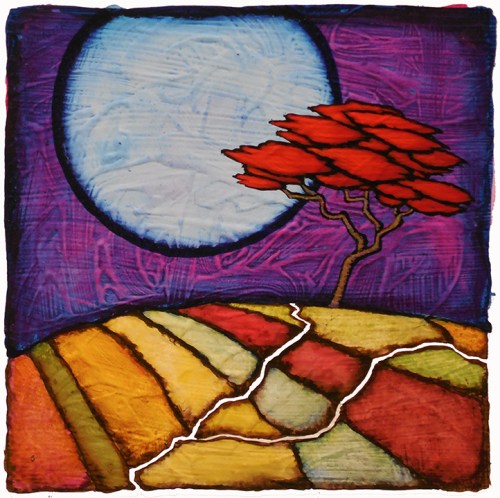
GC Myers- Under the Blue Moon sm


Now I’m standing in the wake of forty years
And from this prison I have broken free and clear
And I’m praying that the morning won’t catch me here

— Full Moon, Peter Bradley Adams


The small painting above is called Under the Blue Moon. It’s headed to the Principle Gallery for my annual show there which open June 4. This year’s show is titled Between Here and There and is my 22nd show at the Alexandria gallery.

It’s hard to believe that it’s been 22 years since my first solo show at the Principle. So much has changed in the world. My work has also changed but it is an incremental thing, one that I would like to believe maintains a consistency even as it changes.

This piece is a good example of it, painted very much in the same style with a similar process to the work I was producing back at that first Principle Gallery show in 2000. But while it maintains its recognizable features, it has changed, with colors that are more intense and a bit more layered and complex. The suns and moons in my work have grown in size over the years, as a result taking on a more prominent role in the composition.

That’s definitely the case here. This piece just feels good for me with the colors and angles of the forms triggering a lot of different responses within me. It has a feeling of the vulnerability of a confession for me, the Red Tree standing in the wide open beneath the unwavering and all-knowing eye of the bluish moon.

What hasn’t it seen? What doesn’t it know?

Makes me wonder and that’s all I ask of it.

Here’s song to go with it. It’s from singer/songwriter Peter Bradley Adams, whose songs, which are classified as being Americana which is a term that says a lot without saying much about what the music really entails in subject or form.  I have just recently started exploring Adams’ work and this song felt right this morning. It’s called Full Moon.


Late Fragment

GC Myers- Late Fragment- Raymond Carver ca 1997 sm


And did you get what
you wanted from this life, even so?
I did.
And what did you want?
To call myself beloved, to feel myself
beloved on the earth.

–Late Fragment, Raymond Carver


I was looking for something yesterday in the bedroom here in the studio that I call the library. It’s a room lined with bookshelves and the floor littered with boxes with old unframed paintings. It’s a great place in which to retreat when I am feeling stuck. I can pull out a book and read a passage that I haven’t thought of since I last read it, in some cases that being forty years ago. It always feels like there is something new or old or, at least, interesting to find in there.

But yesterday I stumbled across two long thin pieces of old matboard held together with artist’s tape. I couldn’t remember what might be sandwiched between them and opened it, revealing the piece shown at the top. Seeing it brought back a flood of memories.

It was an old painting done back in the 1990’s, probably 1997. It is called Late Fragment after the short Raymond Carver poem above. I had once had it framed and displayed it at the West End Gallery many years ago. I remember distinctly discussing it with several folks at an opening. But it eventually came back to me and for some reason it ended up being unframed. It obviously has bounced around in my old studio in the woods and now my current one as it is stained and a bit grimy.

But there are things in it that had slipped my mind that came back yesterday. I remembered that this piece was originally meant to be in a handmade book of my small paintings accompanied by favorite short poems. I did a couple back around that time. I haven’t seen them in many years and have no documentation on them that I can find but I remember binding them with thick heavy thread along with bookcovers made from heavy dense cardboard covered in rice paper. I would love to see them again.

This piece was meant to be in the center of one of these books and would fold out to reveal itself in whole. You can see the creases where it was folded which gave it a segmented look that I have replicated in paint may times since. If I remember right,  the heavy watercolor paper made it too thick for the book in which it was intended so it ended up in a frame instead.

It’s not a great piece. There are so many ways in which it would be different now. But there’s something in it that is endearing to me. Maybe it’s rawness of it which is accentuated now by the grime and stains that adorn it. Maybe it’s attraction comes from this as a metaphor for the aging process we all go through.

Or maybe it’s the nascent quality of the painting itself. The way the tree is handled as more of a silhouette than with real details of any sort. Or the tiny sun/moon off in the distance. That was not uncommon in my work at that time.

Or maybe it was just the reality and potential held in it. It was a whole entity then, both as a painting and as a symbol of who I was then. It remains true now but I have changed in the intervening years and while I remain basically the same, I am different. My views and ways of expression have changed and evolved, hopefully for the better.

But who knows? Maybe twenty some years from now, if I can keep myself alive that long, I will look back on this post or a recent painting and say the same thing:

Yes, that was me and while all in it is still true, this is where and who I am now. 

GC Myers- The Peaceful Silence sm

“The Peaceful Stillness”


I want to be quiet this morning. No, I need, not want, to be quiet this morning.

Need to be quiet.

It’s one of those days when I wake up in the dark of the early morning. My dreams, which evaporate as soon as my feet touch the cool floor, have somehow dashed any facade of confidence I may have been wearing and I am already a bit glum before I have even seen the first light of morning. I slip on my jeans that are covered with paint and as I slide my right leg in, my toe catches a small tear in the pant leg. For some reason, my jeans always tear in this same spot, just above the right knee.

But this morning my toe catches that tear and in the darkness I hear it rip even more. I feel anger and frustration layering on top the glum blueness I woke up with and I want to just let my toe rip the hell out the jeans then throw them across the room in the dark. And scream so hard that my diaphragm aches and my throat burns from the effort.

But I don’t. I restrain myself and just stand there in the dark stillness, taking a long breath of cool air. Then I calmly ease my leg into the torn jeans. My eyes adjust a bit to the dark and I can see out the window that morning light is beginning to sift through the trees. The sun will soon be up.

I tell myself there’s still time for hope. I just need to be quiet and let it find its way here this morning.

I make my way along the path through the woods to the studio and I feel much of the frustration and anger slip away. I am still a bit glum and blue but lying on the kitchen floor with my Hobie, the faithful and loving cat with which I share my space, helps. Her loud purrs of satisfaction are like an elixir. I am tempted to click on the news to catch up and immediately turn it off after about 45 seconds of it make my blood pressure tick up a few notches.

I need quiet but I need some music. I remember this piece from the great jazz pianist Bill Evans, Peace Piece. I put it on and its quietude and gentle tone bring me back. And the music keeps playing and I know I have dodged a bullet of sorts. My blue is okay now. It’s like an old grouchy friend who I know how to deal with.

I can manage this. All I need is some quietness, some light, some hope.

I am showing a new piece at the top, one that I call The Peaceful Stillness. It’s 18″ by 24″ on aluminum panel and is part of Between Here and There, my solo show at the Principle Gallery which opens on June 4.

I wasn’t planning on writing this blogpost for this painting but it seems to work with it. I know I felt an easing of my angst and frustration on seeing this painting. It mirrored my attempts to find that quietness within. So, while I should probably talk about the process or meaning or symbolism in it, I am going to let it stand as is this morning.

It did what I wanted it to do. No, what I needed it to do.

Here’s Peace Piece from Bill Evans if you need some help on your end.


Vincent-van-Gogh-Whaet-Field-with-Cypresses.-Image-via-wikimedia.org_


A few days back, I shared a video from composer Barnaby Martin that concerned the work of Wassily Kandinsky and how color related to music. I thought I’d share another of Martin’s videos this morning, this one again about the role of music and its relationship to painting, this time focusing on the work of Vincent Van Gogh.

This interests me because I have thought many times about how painting is related to music and how I often view my paintings as musical compositions. Many are simple tunes but some take on the grander aspects of a concerto or symphony.

I notice this more in recent years as many of the paintings take longer and longer to finish. I would have finished many of these paintings much sooner in earlier years but they would have remained simple tunes. And that’s fine. Who doesn’t love a simple that stays with you long after hearing it?

But time has shown that the once simple tune can often expand and deepen, growing into something that speaks to larger universal concepts.  The extra time spent now on these paintings is used in deepening and expanding the range within itself. Finding extra rhythms and harmonies within the colors. Adding dissonance and consonance, small counterpoints and contrasts that may not even be noticed to the casual viewer.

It’s not something I intended to do with my work. It just evolved as I saw more and more room to grow within the work. A lot of that comes from working in the way this video describes the process of painter Eugene Delacroix who had an influence on Van Gogh. Much of Delacroix’s work dealt with repetitions of subject and form. This allowed him to focus on fully exploring color and its effects.

This is something that I understand very well. I have used similar compositions many times through the years and each is significantly different than the others. Differences in color, tone, shading, contrast, texture and other color qualities give each piece its own unique emotional feel and voice.

Every artist works a bit differently and has different aims for their work. They have their own reasons for doing what they do. To be honest, I don’t really know why I do things the way I do. Maybe I look at the works and writings of others with the hope of finding some illumination into my own motivation and rationale.

Maybe it’s just my way of making music in the only way I know. Who knows?

Anyway, hope you’ll take look at this video from Barnaby Martin. It’s worth a few minutes of your time.


GC Myers- Harmonia Aeternam


There are seconds, they come only five or six at a time, and you suddenly feel the presence of eternal harmony, fully achieved. It is nothing earthly; not that it’s heavenly, but man cannot endure it in his earthly state. One must change physically or die. The feeling is clear and indisputable. As if you suddenly sense the whole of nature and suddenly say: yes, this is true. God, when he was creating the world, said at the end of each day of creation: ‘Yes, this is true, this is good.’ This . . . this is not tenderheartedness, but simply joy. You don’t forgive anything, because there is no longer anything to forgive. You don’t really love — oh, what is here is higher than love! What’s most frightening is that it’s so terribly clear, and there’s such joy. If it were longer than five seconds — the soul couldn’t endure it and would vanish. In those five seconds I live my life through, and for them I would give my whole life, because it’s worth it. To endure ten seconds one would have to change physically . . . .

― Fyodor Dostoyevsky, Demons


I think I understand what Dostoyevsky was describing in the words above. I imagine –well, hope– that most of you have experienced those fleeting seconds where the harmony of everything suddenly becomes evident to you.

All the things that make up the world, the universe, all the planes of existence, and yourself in that rare moment seem to be just where they should be in relation to all other things. It is as though everything is comprised of floating, constantly shifting plates that periodically find themselves in a position where the perfection of eternity is achieved and revealed to the watchful few.

For a few glorious seconds.

Then the plates resume their shifting and harmony seems, at best, just out of reach. Or, in the case of the other extreme, nowhere to be found as the plates shift to a point of chaos and dangerous imbalance.

Maybe that rare moment of eternal harmony –as I know it– is what I am seeing in this new painting that is headed to the Principle Gallery for my annual solo show, Between Here and There, which opens June 4. It has a feeling of great harmony for me, of things being in alignment, in place. And of the Red Tree as a central figure being aware of the unity of time and place in which it finds itself.

I believe I have experienced episodes of those four or five seconds of clarity and I see it in this piece. I am calling this new 24″ by 36″ painting Harmonia Aeternam. I chose the Latin translation for Eternal Harmony because I felt this piece deserved a weightier title.

It’s strong enough to handle it.

gc-myers-mothers-day-1994-sm (1)


Art is the child of nature in whom we trace the features of the mothers face.

― Henry Wadsworth Longfellow


Hard to believe that 25 Mother’s Days have come and gone since my mom passed away. Seems like it was just a year or so back in time.

Longfellow was probably right about art being a product of the influence of our mothers, if I am understanding his words correctly. I know my mom played a role in me becoming an artist if only for the fact that she never discouraged me from following any particular path and always gave the encouragement she could.

I wish she had lived long enough to see that things worked out okay for me and my work. She only saw my earliest work, like the piece at the top that I gave to her on Mother’s Day in 1994 and which now hangs in my studio to remind me of her. She never saw it hanging in a gallery or museum nor would she know that I would end up making art as my livelihood.

Looking around the studio at the work assembled for my show in June, I think she would be really happy with it. I am not saying she would love the work itself. I will never really know that. But she would love the fact that I did it and I know that would be enough, that it would be a source of great pride for her.

And that makes me happy.

Maybe that’s what Longfellow was referring to with his words.

I don’t know. Just going to take some time today to remember my mom, though a day seldom goes by without some trace of her coming through to me. So glad I have those memories of her.

Like the song says: they can’t take those away from me.

For this Mother’s Day Sunday musical selection, here’s a recording of that classic George and Ira Gershwin tune done by Billie Holiday at a later stage of her career, in 1957. I like this performance a lot with Ben Webster on sax and Barney Kessel on guitar.


Kandinsky Sketch for Composition II

Wassily Kandinsky- Sketch for Composition II- 1923


Color is the keyboard, the eyes are the harmonies, the soul is the piano with many strings. The artist is the hand that plays, touching one key or another, to cause vibrations in the soul.

-Wassily Kandinsky


I came across a short film that I would like to share. It’s What Does Colour Sound Like? and was made by modern composer Barnaby Martin. This ten minute film discusses painter Wassily Kandinsky (1866-1944) as he tried to reconcile the connections between color, music, and emotion in his work throughout his career.

Kandinsky’s work and his writings have always struck chords with me. I know it influenced how I look at works of art, including my own. I often feel and describe paintings in terms of music and, like Kandinsky, view the colors and shapes within a painting as musical elements which are more vital to the work than the actual representation of any one object.

At this point in my preparation for a show, when there is an abundance of new work surrounding me in the studio, the importance of color and form as carriers of emotion becomes clear. Maybe that’s why this film and Kandinsky’s words speak so directly to me this morning.

If you have ten minutes to spare, I urge you to take a look. And a listen.


Suggestions

Ralph Fasanella Bread and Roses

Ralph Fasanella- Bread and Roses


This past week was the beginning of May and May Day, the first day of the month which is a holiday of several stripes, from a pagan celebration of the coming of summer to one that celebrates the rights of workers around the world. For me, it always reminds me of the late folk artist Ralph Fasanella. Before becoming a painter, he was a union organizer throughout his life and it is represented in much of his work. The painting at the top, Bread and Roses, for example, depicts the long and often violent 1912 labor strike against the textile mills in Lawrence, Massachusetts. The striker was called the Bread and Roses strike because the strikers demanded both better pay and benefits– the bread– as well as respect and recognition– the roses.

But when I think of Fasanella, beyond his labor and baseball paintings, I am also always reminded of a story about his response to a suggestion from someone about this painting. I have talked about it in posts here before but thought it would be a good story to share once more.

Anyone who does anything that people look at, listen to or read is always susceptible to a host of well-meaning folks who want to share ideas on how whatever it is that you do can be done better. It usually starts with some simple phrase: What you really need to do is… Or it could  be You should really try to… 

I generally listen politely and say something like I’ll look into that or Maybe I will try that sometime. Some of the suggestions are quite good and if I were so inclined might well be something I would do. But that is the key thing here: if I were so inclined.

If it’s not something that I want to do with great energy or excitement, if it’s not something that fits in with how I work and see things, then it ain’t getting done.

Another suggestion is that the artist or author should try to do something like other artists. That always hits a sour spot with me. It usually starts with Your work reminds me so much of… or Have you tried painting like….

I know when I was starting that a goal was to not have my work constantly compared to others so when I talk with young artists I try not to tell them that their work reminds me of another artist. There are exceptions to this, say when an artist is very new to the process and needs the affirmation that they are capturing something in the same way as a well known artist. But unless I know what the artist is trying to do and say with their work, it’s not my place to tell then how they should change their work or how it reminds me of other artists.

That brings me back to my Fasanella story. I am replaying a bit from when I first posted it here ten years ago. The portion with the Fasanella story is from a blog post from the Fenimore Art Museum which has a great folk art collection and whose president, Paul D’Ambrosio, was a friend and chronicler of  Fasanella’s work and life.

Here’s that post from 2011:


Over the years, I have been approached by several people who think they are doing me a great service by telling me that I should change the way I paint in some way or that I should try to paint more like some other artist. Early on, when I was first exhibiting my work, I had another more established artist tell me that I should change the way I paint my figures, that they should look the way other artists paint them. I responded to this artist and the others who offered me their advice with a smile and an “I’ll look into that.”

But that one time, I also mistakenly heeded the older painter’s words, being inexperienced and seeking a way as I was, and stopped painting figures for a while before realizing that this was not good advice at all. My style, after all, was my own and didn’t need to conform to what others thought were rules.

Here’s the post about Fasanella and his response to such advice.

Ralph Fasanella had trouble painting hands. A lot of trained artists do too, so it is not surprising that a union organizer who turned to drawing suddenly at the age of 40 would struggle with hands early in his career. But he did have something that proved better than years of formal training: he believed that he was an artist and that what he was doing – painting the lives of working people – was a calling that deserved his complete attention and all-consuming passion.

And that made him react when anyone suggested that his paintings weren’t up to snuff. He said that he was painting “felt space,” not real space. His people and the urban settings he placed them in were not realistic in the purest sense of the word, but they sang with spirit and emotion. As Ralph said, “I may paint flat, but I don’t think flat.”

Rembrandt Hands

His most memorable quote, and the one that says the most about him, occurred very early in his artistic career, when someone told him that his hands looked like sticks. He ought to study Rembrandt’s hands, they said, in order to get it right.

His response is priceless: “Fuck you and Rembrandt! My name is Ralph!”

I may not really adopt Ralph’s approach but you can bet his words will be echoing in my head the next time someone says “You should paint like…”


So, those are some of my thoughts on suggestions. Now I am going back to my work, doing it in the only way I know or can. If you have some suggestions for me, well… I’ll look into it.

GC Myers- Pillars of Wisdom- Wait and Hope sm


“There is neither happiness nor misery in the world; there is only the comparison of one state with another, nothing more. He who has felt the deepest grief is best able to experience supreme happiness. We must have felt what it is to die, Morrel, that we may appreciate the enjoyments of life.
” Live, then, and be happy, beloved children of my heart, and never forget, that until the day God will deign to reveal the future to man, all human wisdom is contained in these two words, ‘Wait and Hope.”

Alexandre Dumas, The Count of Monte Cristo


The painting above is another that is included in my show, Between Here and There, that opens June 4 at the Principle Gallery in Alexandria, VA. It is 12″ by 16″ and is also painted on an aluminum panel.

It is titled Pillars of Wisdom: Wait and Hope. This was inspired, in part, by the excerpt above from the classic The Count of Monte Cristo by Alexandre Dumas. As I was painting it, I began call this piece Pillars of Wisdom but after it was completed I came across this bit from Dumas. The idea of seeing these being trees named Hope and Wait and that they represent the totality of human wisdom seemed perfect.

So many of us live with a certainty and assurance that is beyond me. We have yet to learn all there is to know, all the answers to the infinite number of questions that hover over us like so many stars in the night sky. Perhaps one day we will fully be bathed in the light that is all wisdom, but until then all we have are those two words: Wait and Hope.

Hope waits for the light to come and Wait hopes for it.

Wait and Hope. What more do you need to know?