Feeds:
Posts
Comments

**************************

For how can you compete,

Being honor bred, with one

Who were it proved he lies

Were neither shamed in his own

Nor in his neighbors’ eyes;

William Butler Yeats,

From To a Friend Whose Work Has Come to Nothing

*************************
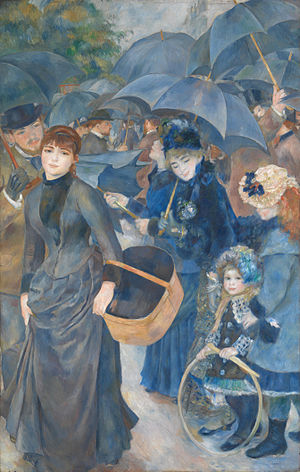
I can’t say that I am a big Bill Kristol fan, the conservative political analyst, but yesterday he deftly used the excerpt above from a W.B. Yeats poem to describe the Mueller hearing of the day before. It so well described an honorable man dealing with the current occupant of the white house* and his minions in congress* that I wanted to know a bit more about that particular piece of verse.

It turns out that the poem from which those lines come is titled To a Friend Whose Work Has Come to Nothing that was included in a small volume of poems called Poems Written in Discouragement 1912-13.

The poem is at the bottom of the page and at first I thought it referred to someone in Yeats’ universe, a writer or artist or playwright, who had put their all into their work for years and years only to never be recognized for that work while others– who this person at least equals in talent and effort– gain greater recognition. That seems like a logical interpretation.

Turns out there is a different story behind the poem.

It has to do with an Irish art dealer named Hugh Lane who was trying to establish a public art gallery that would bring modern art of that time to Dublin at the beginning decades of the 20th century. He proposed to give the city his collection of 39 modern masterworks from Renoir, Manet, Degas, Monet, Daumier, Pissarro and Morisot so that they might establish a museum/gallery. The painting at the top from Renoir, The Umbrellas, was part of his collection.

To that time, Dublin had yet to display the new art of the age and its city fathers and religious leaders were not swayed by the offer. They viewed the new art as being decadent and with an air of libertinism to it. This turned into a heated public battle in which Yeats and others in the Irish artistic community fought to bring the new art culture to the country. They eventually lost and the collection ended up in the possession of the National Gallery of Great Britain after Lane died in the sinking of the Lusitania by German U-boats in 1915. He was returning from NY where he had sold two great pieces to what would become the Frick Collection. The Lusitania was only eleven miles from the Irish coast.

The battle for Hugh Lane’s collection has been fought continuously for the past century between the National Gallery and the Irish government. There are a lot more details so I am not going to get into the whole affair here. There is great article in the Guardian that goes into everything that transpired.

I just find it interesting how Yeats could turn a poem that dealt with the loss of a public debate about art and philanthropy into a poem that feels like it could be applied to many people who are in creative fields and may never realize the recognition their work may well deserve.

Or to a prosecutor dealing with shameless liars.

Here’s the whole poem:

To a Friend Whose Work Has Come to Nothing


Now all the truth is out,

Be secret and take defeat

From any brazen throat,

For how can you compete,

Being honor bred, with one

Who were it proved he lies

Were neither shamed in his own

Nor in his neighbors’ eyes;

Bred to a harder thing

Than Triumph, turn away

And like a laughing string

Whereon mad fingers play

Amid a place of stone,

Be secret and exult,

Because of all things known

That is most difficult.

–William Butler Yeats, Poems Written in Discouragement 1912-1913


The Holdup

Got up late this morning and thought I’d save some time by rerunning an older post that has a piece of music.

I grew up in a time without computer screens, smartphones, video games or much of anything else in the way of distraction.  I’m not saying that we used to go down to the quarry to throw rocks at the dinosaurs but, compared to the multitude of options available to a kid today, it was relatively spartan. We lived in the country where for years we only had two TV channels and FM radio was in its infancy, at least in our area. I’m not sure we even had an FM radio. So, the local AM radio stations filled the bill.

At that time, our local AM channels were one-size-fits-all affairs, playing every genre of music in a grand mishmosh. You might go from hearing the Rolling Stones or the Doors to Nat King Cole to the Temptations to Patsy Cline and back to Chuck Berry in a matter of twenty minutes. It made for very eclectic listening.

The one I usually listened to was WENY and at the time my favorite DJ was a guy named Paul Leigh, who also hosted a late Saturday night movie on  WENY’s sister TV channel. On that, Leigh played his alter ego, the Undertaker, and played schlocky monster movies. He was entertaining for a 12 or 13 year old kid and had a pretty sharp wit for a DJ in a small market. He was always running call-in contests and on one night I was lucky (and persistent) enough to be the 20th or whatever caller.  I won a stack of 25 albums and picking them up at the station, I thought I was in pig heaven.

Of course, they were just getting rid of all the promos albums from record companies that had come their way. Almost all of them never made it on the air, most being pretty bad while some were just not the taste for a teenager. I remember there was an Ornette Coleman LP that was a very conceptual jazz thing that sounded like squawks and buzzes to my ears at the time.  Actually, it still sounded that way to me every time I’ve pulled it out over the years. But there were a few gems in there.

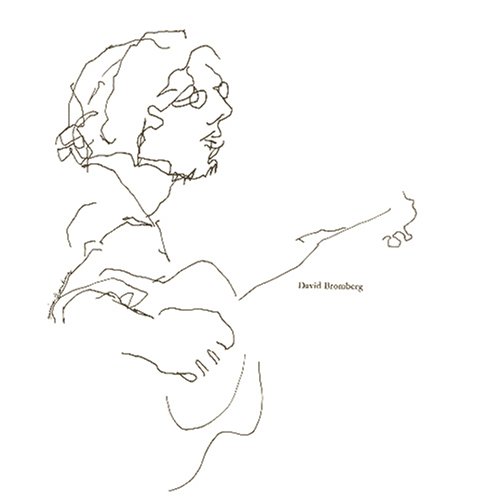
One was this self-titled first album from David Bromberg.  It was produced by George Harrison who appears on the very enjoyable song below, The Holdup.  Several of the songs are Bromberg’s interpretation of blues and traditional classics mixed in with some wonderful originals, including the strange and haunting Sammy’s Song. I still listen to it on a regular basis and it has always held up through the many years.

Bromberg’s an interesting guy, a folk guitar wiz who basically quit the business for several years in the 1990’s to learn the art of violin making. He returned to playing and touring but still maintains a violin shop in Wilmington, Delaware. He seems like a  man who lives life on his own terms. A rare and wonderful thing.

Give a listen to The Holdup and have a good day.
*****************

Light of Day

**************************

I always have a curious sort of feeling about some of my things – I hate to show them – I am perfectly inconsistent about it – I am afraid people won’t understand – and I hope they won’t – and am afraid they will.

–Georgia O’Keeffe

***************************

I came across this quote from Georgia O’Keeffe and it made me smile. I think I know exactly what she meant.

An artist is always in constant state of self-editing, constantly putting out to the world the work they believe best represents them. It is their public face. But this public face usually can’t fully represent the artist as a whole because in this self-editing there is always work that falls into the territory to which O’Keeffe referred.

I think every artist has work they may never show to the world. Some is flawed, some is just plain crap and some is just too personal, showing aspects of the artist that don’t necessarily coincide with the public face they have worked diligently to create. I know that I have a lot of this work, much of it in the flawed and plain crap categories. More than likely, most of it will never see the light of day.

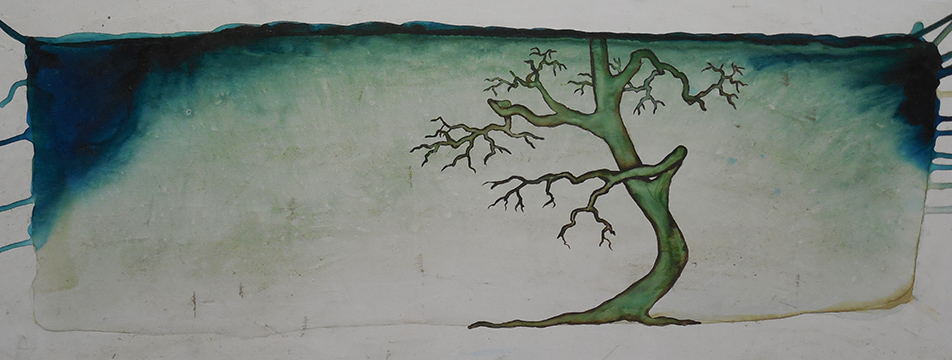
But the longer I do this, I understand that it is all part of who I am as an artist. I become less wary of showing the good and the bad of what I do and have done. Take the piece at the top. It’s another found piece from my old studio, about 17″ square on paper.

At the time I painted it, I made the decision that it didn’t fit in with the face of the work I was putting out then. It was too sloppy, too raw. But almost 20 years later, it is this very rawness that makes me want to show it.

I can see plainly the urgency that was present when it was painted. It shows in the bellies that jut out from each side vertical edges, from the masses of spews that burst from its top. Even the surface of the tree shows me signs of this urgency.

It’s a flawed painting but it is fully alive and that’s all I am looking for in the work. Why wouldn’t I want to let it see the light of day?


In the entry here last week where I wrote about old works I had discovered hidden away in my old studio, I mentioned that I had found that the old studio was deteriorating quickly in a visit to it last year. The roof had been breached and the pilings were beginning to fail at that time but it wasn’t nearly as bad as it was after year of exposure to the elements.

In that post I failed to mention that when I was in the studio that time I had also uncovered some other old pieces. As I scanned the damage, I went to a tall counter in the corner that was covered in debris from the collapsing ceiling and roof. Under it was a large cardboard box filled with scrap matboard. I dragged it out and discovered that behind it was a group of plywood panels bundled together.

I pulled them out and turned them around to see their surfaces. I recognized the work immediately. They were from around 1998 up to perhaps early 2000. I had bought a bunch of scrap lauan plywood from a bin at my local hardware store. They were all about 16″ by 36″ and I had sealed them with a wood primer/sealant–Kilz I believe it was– and then a layer of gesso. I had done a bunch of work on this material and many had turned out very well, making their way out of the studio and into galleries. Almost all had found homes.

But this group of four for some reason never made it out of the studio. Don’t think I ever showed them publicly, actually. And looking at them now, I can’t figure out why. Even though they showed some damage from their time under that wet counter– for example, the piece at the top shows some dark spotting on its surface that I have yet to address– these seem like strong pieces from the time frame in which they were created.

I like these four pieces. Maybe its my own personal nostalgia more than an objective evaluation of the work that makes me feel this way. For myself, I can sense the excitement I felt at the time in which I was creating this work, that feeling of discovery in each new piece. Each individual block of color seemed to have its own feel, its own voice and each piece had its own lesson to teach me.

Each day then seemed filled with new discoveries. It was an exciting time for me and I felt like an open conduit, the work pouring easily through me.

It’s a bit different now. The work doesn’t flow endlessly through my conduit now. It comes in surges, fits and starts. But it still surges on a regular basis. Most likely, the experience of having done this for so many years and the knowledge I have absorbed has tempered my response but I still feel giddy excitement and still discover new things within the work and its processes on an almost daily basis. And that is a good thing.

Maybe that is the purpose of this work now– to remind me what it was that I desired and needed to pull from my work then.

And now.


An Exuberant Life

**************************

Joy is everywhere; it is in the earth’s green covering of grass: in the blue serenity of the sky: in the reckless exuberance of spring: in the severe abstinence of grey winter: in the living flesh that animates our bodily frame: in the perfect poise of the human figure, noble and upright: in living, in the exercise of all our powers: in the acquisition of knowledge… Joy is there everywhere.


—Rabindranath Tagore

***************************

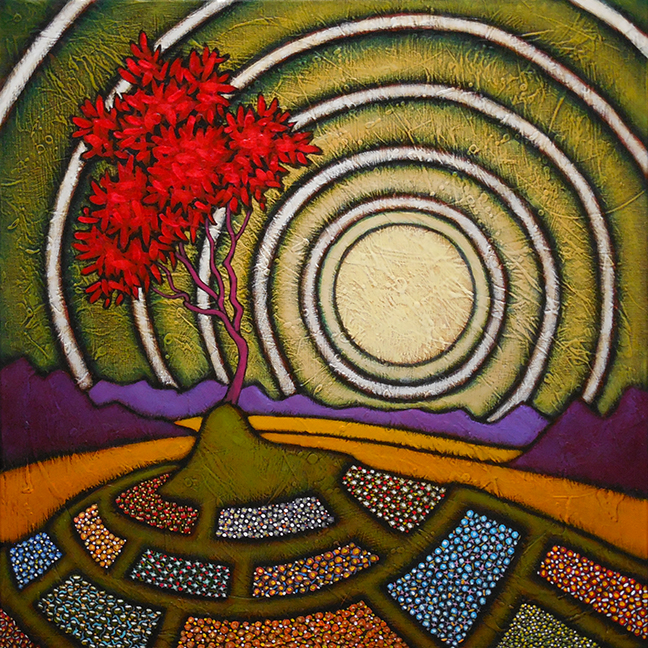
The painting at the top is part of Moments and Color, my solo exhibit currently on display at the West End Gallery. It’s titled An Exuberant Life and is a 24″ by 24″ canvas.

I don’t know that we are living in a time of joy at this point in history. At least, not in a way where one day we as a people will look back and remember it as a golden age filled with good will and There’s certainly an abundance of anxiety, ignorance, anger and about any other negative attribute you can come up with.

I believe that in times like these, we have to actively seek and identify the joy and exuberance that exists in this world. We take so much that surrounds us for granted as we bounce along the bumpy road we’re on at the moment. We find ourselves often blinded by our outrage or so inwardly turned in a defensive pose that we lose track of our surroundings.

Forget to see simple things. A ray of sunlight. The beauty in a tiny paused moment of silence. Tasting the pleasant bitterness of coffee on the tongue.

I could do a long laundry list of my own small pleasures, things that give me a sense of the joys in this world. But they are mine alone. You must find your own. Your list of joys must be your own sanctuary in these times. You’ll know them at once from the feeling of peaceful satisfaction they instill in you.

Maybe finding the exuberance of your own life will influence others to seek their own.

That would be a good thing.

And that’s kind of what I see in this painting– finding one’s joy and affecting the world with it. That is certainly something we could use in these times.


I Got Life

I woke up tired this morning. So tired. Stumbled over here in the already blooming heat which did nothing to revive me. Plunked down in front of my laptop with a cup of coffee and just wanted to close my eyes.

Certainly didn’t want to write this. But I felt a certain obligation to my routine to play a Sunday song here. I could at least say that I did something.

I at first thought that I’m So Tired from the Beatles would fit. It’s from their White Album released in late 1968. That made me think. I wondered what album was sitting at #1 on the charts back on this date in 1969, fifty years in the past. It was such an interesting time, one filled with monumental events and people who shaped the world we live in today.

We were still reeling from the murders of MLK and RFK, Nixon took office in January, the draft was still sending young men into battle in Viet Nam, protests and race riots raged in the streets, our astronauts walked in epic fashion on the moon, and hundreds of thousands of people gathered together on Yasgur’s Farm outside Woodstock for a concert that immediately entered into the mythic realm.

But going back to seeing what the #1 album was on this date in 1969, I found that it wasn’t the White Album. No, it was the self titled second album from Blood Sweat and Tears which knocked the Original Cast Recording of Hair from the top of the chart. Looking further, the chart that year was topped by iconic albums from several genres. The White Album held the top for 8 weeks early in the year. There was a week with a compilation album from a TV special featuring Diana Ross and the Supremes and the Temptations Then Wichita Lineman from Glen Campbell held the top for a month, the Johnny Cash at San Quentin album for another month, Blood Sweat and Tears for 7 weeks, and Hair for 13 weeks. The year finished with 2 weeks from the supergroup Blind Faith, a month of Green River from Creedence, 8 weeks of the Beatles’ Abbey Road until Led Zeppelin II closed out the final week.

That is an epic year of music on the charts. Probably at least a hundred songs on those albums alone that most people my age can sing along to. But when you consider that the Beatles, the Rolling Stones, the Who, Jimi Hendrix, Janis Joplin, Aretha Franklin, Bob Dylan, the entire Motown roster and just about every other musical rock, pop and soul god was still alive and at the peak of their creative powers, it only seems fitting. I was just a kid then but I am so grateful to have been influenced by that time and its music.

Don’t feel quite so tired now.

Here’s I Got Life from Hair. That was an album that was ingrained in my mind from an early age and I can still listen to it over and over. I think this song speaks to people in any time. Have a good day.

The other day I wrote about going up into the wood to my quickly deteriorating old studio where I found a cache of older works tucked behind a  stack of old frames.The reason I had decided to head up there was that I have an upcoming show in late August at a small public gallery, the Octagon Gallery, in the historic Patterson Library in Westfield, NY. It’s a village in Chautauqua County out near the shores of Lake Erie. It’s an area known for its vineyards filled with the Concord grapes that have been made into Welch’s Grape Juice at a plant there since 1897. The library is a gorgeous Beaux Arts structure from the early 20th century and the gallery is, as its name implies, a large octagon shaped space.

I wasn’t planning on doing the show at first but decided it would be a good venue to show some of my more private work, pieces that I would never sell. It’s called Exiles and Icons and has all of the pieces from these series that I have in my possession.

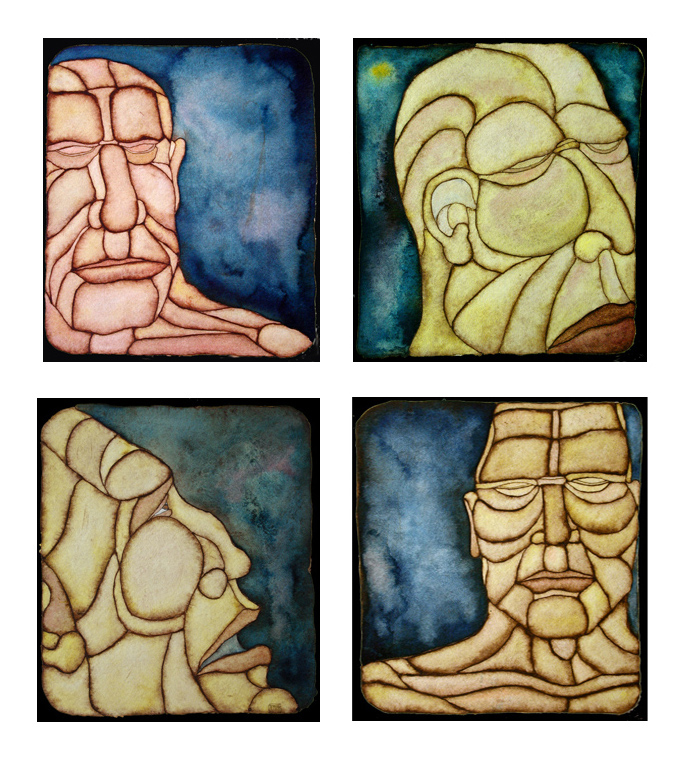
I began going through these pieces last week. Even though I have taken them out and looked at them a number of times over the years, this was the first time I was putting them together and really doing a type of inventory of them. As I looked them over, I realized that a vital piece from the Exiles series was missing. It was the piece shown at the top, Exiles: Quartet, a group of four of the Exiles characters assembled and matted together to make one piece.

I was positive it was somewhere here in the studio, having distinct memories of taking the unframed four pieces out of the mat and discarding the mat, folding it and shoving it in the garbage. This set off a search in the studio that had me going through every shelf, drawer, box, crack, and crevice in the place. I was frantic. I went through this studio several times over three days, examining folders and bins time and time again thinking I might have somehow overlooked these four paintings.

Nothing.

The next move was to go look through the old studio space. Maybe I had a failure of memory, maybe I had somehow overlooked these paintings from the very beginning and had believed they were always there with me in the new studio. After tearing apart my current studio, that was the only possibility outside of me having sold the paintings and then forgotten this. But I knew that was not the case after going through my records.

So, I went through the wreckage of the old studio and found the cache of older paintings including one that was finished on the day my mom died back in 1995. I found a few other things but the Exiles paintings were nowhere to be seen. I took my found pieces and headed down the hill, thrilled just to have rediscovered these paintings.

Later that evening, I began to think that if I had missed these pieces when I was clearing it out all those years ago in 2007, maybe it was possible that I had missed the Exiles pieces as well. Maybe they were still there. The next morning, I headed back up the hill and began another search in the rubble.

I spent about an hour looking, sifting through wet debris under pink insulation hanging from the gaping hole in the roof and moving anything that might hide these pieces.

Nothing.

Ready to give up, I went to a little storage space in the back of the studio. The floor beneath it was racked severely, dropping a foot or more in a short span so that the side wall separated from the floor, leaving a gaping hole of maybe six inches going to the outside. The questions of how much weather and how many vermin had ran through this spot jumped to my mind. I began sifting through a stack of old cardboard.

I went through once. Nothing. Okay, these pieces were either lost or tucked away somewhere I might never find.

But I decided that I would do this pile again. Most of the way through and still absolutely nothing. I decided that the search was futile and done. But near the final sheet, a piece of white cardboard  that laid flat on the floor next to the hole in the wall, I noticed that there was a white sheet attached to its surface that almost blended perfectly with it, camouflaging it from my first inspection. I reached done and pulled it up away from the white sheet of corrugated cardboard.

There they were, the whole quartet looking up at me from their original matting. They had been waiting there for more than 12 years for me to find them, to release them from their musty cardboard prison. I took them out into the light and was amazed at how well preserved they were after all this time in these conditions. The acid free matting had protected them in great part and there was a minimum of mildew and foxing on them.

Exiles: Quartet is safely with me now and getting ready to be shown publicly for the first time in almost 25 years. I am dumbfounded at having found it and, of course, greatly relieved. This series means a lot to me, having been done over the time my mom was suffering through the final months of her struggle with lung cancer. This particular piece was important to the series as well as a favorite of mine. Finding it felt like gaining some part of myself long lost.

It’s funny how your mind and memory sometimes plays tricks on you. I thought all this time that these pieces were here. I had even formed a memory associated with it. That was either a false recollection or one confused with a different piece where I took the pieces from their mat and discarded it. Don’t know if I will ever know the answer to that but I am happy enough just to have this bit of my past, this bit of living memory, back with me.


Lost and Found

Looking From Above Old Studio, Circa 2007

The studio I built over 20 years ago and worked in for over 10 years is deteriorating and slowly collapsing up in the woods.

I am not surprised by this fact. Out of necessity, it was built quickly with little money.  It was not built to last and I knew that eventually Mother Nature would more than likely reclaim that space as its own.

And she is doing just that.

I went up to see it the other day, taking the short hike up the hill that I had done thousands of times before in the years when I worked there 12 hours a day for 7 days a week. I had avoided it in recent times, mainly because I knew this collapse was imminent. A tree had fallen against it years ago and while it looked like it had only did a little damage to the overhang of the roof, a small branch had breached the roof. In the years that followed rain and snow had did their worst work and last year I found it with a gaping hole in the roof. That along with the rapid decay of a couple of the wood pilings I had employed as a foundation which caused the floor to heave and the doors and windows to rack made this building a total wreck.

It’s sad to see it in this condition, this place that had such a large effect on my life and my work. I know that I failed in many ways by not planning better in its initial construction and for not maintaining it in recent years.

But my failures are not the story I want to focus on here today. There’s actually a positive note here.

I went into this old studio a few days ago to see if I had left anything in here that should be removed. Going through a rack of old frames, some which I would take out later to see if the wood could be salvaged, I came across a piece of plywood pressed against the end of the top shelf. I don’t know why I looked behind it but I pulled it out, revealing a bundle of several large sheets of watercolor paper.

I pulled it out and found a spot where I could examine it. Flipping over the first sheet, I felt like I was slapped. It was a painting from the late 1990’s, one that I distinctly remember. I continued to the next and the next and they all were immediately recognizable pieces. Some were what I would consider good examples of my work at the time and one was a failed piece that I remember well. It was an oil on paper where the color never came together in the way I wanted.

It was all in oddly good condition, given that only several feet away there was gaping hole where all sorts of weather were free to fall. There was some foxing and a little grime but it wasn’t terrible and could be addressed. Obviously, using the acid free cotton watercolor paper and having them bundled together had provided some protection.

But it was the last piece in the bundle that made me tear up. It was a landscape and it had a title and a date at the bottom of the sheet. It was painted on November 9, 1995 and its title was The Sky Will Never Forget ( Hoping For Light). My mom from cancer died later that night, in the first few hours of November 10.

We knew at the time it was coming and it occupied my mind much of that time, often showing itself in my work. My Exiles series is based on that time and her death. How I had lost track of this piece, my most personal document of that time, is beyond me. Another failure. But finding it safely in the wreckage felt like a triumph, a calling out to me from the past.

Like I said, I found myself with tears in my eyes while standing in a wasteland of rubble.

There’s more to this story that connects it further to the Exiles series. That story will have to wait to be told in the days ahead.

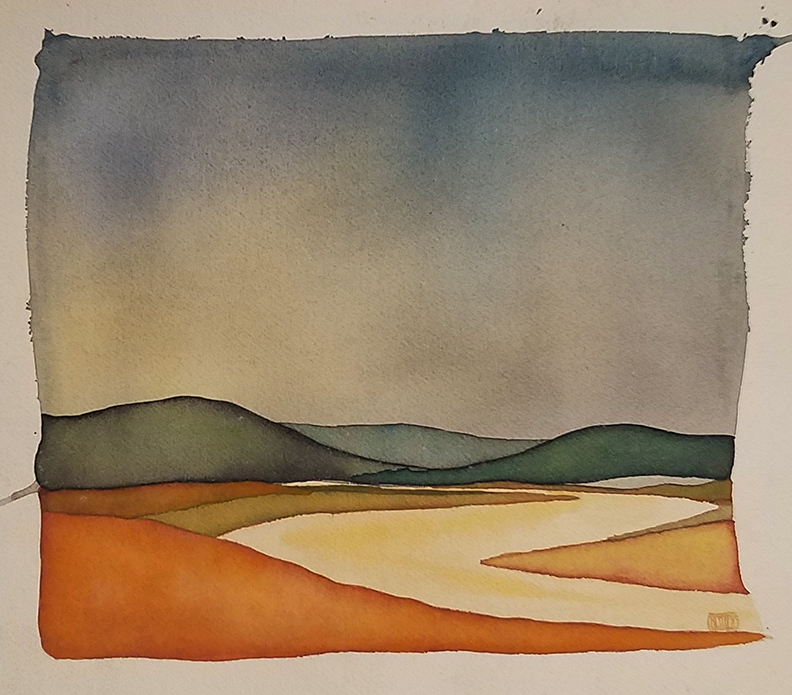
Here’s that piece. It needs a little cleaning and a better photo but this captures it.

The Sky Will Never Forget (Hoping For Light) 1995


Received a small package the other day. On my first glance at it, I couldn’t tell where it was from. It was in packaging that was reminiscent of those used by my longtime friend in Northern Island but the hand lettering on the address was a bit more legible. The return address didn’t help. It listed a city and a postal code but no country or state.

It wasn’t until I spotted the lettering on the affixed stamps– Kiwi Stamp— that I knew from where it originated.

Ah, New Zealand.

It turns out that I had been approached a while back with an inquiry as to whether a New Zealand magazine called Tui Motu InterIslands, an independent Catholic magazine, could use one of my paintings for an upcoming issue. I had consented and had put it in the back of my mind until it appeared on Saturday.

I was pleased to see that this edition dealt with the search for truth. In fact, the title of the painting, Seeking Truth, was the same as the headline used on the cover along with its Maori equivalent, Te Rapu I te Tika. My image accompanied an article that dealt with the use of critical thinking to find truth in the flood of opinion and falsehoods that we are faced with on a daily basis. The author, Paul Tankard, makes a great point in saying that the skepticism that many people hold for journalism of any sort is as naive as those who have a blind acceptance of what they read online or in print.

The name of the American president* was mentioned several times through the issue which was not a surprise given that the subject was truth. Obviously, this manchild’s tenuous relationship with the truth ( and his love affair with misstatements, half-truths and outright lies) obviously has had a rippling effect on the rest of the world, one that has them concerned about the future viability of truth.

As the writer, Binoy Kampmark, of another article on the effects of unchecked lies stated: The tissue that binds communities matters; the untruth tears it. And a community unable to detect lies is, according to renowned US journalist Walter Lippman, one without liberty.

From here in the US to every far point on this planet, we are at a dangerous point in history. The folks in New Zealand understand this. How we see and determine the truth may well determine our future. Real engagement along with critical examination is needed more than ever if we are going to have a future based in truth.

Truth is righteousness.

So, let’s make seeking truth our mission. As my friends in New Zealand put it–Te Rapu I te Tika.

Thanks to Tui Motu InterIslands for including my work in your fine magazine. Nice to see the Red Tree in that context.


Thought I’d take it easy this morning and just share a song, as I do every Sunday morning. The painting here is a favorite of mine, Le Cirque from Georges Seurat, which is I believe is considered to be the last painting from the great French Pointillist.

I am not a big fan of circuses now but as child I had a slight fascination with them. I have distinct memories of watching lion tamers, acrobats and high wire walkers on a television show that used to be on Friday nights in the early and mid 1960’s. It was called International Showtime hosted by Don Ameche, featuring filmed performances from European circuses. I think my interest in the circus was mine alone in my family because I seem to remember watching this show alone.

It’s one of those things I moved past. I began to have a great dislike for animals (or children, for that matter) in cages and gained an understanding of the hardships and tragedies of the lives of many of the circus people. The glossy fascination of childhood dulled and the clowns that once made me smile now make me slightly sad.

But I still like this song very much. It has wonderful imagery that rekindles the lure of the circus a bit though it points out the seedier aspects that I didn’t notice as a 6 year old but which ultimately made the circus less appealing. This is a live performance of Wild Billy’s Circus Story from Bruce Springsteen from way back in 1973.

Sigh.

Have a good Sunday.