Feeds:
Posts
Comments

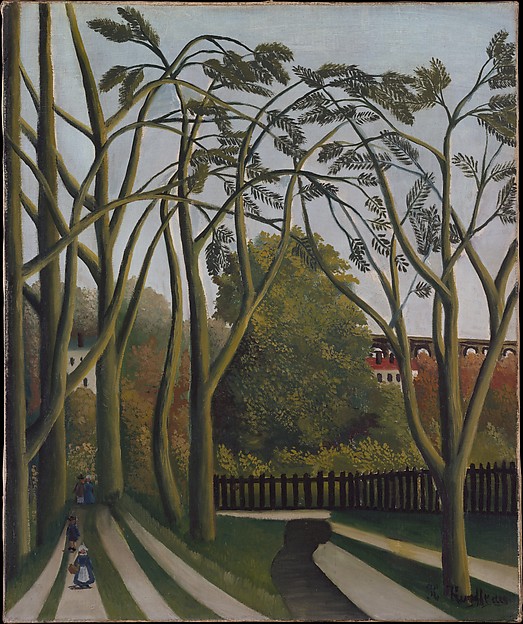
One of the best pieces of advice I can give to artists (those who paint) is to paint the pictures they want to see. For me, there is no better way to illustrate this than to look to the work of Henri Rousseau. The post below is from five years back and points out the fearlessly unique quality of his work. I’ve added a few images along with a lovely animation of his work that had slipped my mind.

***********************

Henri Rousseau- Self Portrait -1890

Henri Rousseau- Self Portrait -1890

I wrote a tiny bit on this site about Henri Rousseau over five years back [ten years now], showing a few of  his paintings that I count among my favorites. Over the years, that little blogpost is consistently my most popular page, receiving a considerable number of hits each day. It’s a testament to the  power of his imagery, both in its ability to draw in the viewer and in the timeless quality it possesses in its evocation of mood. I know those are the two qualities that drew me to Rousseau and the qualities I have sought to emulate in my own work.

But going through a large book of his work yesterday, I was stuck by one of his greatest attributes, one that I had overlooked: his fearless approach to painting. His work never tried to be something that it was not and always displayed his hand proudly, always declaring itself as his. It gave even his lesser works a strength that is undeniable and true.

It was evidence of a supreme belief in the manner in which he was expressing himself.

That’s not a small thing. I know for myself, there is a constant struggle to maintain my own voice and vision, to not try to conform to the expectations and definitions set down by others in my work. To remain fearless like Rousseau.

henri_rousseau_-_a_carnival_eveningRousseau was born in 1844 and worked most of his life as a civil servant, a clerk who collected taxes on goods going into Paris. He didn’t start painting until he was in his early 40’s and was not a full-time painter until he was 49.  He was basically self taught and worked for the next seventeen years as a painter, blissfully maintaining his fearless work even though he was ignored or disparaged by most of the critics and much of the art world in general.

Yet, among the painters of his day he was tremendously influential, directly inspiring other giants such as Picasso and many of the the Surrealists. I think they, too, were drawn in and empowered by his fearlessness.

I think he might have been one of the great examples of someone painting the paintings he wanted to see. And that, too, is not a small thing. This and his bold approach are constant reminders to painters who want to maintain their unique voice, who don’t want to be lumped in with genres and styles and schools to stay fearless. To believe in their own voice.

I will try.
***************

henri-rousseau-sleeping-gypsy Henri Rousseau the dream 1910

Have a lot of things to get at this morning so I wasn’t planning on  writing anything. But I came across a painting from an artist unknown to me that I thought I would share. The artist is Todros Geller, a Jewish American printmaker/painter who was born in Ukraine in 1889 and, after immigrating to Canada in 1906, in 1918 moved to Chicago which remained his home until his death in 1949. I don’t know much about Geller but found this painting intriguing along with some of his other works which I urge you to look into.

Strange Worlds, above, is a 1928 painting which depicts an older man, most likely a newspaper vendor under the steps of the elevated rail in Chicago. The composition really pulled me in as did Geller’s treatment of his colors and tones. Just a wonderful piece.

I also found a nice video on this work that better interprets the painting and explains the background and history behind it. I am normally not thrilled with these kinds of interpretative art videos but this was well done and really felt that the information provided here filled out this particular painting nicely. Please take a few minutes to watch and see what you think.

The Real Grinder

Whenever I come across an image of this small painting, Grind, from back in 2006 I think of my friend, Joe DeAngelo, who along with his wife, Kathy, runs the Kada Gallery in Erie.  I was greatly saddened yesterday to learn that he had passed away on Monday night at an Erie hospital.

I have been with their gallery since 1996 and while Kathy is the unmistakable and unrelenting energy source of the gallery, Joe has always been the engine, the working force, that keeps it going. He gets things done. So, when he chose this painting for himself many years ago, I was very pleased. Joe told me that he identified with this painting because it really represented how he saw himself– as a grinder, a shoulder against the wheel worker who persisted through all conditions until the job was done.

Joe was a grinder in other ways, as well. He had medical issues for many years including a kidney transplant. In recent years he suffered a major heart attack that drained him physically. Yet, grinder that he was, he refused to stop working every day at the gallery where he was, with his lifetime of engineering experience, a meticulous and top notch framer. As his condition worsened in recent months, he still made his way to the gallery each and every day, against the protestations of doctors and family, because he felt it was his duty and purpose.

As I said, Joe was a grinder.

I am going to miss Joe’s straight forward manner along with his balanced blend of crustiness– he didn’t suffer fools easily– and great humor. He had a great laugh that came quickly.  I always enjoyed my time spent chatting over coffee with him when I was at the gallery. A truly good guy with a big heart and a deep love for his family.

Along with many other folks, I am going to greatly miss my friend, Joe. Hopefully, he can now put down that rope and rest.

*******************

It’s on the strength of observation and reflection that one finds a way. So, we must dig and delve unceasingly.

-Claude Monet

*******************

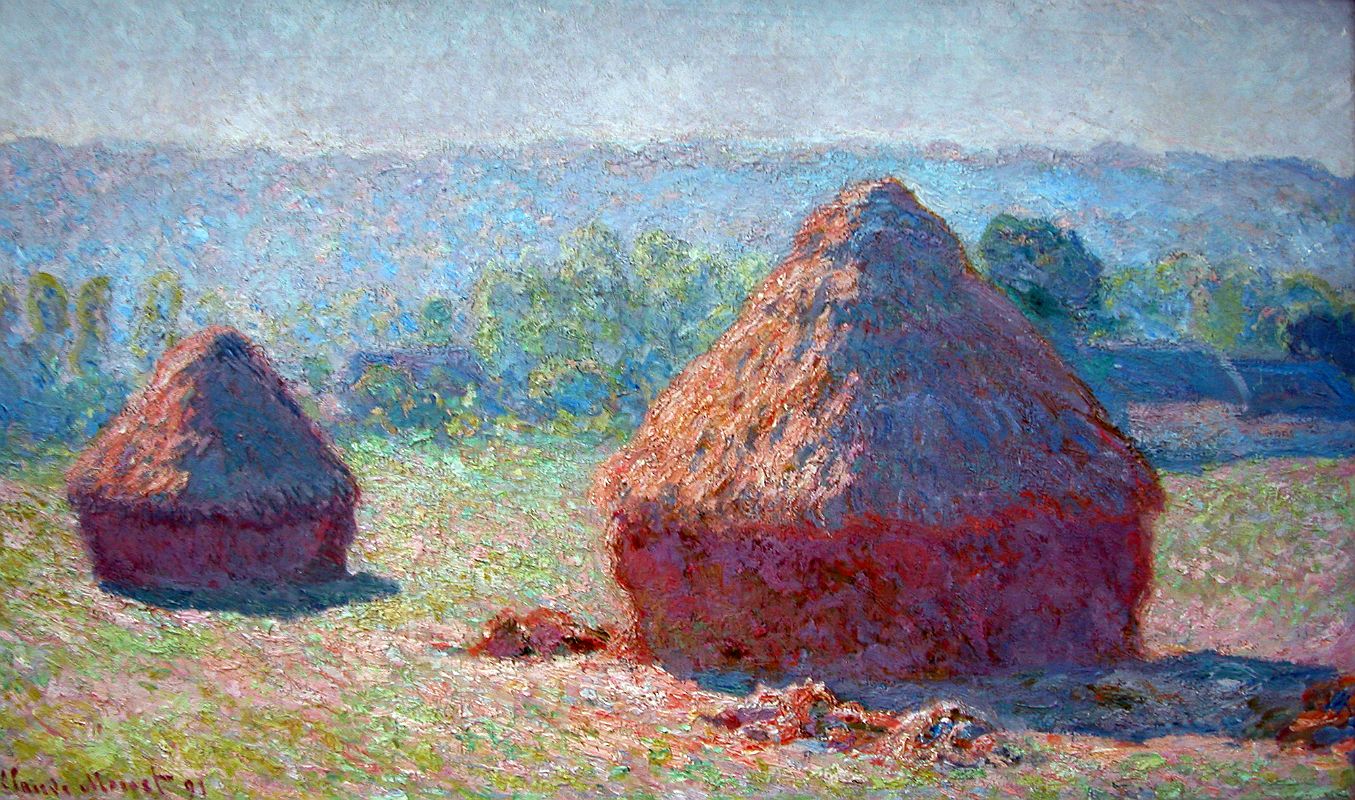
Busy this morning so I thought several haystack paintings from Claude Monet might fill the bill. Those and the quote above which immediately spoke to me when I first came across it.

Art has served as a way forward for me and part of that is allowing myself the time to observe and reflect. I have found that once that becomes ingrained as habit, the digging that comes with this observation and reflection becomes, as Monet points out, unceasing. Actually, more like obsession, occupying nearly every waking moment of each day, along with more than a few others in dreams.

Writing it out, this compulsion sounds awful. But it’s not something I even notice. It just becomes part of one’s natural state of being. And I greatly prefer this state of being over those that existed for me before I began this life in art.

Enjoy the Monets. I have work to do.


***********************

“It’s snowing still,” said Eeyore gloomily.

“So it is.”

“And freezing.”

“Is it?”

“Yes,” said Eeyore. “However,” he said, brightening up a little, “we haven’t had an earthquake lately.”

― A.A. Milne

***********************

The reactionary part of me has me feeling a bit like Eeyore this morning.

It’s a morning filled with way too much reactionary behavior from both sides for something of which almost everybody still has little, if any, knowledge. The facts are still unclear and there are many,many questions to be answered and loose ends still to be tied up before any of us should be too optimistic or pessimistic. For now, refrain from gleefully high-fiving or angrily punching holes in the wall.

So, while I am feeling a bit gloomy like my friend Eeyore this morning and feel that it can only get worse, I also know this is only a short summary by a biased reader at the end of one chapter in a long story still waiting to be told.  We can’t close the book now thinking we know how it will all end when there are so many pages and chapters ahead.

We must be patient and wait, hard as that is, for the story to unfold.


Moon Flowers

*************************

The moon, like a flower

In heaven’s high bower,

With silent delight

Sits and smiles on the night.

—William Blake

**************************

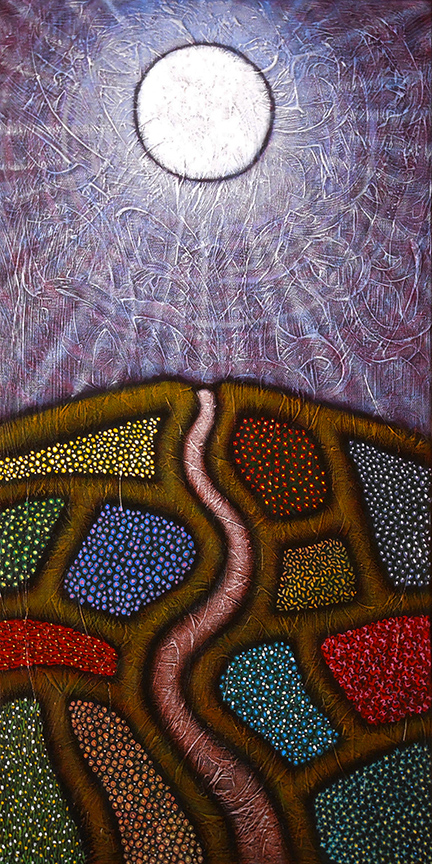
Finished this new painting just the other day. It’s a very quiet, almost meditative piece that I am calling Moon Flowers.

It’s a piece that I find myself looking at a lot these past couple of days. While it is simply constructed, there are some there things taking place in it that keep my eye occupied. The relationships between the beds of flowers, for example, with their individual color vibrations and shapes. Or the relationship between the moon and the path below. There seems to be a connection between the two.

These relationships and the organic quality of the lines within it give it an abstract quality that I like very much. If I just let my mind go where it desires, it allows me to move beyond what seems to be represented and see something quite different.

Or rather, feel something quite different.

And ultimately, that is what I hope for in my work– to move the viewer beyond the representation of the image presented. How that’s done, I do not know. Maybe the answer is somewhere on that path under that moon. Maybe that is what I am seeing in this picture that is pulling me in.

Only time will tell.

So, for this Sunday morning music let’s go with a piece with an apt title, Moonflower, the title track of a 1977 album from the great Carlos Santana. Hard to believe this piece is over forty years old now. Time!

Have a great day.

Illumination

*****************************

There are very few human beings who receive the truth, complete and staggering, by instant illumination. Most of them acquire it fragment by fragment, on a small scale, by successive developments, cellularly, like a laborious mosaic.

-Anais Nin, Journals of Anais Nin, Vol 3

*****************************

I see in the new painting above, Illumination, a moment when all the fragments of that mosaic, as mentioned in the words of Anais Nin, come together. That moment when we are no longer seeing only individuals pieces of the mosaic, those bits and pieces of acquired information and observations we gather over a lifetime. That moment when we suddenly see those gathered bits as a complete image of a greater truth in all its wholeness.

That moment which reveals the why of the universe after a lifetime of showing us only the whats.

Does such a moment ever come to us, do we ever receive true illumination?

I certainly don’t have that answer.

I am still in the process of gathering bits of the mosaic as I see it. Some days, the various pieces I’ve put together seem to show a glimpse of a pattern of the image of a greater whole. Those are inspiring and hopeful days.

But often, I can’t find that same pattern on the next day. Those days have less hope and have me questioning whether all these mosaic pieces ever come together to create a fuller image. Is there a purpose to this all?

Again, I can’t say. But I’ve got too many mosaic pieces before me now to not want to keep moving forward. Too many to not keep trying to assemble them in the hopes of receiving some sort of illumination that gives me the peace that comes with understanding.

And that may be the purpose of art– gathered bits of a mosaic that allows us to see a greater whole and gain some vestige of understanding.

Hmmm. Sounds good right now. Ask me in 15 minutes and I may see it in a different light. But for this moment, I feel hopeful in simply looking at this painting.

[The title of this painting was later changed to Solitude’s Rapture]

Dies Irae

Came across a blogpost from back in 2009 had a piece of music that I couldn’t remember. Playing it this morning fascinated me and I listened to it a few times. It’s a big loud choral piece with ominous sounding Latin lyrics and a thumping percussion rhythm that drives it forward in a way that makes it feel as though it is absolutely unstoppable.

It’s a piece called Dies Irae from a 2005 work, Requiem, from the contemporary Welsh classical composer Karl Jenkins. Dies Irae translates as Day of Wrath and the tone of this piece has that feel, without a doubt. Powerful stuff.

It certainly woke me up this morning. I found myself wanting to be able to paint with that kind of feel. It’s something I can;t explain fully. I see big slashes of color and full sweeps of the arm across the surface with my feet set wide apart in front of the easel as though I was delivering body blows to the canvas. Primal. No delicacy here, no up close touches of paint. Every stroke a deep mark, a bruise, on the surface.

Like I said, I can’t really explain it.

But here it is along a video comprised of apocalyptic imagery, most from the artist Alfred Kubin who I have featured here in the past. The piece at the top, Into the Unknown, is from Kubin. It may startle you awake or, at least, stir  something deep within you.

Night Nirvana

*****************************

“Nirvana is right here, in the midst of the turmoil of life. It is the state you find when you are no longer driven to live by compelling desires, fears, and social commitments, when you have found your center of freedom and can act by choice out of that. Voluntary action out of this center is the action of the bodhisattvas — joyful participation in the sorrows of the world. You are not grabbed, because you have released yourself from the grabbers of fear, lust, and duties.” 

Joseph CampbellThe Power of Myth

*****************************

I was going to share another of the Multitudes pieces that will be included in this year’s June exhibit at the Principle Gallery. But I saw that I have been a little heavy on my sharing of that work as of late and was a little concerned that people might think that was the sole focus of this show.

The title of this show, Redtree 20: New Growth, refers to the fact that this is my 20th solo show at the gallery. My first exhibit in 2000, Redtree, basically marked the beginning of the Red Tree that has become the trademark element of much of my work through the years. Though many elements have entered my visual vocabulary, the Red Tree is a constant and feels new to me each time I paint it.

Now the painting I am showing today, Night Nirvana, a 30″ by 40″ canvas, is what I would call a Red Roof painting, not a Red Tree piece. But it very much reflects the evolution and change taking place in the work over the years.

The process is always changing in some way. Some colors move forward and others recede. New elements are added and some fade away. Even something as basic as the way the surfaces are prepared has gone through changes.

I think that the fact that there is this constant evolution is the reason that my friends at the Principle Gallery are still inviting me to do this show after all these years.

But one thing that hasn’t changed in those 20+ years is the underlying purpose that I hope to find in the work– a place of inner peace and freedom from a world that seems chaotic and in turmoil all too often.

A Nirvana, if you will.

I think the words of Joseph Campbell above, from The Power of Myth, sum up very well what I hope to find in my work. And that aligns very well with what I feel in this new piece which is a sense of a found tranquility that finds a peaceful order amidst the chaos.

It is the realization of self, freed from the expectations and limitations of others.

Well, it is hopeful. And that keeps me want to keep moving forward.

And that is enough.

*******************

Redtree 20: New Growth opens June 7, 2019 at the Principle Gallery in Alexandria, VA.

Hartley’s Way

*************************

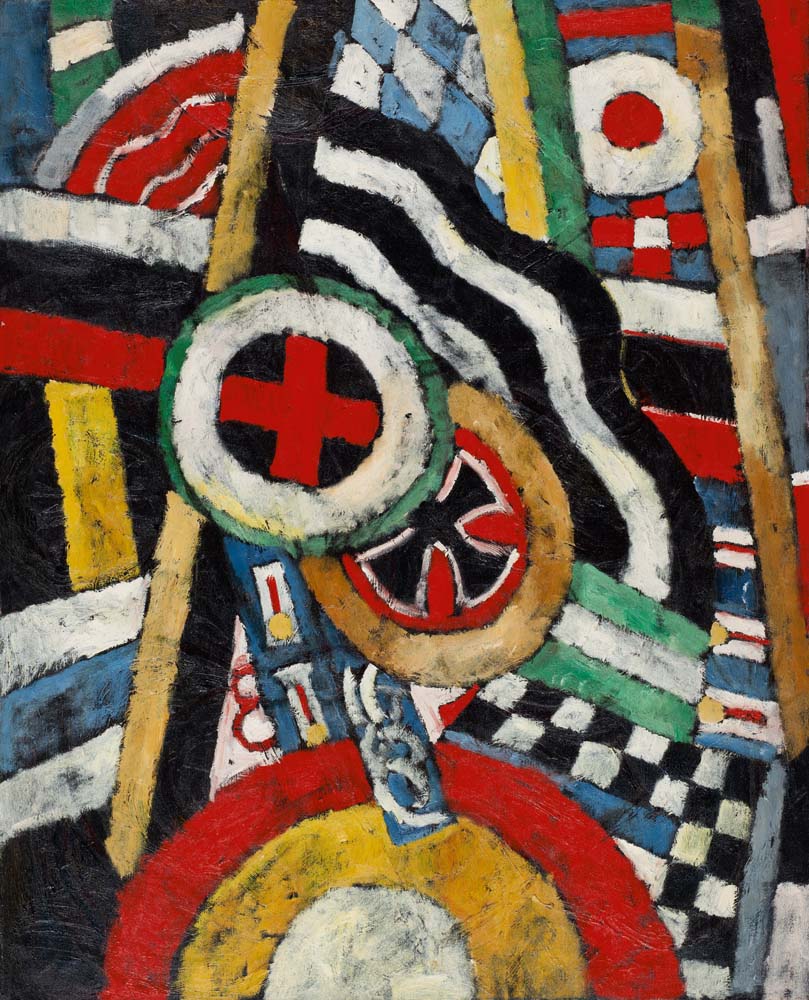
“I have always said that you do not see a thing until you look away from it. In other words, an object or a fact in nature has not become itself until it has been projected in the realm of the imagination.

~ Marsden Hartley

*************************

Marsden Hartley (1877-1943) is a favorite of mine both for his paintings and his words, which often express thoughts about painting that ring true for my own experience. For example, I love this quote above. Some of the strongest images for me are those that are taken at a glance, sometimes while driving down the highway at 70 miles per hour.

If the imagery strikes me in a powerful way, my mind immediately starts breaking down the image into a sort of shorthand, blocking in the forms and organizing them in a way that registers deeply. It is simplified but contains the elements and the effects that struck me. Sometimes I will move my arms while doing this, trying to create a muscle memory of the rhythm of that which I am seeing in my mind.

The image is thus entered into my imagination. Everything else around it that is not part of image that spoke out to me seems to not exist in that moment. It s a funny process and is deeply ingrained to the point that I don’t even think about it but for this reminder from Hartley.

Got to get to work. Have a great day.