Feeds:
Posts
Comments

Posts Tagged ‘Music’

GC Myers- Releasing the Fire  2024

Releasing the Fire–At West End Gallery


Work is the order of the day, just as it was at one time, with our first starts and our best efforts. Do you remember? Therein lies its delight. It brings back the forgotten; one’s stores of energy, seemingly exhausted, come back to life.

Boris Pasternak, as quoted in The New York Times (1 January 1978)


I was determined to write something lighter as a counterpoint to my last couple of diatribes here. But desperate times require a little more effort or at least a rousing call to action. I think the song at the bottom serves that purpose very well.

No time to relax now. Full effort required.

Pedal to the metal.

I played this song a couple of years back in the runup to the 2022 elections and what follows is from that blogpost.

I recently became aware of a new album from the Boston-based Celtic punk band, the Dropkick Murphys. The album is called This Machine Still Kills Fascists and is their take on a group of unrecorded songs written by Woody Guthrie.

This is not a new idea. One of my favorite albums is Mermaid Avenue from a collaboration of Wilco and Billy Bragg in which they did very much the same thing, setting music to Guthrie’s unpublished lyrics. In both cases, the Guthrie family approached these artists and invited them to take on the project of bringing these lyrics to life.

In the case of the Dropkick Murphys, this began about 20 years ago when Nora Guthrie, Woody’s daughter, made them the offer, saying that she thought her father would have felt like a kindred spirit with the band and what they were doing.

They took it on then and the result was their version of Woody’s Shipping Up to Boston. It is, by far, their most well-known song. It was used effectively in a pivotal scene in Martin Scorsese‘s film of Boston gangsters, The Departed. It is also considered the unofficial anthem of Boston. To be honest, though I was a fan of the song, I didn’t know Shipping Up to Boston was a Woody Guthrie song and only recently became aware that they had recorded that small group of his songs that were included in their 2005 album, The Warrior’s Code.

This new album is a more direct collaboration with Guthrie’s music, comprised only of his songs and borrowing its title from the message famously scrawled on Woody’s guitar, This Machine Kills Fascists. They also went out to Tulsa, Oklahoma, which is Woody’s hometown and home to the Woody Guthrie Center, to record the album at Leon Russell’s The Church Studio. Leon Russell was also a Tulsa native.

The result is stirring group of Guthrie’s pro-union/labor, anti-fascist songs infused with the Celtic fighting spirit of the Dropkick Murphys. The song below is titled Ten Times More which has Woody saying that in order to beat back those who would oppress you, you have to meet their effort with not equal effort but ten times more effort.

In short, you can’t take half measures with would-be fascists– you have to overwhelm them with the fire and energy of your resistance. Like the song says:

When the crooks they work, we gotta work
Not once, not twice, but ten times more
Where the robbers they walk, we gotta walk
Not once, not twice, but ten times more

Pedal to the metal, folks…


Read Full Post »


Do I contradict myself?
Very well then I contradict myself,
(I am large, I contain multitudes.)

–Walt Whitman, Song of Myself, 1855


GC Myers- Niche  2024

Niche— At Principle Gallery, Alexandria

I use the word favorite quite a bit on this blog. I list many songs, movies, poems, quotes, people, etc. as being favorites of mine. There are probably a thousand songs or more that I could list as favorites, songs that always jump out at me. These are songs that raise very distinct feelings on hearing them. It might not be the same feeling for any of them. In fact, it certainly is not. Just something unique in each that excites me in a very specific way.

It’s that way with my work, as well. I am almost always asked at shows which painting is my favorite. It’s a question I can never answer as nearly every piece has something unique in it that speaks to me. Each affects me in its own way.

Some make me happy. Some make me think on darker things. Some make me look back and some forward.

Some make me feel large and powerful while others make me feel small and insignificant. I number many of both of these among my favorites.

Some make me cry. The painting shown here is one such painting. Even now, seeing it only on the screen, makes me emotional. As I wrote in an earlier post about this painting, Niche, they are not sad nor are they happy tears. They are tears of recognition and acknowledgment of the human condition. Tears of catharsis on clearly recognizing a large part of myself in it.

How could I not see this as a favorite?

It might seem improbable that one should have so many favorites but that’s the way it is. How could I place one above another? And why would I want to?

They say life is a banquet. Or maybe they should say life is an endless buffet of favorite things.

Anway, here’s a favorite song from a favorite artist. This is Favorite from Neko Case. How could this not be a favorite of mine?


Read Full Post »

GC Myers- And the River Flows 2024

And the River Flows– At the West End Gallery


That time
we all heard it,
cool and clear,
cutting across the hot grit of the day.
The major Voice.
The adult Voice
forgoing Rolling River,
forgoing tearful tale of bale and barge
and other symptoms of an old despond.
Warning, in music-words
devout and large,
that we are each other’s
harvest:
we are each other’s
business:
we are each other’s
magnitude and bond.

–Gwendolyn Brooks, Paul Robeson


I had come across part of the poem above from Gwendolyn Brooks before, those last three lines: …we are each other’s harvest: we are each other’s business: we are each other’s magnitude and bond. These are strong lines, sentiments that always speak loudly to me, ones that I hope will more people would realize and take to heart.

Unfortunately, I hadn’t taken the time to search out where it had come from in her work.  I was pleased when I finally came across the whole poem and found that it was titled Paul Robeson, about someone who I consider one of the most fascinating people of the last century.

Paul Robeson (1898-1976) was a star athlete, a lead actor and headlining singer– the bright light in any sky in which his star appeared. He was also a scholar– valedictorian for the 1919 class at Rutgers where he was the only black student. He went on to graduate from Columbia Law School and worked for a time as lawyer. But his performing talents were undeniable and they brought him worldwide acclaim. But beyond all this, Robeson was throughout his life a ceaseless champion of the labor and civil rights movements, here and abroad. If you don’t know much about Robeson, please look him up.

He is best known to most folks for his performance of Old Man River in the musical Showboat. I thought the song would be a fitting companion to the painting at the top, And the River Flows. It’s a piece that keeps drawing me back to look a little deeper. I feel there’s something beyond the surface, a message or story in the river rolling by or in a lit room in one of those buildings that overlook it. I might never know that message or hear those stories but just knowing that the river keeps rolling it good enough this morning.

All I need to know…


Read Full Post »


The post below is from four years ago, in the runup to the 2020 presidential elections. It was a time at the end of an administration that had buffeted the American people for nearly four years of continuous lies and divisive hate-filled rhetoric. It culminated in the events of January 6, 2021. It’s four years later and the person responsible for that division and violence is frantically operating at an even greater magnitude of darkness in his appeal to his followers. Tomorrow, we will be a mere four weeks from Election Day. The same person who stoked the storm that was January 6 is desperate and is once again attempting to set a whirlwind upon us that he hopes will tear us apart so that he might once more take power.

I thought this post was appropriate to this time, as it was four years before and as it was in 1936. Be mindful, my friends, for there are perilous weeks ahead of us.


Lately, I have been reading bits and pieces from a book of Carl Sandburg poems called The People, Yes. Published in 1936, It is a broad work that attempts to span the multitudes, much like Whitman and his Leaves of Grass. It is a deep reflection on the American people at that time, in the midst of the upheaval of the Great Depression and the rise of Fascism and Naziism in Europe.

As I say, I have been reading it piecemeal, picking it up at loose moments. Each time I am struck how relative it is to this time even though it is nearly 90 years old. For all the technological and societal changes that have occurred, for all the progress and sophistication we assume took place, we are still pretty much the same and pretty much in the same place. Still maintaining many of the same conceptions and misconceptions, still as biased and still as vulnerable to being manipulated.

One verse from this book that I keep coming back to is shown above, at least its beginning, #102.

It begins with bits from President Lincoln’s July 4, 1861 speech to Congress, one in which he justified his actions in the aftermath of the Confederate’s attack on Fort Sumter. In it, he outlined how the leaders of the Southern rebellion stoked the enthusiasm for conflict among the people living there through the dispersal of misinformation and fallacies. Some things never change, eh?

Reading Sandburg’s take on this is a bit scary. It seems to reflect what has happened here so well. The public has been barraged with lies and hateful, divisive rhetoric for the last four [now eight] years to the point that we are without moorings. Many of us have lost the ability to discern truth from the lie and right from wrong. And now, in this unsteady state, we are experiencing the convergence of events that have been precipitated by these actions.

We are reaping the whirlwind.

And, unfortunately, the man and his accomplices who have done this, who have unleashed this awful power, can no longer control its direction or the scope and range of its destructive power.

As Sandburg put it:

Is there a time to repeat,
“The living passions of millions can rise
into a whirlwind: the storm once loose
who can ride it? You? Or you? Or you?
only history, only tomorrow, knows
for every revolution breaks
as a child of its own convulsive hour
shooting patterns never told of beforehand”?

As I say, some things never change. There will always be those who try to benefit from inciting chaos and division upon the people. But, as it has always been, these devious people have never been able to reliably predict or control the whirlwind they let loose.

The public mind generally has the final word in such matters.

And it is speaking now.


Let us hope the people answer the call in the coming four weeks…

Read Full Post »

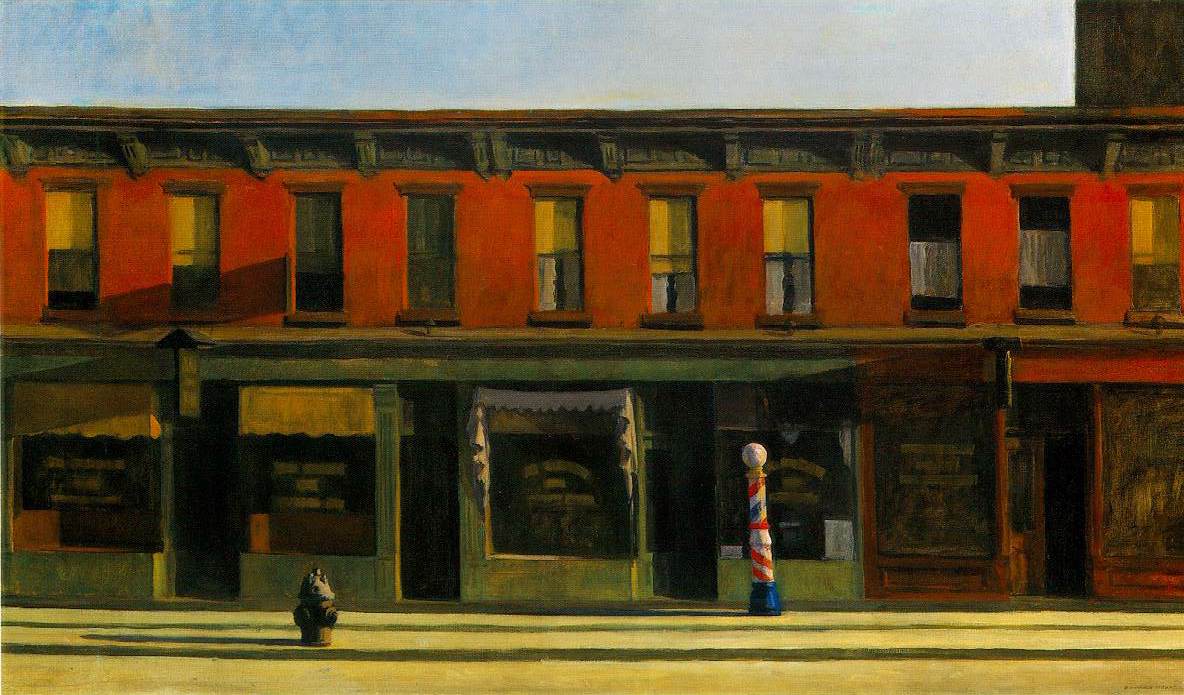
Edward Hopper -Early Sunday Morning 1926

Edward Hopper -Early Sunday Morning 1926


Freedom’s just another word for nothing left to lose
Nothing don’t mean nothing honey if it ain’t free


Things have been a bit hectic and I failed to mention the death of Kris Kristofferson this week at the age of 88. The line above from his song Me and Bobby McGee, has echoed in my mind since I was a kid. So much so that when a high school English teacher asked our class how we would define freedom, I quoted that line as my answer. He took off his shoe and threw it at me.

The following paragraphs are taken from a post from a few years back, on his 85th birthday.

Kris Kristofferson was many things in his life, as the bio on his website points out:

He was an Oxford scholar, a defensive back, a bartender, a Golden Gloves boxer, a gandy dancer, a forest-fighter, a road crew member, and an Army Ranger who flew helicopters. He was a peacenik, a revolutionary, an actor, a superstar, a Casanova, and a family man. He was almost a teacher at West Point, though he gave that up to become a Nashville songwriting bum.

Definitely one of the more interesting people of our time. And a helluva songwriter.

As I mentioned, Me and Bobby McGee is burned into my brain, especially the version from Janis Joplin. He also dated Janis for a while, which adds to his interest factor. There are plenty of other songs to mention– Help Me Make It Through the Night, Why Me, For the Good Times, etc.–but for me, my mind always goes to either Bobby McGee or to Sunday Morning Coming Down, whose big hit for Johnny Cash remains a favorite of mine.

The feel of Sunday Morning Coming Down is unmistakable and for someone who grew up when the Blue Laws were still in effect and Sundays were, for the most part, shut down affairs, it rings true. The Edward Hopper painting at the top, a favorite among many other Hopper favorites, captures that same feeling for me.

The angle of the sunlight creates an unflinching glare on the storefronts that feels like it is burning off the sins of the night before.  It has that stillness that comes after long Saturday nights spent knowing that the following day was there for recuperating.

And it brings up the memory of the weekly Sunday dinner from that time. Ours was often a roast chicken meal, if we weren’t going to another relative’s home for the meal.

The song opens up floodgates of memory and feeling. Though the world is now 24/7 all systems go-go, this song takes me back to those slow-moving Sundays of my childhood. There were many Sunday mornings and throughout my life that had that same quality of sunlight and stillness. That surge of personal memory makes this song so memorable for me.

Anyway, here’s the late Kris Kristofferson and Johnny Cash performing his Sunday Morning Coming Down. Thanks for the music and good travels to you, Kris.


Read Full Post »

Comes a Wind

GC Myers- Comes a Wind  2024

Comes a Wind— Now at Principle Gallery


That man’s best works should be such bungling imitations of Nature’s infinite perfection, matters not much; but that he should make himself an imitation, this is the fact which Nature moans over, and deprecates beseechingly. Be spontaneous, be truthful, be free, and thus be individuals! is the song she sings through warbling birds, and whispering pines, and roaring waves, and screeching winds.

Lydia Maria Child, Letters from New York (1843)


Be spontaneous, be truthful, be free, and thus be individuals!

Is there any better advice than those words from Lydia Maria Child way back in 1843? She is best known for writing the famous Thanksgiving poem, Over the River and Through the Woods. But more than that, she was a forward thinker in her time– an abolitionist, women’s rights and Native American rights activist, journalist, poet and novelist whose work often took on white supremacy and male dominance, issues that plague us to this day.

She would no doubt be a forward thinker in our time. Her words certainly ring true, then and now.

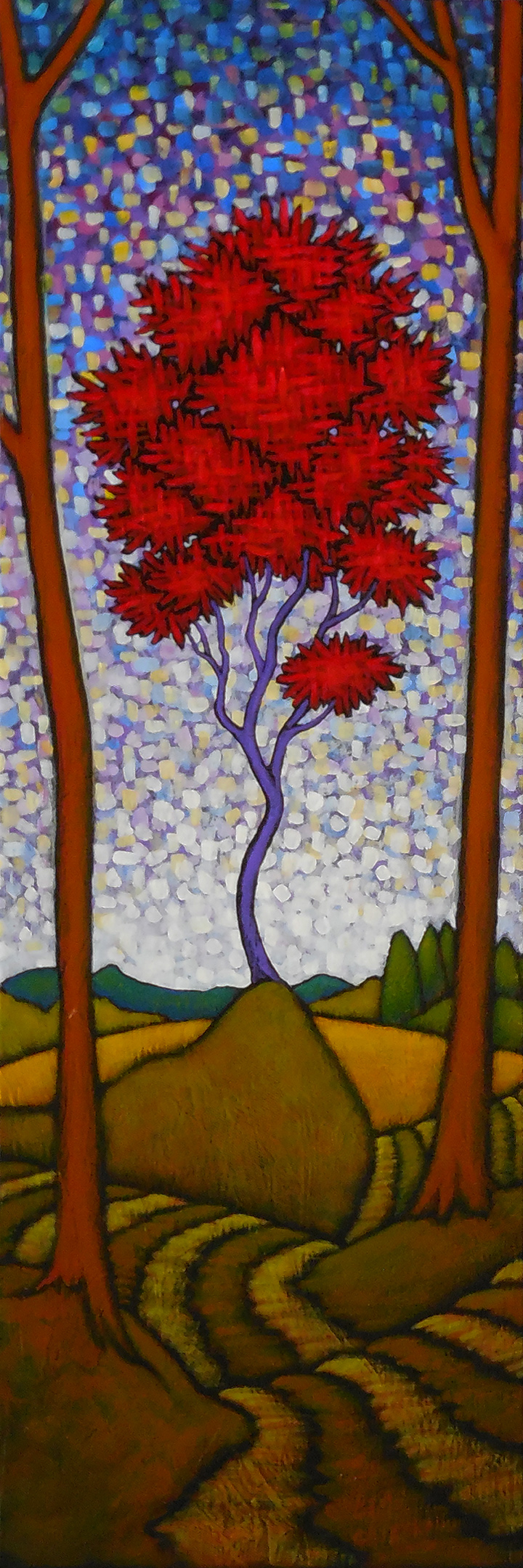
I am using her words today to accompany the new painting above, Comes a Wind. It’s one of the larger pieces, 30″ by 48″ on canvas, from my Principle Gallery show that opens tomorrow night. I chose her words because I felt they somewhat described how I view my landscape work. I never have tried to imitate the reality nature, never wanting exactitude or even a representation of a single real location.

I just wanted to capture the feel and rhythm of the landscape. We live in it and with it. We are part of it, carrying that same feel and rhythm within us. At least, that’s the hope. I believe we sometimes lose that feel and rhythm that connects us to the land. We fail to see the grace and inevitability of nature. When left to its own devices, the landscape achieves an organic perfection.

It is as it should be and only as it can be.

I think this piece is a great example at my attempt to capture that feel and rhythm. It has an organic quality in the curves and lines of the landforms that calms me in much the same way that I feel looking at a panoramic landscape in reality. Like much of my work, there is an area somewhere near the center of the landscape where the landscape’s layers go down then rises up, creating what I call the saddle or easy chair (taken from an old Dylan song) of the painting. I don’t know exactly why I do that, but it feels like it acts as place for the eye to settle in and rest, like one might in a saddle. Or easy chair.

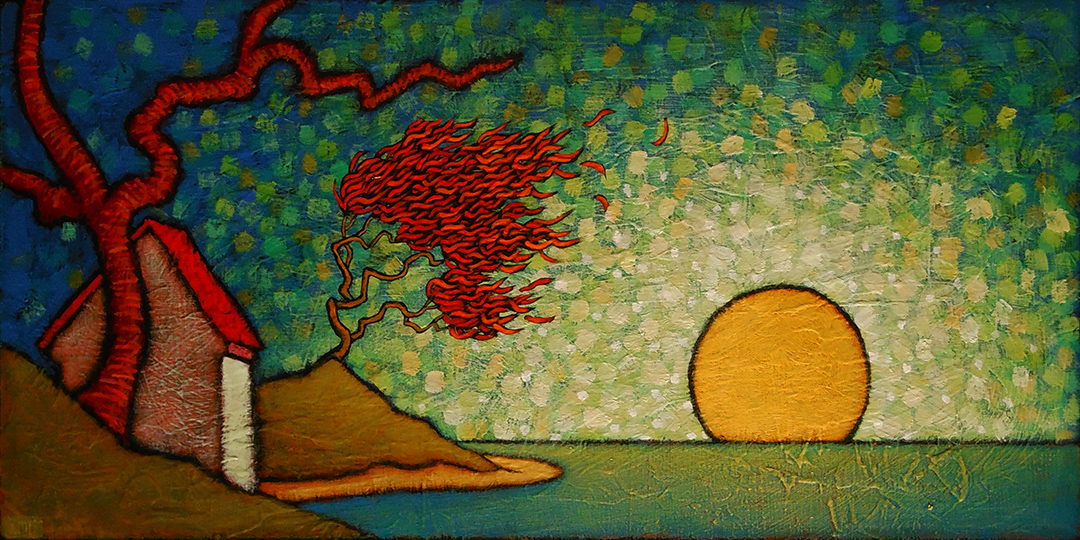
When I first finished this painting, I saw it as being about some forewarning brought on the wind. I still see that somewhat but I now also see the wind as pictured as being about letting ourselves go with the rhythms of nature, about reconnecting to our place within the greater forces.

Or as Ms. Child may have put it: Be spontaneous, be truthful, be free, and thus be individuals!

Here’s that Bob Dylan song with the easy chair reference, You Ain’t Goin’ Nowhere. From1967, it was part of his Basement Tapes and more famously recorded by the Byrds in 1968. This is a newer version that I like very much from Glen Hansard and Marketa Irglova. It’s a great tune. Worth a listen.


Comes a Wind is included in Continuum: The Red Tree at 25 which opens tomorrow, Friday, June 14, at the Principle Gallery in Alexandria. The opening reception runs from 6-8:30 PM on Friday. I will be there so please stop in and check out the show. Maybe have a chat.


Read Full Post »

GC Myers- Nocte Bleu sm

Nocte Bleu” – At the West End Gallery

Almost without exception, blue refers to the domain of abstraction and immateriality.

–Wassily Kandinsky


Though the Red Tree and the color red play a large part in my body of work, I am a confessed addict of the color blue. I have written in the past about instances of painting with blue where I almost feel an intoxication after hours of having my face inches from it for several hours at a time. I often have to consciously refrain from using the color at times for fear I will fall into an uncontrollable spiral where all my work is nothing but blue.

That might not be so bad, now that I think about it.

But I do let my addiction off the leash periodically, especially for my shows where there is generally at least a handful of what I would call blue pieces. The piece shown here, Nocte Bleu, is an example. It’s a new 10″ by 20″ painting on aluminum panel that is included in Through the Trees, my annual solo show at the West End Gallery that opens this coming Friday.

I almost felt guilty painting this piece, it gave me such pleasure. And it continued even after the process was done. It was one of those pieces that kept me peeking at it while it was in the studio. Just something in it that satisfied a need within me.

I understand that this doesn’t describe the painting or process or help you understand it in any way. But that’s the way it is with us addicts. Sometimes you just got to have the good stuff, the real blue.

For this Sunday morning music I am going to a favorite piece, a sort of obscure song from jazz horn player Richard Boulger and his 2008 LP Blues Twilight. Blues– see? He knows. The song is Miss Sarah, one that I have played here awhile back. I think it’s a great song to kick off a Sunday morning. Try it on for size.


Read Full Post »

GCMyers-- La Bella Vita sm

“La Bella Vita”– Now at the Principle Gallery-16″ x 40″ on canvas


You wanna fly, you got to give up the shit that weighs you down.

Toni Morrison, Song of Solomon


Came across this new song from Jon Batiste yesterday and immediately knew that I would be using it this week’s Sunday morning music. It’s called Freedom and it celebrates the joy that comes in movement and dance.

Myself, I’m way too self-conscious to be a dancer but I certainly recognize the joy found in it in others, those who dance without any self-consciousness or restraint. But while I may envy them, I also take a little of their joy and freedom for myself.

There’s an infectious quality to that kind of freedom of expression. The good kind of infectious.

Give a listen. It might make you feel like getting up and moving a little. And that’s always a good thing.


Read Full Post »

GC Myers-  Symphony of Silence  2021


Out beyond ideas of wrongdoing
and rightdoing there is a field.
I’ll meet you there.

When the soul lies down in that grass
the world is too full to talk about.

― Rumi, 13th century Persian poet


The new painting at the top, titled Symphony of Silence, is an 18″ by 36″ canvas. This weekend, it is headed down to the Principle Gallery as part of my solo show, Between Here and There, which opens June 4th.

I have written in the past about what I see as the connection between painting and music, how I see some of my pieces as simple songs and others as more intricate compositions. Perhaps symphonies or concertos.

This, in my eyes, is one that seems simple at a first glance. It is sparse and without great details. But the more I look at it, the more I see in it. How each element and color plays off the next and how they are fortified by each. It feels like there are rhythms and melodies running through it, from side to side as the terrain flows and up and down with rise of the moon.  There is inward and outward movement with the light of the stars and the undulation of the trail. The blocks that make up the night sky seem to swirl and rotate in all directions. The far mountains appear almost as sound waves. 

There is seemingly constant movement throughout the landscape and the skyscape. Almost a cacophony.

Almost.

It is silence.

Somehow the movements, the rhythms, and contrasts all run together at some point.

Harmony. Made up of the stars in motion countless lightyears away and the ancient wisdom contained in the stillness of the land and water. Always there but in silence. 

It is a simple piece but one that constantly shares something more than it lets on with a mere glance.

Here’s a piece of music to accompany it, a longtime favorite of mine and one that has played a large part in how I came to view my own work. It’s from composer Arvo Pärt and his composition Tabula Rasa. This is the second movement, fittingly titled Silentium. It feels right with this painting.


Read Full Post »

GC Myers- Under the Blue Moon sm


Now I’m standing in the wake of forty years
And from this prison I have broken free and clear
And I’m praying that the morning won’t catch me here

— Full Moon, Peter Bradley Adams


The small painting above is called Under the Blue Moon. It’s headed to the Principle Gallery for my annual show there which open June 4. This year’s show is titled Between Here and There and is my 22nd show at the Alexandria gallery.

It’s hard to believe that it’s been 22 years since my first solo show at the Principle. So much has changed in the world. My work has also changed but it is an incremental thing, one that I would like to believe maintains a consistency even as it changes.

This piece is a good example of it, painted very much in the same style with a similar process to the work I was producing back at that first Principle Gallery show in 2000. But while it maintains its recognizable features, it has changed, with colors that are more intense and a bit more layered and complex. The suns and moons in my work have grown in size over the years, as a result taking on a more prominent role in the composition.

That’s definitely the case here. This piece just feels good for me with the colors and angles of the forms triggering a lot of different responses within me. It has a feeling of the vulnerability of a confession for me, the Red Tree standing in the wide open beneath the unwavering and all-knowing eye of the bluish moon.

What hasn’t it seen? What doesn’t it know?

Makes me wonder and that’s all I ask of it.

Here’s song to go with it. It’s from singer/songwriter Peter Bradley Adams, whose songs, which are classified as being Americana which is a term that says a lot without saying much about what the music really entails in subject or form.  I have just recently started exploring Adams’ work and this song felt right this morning. It’s called Full Moon.


Read Full Post »

« Newer Posts - Older Posts »