Feeds:
Posts
Comments

Posts Tagged ‘Principle Gallery’

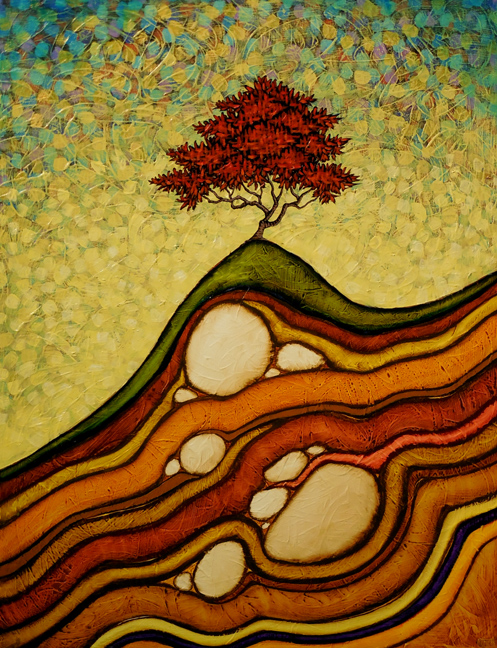
GC Myers-  In the Pocket of Time sm

In the Pocket of Time, 2014


The crystal sphere of thought is as concentrical as the geological structure of the globe. As our soils and rocks lie in strata, concentric strata, so do all men’s thinkings run laterally, never vertically.

Ralph Waldo Emerson, The Method of Nature (1841)


I came across the passage above from an Emerson essay and decided to look it up to find the context from which it came. It originated in an essay/oration that was written in the 1839-1841 period and was titled The Method of Nature.

I am still trying to glean the exact meaning of the essay but the section that contained the line above speaks about how those who, in any time, claim to have the answers to existential questions or insights into the deepest concerns of mankind eventually reveal themselves to be superficial. Their thoughts seldom, if ever, dig deeply enough to reveal eternal truths that might unify all people and times.

As he put it, their thinking runs laterally, not vertically.

I immediately felt that this might be applied to the painting the top, In the Pocket of Time. It’s a painting (30″ by 24″ on canvas) from 2014 that I brought to the Principle Gallery this past weekend as part of a group of work featured at my Gallery Talk there. It is from a subset of my Archaeology series that I call my Strata work. It is much like the Archaeology pieces without evidence of humans, focusing instead on the layers below the surface.

This particular painting from that Strata series has been with me for a while now. It hung for the last few years in a back bedroom/storage space of my studio. It reminds me of fine wine as it seems to get better with time. I am more and more struck by its surface finish and the rhythm of the strata, as well as how well it transmits its feeling and message from the wall. It’s a piece that speaks directly to me.

Putting Emerson’s thought to it deepened my appreciation of it. I could see in it how we deal always with what is presented on the surface and how seldom we recognize how much more there is to discover if we would only dig a little deeper.

That might be a gross simplification. Or not. Who knows? The words and the mage just seemed to click for me and maybe that’s enough to say.

Let’s tie this up with some music. Here’s a 1992 song from Peter Gabriel titled Digging in the Dirt.  The video is from the same time frame as his Sledgehammer song/video and, like it, this video has some interesting visuals.


Read Full Post »


Art is lunging forward without certainty about where you are going or how to get there, being open to and dependent on what luck, the paint, the typo, the dissonance, give you. Without art, you’re stuck with yourself as you are and life as you think life is.

–Mark Vonnegut,  Just Like Someone Without Mental Illness Only More So: A Memoir


GC Myers- Point of Contact 2016

Point of Contact — You Could Win It!

I am on the road this morning, heading to Alexandria, VA for the Gallery Talk I will be giving today, beginning at 1 PM. I have some new paintings with me, like the three smaller pieces shown at the top, along with some other cool stuff to give away, including the painting, Point of Contact, shown here on the right. I think it’s going to be a fun talk as well as an insightful one.

I am focusing today (this is written yesterday since I am on the road right now) on luck since someone will have a bit of luck at today’s Talk when they walk away with a favorite painting of mine.

I also thought luck was appropriate since luck or serendipity or whatever you want to call it has played a big part in my career as an artist. I’ve encountered it in my dealings with galleries and people who’ve helped me move along. I’ve seen it play a part in my painting , when what looked like a mistake suddenly turns out to be hugely fortuitous, opening up new avenues that I hadn’t recognized before.

I included the passage at the top from Mark Vonnegut, son of the great Kurt Vonnegut, from his memoir on his struggles with mental health issues. His thought here on art and how it helps one sort out and find a way to escape the trap of living as someone you know yourself not to be makes sense to me and speaks to my own journey and luck as an artist.

That might part of the talk today. Not exactly positive on that but it’s a possibility. I won’t know until I am standing there.

Hope you can make it. If you can, good luck to you!!

1 PM at the Principle Gallery in Alexandria, VA.

Here’s song for the road. It’s a highly entertaining version of Road to Nowhere, the old Talking Heads classic. This from David Byrne‘s wonderful stage show, American Utopia. Lots of fun…


Read Full Post »

GC Myers-- Harmonia  2024

Harmonia— Coming to Principle Gallery


When we speak of man, we have a conception of humanity as a whole, and before applying scientific methods to, the investigation of his movement we must accept this as a physical fact. But can anyone doubt to-day that all the millions of individuals and all the innumerable types and characters constitute an entity, a unit? Though free to think and act, we are held together, like the stars in the firmament, with ties inseparable. These ties cannot be seen, but we can feel them. I cut myself in the finger, and it pains me: this finger is part of me. I see a friend hurt, and it hurts me, too: my friend and I are one. And now I see stricken down an enemy, a lump of matter which, of all the lumps of matter in the universe, I care least for, and it still grieves me. Does this not prove that each of us is only part of a whole?

For ages this idea has been proclaimed in the consummately wise teachings of religion, probably not alone as a means of insuring peace and harmony among men, but as a deeply founded truth. The Buddhist expresses it in one way, the Christian in another, but both say the same: We are all one.

–Nikola Tesla, The Problem of Increasing Human Energy


This is another new painting that is headed to the Principle Gallery with me tomorrow as part of a group of new work. It is titled Harmonia and is 8″ by 8″ on panel. Like a few other of the new pieces, this has an smooth untextured surface that gives it a very glass-like appearance. This is especially so with the transparency of the paints which allows the white ground underneath to shine through, producing an effect as though the piece is lit from behind.

That’s something that I always aim for in my work. When it appears, it shows itself in lesser or greater magnitudes. I think this one is on the higher end. It has a very striking appearance, much more so in person than in the image shown here. Sometimes a photograph loses some of the fullness of a painting, flattening out the colors and not fully capturing their depths, intensity or transparency. I think that is the case here.

The title comes from a belief of mine that is very much attached to the words above from Nikola Tesla, that we are all as one. It’s the same sentiment that echoes from poet John Donne:

No man is an island, entire of itself; every man is a piece of the continent, a part of the main; if a clod be washed away by the sea, Europe is the less, as well as if a promontory were, as well as if a manor of thy friend’s or of thine own were; any man’s death diminishes me, because I am involved in mankind, and therefore never send to know for whom the bell tolls; it tolls for thee.

That is the feeling I get from this piece, that as much as we try to isolate ourselves from the world we are forever attached to and affected by this connection. We live our best lives when we recognize this and achieve some sort of harmony — or should I say truce– between ourselves and the world. It’s a matter of giving everyone and everything the same degree of respect and kindness that we expect to be given by others. 

It’s another form of the old love-thy-neighbor adage. It’s been around forever because it contains an eternal truth. Harmony, both inner and outer, might be the prescription for all that ails us. That’s the easy part.

Finding it is another story. But like anything, once you know what you seek it becomes easier to find.

Speaking of harmony, here’s a song that practically oozes with it. It’s Helplessly Hoping from Crosby, Stills and Nash.


TOMORROW!!

SATURDAY, SEPTEMBER 28

GALLERY TALK at the PRINCIPLE GALLERY

 GOOD CONVERSATION, ART, SOME LAUGHS,

THE CHANCE TO WIN A PAINTING–AND MORE!!!

BEGINS AT 1 PM.


Read Full Post »

GC Myers- Between Order and Chaos

Between Order and Chaos– Coming to Principle Gallery


In all chaos there is a cosmos, in all disorder a secret order.

–Carl Jung


I am busy getting ready this morning for the Gallery Talk I will be presenting this coming Saturday, September 28, at the Principle Gallery, beginning at 1 PM. Part of this preparation is finishing new work and packing up that work as well as the painting that will be given away in a free drawing for those at the talk, along with a few other surprises. You have to come to the talk to know what those will be.

GC Myers- Point of Contact 2016

Point of Contact — You Could Win It!

Along with the new work, I am also bringing four favorites of mine from the past decade. One is the painting above, Between Order and Chaos, shown above. It is a piece that jumped out at me in many ways since it was first painted. The post below from a couple of years back explains one of those aspects.


There is a philosophical concept called Unus Mundus— Latin for One World. Its premise is basically that behind the evident chaos of this world and the universe there is a unifying realm of absolute knowledge on which all existence is based.

It has been around for ages, going back in some form to the ancient Greeks. In the last century, Carl Jung became the biggest advocate of this theory, using it to explain the similarity in the content and construct of the myths and stories of the cultures and their belief systems. Each represents the discovery of some small bit of the order or pattern contained in chaos surrounding this world and becomes a recurring symbol, forming what Jung termed as an archetype. 

I describe an archetype as being how there are universal reactions and interpretations to certain images. One of the main reasons I use the Red Tree and the Red Roof, the Red Chair, and the ball in the sky that serves as the sun/moon is that each translates seamlessly across cultures. You don’t need specific cultural knowledge to understand the reality they symbolize. Each carries universal meaning.

This theory, the Unus Mundus, is what I see as the force behind the new painting at the top, Between Order and Chaos. It’s about how we struggle to create order in the face of constant chaos (represented in the sky’s slashing marks) with the orderliness of the flower beds representing this attempt.

The round flower bed caught in the curve of the path echoes the sun above. I see it somewhat as a symbol of synchronicity, another term coined by Jung. He uses it to explain some coincidences that seem to have some sort of meaning though there is no explanation for this feeling.

A coincidence might be just that or it might be that we have unwittingly come in contact with a strand of the Unus Mundus.

I sometimes feel as I have had fleeting moments of synchronicity but I can’t be sure of that.

How does one really know such a thing?

And I can’t say that we will ever learn more about or understand the Unus Mundus or the meaning of synchronicity, even though it might be for the betterment of us all as a species.

Perhaps we have become too comfortable living in this slice of the universe between order and chaos?

I don’t know. But for now, it’s all we have.

Read Full Post »


GC Myers- Too Many Moons

Too Many Moons— Coming to Principle Gallery

Nothing is more fatal to happiness than the remembrance of happiness.

André Gide, The Immoralist


I am still trying to figure out what I am seeing in this painting that contains what I perceive to be multiple moons. It feels playful on one hand but also feels like a representation of some sort of remembrance of the past.

I don’t think it represents a longing or nostalgia for the past. Like the words above from Gide, I tend to believe that nostalgia discounts and takes away from the wonders of the here and now or, at least, distracts us from fully appreciating and engaging with the present.

No, this feels less like nostalgia and more like a deep recollection of the past, where one is trying to determine the precise course that brought them to the present moment. All the twists and turns of life, the ups and downs. The right decisions and the wrong.

Everything meaningful that took place while going unnoticed or unappreciated at the time. All those moments that made us what we see ourselves as being today.

It’s an impossible task and maybe that’s what this represents– that there are too many moons to recollect. To appreciate the present moment and where you are.

Hmm. That’s not too bad for 6 AM. I might go with that. It works for this morning, at least.


This painting, Too Many Moons, 8″ by 16″ on canvas, is coming with me this Saturday, September 28, when I head down to the Principle Gallery in Alexandria, VA. I will be giving my annual Gallery Talk there on that day, beginning at 1 PM. It is usually an hour of a little talk, many questions and a few answers, a free drawing for one of my paintings (see Saturday’s post!) and a few other surprises. Hope to see you there.

Read Full Post »

GC Myers- To the Calling Moon  2021

To the Calling Moon“- Now at the Principle Gallery


I Am Much Too Alone in This World, Yet Not Alone

I am much too alone in this world, yet not alone
  enough
to truly consecrate the hour.
I am much too small in this world, yet not small
  enough
to be to you just object and thing,
dark and smart.
I want my free will and want it accompanying
the path which leads to action;
and want during times that beg questions,
where something is up,
to be among those in the know,
or else be alone.

I want to mirror your image to its fullest perfection,
never be blind or too old
to uphold your weighty wavering reflection.
I want to unfold.
Nowhere I wish to stay crooked, bent;
for there I would be dishonest, untrue.
I want my conscience to be
true before you;
want to describe myself like a picture I observed
for a long time, one close up,
like a new word I learned and embraced,
like the everyday jug,
like my mother’s face,
like a ship that carried me along
through the deadliest storm.

–Rainer Maria Rilke ,  1875-1926


Read Full Post »

GC Myers--Facing Mystery 2021


Faith and love are apt to be spasmodic in the best minds: Men live on the brink of mysteries and harmonies into which they never enter, and with their hand on the door-latch they die outside.

–Ralph Waldo Emerson, Letter to Thomas Carlyle, March 1838


I think that the words above from Emerson to Scottish philosopher Thomas Carlyle perfectly fit the vibe I get from the painting above, Facing Mystery, another new painting now hanging at the Principle Gallery.

So often we avoid following the paths of both those mysteries and aspirations that haunt us. We often face, or worse yet, create barriers– here it is a forest of red that seems dark and deep– that we use as an excuse for staying in our safe and consistent space.

Close to home or as Emerson put it, with their hand on the door-latch.

It’s understandable. I don’t fault anyone for wanting to stay in their own safe and secure comfort zone. I might be a prime example of that right now, sequestered in my own dark forest, panicked sometimes at the thought of venturing outside it. Luckily for me, mysteries and aspirations as well as the harmonies to which Emerson refers are close at hand here.

For the most part. But even as I rationalize my own safe existence, I know there are more mysteries and harmonies, with answers and depths to be added to my being, out there to be found if I can only shake free of my own door-latch.

That might be the existential question here: Are we willing to face and follow the real mystery of our lives?

I don’t have an answer for myself yet.

I am hopeful and feel willing but find myself still holding onto that door-latch of that simple little house.


Facing Mystery is part of Between Here and There, my current solo exhibition at the Principle Gallery in Alexandria, VA. The show, my 22nd annual at the Principle Gallery, opened June 4th and hangs there until the end of this month.

ΩΩΩΩΩΩ


GC Myers- Facing Mystery Principle Gallery 2021 Catalog page

Read Full Post »

GCMyers-- La Bella Vita sm

“La Bella Vita”– Now at the Principle Gallery-16″ x 40″ on canvas


You wanna fly, you got to give up the shit that weighs you down.

Toni Morrison, Song of Solomon


Came across this new song from Jon Batiste yesterday and immediately knew that I would be using it this week’s Sunday morning music. It’s called Freedom and it celebrates the joy that comes in movement and dance.

Myself, I’m way too self-conscious to be a dancer but I certainly recognize the joy found in it in others, those who dance without any self-consciousness or restraint. But while I may envy them, I also take a little of their joy and freedom for myself.

There’s an infectious quality to that kind of freedom of expression. The good kind of infectious.

Give a listen. It might make you feel like getting up and moving a little. And that’s always a good thing.


Read Full Post »

GC Myers- All Fall Down sm


Ring-a-round the rosie,
A pocket full of posies,
Ashes! Ashes!
We all fall down.


I was thinking of the old nursery rhyme when I named the painting above All Fall Down. It’s a small piece included at my current show hanging at the Principle Gallery.

I was thinking of it in terms of how most of us stumble at some point in our lives. We sometimes find ourselves face down on the ground– physically or emotionally or sometimes both.

The trick, of course, comes in getting up.

Maybe I shouldn’t say trick. Maybe triumph would be a better word because every time we drag ourselves to our feet is a victory of sorts. Some of us don’t make it up every time so there’s cause for some small celebration.

I used the old nursery rhyme above at the top without even thinking about its origins which come from the Black Death or Bubonic Plague that ravaged Europe from the 14th to 17th centuries.

The first line– ring-a-round the rosie — refers to the red rings or rash that would first show on the victim’s skin. These would later transform into black boils or buboes.

The second line– a pocket full of posies — refers to the belief then that the disease was transmitted through a bad smell. People would carry flowers and put them to their faces in public to protect themselves from the bad odors. The plague doctors wore an odd birdlike mask which was shaped so as to allow the beak to be filled with fragrant flowers to protect them.

The third line– Ashes! Ashes! — can be seen either as the sound of a cough or sneeze from the disease or the ashes and soot in the air from the mass burning of the many bodies of the deceased.

The last line– We all fall down — is pretty obvious. So many died that one’s own mortality was unavoidable. Probably why such a thing ended up as a nursery rhyme. No sense in trying to hide something from the kids when you’re walking by piles of folks on the street.

But at least they didn’t have to deal with being magnetized! While on the way to the studio this morning, I walked by my car and found myself stuck to the side of it, an unwitting victim of  my vaccination! It took me twenty minutes to pry myself free and be on my way. And even then it was with a garden rake firmly attached to my butt.

Of course, I kid. When you’re faced with craziness and ignorance sometimes the only response is to laugh. Or make up simple songs and nursery rhymes. A couple hundred years from now folks might well be singing ditties about Magnetic Mary or something like that.

Let’s just hope that this time, as in the past, that we are able to get back up after the fall.


GC Myers- All Fall Down in situ PG 2021

Read Full Post »

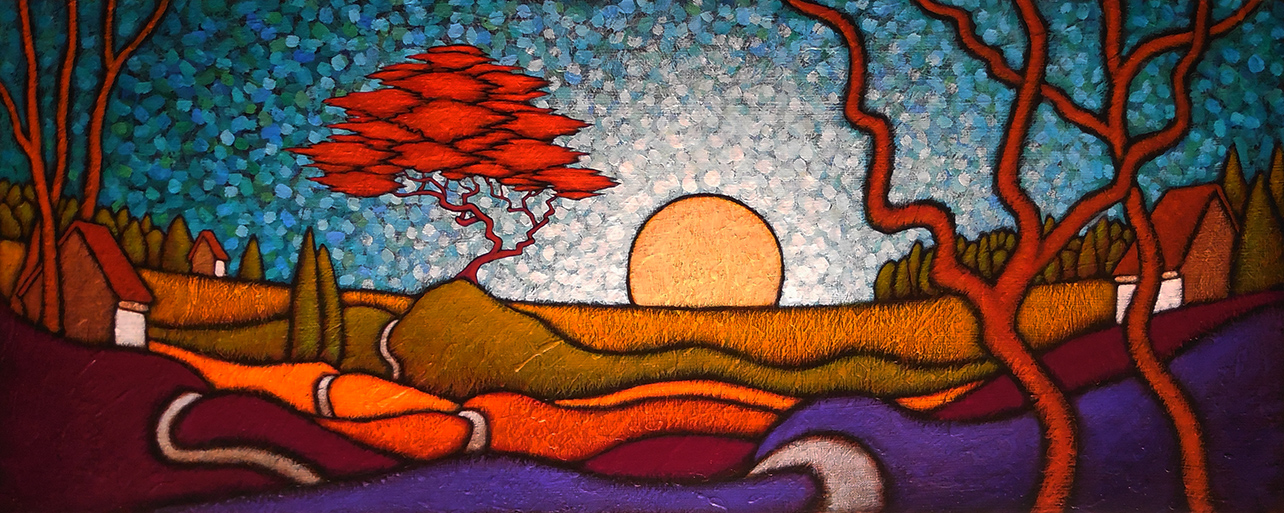
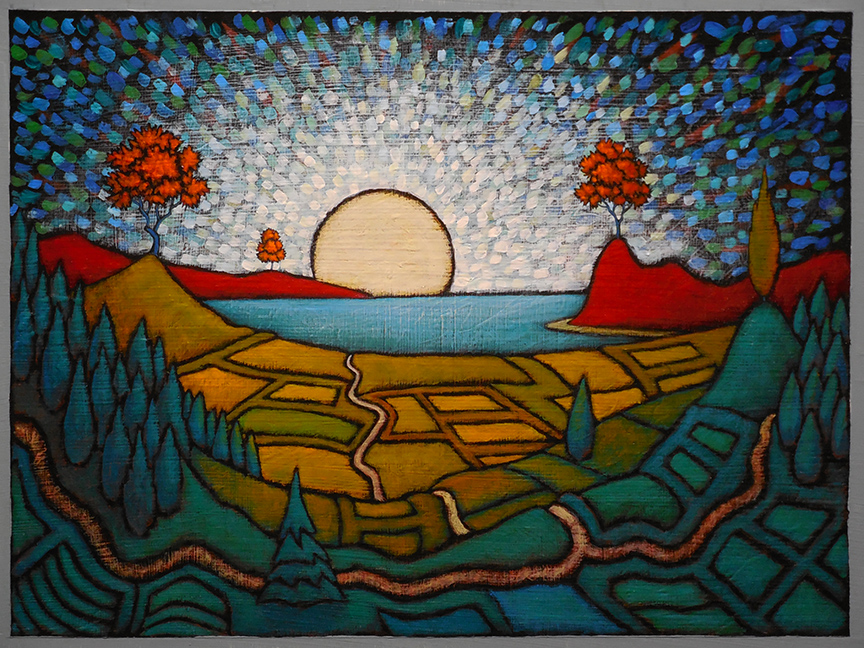
GC Myers- Distant Communique 2021


How it is that animals understand things I do not know, but it is certain that they do understand. Perhaps there is a language which is not made of words and everything in the world understands it. Perhaps there is a soul hidden in everything and it can always speak, without even making a sound, to another soul.

Frances Hodgson Burnett, A Little Princess


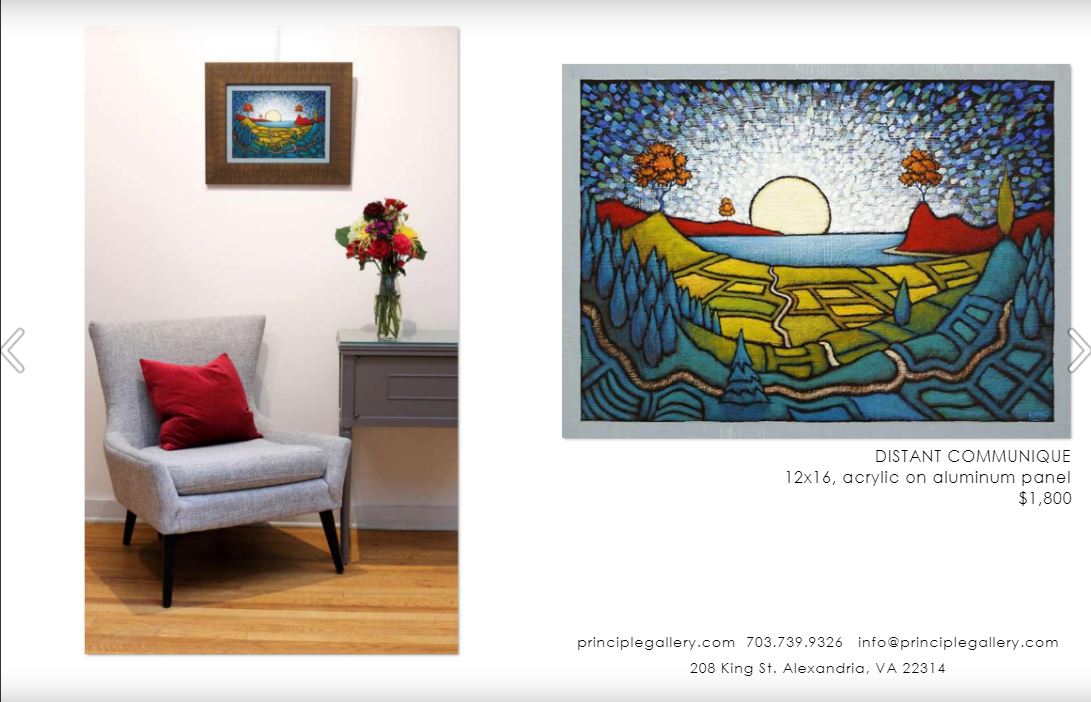
The new painting at the top, Distant Communique, is included in my current solo exhibit at the Principle Gallery. I think I want to let it stand with the words above from the author Frances Hodgson Burnett, best known for her beloved book The Secret Garden.

A language without words. That’s very much what art is. It implies a common knowledge or understanding of how things are and transmitting it from one being to another with gesture and nuance.

We’ve all experienced it, I am sure. A knowing glance across a room. A nod to someone that speaks volumes. The tilt of a head. The evasion or linking of eyes that reveals so much more than the sometimes clumsiness of words.

It’s with this innate understanding, this intuition, we sometimes recognize kindred spirits without a word. The same goes for those we would be better off avoiding.

There’s more to be said on this but that seems somewhat contradictory to the message. Let me just leave it as it is and you might better understand what I am getting at with the painting.


GC Myers- Distant Communique-Principle Gallery 2021 Catalog Page

Read Full Post »

« Newer Posts - Older Posts »