Feeds:
Posts
Comments

Posts Tagged ‘Quote’

Kandinsky Sketch for Composition II

Wassily Kandinsky- Sketch for Composition II- 1923


Color is the keyboard, the eyes are the harmonies, the soul is the piano with many strings. The artist is the hand that plays, touching one key or another, to cause vibrations in the soul.

-Wassily Kandinsky


I came across a short film that I would like to share. It’s What Does Colour Sound Like? and was made by modern composer Barnaby Martin. This ten minute film discusses painter Wassily Kandinsky (1866-1944) as he tried to reconcile the connections between color, music, and emotion in his work throughout his career.

Kandinsky’s work and his writings have always struck chords with me. I know it influenced how I look at works of art, including my own. I often feel and describe paintings in terms of music and, like Kandinsky, view the colors and shapes within a painting as musical elements which are more vital to the work than the actual representation of any one object.

At this point in my preparation for a show, when there is an abundance of new work surrounding me in the studio, the importance of color and form as carriers of emotion becomes clear. Maybe that’s why this film and Kandinsky’s words speak so directly to me this morning.

If you have ten minutes to spare, I urge you to take a look. And a listen.


Read Full Post »

Paul_Gauguin_-_D'ou_venons-nous


What still concerns me the most is: am I on the right track, am I making progress, am I making mistakes in art?

–Paul Gauguin


I run this post every few years, usually when I am at a low ebb, when self-doubt is really nagging at me. Right now, as I prep for my upcoming Principle Gallery show, I am bouncing from highs to lows each day which is normal for me in my process. It’s during these times that I ask myself questions like those above that Gauguin posed for himself. However, this morning I feel pretty good. Fairly confident, feeling that my work is very much progressing and evolving in a positive way. But time has taught that by this afternoon I may be racked with doubt about my abilities or my own judgement of them. 

So, I try not to dwell on it and attempt to simply work through it. That. usually provides the answer to my questions and doubts. That’s what I am going to do right now, thank you.


At one of my gallery talks a year or two ago, I was asked about confidence in my work. I can’t remember the exact wording but the questioner seemed to imply that at a certain point in an artist’s evolution doubts fade away and one is absolutely certain and confident in their work.

I think I laughed a bit then tried to let them know that even though I stood up there and seemed confident in that moment, it was mere illusion, that I was often filled with raging doubts about my voice or direction or my ability. I wanted them to know that there were often periods when I lost all confidence in what I was doing, that there were days that turned into weeks where I bounced around in my studio, paralyzed with a giant knot in my gut because it seemed like everything I had done before was suddenly worthless and without content in my mind.

I don’t know that I explained myself well that day or if I can right now. There are moments (and days and weeks) of clarity where the doubts do ease up and I no longer pelt myself with questions that I can’t answer. Kind of like the painting at the top, Where Do We Come From? What Are We? Where Are We Going?, the masterpiece from Paul Gauguin. Those are tough questions to answer, especially for a person who has little religious belief.

And maybe that’s the answer. Maybe my work has always served as a type of surrogate belief system, expressing instinctual reactions to these great questions. I don’t really know and I doubt that I ever will. I only hope that the doubts take a break once in a while.

There was another quote I was considering using for this subject from famed art critic Robert Hughes:

The greater the artist, the greater the doubt. Perfect confidence is given to the less talented as a consolation prize.

I liked the sentiment but it felt kind of self-serving, like saying that being aware aware of your own stupidity is actually a sign of your intelligence. While I would really like to believe that all those times when I realized I was dumb as a stump were actually evidence of my brilliance, I have real doubts about the logic. If it is true, there are a lot of geniuses out there operating under the guise of stupidity and overwhelming self-doubt.

However, if Hughes is correct then I may be one of the the greatest artists of all time and a genius to boot.

But, at the moment, I have grave doubts about that.


Read Full Post »


GC Myers- Hiding in Plain Sight

“Hiding in Plain Sight”- Bid for it on the SPCA Fundraiser


What makes a hero? Courage, strength, morality, withstanding adversity? Are these the traits that truly show and create a hero? Is the light truly the source of darkness or vice versa? Is the soul a source of hope or despair? Who are these so called heroes and where do they come from? Are their origins in obscurity or in plain sight?

– Fyodor Dostoevsky


I want to let everyone out there know that the painting above, Hiding in Plain Sight, is currently part of the online auction to benefit our local Chemung County SPCA. This painting is 10″ by 14″ on paper which is matted in a 16″ by 20″ frame. It is valued at $1500 and the current high bid is $1050. It is Auction Item #14.

This virtual fundraising event which takes place tomorrow, Saturday, May 1, runs from 4-7 PM on Facebook Live with the auction for all items ending at 7 PM. It also has a variety of entertaining musical performances though out the event. You can check out or bid on this painting or any of the many donated items by  clicking on this link for its Facebook page, SPCA Virtual Facebook Fundraiser and scrolling down through the items. As I said, this painting is Auction Item #14.

I hope you will take advantage of this opportunity to help out a worthy organization, our SPCA, and perhaps take home an original painting.

For me, this painting has message that aligns well with what Dostoevsky questions above. What makes a hero? What is beauty? What are we seeking? Is it beyond us or is it in plain sight?

My guess is that all that we seek and all that we are or need is always right before us, in plain sight.

So, come out of the shadows and stake your claim to heroism by helping the SPCA continue to help out the animals here in Chemung County. Like so many other things, those in need are often in plain sight, waiting for a helping hand.

Read Full Post »

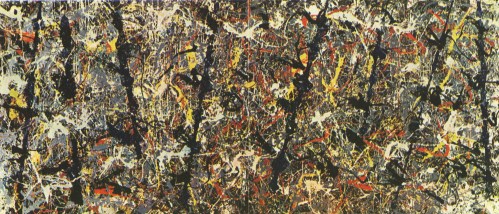
pollock-blue-poles-1953-jpeg


It doesn’t make much difference how the paint is put on as long as something has been said. Technique is just a means of arriving at a statement.

–Jackson Pollock


I am sure there are plenty of artists who would argue this point made by Jackson Pollock. Like religion, many would most likely defend their chosen means of expression as the best.

But I think he is saying there is no one right way, no one technique that ranks above all others in putting forth an artist’s voice and statement. Each artist’s individual voice comes through their own chosen technique. Their statement–their truth or belief, if you will– arrives via that technique.

I know that’s been my experience when I am looking at art. I am generally looking for a statement of some sort from an artist in their work, something that displays their own truth regardless of how it is expressed. It doesn’t have to be a world shaking or any sort of grand statement. Just something that tells me about this artist’s situation in the world, how they see and feel it. I am mainly looking for something that makes me feel the need to look at it, to engage with it.

It can be in any style, stretching from the most refined painting created by a classically schooled artist down to an untrained folk artist who uses their local mud as their painting medium because that is all that is at hand. So long as each is earnestly created (and that is an important distinction) and provokes a true emotional response, any and all technique is valid.

To bring it back to the religious analogy, the earnest belief of the lone person sitting in a decrepit hut somewhere may be as valid as that of a priest in the grandest cathedral.

Art, like religion, is diminished when we fail to see the validity of all other voices.


This ran several years ago. Maybe it’s my own attempt to validate my own work which doesn’t fully fall in any traditional category. I like to think it’s more about validating anyone who has the need to express but feels like their lack of training or materials diminishes in some way. Honest expression always rules the day.

Read Full Post »

PG GCMyers-- Comforter sm


But there is a greater comfort in the substance of silence than in the answer to a question. Eternity is in the present. Eternity is in the palm of the hand. Eternity is a seed of fire, whose sudden roots break barriers that keep my heart from being an abyss.

The things of Time are in connivance with eternity…

― Thomas Merton, “Fire Watch, July 4, 1952”


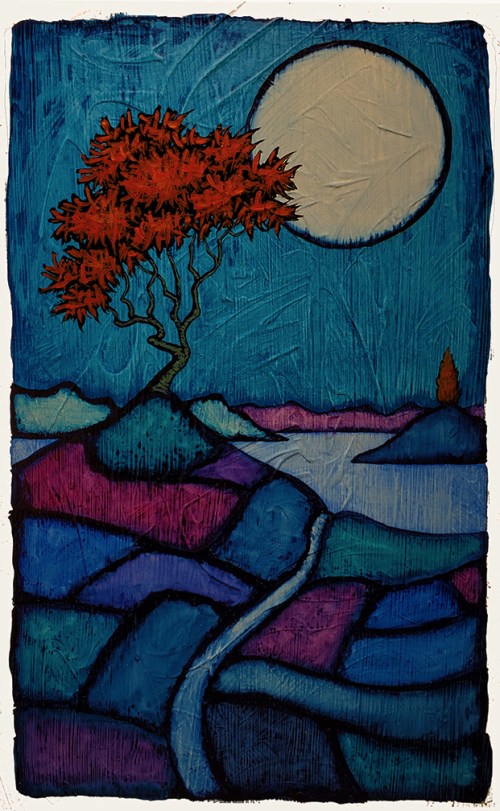
I had been looking for an image that would match up well with the lines above from the late mystic monk/theologian Thomas Merton when thought of this newer piece. It is titled Comforter and is part of my upcoming June solo show at the Principle Gallery in Alexandria.

The title feels self-evident in the painting with its shades of blue that are underlaid with layers of magenta that give it a warmth that I finding comforting. The warm light of the moon also has a calming effect and the patchwork effect of the fields speaks directly of a comforter.

As I said, the title speaks for itself.

But Merton’s passage adds a layer of spiritual comfort. It comes from an epilogue for his book The Sign of Jonas and details one of his first duties as a novice monk performing a fire watch. It entailed walking through the monastery in the early hours of the morning making sure that all was well, that no accidental fires or water leaks were taking place. It was a task filled with silence and vigilance but also one that offered comfort in the knowledge that all was well.

And that seems to fit with this small painting. The Red Tree seems to be overlooking all while pondering its own existence, its own purpose. And in doing this silent duty, it finds comfort.

Another passage from Merton’s essay seems applicable as well:

And now my whole being breathes the wind which blows through the belfry, and my hand is on the door through which I see the heavens.  The door swings out upon a vast sea of darkness and of prayer.  Will it come like this, the moment of my death?  Will You open a door upon the great forest and set my feet upon a ladder under the moon, and take me out among the stars?

Perhaps the Red Tree is looking for that ladder under the moon.

I think I will think on that some more. In the comfort of silence.

Read Full Post »

“Placidarium”


The more intensely we feel about an idea or a goal, the more assuredly the idea, buried deep in our subconscious, will direct us along the path to its fulfillment.

—Earl Nightingale


It’s funny sometimes what you take from an experience in your life. At one point in my life I was in the retail car business, working at a Honda dealership both as a salesman and for a time as a finance manager. In order to keep their sales staff engaged and excited about pushing their product, the management there would periodically send us to seminars with industry-specific motivational speakers and would also have sets of motivational tapes from other speakers that they would encourage us to listen to in our free time.

One of the sets of tapes was from famed motivational speaker Earl Nightingale who had a deep and engaging voice that added a serious dimension to whatever he said. As I listened to his tapes, it was easy to feel my interest growing as he told his little tales and his lessons began registering within me.

One of his stories was a short retelling of a classic lecture called Acres of Diamonds from Russell H. Conwell (1843-1925), an interesting fellow who was a Baptist minister, a lawyer, a philanthropist and the founder and first president of Temple University. The lecture, one that Conwell delivered over 5000 times during his lifetime, made the point that the riches we seek are often right in our own backyards. His tale is of an African farmer who sells his farm in order to go in search of diamonds and finds nothing but failure that ends with his suicide. Meanwhile, the man who took over the farm found an abundance of diamonds and ended up with one of the largest diamond mines in Africa.

There were a lot of lessons to be learned from this tale. obviously. But the primary lesson for me was that I had to leave the car business– it was not my backyard. It was the place to which I had come in search of my own diamonds. I had not even, at that point, began to search my own backyard.

I am not sure if that was the message that management had been hoping would sink in.

Or maybe it was. 

Their intent didn’t matter as I was soon on a different path, one that ultimately led me here, thankfully.

The other part of Nightingale’s message was that you had to set a course, aim for a destination. Everything was possible if you knew where you wanted to go and truly set your mind to it. He gave a laundry list of great human accomplishments that were achieved once we put our minds and wills in motion towards their fulfillment.

That resonated strongly with me. I had seen many people over the years who seemed deeply unhappy in their lives and most had no direction going forward, no destination for which they were working. Aimless, they drifted like a rudderless boat on the sea, going wherever the strongest current took them without having any influence over this motion.

If you can name it, you can do it in some form. Having a desired destination allows the mind, often subconsciously, to create a course that leads to that place.

As I said, it’s funny how things influence you. It’s been over thirty years since I heard those words but they still resonate strongly with me, even now. I try to be always conscious of the goals I set, knowing that the mind and the universe will always try to make a way for the possibility of achievement.


I run this post about every five years or so. As I say, there are lessons to be learned in every endeavor we undertake. Every job I ever held gave me something more than a paycheck. They showed me what I was and was not. In this case, I learned to work the fields that I knew and loved. 

It was a good lesson.

Read Full Post »

GC Myers- The Sky Is Always the Sky 1995 sm


There is one spectacle grander than the sea, that is the sky; there is one spectacle grander than the sky, that is the interior of the soul.

Victor Hugo, Les Misérables


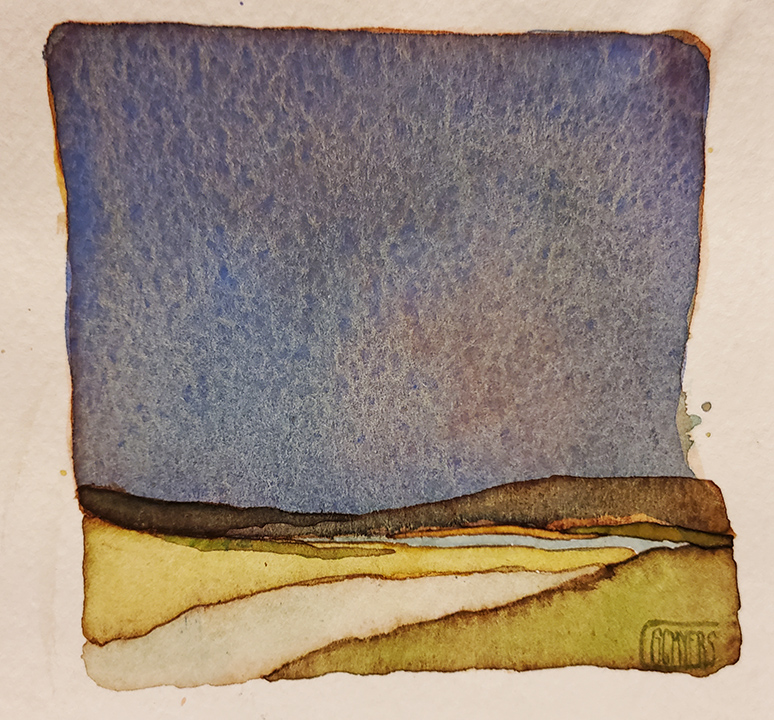
Thought I’d share another older piece, one that also never found its way out of the studio. Some times the reason they stay with me is obvious and other times not so much. This small piece falls in the not so much category.

It’s from mid 1995, not long after I first started showing my work publicly. Across the bottom of the piece of watercolor paper on which it is painted is the title The Sky Is Always the Sky along with the date it was painted in 1995.

Looking at it now, I can’t figure out why I felt it wasn’t worthy to show at that time. I am actually pretty pleased to be able to show it now. It has much in it that I wish would show up in my work now, twenty five years later.

For example, its utter simplicity and the gracefulness of its linework. Well, my definition of gracefulness, anyway. There’s also the way the layers of color go together so well with the grainy pigments of the cobalt blue settling into the shallow pits of the paper above a sepia underlayer.

Looking at it, I realize that many of the changes that took place in the following years in my work were material related. A few years after this I went from employing traditional watercolors in my work to acrylic inks. The difference is that the inks have a more and finer pigments which make their colors more explosive, more impactful. There is a difference in the more subtle aspects of the watercolors that is hard to replicate with the inks. This piece is an example, at least by my analysis.

Another difference was that I also began using a gessoed surface a few years later which also brought dramatic changes to the work. The positives of using gesso outweigh not using it for me but the beauty of cotton watercolor paper and its tactile appearance is undeniable.

The other difference was that the brushes I was using at the time were  wonderful Winsor & Newton round brushes that have long since been discontinued. These round brushes had a different brush profile than almost any other round brush I have been able to find since that time. I use a round brush almost all the time in my wet work even when a flat brush might sometimes be a more obvious choice. I like the organic quality it gives the work and the linework it produces. Brush choice has a big impact on how the work appears and I am still trying to find brushes that have the same qualities as those old W&N brushes.

Anyway, looking at this old piece again so closely gives me inspiration, makes me want to revisit those elements that make it work so well for me. We’ll see

Here’s an old Chris Isaak song, a favorite that is centered around a particular blue sky. It’s the tone I would like for this piece. Here’s Blue Spanish Sky.


Read Full Post »

theodore rousseau-underthebirches1842-43

Theodore Rousseau- Under The Birches 1842


It is better in art to be honest than clever.

–Theodore Rousseau


Theodore Rousseau (1812-1867) was part of the Barbizon school of painters, an art movement in 19th century France that was instrumental in moving away from from the traditional formalism that was prevalent in art up to that point and towards naturalism and artistic expression of emotion. It was very influential on many of the painters who later created the Impressionist movement.

Rousseau and Jean-Francois Millet, best known for his peasant scenes, were the two artists from this school whose work really spoke to me, seeming to have honest emotional content in them. Perhaps that is why his short quote resonated so strongly with me. That and the fact that I have found myself less impressed with cleverness than honest expression through the years. I have always believed that art comes from tapping into the subconscious, something other than the part of our brain that produces conscious thought.

I guess I just don’t think we are that smart. Or clever.

I know I am not.

My work is at its best when it comes from a place of honesty and real emotion, when it is made with more intuition than forethought. When it is too thought out and directed it begins to feel stilted and contrived, losing its naturalness and rhythm and becoming heavy-handed.

That is probably the reason I tell young or beginning painters to focus not so much on the actual idea or subject of a painting but more on things like paint handling and color quality, those things that make up the surface of a painting and convey the real meaning of the painting.

And I think that is what Rousseau was probably getting at in his terse quote.

But maybe not. Like I said, I am not that clever.


This post ran about six years ago and like they say, some things never change. I certainly haven’t gained any cleverness and I still believe that honest emotion is the basis of all impactful art. But what do I know?

Read Full Post »


Sometimes the horizon is defined by a wall behind which rises the noise of a disappearing train. The whole nostalgia of the infinite is revealed to us behind the geometrical precision of the square. We experience the most unforgettable movements when certain aspects of the world, whose existence we completely ignore, suddenly confront us with the revelation of mysteries lying all the time within our reach and which we cannot see because we are too short-sighted, and cannot feel because our senses are inadequately developed.  Their dead voices speak to us from nearby, but they sound like voices from another planet.

–Giorgio de Chirico

***************

I am busy this morning but wanted to share a post from several years ago about painter Giorgio de Chirico. I thought I’d run it again today with the addition at the bottom of one of his more famous paintings and a short MoMA video about it. The idea that is presented about the metaphysics contained in dealing not with “perceived reality” but a “reality imagined” and of creating “a plausible representation of a believable and negotiable space” rang a bell for me as that is the space where I try to operate. Take a look.


de chirico_mysteryA turning point for me when I was first stumbling around with my own painting was when I encountered the work of Giorgio de Chirico, an Italian painter of darkly toned metaphorical works. He lived from 1888 until 1978 but was primarily known for his early work from 1909-1919 which is called his Metaphysical PeriodMetaphysics is  devoted to the exploration of what is behind visible reality without relying on measurable data.

His work from this defining ten year period is very mystical.

De Chirico’s work after 1919 became much more based in reality and far more traditional. This later work was less colorful, less symbolic, less powerful and way more mundane. It is definitely the work from the earlier Metaphysical period that defines him as the artist as we know him today.

I was immediately drawn to that early work. It was full of high contrast, with sharp light and dark. The colors were bold, bright and vibrant, yet there was darknessde-chirico-the-great-tower implied in them. The compositions were full of interesting juxtapositions of forms and perspectives, all evoking a sense of mystery. It was a visual feast for me.

At that time in my own painting, I was still painting in a fairly traditional manner, especially with watercolors. That is to say that I was achieving light through the transparency of my paint, letting the underlying paper show through. It was pretty clean which was fine. But it wasn’t what I was looking for in my work.

Seeing de Chirico’s paintings made me realize what I wanted.  It was that underlying darkness that his work possessed. It was a grittiness, a dark dose of the reality of our existence. I immediately began to experiment with different methods that would introduce a base of darkness that the light and color could play off.  Plus, his ability to create a reality that seemed possible and recognizable but seemed filled with mystery  was something aspired for in my own pieces.

Working with this in mind, my work began to change in short order and strides forward came much quicker as a result of simply sensing something in de Chirico’s work that wasn’t there in my own.

Perhaps that is what is meant by metaphysical…


de-chirico


Read Full Post »

“Home In Sight”– Now at the West End Gallery


Knowledge of what is possible is the beginning of happiness.

— George Santayana


As St. Patrick’s Day approaches, which was also my mother’s birthday, I gave some thought to my parents this past weekend, thinking about how they influenced me early in my life. It reminded me of a post that ran many years back, in 2009.

It was a brief recollection of that time as a child when I had not idea what was or wasn’t possible in my life. Oh, I had an idea that I would never be roaming the outfield for the Yankees or taking one small step on the surface of the moon but for the most part, everything seemed in play.

To an 8 year old everything is still attainable, anything is possible. My parents never pushed me in any one direction or tell me what I should try to accomplish, mainly because they most likely because they themselves didn’t know what was possible. They simply didn’t have the knowledge needed to direct me in any way. At the time, it seemed frustrating because of the lack of direction given.

Kind of like being told that you should build a cabinet but you’re not given any materials or instructions. You had to figure it out for yourself. You had to design and build it on your own. Except it wasn’t a cabinet, it was your life.

But to their credit, my parents never discouraged me or imposed any limits on my imagination or aspirations. They gave me free rein to explore and a little help when the opportunity to do so arose. That was their form of encouragement. 

It worked out in the long run. It took a lot more trial and error but the independence gained in those early years got me through the difficult times. I overlook their flaws now and focus on the appreciation I have for the things they did try to do for me, knowing that they were grasping at straws in the dark. They didn’t know what to do, didn’t know what was possible. They just wanted to help. And I am forever grateful for that expression of their love.

Here is what I wrote back in 2009:

When I give gallery talks, generally there is a part at the beginning where I run through how I came to be a painter. I usually tell how I somehow came across the idea that I wanted to be a painter when I was a small child, maybe 7 or 8 years old. Don’t know what made me come to that idea.

My parents didn’t know how to foster this idea but they did react, buying me an oil painting set from the old Cardinal Paint store in Elmira, where they sold art supplies alongside their house paints. I remember standing on the street looking at the display of art supplies in the window of their store on Water Street. I think I was only there because it was next door to the S&H Green Stamp Redemption Center, the place where you traded in your books filled with those green stamps for household items. I guess S&H Green Stamps may have had something to do with me becoming a painter.

Of course, I didn’t have the first idea how to use the paints and the canvas panel ended up covered with a smear of a color that could best be described as looking like gray and brown puke smeared on a board. Unfortunately, that was not what I was hoping to see. Discouraged, I put the paints aside and moved on to other things. Many other things through the years.

Now, that might seem, at first blush, like a sad little story but it always touches me. My parents didn’t know how to go about helping me but they did what they could and never discouraged me from whatever avenue I chose to follow. I was never told I couldn’t be this or that I should be that. They didn’t know what was possible and never tried to put limits on my hopes.

In high school, I harbored dreams of being a writer and for Christmas one year they gave me a Remington Rand office typewriter. It was a reconditioned monster of a machine, must have weighed 75 pounds. I had it for years, hefting that monster from place to place, and when I did finally get rid of it, it was with great sadness. It remains one of the best gifts I’ve ever been given and is forever a symbol of my parents’ desire to encourage me. 

The point of this is that my parents allowed me the freedom to discover what was possible for me in my life. Did they always go about it in the best way or guide me in any way? Probably not but that didn’t seem as important as the freedom they gave me to search for what was possible for me.

And being able to find what was possible, as the saying above says, is the beginning of happiness…

Read Full Post »

« Newer Posts - Older Posts »