Today and the next several days ahead are busy for me as I do prep work for the June 2 opening of my solo show at the Principle Gallery. Even though it’s really hectic it’s not a disorienting kind of chaos. I’ve done this so many times that I understand the rhythm and timing that is required for these preparations.
That knowledge takes care of some of the anxiety but certainly not all of it. Every show has a level of trepidation as you worry about how it will be received. That particular anxiety will never go away and is actually, at least for me, kind of reassuring. I tend to think that when I stop feeling that tension before a show I will have become complacent.
So, I am currently busy, anxious and worried. In other words, things are going about as good as can be expected.
I thought I’d share a nice video I found of the work of Van Gogh set to Don McLean‘s lovely ode to the artist, Vincent. It’s a very pleasant combination for a bustling Monday morning and definitely eases the nerves.
Watching the video the other day of the Rose Garden hullabaloo with the faces of the wealthy and predominantly white men all gleefully gloating the mere passage of a House bill that has the potential to do far more harm than good made me angry and ashamed for this country. To see them so wildly exulting something that does nothing to address the very real problems that exist in the availability and delivery of healthcare to our citizens is an abomination. They shift around some money to the advantage of those already well endowed and they celebrate like they personally defeated an alien force hellbent on overthrowing the Earth.
What drives these people? I am sure that if asked, they would spew the requisite “they’re there to serve the people“nonsense. But they seem to believe, if their actions are evidence of any sort, that the people they must serve the most are the people who need their assistance the least.
Do these men in congress really know the true extent and face of poverty or is it just an abstract notion, anonymous and in the distance? Personally, I believe they should be speaking for those who cannot speak for themselves, that they should be acting in order to lift those in need. Instead, they seem quite content in enriching their own bank accounts and those of their cronies while they do little, if anything, for the greater good.
Maybe they should take a few minutes and look at some of the photos of Lewis Hine, the photo-journalist and social activist. His powerful photos taken around the turn of the century brought to light the plight of working children and spurred on the union movement that brought about great reforms for workers across the nation. Perhaps if they studied the faces of the children in these photos, they would get a better understanding of what should be their own purpose in their positions of responsibility. Those faces can still be found today, if they would only take the time to look.
Here’s a nice slideshow of some of Hine’s photos set to the Gary Jules version of the Tears For Fears song, Mad World.
“Can anything be imagined so ridiculous, that this miserable and wretched creature [man], who is not so much as master of himself, but subject to the injuries of all things, should call himself master and emperor of the world, of which he has not power to know the least part, much less to command the whole?”
Dominium is the title of this new painting, a 24″ by 24″ canvas that is part of my annual solo exhibit at the Principle Galleryin Alexandria, VA. The show opens June 2.
I’ve spent a considerable amount of time looking at this painting in the last several weeks and have found that it is an easy piece in which to withdraw. Even though there are paths coming into the picture, which normally denotes the presence of people, it is the absence of humans that is the message that I get from this piece.
We have no dominion over this world. It is the land that holds sovereignty for no matter how badly we abuse and squander the bounty that this world provides, it will no doubt persist in some living form well beyond the very short time our species will litter its surface. We are not the owners of the land or its creatures nor treat this planet as though we were. No, we should act only as caretakers and custodians of this world, for that is the only way we can extend our tenuous time in this bountiful place.
Maybe this is snapshot of a time beyond ours. Or maybe it is a hopeful example of how we should coexist with our environment.
I don’t know which. I do know that it makes me feel better to just stare at it for a while and that’s a good thing these days. It’s far too easy today to cynically believe that the hubris, stupidity and selfishness that is so prevalent in our species will prevail. All available evidence points in that direction.
But this piece gives me a bit of peace of mind and with that comes the possibility for hope. And that hope at least makes possible the opening of one’s mind which leads to the possibility of obtaining wisdom. And wisdom gives us a chance to use our limited knowledge and abilities to the greatest benefit, to possibly avert destroying our world.
Save the world. That’s a lot to ask of a simple painting. But maybe that is a major purpose of art– to save us from ourselves, to bring light to the darkness.
Okay, in that same vein, this week’s Sunday morning musical selection deals with the ecology. It’s the classic Mercy Mercy Me from Marvin Gaye. That’s two Sundays in a row for Marvin but it just felt so right.
Give a listen, have some hope and with that, a great day.
Several years back, I wrote here about the late Croatian painter Ivan Generalic (1914-1992). I don’t really know how his work is categorized. He mixed folk art, rural Eastern European village life and folklore, and allegory in a painting style that was richly colored and inviting. It was most often painted on glass which increased its vibrancy and glow. It had a certain charm that reminded me of the jungle paintings of Henri Rousseau.
I thought I’d share a video this morning that features his work set to music, “Raindrops Prelude” by Grupo Pedagógico Infantil. It’s a nice and interesting watch. I urge you to take a few minutes and give it a look and a listen.
Sometimes the horizon is defined by a wall behind which rises the noise of a disappearing train. The whole nostalgia of the infinite is revealed to us behind the geometrical precision of the square. We experience the most unforgettable movements when certain aspects of the world, whose existence we completely ignore, suddenly confront us with the revelation of mysteries lying all the time within our reach and which we cannot see because we are too short-sighted, and cannot feel because our senses are inadequately developed. Their dead voices speak to us from nearby, but they sound like voices from another planet.
–Giorgio de Chirico
***************
A turning point for me when I was first stumbling around with my own painting was when I encountered the work of Giorgio de Chirico, an Italian painter of darkly toned metaphorical works. He lived from 1888 until 1978 but was primarily known for his early work from 1909-1919 which is called his Metaphysical Period. Metaphysics is devoted to the exploration of what is behind visible reality without relying on measurable data. Very mystical. De Chirico’s work after 1919 became more realistic and more traditional.
His later work was less colorful, less symbolic, less powerful and way more mundane. It is definitely the work from the earlier Metaphysical period that defines him as the artist as we know him today.
I was immediately drawn to that work. It was full of high contrast, with sharp light and dark. The colors were bold, bright and vibrant, yet there was darkness implied in them. The compositions were full of interesting juxtapositions of forms and perspectives. It was a visual feast for me.
At that time in my own painting, I was still painting in a fairly traditional manner, especially with watercolors. That is to say that I was achieving light through the transparency of my paint, letting the underlying paper show through. It was pretty clean which was fine. But it wasn’t what I was looking for in my work.
Seeing de Chirico’s paintings made me realize what I wanted. It was that underlying darkness that his work possessed. It was a grittiness, a dark dose of the reality of our existence. I immediately began to experiment with different methods that would introduce a base of darkness that the light and color could play off. My work began to change in short order and strides forward came much quicker as a result of simply sensing something in de Chirico’s work that wasn’t there in my own.
Perhaps that is what is meant by metaphysical…
This post is a combination of a couple of posts from years ago. I really wanted to use his quote at the top because I often get that feeling from certain paintings, that they represent “voices from another planet,” that they come from a point well beyond our realm of knowledge. I also wanted to include the video below that shows much of De Chirico’s metaphysical work. Take a look below.
I have been enjoying the films I’ve been sharing lately featuring the work of some of my favorite artists. It sometimes gives me a wider view of their body of work, giving me glimpse at lesser known pieces alongside their greatest hits while listening to music that often fits the tone of the work.
Today’s pick was an easy one for me. It’s a lovely compilation of the work of Andrew Wyeth set to the gorgeous guitar of John Williams‘ version of British composer Stanley Myers’ Cavatina. You might recognize the song from its prominent place in the film The Deer Hunter.
Andrew Wyeth would have been 100 years old in 2017 and to mark the occasion, the Fenimore Museum in Cooperstown has an exhibit opening in May that celebrates the life and work of Wyeth. It is curated by his granddaughter, Victoria Wyeth, and includes many items from his personal collection. It is on my to do list.
Anyway, enjoy this beautiful group of paintings and the music that accompanies it. I am off to work, happier for having watched this short film this morning.
In the inner place where true artists create there exists a pure child.
–Lawren Harris
**************
I was planning on throwing up a quick post with a video of some of the paintings from another favorite of mine this morning.
Quick. Easy. Done and I’m on my way to the rest of my day.
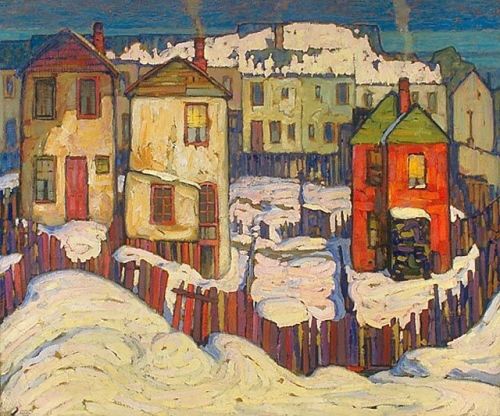
The problem is that once I start looking at the paintings of Lawren Harris time just evaporates for me. I find myself just staring at so many different pieces, taking in their colors, their harmonies, their stillnesses, and their sheer beauty, that time floats away. I find myself enthralled by his work maybe more than any artist I’ve encountered.
The video below is a group of his work set to a Barhms sonata. A few of the images are a bit fuzzy but it’s a pretty well done video and gives a good idea of the full range of Harris’ work. So while this post is short today be advised that it is one that might take up some of your time. It took a bunch of mine this morning!
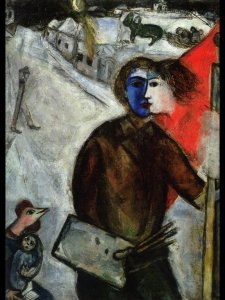
I’ve been very busy recently and haven’t had chance to write as fully as I would like. I’ve been doing this long enough that writing the blog has become habit and I feel a little guilty when I think I’m not attentive enough. But I have tried to alleviate some of my guilt by sharing some things that I do like. Like the video below of the work of Marc Chagall set to the music of Mozart’s Piano Concerto #23 Adagio.
I’ve always been a fan of Chagall’s work. It’s hard to not let myself get caught up in the world of Chagall’s paintings. It’s easy to happily absorb yet you’re never quite sure what it is that you’re taking in. Something magical and mystical there.
Lately, when I have been very busy, I’ve been sharing some videos of artists’ work set to music. For example, I’ve shared videos of the works of Edward Hopper and Thomas Hart Benton in recent weeks. It’s always interesting to see artists work set to music, especially when they seem to complement one another.
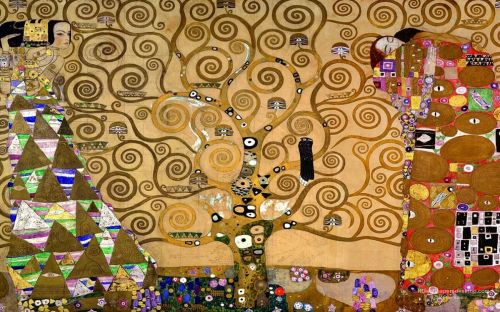
Well, I am busy again today but want to share a nice video featuring the work of Gustav Klimt put together by a Brazilian musician, Juliano Cesar Lopes, who creates musical scores for films under the name JCSL Studio Recording. He has produced a number of short films like this one as a showcase for his skills. I like his work on this short film and hope you will as well.
I am really busy today. I am working on a bigger piece that I started late yesterday. There are just a lot of things percolating and I really want to get at it this morning. I’ve been at this long enough that I know this is a time of which I need to take advantage.
The Muses come in fleeting moments and rarely, if ever, stick around for you if you don’t give them the attention and the time that they demand.
So while I go back to work I thought I would share a nice video of Edward Hopper landscapes and cityscapes set to music. The maker of the video didn’t credit the music but I was able to discover that it is a solo piano cover of Pink Floyd’s Wish You Were Here from musician Steven Garreda. It’s a really nice fit for the contemplative quiet of the Hoppers.
 Today and the next several days ahead are busy for me as I do prep work for the June 2 opening of my solo show at the Principle Gallery. Even though it’s really hectic it’s not a disorienting kind of chaos. I’ve done this so many times that I understand the rhythm and timing that is required for these preparations.

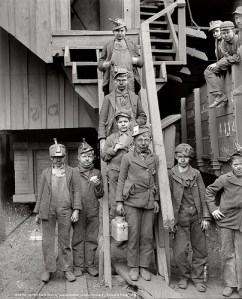 Watching the video the other day of the Rose Garden hullabaloo with the faces of the wealthy and predominantly white men all gleefully gloating the mere passage of a House bill that has the potential to do far more harm than good made me angry and ashamed for this country. To see them so wildly exulting something that does nothing to address the very real problems that exist in the availability and delivery of healthcare to our citizens is an abomination. They shift around some money to the advantage of those already well endowed and they celebrate like they personally defeated an alien force hellbent on overthrowing the Earth.
 “Can anything be imagined so ridiculous, that this miserable and wretched creature [man], who is not so much as master of himself, but subject to the injuries of all things, should call himself master and emperor of the world, of which he has not power to know the least part, much less to command the whole?”
  Several years back, I wrote here about the late Croatian painter Ivan Generalic (1914-1992). I don’t really know how his work is categorized. He mixed folk art, rural Eastern European village life and folklore, and allegory in a painting style that was richly colored and inviting. It was most often painted on glass which increased its vibrancy and glow. It had a certain charm that reminded me of the jungle paintings of Henri Rousseau.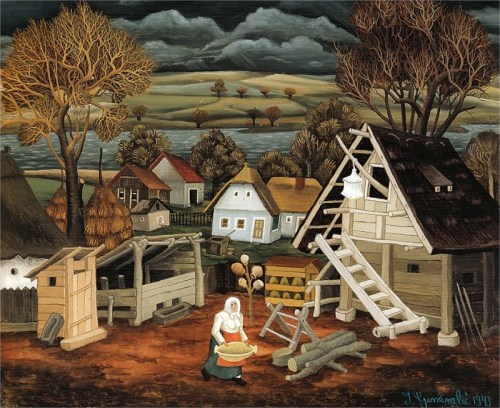
 Sometimes the horizon is defined by a wall behind which rises the noise of a disappearing train. The whole nostalgia of the infinite is revealed to us behind the geometrical precision of the square. We experience the most unforgettable movements when certain aspects of the world, whose existence we completely ignore, suddenly confront us with the revelation of mysteries lying all the time within our reach and which we cannot see because we are too short-sighted, and cannot feel because our senses are inadequately developed. Their dead voices speak to us from nearby, but they sound like voices from another planet.


 I have been enjoying the films I’ve been sharing lately featuring the work of some of my favorite artists. It sometimes gives me a wider view of their body of work, giving me glimpse at lesser known pieces alongside their greatest hits while listening to music that often fits the tone of the work.
 Today’s pick was an easy one for me. It’s a lovely compilation of the work of Andrew Wyeth set to the gorgeous guitar of John Williams‘ version of British composer Stanley Myers’ Cavatina. You might recognize the song from its prominent place in the film The Deer Hunter.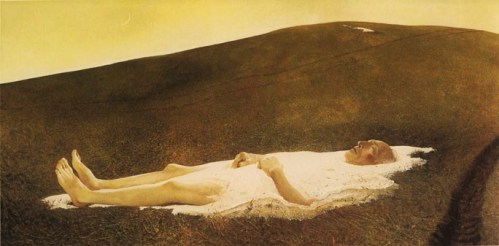
 In the inner place where true artists create there exists a pure child.
 I was planning on throwing up a quick post with a video of some of the paintings from another favorite of mine this morning.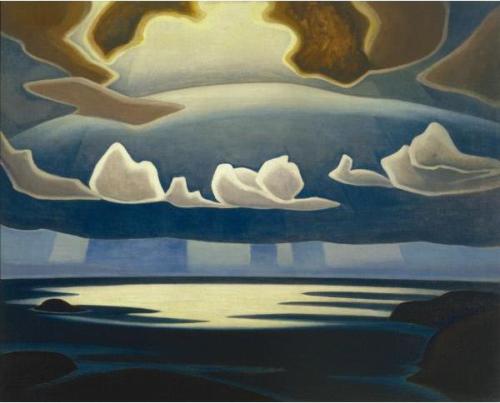

 I’ve been very busy recently and haven’t had chance to write as fully as I would like. I’ve been doing this long enough that writing the blog has become habit and I feel a little guilty when I think I’m not attentive enough. But I have tried to alleviate some of my guilt by sharing some things that I do like. Like the video below of the work of Marc Chagall set to the music of Mozart’s Piano Concerto #23 Adagio.
 Lately, when I have been very busy, I’ve been sharing some videos of artists’ work set to music. For example, I’ve shared videos of the works of Edward Hopper and Thomas Hart Benton in recent weeks. It’s always interesting to see artists work set to music, especially when they seem to complement one another.
 I am really busy today. I am working on a bigger piece that I started late yesterday. There are just a lot of things percolating and I really want to get at it this morning. I’ve been at this long enough that I know this is a time of which I need to take advantage.
 Redtree Times