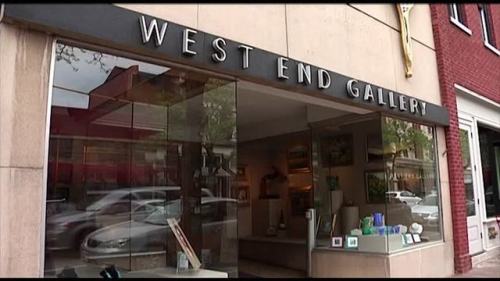
 Tonight, the West End Gallery celebrates its 40th anniversary of selling art on Corning’s lovely Market Street. There is a coinciding opening for a retrospective show of the paintings of the gallery’s co-founder, Tom Gardner. The festivities begin at 4:30 this afternoon with a ribbon cutting and following that there will be music from guitarist Bill Groome, plenty to eat and drink and a few surprises.
I’ve said and written this many times before, but without the West End Gallery I have no idea what or where I would be. The chance to show my work given to me by then gallery owners Lin and Tom Gardner forever changed the direction of my life, opening new doors of opportunity that I couldn’t even imagine in my former life. Ultimately, it changed how I viewed the world and myself.
It’s rare that you can pinpoint a moment in time that alters your life in such a drastic manner that you can see the results that extend from that moment a la It’s a Wonderful Life. But I have such a moment from a day in early 1995 when Tom critiqued my work and Lin asked me to show a few pieces in their next show. Without that moment with them, every good thing that has come to me via my work most likely would have never happened. The numerous paintings that have found their way around the world, the 50 or so solo shows and the many, many wonderful people I have been fortunate to encounter through my work– all of it would probably have never occurred.
I don’t want to even consider what would be without that moment.
In my own way, I say “Thank You” to them every day I enter my studio and take part in the life and work that I so enjoy now. It is all due to that moment and I will never forget that. Nor will I ever be able to thank them enough.
For forty years, the West End Gallery has given me and so many other artists an opportunity to take a chance on a different life. It has persisted through the ups and downs of the economy, through booms and busts. Now under the capable hands of Tom and Lin’s daughter Jesse and her husband, John, it is looking forward even as it celebrates its past tonight. They are working hard every day to make the gallery better in every way.
I wouldn’t be surprised if there’s another 40 years in the cards for the West End Gallery.
So, if you’re in the area tonight, make your way to the West End Gallery for a celebratory drink, a little bite, some great conversation and some wonderful art and music. If you’ve never been, they’ll make you feel right at home.
I can tell you that from first-hand experience.
Thank you for everything, Lin and Tom and Jesse and John.
I mean that literally.


 Several years back, I wrote here about the late Croatian painter Ivan Generalic (1914-1992). I don’t really know how his work is categorized. He mixed folk art, rural Eastern European village life and folklore, and allegory in a painting style that was richly colored and inviting. It was most often painted on glass which increased its vibrancy and glow. It had a certain charm that reminded me of the jungle paintings of Henri Rousseau.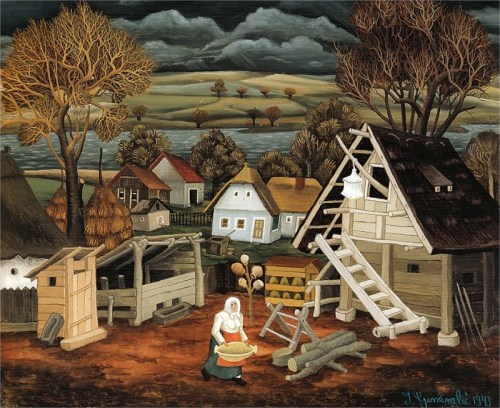
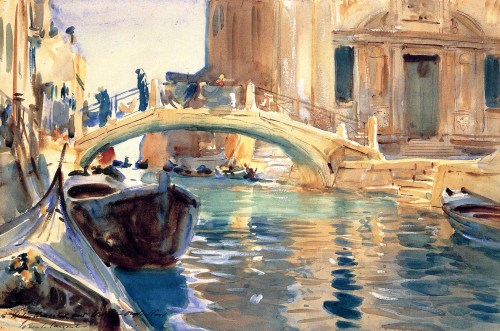 I have a lot going on this morning but I thought I’d share a lovely video that features the work of John Singer Sargent, focusing on his work, primarily his watercolors, painted in Venice. He visted the city a number of times in his life and held a certain fascination for it which certainly shows up in this work.
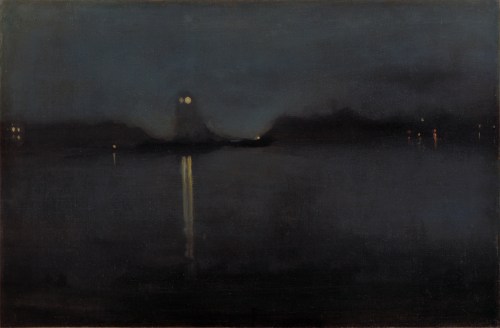 Another Sunday morning and I am ready for a little music. I was looking at some of the Nocturne paintings of James McNeill Whistler that I so much admire, like the one shown above from 1877, and thought I’d use that as the theme for this week’s music.
 Sometimes the horizon is defined by a wall behind which rises the noise of a disappearing train. The whole nostalgia of the infinite is revealed to us behind the geometrical precision of the square. We experience the most unforgettable movements when certain aspects of the world, whose existence we completely ignore, suddenly confront us with the revelation of mysteries lying all the time within our reach and which we cannot see because we are too short-sighted, and cannot feel because our senses are inadequately developed. Their dead voices speak to us from nearby, but they sound like voices from another planet.



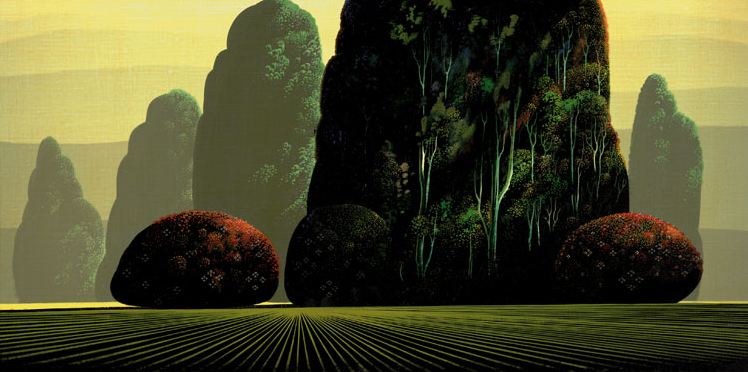

 I have been enjoying the films I’ve been sharing lately featuring the work of some of my favorite artists. It sometimes gives me a wider view of their body of work, giving me glimpse at lesser known pieces alongside their greatest hits while listening to music that often fits the tone of the work.
 Today’s pick was an easy one for me. It’s a lovely compilation of the work of Andrew Wyeth set to the gorgeous guitar of John Williams‘ version of British composer Stanley Myers’ Cavatina. You might recognize the song from its prominent place in the film The Deer Hunter.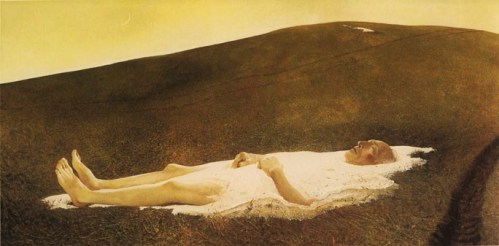
 I only have time enough this morning to throw this song out for this week’s Sunday morning music. The song is At My Window Sad and Lonely with lyrics by Woody Guthrie. The band Wilco and singer Billy Bragg put music to these lyrics along with a number of other Guthrie songs in the Mermaid Avenue albums. The version below is an acoustic version from Wilco frontman Jeff Tweedy. Nice stuff.
 Redtree Times