Feeds:
Posts
Comments

Archive for the ‘Poetry’ Category

******************************************

“In the midst of a thousand clouds and countless waters
there is an idle person.
By day, he roams the green mountains,
at night, he returns to sleep beneath the cliff.
Quickly, the seasons pass
in serenity, with no worldly bonds.
How joyful! What does he depend upon?
Quiet, like a large autumn river.”

― Hanshan

Translated by Peter Levitt, The Complete Cold Mountain: Poems of the Legendary Hermit Hanshan

************************************

Quiet. Like an autumn river.

This sounds pretty good this morning.

Little thinking and little writing.

Just flow. And be.

Just to pass on a little knowledge this morning, Hanshan was a legendary Chinese Buddhist monk who is thought to have lived as a hermit in the 9th century. Little is known of his life or if he even truly existed but there is a group of of several hundred poems attributed to him that were written on the rocks of the region in which he is purported to have resided.

Another factoid: Jack Kerouac dedicated his book, The Dharma Bums, to Hanshan.

Okay, enough with the thinking this morning. Back to being a cool autumn river.

To that end, here’s a favorite, River, from Joni Mitchell.

Be the river and have a good day.

**************

Read Full Post »

“The Timeout” At West End Gallery

************************

Why do you so earnestly seek
the truth in distant places?
Look for delusion and truth in the
bottom of your own heart.

― Ryōkan Taigu (1758-1831)

***********************

Do the deluded know the truth of who and what they are?

Or has their delusion replaced the truth at the bottom of their heart?

Can truth and delusion coexist within the heart of a person?

Or is truth a form of delusion in itself?

I think if we could figure this out, a lot of the problems of the world might fade away. Well, at least, not not seem quite so dire.

But that’s just the deluded opinion of one person…

Read Full Post »

*********************

The film Jojo Rabbit premiered on HBO over the weekend, which made me very happy. It hits a lot of sweet spots for me.

A great cast and a script filled with a beguiling mix of dark satire and tragic poignancy. Strong visuals. Big laughs and plenty of tears. Ridiculous (but still scary) Nazis.

Hitler eating a unicorn.

Yeah, you read that right.

There’s even some poetry from Rainer Maria Rilke as the film ends, a snippet from his poem Go to the Limits of Your Longing, which is shown at the top. Words that seem applicable to this time, for sure.

It also uses its soundtrack brilliantly. It begins with the Beatles singing their German version of I Want to Hold Your Hand over archival clips of Hitler’s adoring fans at huge nationalistic rallies that are chilling in their magnitude and fervor. Images from the infamous Nuremberg rally always puts a knot in my stomach. The film ends with the German performance from David Bowie of his always rousing Heroes.

Filmmaker Taika Waititi also makes brilliant use of the song Everybody’s Gotta Live. It’s a song from 1972 from a band of that era, Love, that is very underappreciated. Led by the late Arthur Lee, it was an interesting group, a multiracial group that dabbled in folk rock and psychedelia a la the Byrds. Their 1967 release, Forever Changes, is on the Rolling Stone’s list of the 500 Greatest Rock Albums and was added to the Library of Congress’s National Recording Registry in 2011.

Even so, I am sure most of us haven’t heard much of their work. But it shines in Jojo Rabbit and is certainly worth examining further.

Here’s a video with the lyrics and images from the film just to give you taste. If you get a chance to see the film, I recommend it highly. But be forewarned, that it is art and, as such, is a subjective thing. What I love may not move you at all.

Take a look and give a listen then have a good day. We all deserve one.

Read Full Post »

*********************

“Faeries, come take me out of this dull world,
For I would ride with you upon the wind,
Run on the top of the dishevelled tide,
And dance upon the mountains like a flame.”

William Butler Yeats, The Land of Heart’s Desire

*********************

When my solo show, From a Distance, opens next week at the West End Gallery, a couple of the included paintings will not be new work. There are a couple of pieces in this show that are older and have an interesting provenance.

One is the painting shown above that I call The Dance. It was painted sometime around late 1996 or 1997. When I painted it, I determined that it didn’t fit in with the face of the work I was putting out at that time. It was too sloppy, too raw. It seemed to be moving in a different direction from the the path I was following. I decided to put it aside, unshown to the world.

But 23 or so years later, it is this very rawness that makes me want to show it.

The interesting thing is that in the intervening years, this piece disappeared from my sight. When I moved from my old studio up in the woods which I had worked in from around 1996 to 2007 to my current studio, this painting, along with several other paintings, were carelessly overlooked in the move. They had been bundled together and this bundle had somehow been misplaced.

I wrote about this episode last year, when I was looking for a group of lost pieces from my Exiles series for an exhibition, heading up to the old studio to search for them. The old studio had suffered greatly in the decade since I had last worked there. A tree had fell on its roof, breaking through to the inside in one small area and the rain and snow had taken a great toll on it. The whole building was now racked and reeling and one side of the studio’s floor held piles of dark rotting debris from the roof and ceiling.

On a rack of old frames in that space, only several feet from the hole in the ceiling and the mound of dark debris on the floor, there were several sheets of old cardboard all pushed together among the frames. I had been looking for awhile at this point and was getting ready to call it a day when I decided to pull out that stack of cardboard.

Nothing.

Behind the cardboard, there was a piece of old plywood pushed up against the end of the shelf. Frustrated, I pulled out the plywood and, lo and behold, there was a bundle of sheets of watercolor paper pressed against the end of the shelving. I pulled them down and found a spot amo0ng the wreckage where I could examine them.

The paintings were all in oddly good condition, given that only several feet away there was gaping hole where all sorts of weather were free to fall. There was some foxing and a little grime but it wasn’t terrible and could be easily addressed. Obviously, using the acid free cotton watercolor paper and having them bundled together had provided a degree of protection.

Kind of like wearing a mask, people!

Each piece was thrill as I shuffled through them. Most were pieces that I remembered distinctly, some very good and one or two that were what I would consider failures that should have been destroyed long ago. This piece was wonderful to see when I came to it. I was giddy with being reunited with this work that I hadn’t even realized I was missing.

But the very last piece in the bundle made me tear up. It was a landscape and it had a title and a date at the bottom of the sheet. It was painted on November 9, 1995 and its title was The Sky Will Never Forget ( Hoping For Light). My mom from cancer died later that night, in the first few hours of November 10. The memory of working on that painting and the emotions of that time flooded back to me.

So, this piece lived in dark peril, lost and forgotten for more than decade. I think it was just waiting to be unleashed so that, in its raw exuberance much like the character in Yeats’ verse at the top, it could dance upon the mountains like a flame.

I am glad to see it dance once again.


Read Full Post »

*********************

“Rats and roaches live by competition under the laws of supply and demand; it is the privilege of human beings to live under the laws of justice and mercy.”

–Wendell Berry

*****************

Man, I want to rage this morning.

It would certainly be easy to do so. We are going through multiple serious crises right now in this country and the ship of state which would normally lead and assist us through this is being steered by a creature whose attitude towards his duty is self-serving and neglectful, at its best, and traitorous, at its worst.

Maybe even treasonous, given yesterday’s revelations.

But I don’t want to go that route. Like the poet Wendell Berry’s words above, this president*** willingly lives his life in the realms of rats and roaches. Today, let’s focus on the flip side of that coin, the human side that lives under the laws of justice and mercy.

Where most of us are privileged to live.

Let’s have some hope that truth will overcome the many falsehoods and lies. That intelligence will prevail over stupidity and science over ignorance. Let’s hope that a sense of community and good will shall sweep away the hateful and selfish behaviors exhibited so often these days.

Let’s just keep a little hope alive and remember these days when they finally come to an end so that perhaps we can avoid them in the future.

That’s asking a lot, I know. For this Sunday morning music here’s a classic song from the great American songbook. It was written by Stephen Foster (who has local connections to this area) in 1854 at a time when America was going through equally hard times in those years leading up to the Civil War. This is Hard Times Come No More as performed by Mavis Staples. It’s such a great tune that there is a multitude of  wonderful versions out there but I just felt like Mavis’ version fit the moment for me.

Give a listen. Keep your head up and have a good Sunday.

********************

Hard Times Come No More

Let us pause in life’s pleasures and count its many tears
While we all sup sorrow with the poor
There’s a song that will linger forever in our ears
Oh Hard times come again no more

Tis the song, the sigh of the weary
Hard times, hard times, come again no more
Many days you have lingered around my cabin door
Oh hard times come again no more

While we seek mirth and beauty and music bright and gay
There are frail forms fainting at the door
Though their voices are silent, their pleading looks will say
Oh hard times come again no more

Tis the song, the sigh of the weary
Hard times, hard times, come again no more
Many days you have lingered around my cabin door
Oh hard times come again no more

Tis a sigh that is wafted across the troubled wave
Tis a wail that is heard upon the shore
Tis a dirge that is murmured around the lowly grave
Oh hard times come again no more

— Stephen Foster

Read Full Post »

“Hunkered Down”- Now at the Principle Gallery

**********************

I slept and dreamt
that life was joy.
I awoke and saw
that life was duty.
I worked — and behold,
duty was joy.

–Rabindranath Tagore

**********************

When I first read the short poem above from the great poet and philosopher Rabindranath Tagore some time ago, it struck a chord with me. It so simply, in just a few lines, put across an observation that takes most of us a lifetime to realize. That is, if we ever do realize it.

Duty was joy.

But what is duty? Is it in being a good parent? A faithful spouse and a loyal friend? Is it in what we do to make a living? Or is it in being decent and caring human being?

Perhaps, it is how our lives touch the lives of others? Could that be a duty?

I don’t know for sure. Most likely joy is not a one size fits all proposition.

My own feeling is that duty is much like having a purpose, a reason for living. I remember reading Holocaust survivor Viktor Frankl‘s transcendent book, Man’s Search For Meaning, which described his time in the Auschwitz death camp. He observed that those who were able to survive the horror were those who somehow had a purpose for their life, who saw a future that they needed to reach ahead for. This purpose, even a modest one, often gave them the drive needed for survival, creating a path forward for them.

In the year after being liberated from Auschwitz, Frankl gave a series of lectures that were the basis for his book. In one he spoke of Tagore’s poem and that final line: Duty was joy:

So, life is somehow duty, a single, huge obligation. And there is certainly joy in life too, but it cannot be pursued, cannot be “willed into being” as joy; rather, it must arise spontaneously, and in fact, it does arise spontaneously, just as an outcome may arise: Happiness should not, must not, and can never be a goal, but only an outcome; the outcome of the fulfillment of that which in Tagore’s poem is called duty… All human striving for happiness, in this sense, is doomed to failure as luck can only fall into one’s lap but can never be hunted down.

In short, lasting joy and happiness cannot be pursued as a goal on their own, without a responsibility to some higher purpose.

I am writing this because sometimes I need to be reminded of this. I have been struggling at times recently in the studio, seemingly fighting with myself to find something that just doesn’t seem to be there. The harder I tried to find it, the further away it seemed. It was like I was looking for something to quell my anxieties and bring me some form of easy happiness. To bring me effortless joy.

I should have known better. Yesterday, I just put down my head and worked without thinking about the end result. I focused solely on my purpose in each moment, the task at hand. Concentrating on doing small and simple things with thought and care was my duty, as it were. As the day went on, my burden felt lessened and I began to feel joy in the work, joy in small aspects that I had been overlooking in prior days.

It was a satisfying day, one that left me feeling that I had moved in some way toward fulfilling a purpose. It may not be a grand, earth-shaking one but it doesn’t need to be. It is mine. My purpose. My duty.

And that is enough to bring me a bit of joy.

Read Full Post »

*******************

“When I pronounce the word Future,
the first syllable already belongs to the past.

When I pronounce the word Silence,
I destroy it.”

Wisława Szymborska, Poems New and Collected

*******************

“When I pronounce the word Silence, I destroy it…”

I love that line from the late Nobel Prize winning poet Wisława Szymborska. It so well sums up my own forays into writing as a young man when I found myself trying futilely to write about silence and places of silence. My words always seemed to defeat my purpose.

You can’t really write about silence.

Using words to describe silence is like using hate to demonstrate love or war to peace.  It doesn’t really work well.

No, you can’t write about silence.

You can only be silent.

Silence is a way of being.

That brings me to the painting shown above called Song of Silence.

This painting, Song of Silence, is being included along with a small group of vintage pieces in my upcoming show, Social Distancing, that opens at the Principle Gallery on June 5. Most of the early work for this show comes the mid 1990’s but this is the latest of the vintage pieces, from 2007.

It is a fairly large piece at 32″ x 32″ on paper and its size seems to accentuate its quietness. I did a number of similar pieces in the mid 2000’s and they were some of my favorites to paint. There was something special in the delicacy and restraint of these pieces. Their simplicity would lead you to believe they were simple to paint but capturing such an ephemeral feelings with minimal elements made them real challenges. Anything even slightly askew could make the whole thing fall apart.

For me personally, when these pieces worked, when they came together in that special way, they felt like magic. They transported me to a different state of being, to that place of silence, if only for a few short moments.

This is one of those pieces for me.

It’s been quite a while since I exhibited this type of work and I am eager to see what sort of response this brings in the gallery.  We’ll see.

The title, Song of Silence, seems like it might contradict my words at the beginning of this post but wordless music often has the ability to convey silence. As an example I am including a selection below from one of my favorite pieces of music, Tabula Rasa, from composer Arvo Pärt that I believe does this effectively. This music, as performed by violinist Gil Shaham, served as a large influence on much of my early work.

***********

Read Full Post »

**********************

“Let me not pray to be sheltered from dangers,
but to be fearless in facing them.

Let me not beg for the stilling of my pain, but
for the heart to conquer it.”

― Rabindranath Tagore

**********************

This is another new painting headed to the Principle Gallery for my Social Distancing show there, opening June 5. It is 22″ by 28″ on canvas and is titled She Glides Through the Fractured Night.

Though the theme for this show concerns itself with the social distancing and isolation that we have experienced in recent months, it is also about perseverance and the will to endure. And that is what I see in this piece.

I hadn’t intended to do this type of piece for the show, with the single figure paddling a longboat under a broken sky. But I really felt a compulsion, a need for this painting, and once I set out on it, it fell into place easily, almost without effort. At every step in the process, it felt complete and ready to send out its message. It didn’t have the highs and lows that normally come in painting a piece. By that, I mean in most paintings there are phases where the piece dulls and flattens out, muddying up the destination that I had began to see in it.

No, this was an incredibly satisfying piece to paint. It just had to be done.

I think the history of what we are going through will tell two different stories: those who did what they must to endure and those felt they shouldn’t have to do anything differently in a world that has presented us with a new way of existence, at least for the short term.

Those that adapt easily to change will glide through this to the other side of this fractured night. They will endure.

I can’t say what will happen to those whose minds remain inflexible and unwilling to adapt to a new of being. Only their actions and time will write that history.

Read Full Post »

**************************

Loneliness clarifies. Here silence stands
Like heat. Here leaves unnoticed thicken,
Hidden weeds flower, neglected waters quicken,
Luminously-peopled air ascends;
And past the poppies bluish neutral distance
Ends the land suddenly beyond a beach
Of shapes and shingle. Here is unfenced existence:
Facing the sun, untalkative, out of reach.

― Philip Larkin, The Whitsun Weddings

*************************

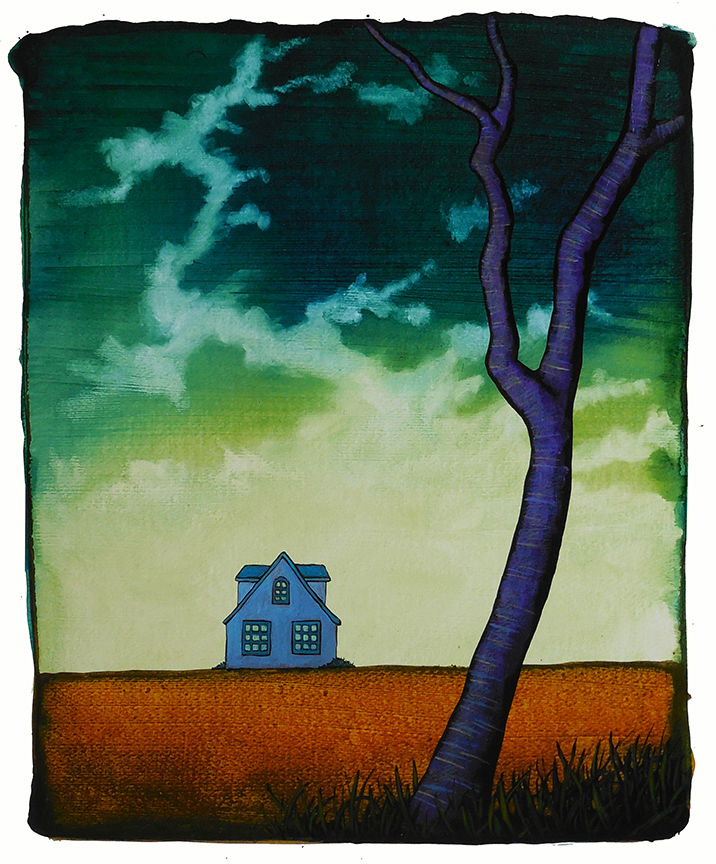
A newer painting, this one on paper called The Quarantine House, that is part of my upcoming show, Social Distancing, at the Principle Gallery. The show is tentatively scheduled to open on June 5. There is, of course, uncertainty about how it might proceed given the current circumstances.

Uncertainty is a common companion for most of us these days. In regular times in the past, there were types of uncertainty that I was comfortable with, having developed a tolerance of sorts for them. You know, things like belief systems, confidence in my own abilities and those sorts of things. In fact, preparing for my annual shows was one of the coping mechanisms that built up that tolerance..

It gave me a defined task and a dead focus on that task. Certainty.

It was a certainty that pushed all other uncertainty to the back of my mind, out of sight and rendered harmless.

But now, there is a constant uncertainty that runs through these days. I still have the task but it feels less defined, less certain. And that dead focus that has sustained me in the past now feels like it is being restrained. Or held captive.

Like it is the one being confined to that quarantine house. It knows there is work to be done but the uncertainty has brought it to a standstill in the dragging minutes and hours of its confinement. It looks around for something that will feed it but all it see are the corners of its confined space and out the windows nothing but endless plains and distant horizons.

That dead focus feeds on certainty and it feels a bit starved at the moment.

I know that dead focus will leave the quarantine house eventually, that it will find its way to sustenance of some sort. A small bit of certainty will whet its appetite and soon, it will once again be ravenous for all the time it can consume.

But for now, I just have to wait it out with that uncertainty as a housemate here in the studio.


Read Full Post »

Earlier, I came across this blog post from several years ago that features an older painting of mine at its top. It’s a favorite of mine that hangs in my main painting space, high in a far corner. But even tucked away, it’s one that often has me glimpsing over it or going over to it and standing in front of it to ponder it for a bit. It seemed like an apt companion for this post years ago and still does now. Its simplicity and stillness echo the final line of Berry’s poem perfectly: make a poem that does not disturb the silence from which it came.

*************************
GC Myers- Trio:Three Squares

**************************

I came across this poem from poet/author Wendell Berry on Maria Popova‘s wonderful site, Brain Pickings. It’s a lovely rumination that could apply to any creative endeavor or to simply being a human being.

I particularly identified with the final verse that begins with the line: Accept what comes from silence. I’ve always thought there was great wisdom and power in silence, a source of self-revelation. Perhaps that is why so many of us shun the silence, fearing that it might reveal our true self to be something other than what we see in the mirror. Berry’s words very much sum up how I attempt to tap into silence with my work.

At the bottom is a recording of Wendell Berry reading the poem which gives it even a little more depth, hearing his words in that rural Kentucky voice. It’s fairly short so please take a moment and give a listen.

******************

HOW TO BE A POET
(to remind myself)

Make a place to sit down.
Sit down. Be quiet.
You must depend upon
affection, reading, knowledge,
skill — more of each
than you have — inspiration,
work, growing older, patience,
for patience joins time
to eternity. Any readers
who like your poems,
doubt their judgment.

Breathe with unconditional breath
the unconditioned air.
Shun electric wire.
Communicate slowly. Live
a three-dimensioned life;
stay away from screens.
Stay away from anything
that obscures the place it is in.
There are no unsacred places;
there are only sacred places
and desecrated places.

Accept what comes from silence.
Make the best you can of it.
Of the little words that come
out of the silence, like prayers
prayed back to the one who prays,
make a poem that does not disturb
the silence from which it came.

Wendell Berry

**************

Read Full Post »

« Newer Posts - Older Posts »